



By J.C. Bradbury
When the Atlanta Braves opened Truist Park in 2017, Major League Baseball Commissioner Rob Manfred called it a “watershed” moment.
What drew so much attention to the new Braves’ stadium in suburban Cobb County, Georgia, at the time was its construction within a mixed-use development, known as The Battery Atlanta. Truist Park anchors a live-work-play campus that includes restaurants, shops, hotels, offices and residences. The idea was to create a year-round attraction rather than build a standalone stadium that serves only as a game-day destination.
Manfred declared that this sort of mixed-used district “provides a road map for clubs to get new stadiums built.” And he’s not alone in that belief.
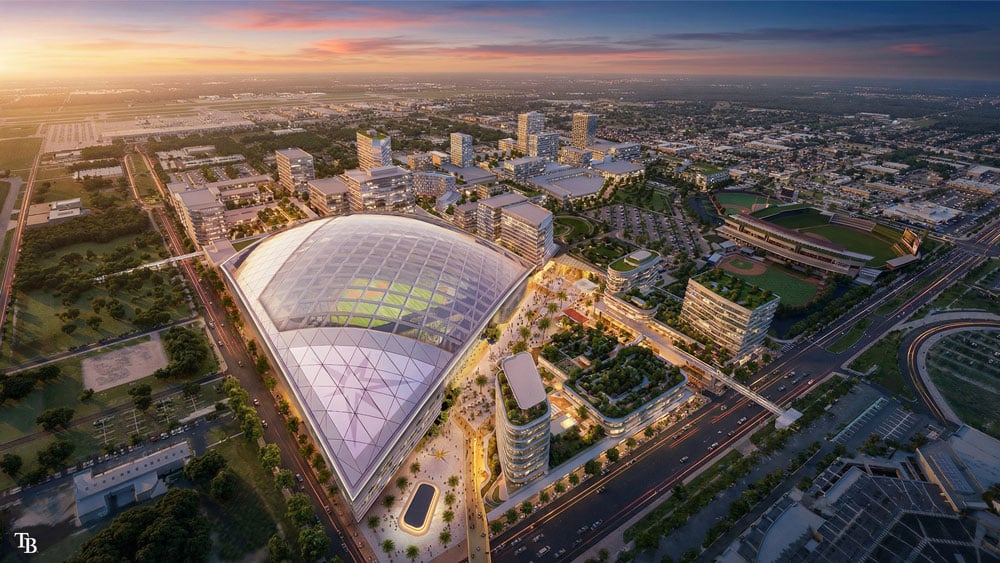
The Tampa Bay Rays’ new owner, Florida home-building mogul Patrick Zalupski, hopes to mimic the Braves’ approach, calling it “the gold standard of what we want to build and develop here in Tampa Bay.”
But what do mixed-use projects like The Battery mean for host communities?
As an economist – and lifelong Braves fan – who lives a few miles from the complex, I’ve had the unique opportunity to experience The Battery as a community member, as well as study it as a scholar. I’ve attended many games, visited on off-days and examined its impact on surrounding businesses, county property values, sales tax receipts and tourism. My forthcoming book, “This One Will Be Different: False Promises and Fiscal Realities of Publicly Funded Stadiums,” looks at the history and economics of public stadium projects, including my hometown Truist Park.
Tampa as a public partner
Critical to Zalupski’s proposal to build a new US$2.3 billion ballpark is a hefty contribution from taxpayers. He is asking the city of Tampa and Hillsborough County to fund at least $1 billion of the cost.
That’s more than triple the $300 million Cobb County devoted to build Truist Park in Georgia, which was funded by a combination of property, hotel and rental car taxes.
In addition to that $1 billion, the state of Florida is offering $180 million for transportation improvements and rebuilding Hillsborough College, whose land would be donated to host the new development.
Rays CEO Ken Babby insists that the immense public outlay is worth it. He described it as “a generational opportunity” for the community that “will strengthen the region by creating jobs, encouraging economic investment and supporting long-term growth.”
But 50 years of consistent research findings show that sports venues don’t generate a financial windfall for host cities. The overwhelming evidence regarding the limited economic benefits of stadiums has produced a strong consensus among economists that sports venues are not worthwhile public investments.
It may seem counterintuitive that stadium events fail to boost local economies, because fans clearly do spend vast sums of money attending games. But most of the spectators in the crowd are locals, who reallocate their spending from other area merchants, rather than generating new commercial activity.
Mixed-use to the rescue?
When the Braves and Cobb County leaders announced their stadium vision, they confidently predicted that The Battery was the key that would unlock the economic potential of the stadium. Truist Park’s complementary development was touted as a game changer that would propel its economic success.
Knowing that past stadium deals had been unprofitable for surrounding communities, the team acknowledged that a standalone venue was unlikely to pay off financially. But with The Battery, president of the Braves Development Company Mike Plant promised, “We’re going to build a city, and we’re going to create tons of jobs, tons of density and year-round tax revenues.”
Now that Truist Park is entering its 10th season, we can assess what the stadium development has meant for the local economy using historical data.
The Braves’ mixed-use development has indeed boosted the team’s bottom line. In 2025, for example, Atlanta Braves Holdings reported that the mixed-use component added $97 million in revenue – primarily from rent, parking and advertising – on top of $635 million from baseball operations.
With those numbers, it’s no wonder the Rays want to follow the Braves’ blueprint.

J.C. Bradbury
Unfortunately, the Battery hasn’t been a boon for taxpayers. My research shows that the relocation of the Braves did attract some new spending into Cobb County. But the gains have been far too small to cover the county’s debt service and other funding obligations, generating an annual loss of around $15 million.
And what spending may be imported into Cobb happens during the baseball season. In other words, The Battery has not been a year-round attraction.
Why didn’t Truist Park’s ancillary development strategy work?
Just as spending inside the ballpark mostly represents a reshuffling of local commerce, purchases within the surrounding district largely come at the expense of other off-campus area businesses. And though nearly $100 million in revenue from the mixed-use development may seem impressive, it’s trivial in comparison to Cobb County’s $80 billion economy.
A new gold standard or fool’s gold?
If the Braves’ mixed-use development hasn’t been able to pay off Cobb’s much smaller $300 million subsidy, it casts serious doubt on Tampa’s ballpark-village strategy to cover its billion-dollar ask of taxpayers.
The evidence shows that stadiums aren’t capable of funding themselves, even with a mixed-use component. The public funding has to come from someone, and it’s local taxpayers who ultimately pick up the tab.
I believe the Rays’ plan and similar stadium developments being discussed in Kansas City, Chicago, Denver and elsewhere should be viewed as risky bets rather than sound public investments.

J.C. Bradbury is Professor of Economics at Kennesaw State University.






















NJ says
Remember this report the next time you hear a promotion of a Sports Complex in Palm Coast! I have been WARNING everyone for years about the “Sports Game Scam” of property taxpayers—-A Never Win Game Bet!
Richard Wielder says
Right because they are actively trying to build a major league sports venue in Flagler County. Go back to NJ and preach your non sense
Jim from Tampa says
I live in Tampa and am familiar with the proposed stadium site. Unlike the Atlanta experience, I don’t believe that new Rays owner Patrick Zalupski’s retail ambitions are going to succeed at this location. There’s just too much established shopping and entertainment in the immediate vicinity. International Mall, Tampa Bay’s most exclusive shopping mall is about 1/4 mile directly to the southwest. Dale Mabry Highway, a 6 lane stroad which is the eastern boundary of the site, has a huge retail area about 1/2 mile to the south. Westshore Mall, one of Tampa Bay’s oldest and largest shopping malls is about 1 and 1/2 mile to the west.
The area around the current Rays stadium, Tropicana Field, would probably be a better location for new retail development.
Pogo says
What a great country — the poor and hopeless increase exponentially; while the obscenely wealthy proliferate in proportion with their avarice, and comfortably situated experts (x=unknown, spurt: a drip under pressure) artfully explain all.
All that, and bag of chips — cash or charge?
Ron Cardwell says
The glaring omission in trying to compare the Atlanta scenario with the Tampa plans is game day attendance. The Rays are lucky to get 5000 fans to show up to a home game, whereas the Braves would consistently bring in over 30,000. Tropicana field is a dump, and the local fans are not attending. So any increase in attendance is not a shifting of spend from one area to another, it’s a straight increase of spend from people who are not otherwise attending. Additionally, the volume of fans from visiting teams will likely increase, too. Go to a Rays game when the Yankees or Red Sox are in town, and it’s predominantly visiting fans attending. The volume of visitors that take in a baseball game will likely increase dramatically if there is a worthwhile venue to draw them in. The worst stadium in the league is not enticing any vacationer to take in a Rays game while they are in town. There just isn’t a parallel with Atlanta when it comes to the volume of visitors that are in the area.
Grandson Of A LEGAL Immigrant says
Sorry J.C. Bradbury, but apparently you’re not aware of the trifecta in Philly (arena, baseball and football stadiums) that have been there for DECADES. The Trop’s location sucks and the new proposal is a definite upgrade. Nice try though.
Richard Wielder says
What ever ding dong that wrote this article clearly has never been to the areas around the Tampa Bay Lightning arena. I think everyone will agree it’s far better than it was in the past. Well democrats might not like it, it’s clean well lit and safe, they seem to prefer trashy, human feces, and crime