



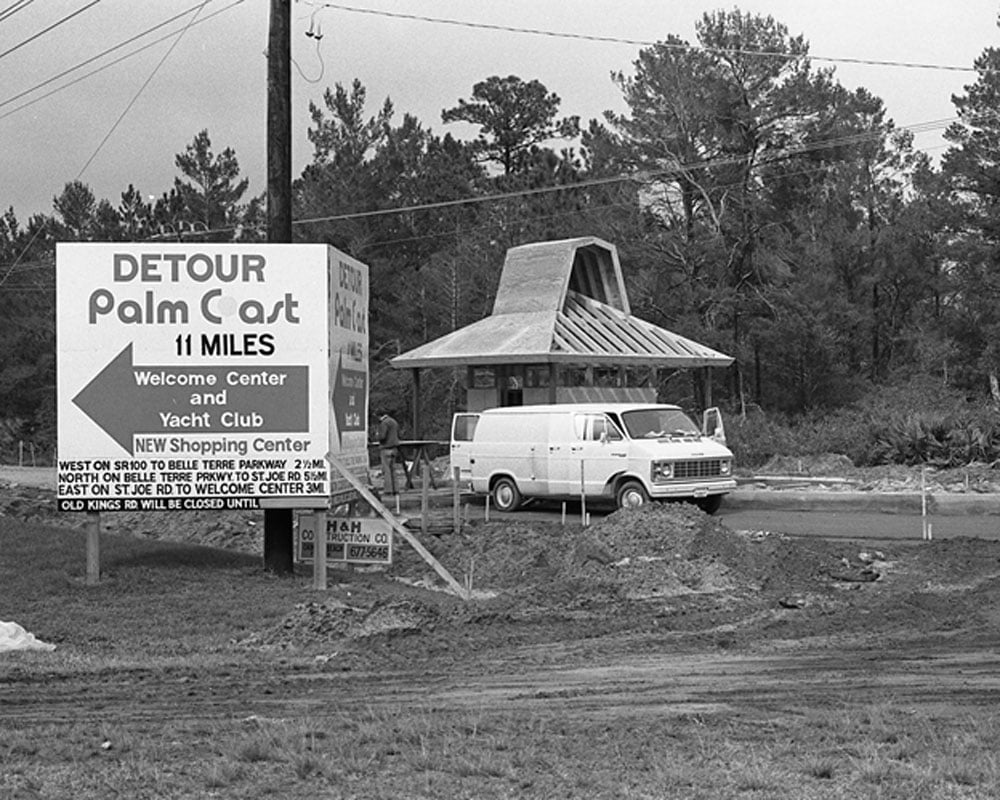
In another “huge win for history,” in the words of Palm Coast Historical Society President Peter Johnson, the Palm Coast City Council Tuesday agreed to draft an ordinance that would lead to the city’s inclusion in a state program focused on preservation, protection and documentation of local historical and cultural resources.
City Council member Theresa Pontieri asked for and quickly received the council’s consensus to direct City Attorney Marcus Duffy to draft the ordinance. Pal m Coast would then become part of the state’s Certified Local Government Program (CLG), which “links three levels of government -federal, state and local- into a preservation partnership for the identification, evaluation and protection of historic properties,” the program’s website states.
“Designation as a certified local government, either as a municipality or a county, makes historic preservation a public policy through passage of a historic preservation ordinance. The ordinance establishes a historic preservation board to develop and oversee the functions of its historic preservation program,” the program states.
Eighty-eight Florida counties and cities are in the program. Remarkably, especially for towns like Marineland and Flagler Beach, not a single Flagler County municipality or the county is in it. (See the participating governments here.)
Fellow council members are strongly supportive. “It’s critically important for the future of our city that we preserve our history and take this proactive approach,” Council member Charles Gambaro said. “So it’s not just the westward expansion piece, it’s whatever else comes through, be it residential or industrial, right? And we just need to make sure that it doesn’t trample on anything that is important to our community, for our kids to learn from.”
Pontieri was in part inspired to push for the CLG designation after Mayor Mike Norris last week asked for the council’s support to direct the city attorney to find a way to give the two local historical societies access to historical sites in the 22,000 acres slated for Palm Coast’s expansion west of U.S. 1, through the planned development of Raydient, the subsidiary of Rayonier, the company that owns almost all the acreage there. (See: “City Council Backs Mayor’s Effort to Identify Hidden History Across Land Slated For Raydient’s 22,000 Homes.”)
“Mayor, you brought up last week a really good point about the westward expansion, but I think that concept should apply to all of our developments in the city,” Pontieri said, “and hopefully the county will move forward with something like this as well.” Getting the CLG designation would “open us up to grant funding that we can use towards historical preservation. So this is kind of like a three-step process in order to get our hands on some of that grant money to, I think, do some things that we’ve all determined are very important to us up here, which is preserving our history.”
Johnson had just appeared before the council to thank its previous week’s initiative and point out that one of the city’s original planning documents had called for “monitoring and protection of the significant sites by interested residents of the Palm Coast community and/or a local museum,” and placed the responsibility for preservation on local governance. He then explained the CLG program.
“We are incredibly grateful to the Palm Coast City Council for recognizing the importance of historic preservation and moving forward with consensus to draft preservation ordinances,” Johnson said today. “This is a historic moment for Palm Coast and something that has never been done before in our city’s history – a critical first step to becoming a certified local government. Although Palm Coast was incorporated in 1999 and began as a community in the early 1970s, many of historic sites and cultural resources throughout our community predate the ‘city’ itself. These ordinances are about ensuring those places and stories are recognized and protected for future generations before they are lost to time themselves.”
The impetus for the council to act was spurred by the County Commission’s decision to turn Old Brick Road, the longest-remaining intact segment of what used to be Dixie Highway, into a red line against development’s alterations. Old Brick Road runs through Raydient’s land. It is a county road, and as such the county controls access to the road, including at-grade crossings. The county wants the city and the developer to make preservation of the road a priority. The county projects turning the road into a walkable, pedestrian-only tourist attraction. The county’s participation in the CLG program would likely buttress its local preservation efforts. (See: “Historic Old Brick Road Now a Battleground Between Flagler County Preservation and Palm Coast Expansion.”)
“For us, this is the bedrock for a stronger preservation effort in Palm Coast and the county as a whole as an important step toward protecting the heritage that defines our community,” Johnson said, “something we personally hope to see other local governments take the steps to enact as well.”
Preston Zepp, the city historian, thanked the council “for being the first council to actually take this stuff seriously and care about our history and heritage and culture in the city.”























James says
So if you happen own a “founder home” in one of the older ITT era sections, would you qualify for some kind of restoration assistance?
Would this lead to complications in an owner’s ability to choose how and with what materials to repair or restore a property?
Just curious.
JimboXYZ says
Just from the time I lived close enough to Hollywood, FL, or even Fernandina Beach. Older homes that comprised their historical districts, the maintenance of those properties were the responsibility of the homeowner, that said, repair & maintaining the designated historical district had to be made in period correct appearance. I would think the goal is anywhere Flagler County would be similar. NSB is another city that has it’s Flagler Avenue business district, homes that turned into small businesses from ocean to intracoastal. Ormond Beach has the Casements area (John Anderson/Riverside Drive) I think there are federal tax incentives, but I also think there are additional costs to the property owners for having to go thru a appropriateness documentation process.
I also think this is more about the Old Brick Road than it is anything else for Westward Expansion. The pier rebuild, not sure if that was historical mandated that the A-Frame and as much of the original pier remain intact for the beach head & dune line ? Let’s face it, Bunnell, FL burned it’s Church down that was located on SR-100.
https://flaglerlive.com/flagler-playhouse-burns/
https://www.hollywoodfl.org/1575/Historic-Preservation
https://www.hollywoodfl.org/m/faq?cat=48#question-552
https://www.hollywoodfl.org/DocumentCenter/View/95/Design-Guidlines-May-2005-docgenda
https://www.fbfl.us/568/FAQs
Just me, I wouldn’t expect the assistance or incentives to pay for the restorations or even offset them enough to make it affordable in an inflationary era of Bidenomics that still persists in the present. Historical properties are a wealthy families property ownership game. And then I’m sure there are those in Bunnell that want to preserve the trailer parks in Flagler County for the generations that their family has lived in those trailer parks ?
James says
From a quick Google search, it seems ITT-Levitt built only a handful of (model) houses. There were nine original designs, of which only four apparently were actually built… the Del Mar, DeSoto, De Bary and Andalusia models. How many additional units of these (and of the other designs) that were built isn’t clear. ITT divested itself of Levitt early in the 1970s, I think that’s when outside builders began to trickle in… probably with their own house designs. Doubt many of the original houses are to be found outside the older canal sections.
Just a-research’n a couriosity.
Peter Johnson says
Where they are congregated is even more specific then that – they are mainly clustered in the “U” by the golf course on Palm Harbor.
James says
The old Paul Katz Building on Palm Coast Parkway where the Wawa was built, might have been a good candidate for historical preservation… it was a rather large unoccupied, unused space. What would you have suggested it be repurposed for if it wasn’t demolished?
What of the several older condominium complexes? Many might date back to the early-mid 1970s, with a very “historical vibe” to their appearance. Would they be protected from demolition?
Just curious.
RobdaSlob says
It doesn’t seem like things younger than me are historical……
FLF says
This entire area has history to some extent. How do we define historical? It means different things to different people and attorneys. To me, habitat loss is historical since once gone, will never be again. In my 65 years living, growing up in Ormond Beach and later Palm Coast I have watched plenty of history destroyed. I just want to make sure we clearly define what historical means and be prepared for the battle with attorneys and developers.
City Tim says
This should be a big NO , will wind up cast us tax payers a lot of money to keep some run down p.o s. around and to bring it up to standards.