


Last Updated: 4:38 p.m. with comments from Raydient and City Historian Preston Zepp.
Joining increasing public and local government concern for the preservation of Old Brick Road and other potential historic sites in the 22,000-acre area slated for development west of U.S. 1 over the next three decades, Palm Coast Mayor Mike Norris on Tuesday won the council’s support to seek “unfettered access” to that area for the Palm Coast Historical Society and the Flagler County Historical Society.
“I would like to see if I can get consensus from the council to create and enter into a memorandum of agreement with Raydient, Rayonier, whatever they’re calling themselves,” Norris said at the end of Tuesday’s meeting, “to allow the Palm Coast Historic Society and Flagler County Historic Society access to those lands to go out there and look for historical sites that could come into play later on. We already know that the county has an issue with Old Brick Road.”
Raydient is the development arm of Rayonier, the timbering and land holding company that owns the near totality of the acreage. Raydient plans a 22,000-home development. Its proposed Master Planned Development order is going before the Palm Coast Planning Board and the City Council in coming months.
The 125-page MPD devotes four and a half lines to “Cultural and Historic Resources,” stating: “Development of the Property will adhere to LDC Section 10.05 related to cultural and historic resources, except that if any portion of the Property is determined to have a potentially significant or a significant cultural resource in areas proposed for development, the Landowner and City will adhere to any recommendations of the state historic preservation officer.”
Raydient appears willing to grant access, but not “unfettered” access.
“Unfettered access is an unrealistic term because we have substantial onsite operations involving various activities, such as hunting licenses where firearms are present and in use and other activities involving equipment that could cause serious injury,” Mike Hahaj, Raydient’s director of commercial development and operations, told FlaglerLive Thursday. “Safety is a top priority for the company as I assume it is for the City and County. We use best practices and have notice requirements to help ensure the safety of anyone who enters our property. It’s a large piece of land. We also recognize there is a regulatory process for identifying Cultural and Historical Resources as part of the environmental permit process. In short, we support recognizing the property’s historical elements, working collaboratively, and celebrating the area’s history. We look forward to working with the Historical Societies in those efforts. ”
Hahaj said he’d met with Preston Zepp, the city historian, a couple of weeks ago. Zepp said he gave him a map of the 25 historic sites in the Raydient area that are in the Florida Master Site File at the Division of Historical Resources. The sites document historical locations with photographs, narratives and other documentation, but they are ongoing studies. The shores of Neoga Lakes, for example, Zepp said, was once a thriving economic center of timbering and turpentine, with homes, businesses and a post office–all gone now. Neoga Lakes is within the Raydient development. Zepp would like to study the location further. But he won’t trespass, of course, and would need Raydient’s assistance to investigate further.
The societies, Norris said, have “all kinds of maps” that would allow them to investigate the area. (Actually, it’s one map that Zepp and Flagler County’s GIS division have developed, though the societies have map collections that could tie into the area’s investigations.) “I want them to be able to go out there and research that area,” Norris said. He specified to City Attorney Marcus Duffy: “I want to make sure that is unfettered access, that they can go out and do what they want, to find the things, because Preston told me flat out: Sir, I can’t go out there because it’s private property, so they need to have access.”
Norris got the council’s full support.
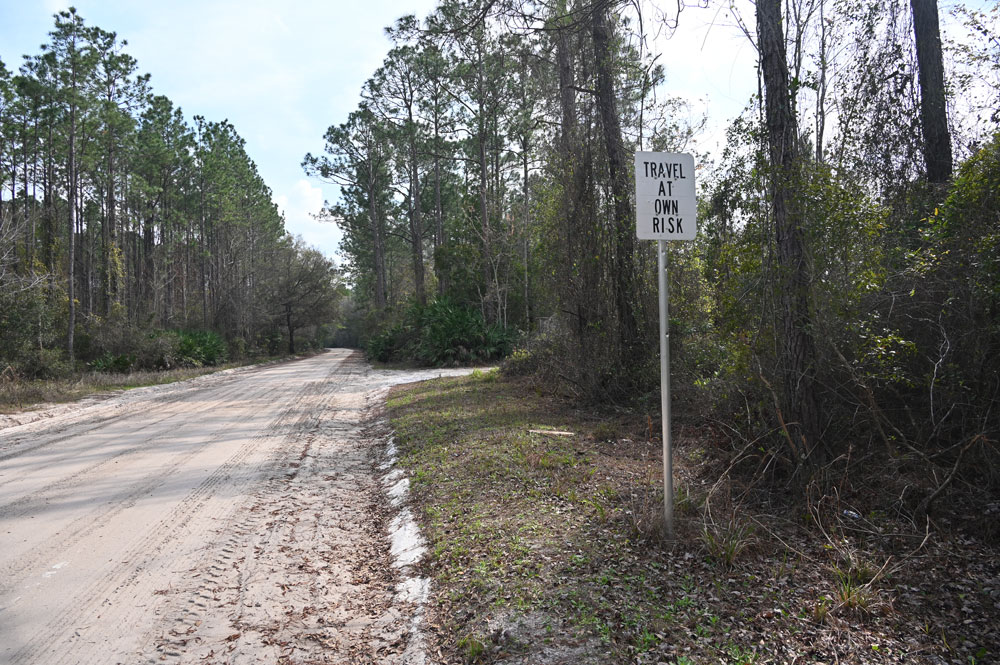
Old Brick Road is part of the old Dixie Highway first built between Detroit and Miami in 1915. The eight-mile segment in Flagler County is one of its last remaining intact portions. Elsewhere, it has either been plowed under or paved over by more modern highways. It is made of bricks, and runs through the Raydient development. The county owns the road, which is driveable. It is mostly used by Rayonier’s logging trucks. Other historic sites are spread around the area.
The County Commission last month took an assertive stand in defense of the road, but only by rejecting key parts of a joint agreement with Palm Coast and the developer that would have allowed several at-grade crossing points (meaning at the same level) of Old Brick Road, removing or burying the brick in those parts and inviting damage to the surrounding roadbed.
Council member Charles Gambaro was under the impression that “it looks like there’s a path forward” on protecting Old Brick Road. That is not yet the case.
“My understanding, they are still working through it. Everything has not been addressed,” City Manager Mike McGlothlin said. McGlothlin had taken a tour of the area with John Zobler, the city’s community development director, and Preston Zepp, the city historian. “Very educational and very well done by Mr. Zepp. But no, not everything’s been worked through on that, sir. No.”
Peter Johnson, president of the Palm Coast Historical Society, credited Norris for seeking access for the societies. Johnson shared a 1970s document, part of the original Palm Coast Comprehensive Land Use Plan, that included a review of historic sites –20 had been identified at the time–and recommendations on how to protect them. “Provisions are made for monitoring and protection of significant sites by interested residents of the Palm Coast community and/or a local museum,” the document states. “While details have not yet been worked out, several advantages of the program are obvious. First, it is hoped that involvement of local residents will serve to educate the community about regional history and, more importantly, the value of protecting cultural resources. Second, it places responsibility for protection of the resource base at the local rather than state or regional level. Last, once sites have been assessed and recommended for some type of management there is little need for further professional involvement unless disturbances appear imminent.”
Disturbances of Old Brick Road are not imminent: they have been unceasing.
Zepp told city officials that there are some 25 historic sites of interest in the planned development zone (there are over 600 in Flagler County). They are not on the National Register of Historic Places, but part of the Florida Master Site File.
“I fully support saving the Old Brick Road,” Council member Theresa Pontieri said. “I fully support preservation in any way we can of our historical sites.”
“To me, it creates more value to save those things and to elevate them so that they can be used and visited,” Council member Ty Miller said, joking with Council member Dave Sullivan, who’s verging on landing on the Register of Historic Places himself: “You told me that you were born on the Old Brick Road.”
“I was on it as a little baby,” Sullivan, who was born in 1941, said. By then the road was in its early adulthood. The WPA Guide to Florida, published a few years earlier, does not mention Dixie Highway.





Koyote says
“Don’t it always seem to go
That you don’t know what you’ve got till it’s gone”
Big Yellow Taxi
Joni Mitchell
JimboXYZ says
“Don’t know what you got, (’til it’s go-oone)” – Cinderella.
DP says
This property was never part of ITT’s master plan. It’s privately held. And the land owner has a right to development. But not at the expense of a potential any histocal site, or the current population or citizens of Palm Coast. IMO if this landowner wants development, it should be 1000% at thier expense, which should include additional sites to meet future demands, for water treatment plants, waste water plants, property for schools, & Public safety, fire, and LEO vehicles just to name a few. And any histocal sites found are to be permatnately preserved. It’s time growth like this pays for itself, and the old saying there building this to make money, not because BS demand. Originally future P.C. stopped at us hwy 1, but thanks to previous commission’s and administrations, they allowed the annexation west of US 1. I stand with Mayor Norris.
Truth to Power says
Last year I wasn’t so sure about Mayor Mike because of his behavior upon taking office. I liked his use of words like “moratorium” and he clearly struck a nerve when all those construction vehicles showed up at a city council meeting. Now, I see he’s not only continued fighting the good fight, he is taking action to preserve our history. Even Theresa Pontieri has jumped in to help. As the elections approach, I’ll be looking carefully at whether city council candidates are likely to help preservation efforts. This blog’s candidate profiles will be interesting to read.
Kill the turtles says
I don’t believe hunting season is 365 days a year so what is the conflict with hunt club leases.
Also that property is loaded with gopher tortoise but if nobody sees them before they disappear oh well ?
T says
Palm coast was so nice til rich and Republicans destroyed it and fl Republicans are disgraceful un-American unconstitutional traitors now