



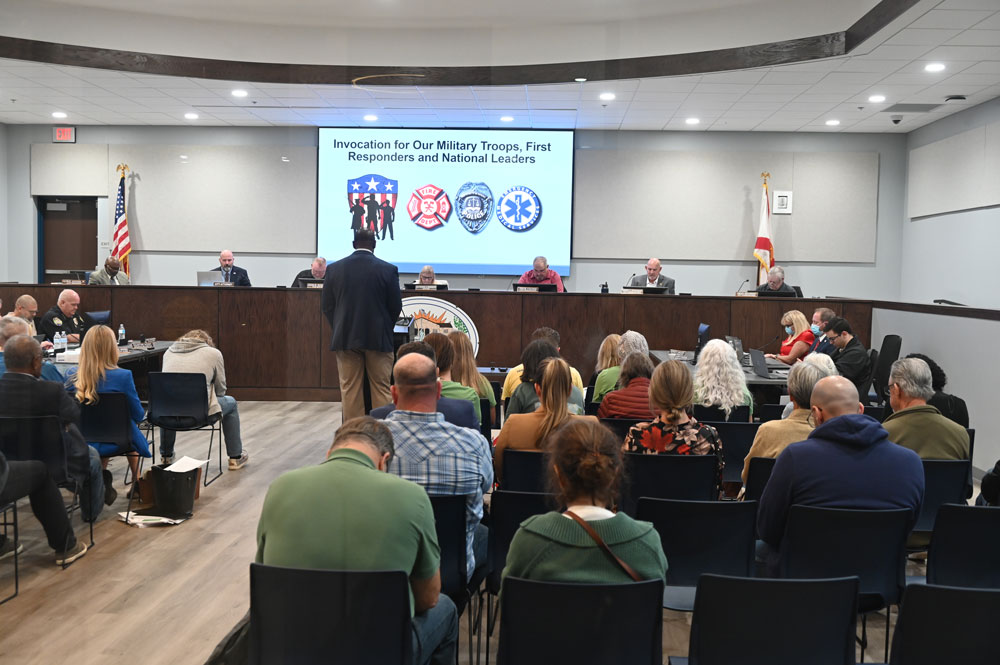
A split Bunnell City Commission again faced down sharp public opposition to approve on final reading the rezoning of 1,259 acres from agriculture to light and heavy industrial. The rezoned land is a vast, rough rectangle on the west side of U.S. 1, toward Old Haw Creek Road and County Road 304. The commission had approved the first reading on a 4-1 vote in September.
There is to be no fuel depot or landfills, but a garbage transfer station is quite possible, as are of course numerous other industrial uses. Some 639 acres are to be heavy industrial and 620 light industrial. The proposal was scaled down from an original plan to rezone 1,900 acres. It is still one of the single-largest such rezonings in the state’s history, dwarfing the city’s urban core.
“When we give them this tonight, that’s like giving them a blank check,” Commissioner John Rogers said. “They can do whatever they want to do at that moment. And I don’t think it’s beneficial for this community, for these people. There’s a lot of risk. And they talk about the reward. What’s the reward? We’re going to have some money. Money is going to come in. At what? At the backs of our people? Their quality of life is going to be messed up forever? Industrial growth must be compatible. I’ve said it all along. There’s nothing that compares to this thing. It’s not compatible.”
Rogers tried to convince his colleagues to vote No. He won Commissioner Dave Atkinson over. Atkinson had voted with the majority to approve in September. He voted No this time. But no one else joined him. Rogers had made a motion to deny, which failed, 3-2.
Commissioner Pete Young’s motion to approve the rezoning carried by the same vote, but not before Rogers asked the attorney whether anything in the approval stops the landowners from accepting a garbage transfer station. The city attorney deferred to the city planner, who made it explicit: “There is nothing that would prohibit a transfer station.”
“That’s why I said it’s a blank check,” Rogers said. “There’s absolutely nothing for them to be stopped from trucking that trash in.” Atkinson noted that the petitioners also made clear that they had no intention to add that prohibition as a condition of approval.
“This is not a project that’s giving them carte blanche to do what they want to do. Everything has to go through and be approved,” Mayor Catherine Robinson said. “We need economic growth. We need to be able to take off the burden of the taxpayers in Bunnell.”
The vote to approve passed, 3-2, as did a vote to approve the comprehensive plan amendment, which Rogers also attempted to deny.
Tara Tedro, the attorney representing the land owners, had said the rezoning would generate significant economic activity and provide “a whole host of different types of employment opportunities that can come from a project like this to allow for, again, a diversification of opportunities, a sustainable future, and the type of economic vitality that allows for generations of residents to not only want to start living here, but to have an opportunity to come back and be able to make a living.”
Tedro claimed the land could generate “upwards of $17 million just in impact fee payments” and cited the city’s finance director’s estimate of “about $4 million in property taxes annually.” The figure appears absurdly off the mark: Bunnell’s entire property tax revenue for the coming year is projected at $3.3 million. Its development impact fees revenue in total add up to a projected $136,000, with an additional $112,000 for water and sewer impact fees.
There’s no question that Flagler County lacks industrially zoned properties, as does Palm Coast. But other than an ill-fated fuel depot that drew sharp public and, eventually, political opposition, there’s been no evidence of a rush of interest—at least none that City Manager Alvin Jackson has been willing to disclose—from industrial enterprises to locate businesses in the county. Nor has Bunnell fielded such an interest with a smaller-scale rezoning.
The 1,259-acre rezoning did not include an analysis of how the land would generate impact fees and property taxes on that scale. Other than hints about a garbage transfer station, the owners have refused to disclose the identity of so much as a single prospective business that might set up shop on the land. The figures are entirely speculative and closer to the exaggerations of a sales pitch than a factually defensible projection.
For comparative purposes, when Palm Coast’s 1,557-acre Town Center was planned 20 years ago, it envisioned “over 5,600 housing units to be built over a 20-year period. A commercial space forecast includes 2.8 million square feet of retail / entertainment / lifestyle center commercial space, 1.7 million square feet of office space, 750,000 square feet of business park/ flex space,” and a new City Hall.
City Hall was built with tax dollars. But less than half the residential units have been sold, only 1.3 million square feet of commercial space was approved, and just 17 percent of projected commercial-retail space was built, according to recently filed court documents.
“We are not a mob. We are not angry people. We are your constituents, and we care enough about Bunnell to be sitting here again on a Monday night,” Savannah Brinkworth of County Road 140 said.
Brent Spain, the land use attorney representing Chelsea Herbert, a Bunnell resident who has opposed the rezoning and is a newly seated member of the city’s Planning Board, contested the city administration’s claim that its staff report is “competent, substantial evidence,” and that residents’ testimony opposing the rezoning is not. The comprehensive plan amendment that the city submitted alongside the rezoning is not supported by “appropriate data analysis,” he said, while issues raised by state agencies responding to the proposed amendments were “brushed aside” by the city.
Spain listed several other concerns and issues with the city’s analysis, particularly in water usage (he foresees a future deficiency in water supplies), inadequate buffers, and the risk of essentially issuing a blank check to the land owners.
Ryan Connolly cast doubt on claims that the rezoning will increase jobs to the extent that its advocates say it will. Several others spoke in opposition to the rezoning, including a neighbor of the rezoned property who said plans look good on paper, but “we have two children that live on that property, and I am deathly scared of what will happen” when something unplanned happens. She meant an industrial accident.
Cory Romaniuk, a North Anderson Street homeowner, told the commission he was supportive of “anything that would involve commercial, industrial in the city,” because his property tax bill “went from $993 from year one to $2,678 to $3,123.” What Romaniuk did not tell the commission was that he bought the house in 2023, which was “year one,” when the tax bill reflected the previous homeowner’s assessment. The following year, the protected value that had built up for the previous homeowner under “Save Our Homes” all but disappeared, resulting in the large tax increase for Romaniuk. But the vast majority of other homesteaded homeowners—and all long-time homesteaded homeowners—have not seen anywhere near such increases, and in inflation-adjusted dollars, have seen their property tax burden decrease.
Romaniuk said that diversifying the tax base would provide relief to residential taxpayers, only to himself observe what has usually been the case: diversifying the tax base does not lower taxes. It merely increases tax revenue. “I’ve seen the exact same thing happen in Fairfax, Virginia,” he said, “they had mass communities, mass industrial projects, and tax base did raise, but they didn’t step back and provide any relief. It just kept going up right along with.”
The owners of the land have included Albert and Suzanne Johnston, the former tax collector, Joy Allen Lands, owned by Lynn Lafferty, a member of Bunnell’s planning board, Georgia Durshimer Thibodeaux, Steven Durshimer, and Nell and James Brown Sr., according to property appraiser records.
See the full rezoning materials here..

























Doug says
“Overriding Public Opposition” – who does the commission answer to? If this isn’t another reason to have no faith in any government, then what is?
Follow the money.
Really annoyed says
A lot of pay offs between politicians, lawyers, and developers for sure!
DeSantisRocks says
This county cracks me up. It’s always ‘we need more jobs,’ right up until someone tries to create jobs, and then it becomes ‘absolutely not, take your jobs elsewhere.’ At this rate, the only industry we’re really supporting is complaining.
Endless dark money says
They closed the boat factory due to tariffs. MAGA terror ends jobs and lives! millions lost this year alone . Keep believing republicans and you’ll keep eating the losses. We know they will starve children for a dollar as they are doing it lol!
Greg says
I give Bunnell credit for planning their own growth and financial future. Unlike Palm Coast that shuts industry down, Bunnell looks to their future needs and growth.
Paul Wright says
A smart yes vote for jobs, economic stability, and the future of Bunnell. Leadership means making decisions that benefit residents countywide, even when it’s not the easiest path. Great job Mayor, Young, and Sechrist you made the right decision, this is why residents voted for you.
Joshua says
My small business requires L1 zoning. There were so few options to place it in Flagler County that we had to open in Putnam. Looking forward to relocating to Bunnell.
chris says
Palm coast and bunnell will be know as a dumping garbage town! There will be odors, traffic, environment damages. wait till your property values go down because you are near the dump! There will be zero jobs for all the goofy people who believe that crap! that cards been played 1000 times! We people want to buy a home now, The question will be, Is it near the dump?
Endless dark money says
Bringing cancer and pollution to your town so a rich guy can make a buck. Haha enjoy your pfa water and early deaths from cancer. Profits over people! Murikkka! Enjoying circling the drain? Did racist Ron’s wife’s company get a piece? End the maga terror!
Keep Flagler Beautiful says
Watch out Bunnell, as well as other entities in Flagler County. The State of Florida is conducting audits because there have been so many complaints from citizens who are sick of the way heavy-handed politicians and elected officials run roughshod with their spending, deal-making, cronyism and secrecy, expecting taxpayers to bear the burden and with no regard for the environment or local quality of life. Daytona Beach is being audited for allegations of a “pattern of troubling financial management practices” as well as “questionable fiscal oversight and internal controls.” And now Miami Beach is on the hotseat, per the Miami Herald, with allegations of “a budget that has risen in recent years to nearly $1 billion, a purported lack of transparency in procurement processes, funds spent on international travel related to a sister cities program,” among other items. Will there be a flurry of quick retirements in our region now that the State is starting to look under the hood here and there to see what lies buried and out of sight? Citizens all over Florida are fed up with feeling they fund the “blank checks” but are NEVER heard in these terrible development decisions, no matter how many of us turn up to object, write letters or make phone calls. It’s a rigged system that’s way out of control. And by the way, just because an official has retired, they should not make the mistake of thinking they are off the hook. The lavish quid pro quo salaries, irresponsible spending, or personal enrichment from some land deal made at the expense of the community and taxpayers? Nothing is off limits. Ever heard the expression, “It all comes out in the wash?” The washing machine cometh.
Ed says
Proven fact
Commercial makes money for cities
Residential cost money for cities.
Tax base is needed
CANT be like Palm Coast and rezone all our commercial properties to Residential
That is a proven recipe for failure leading to unaffordable taxes and utility costs.
Palm Coast. Perfect example on how to ruin a city
Happy Garbage Dump Day says
Let’s calculate what the bill france family pays in taxes in Volusia….It’s not much more than the cost of a few Busssshhhhhh light cans.