



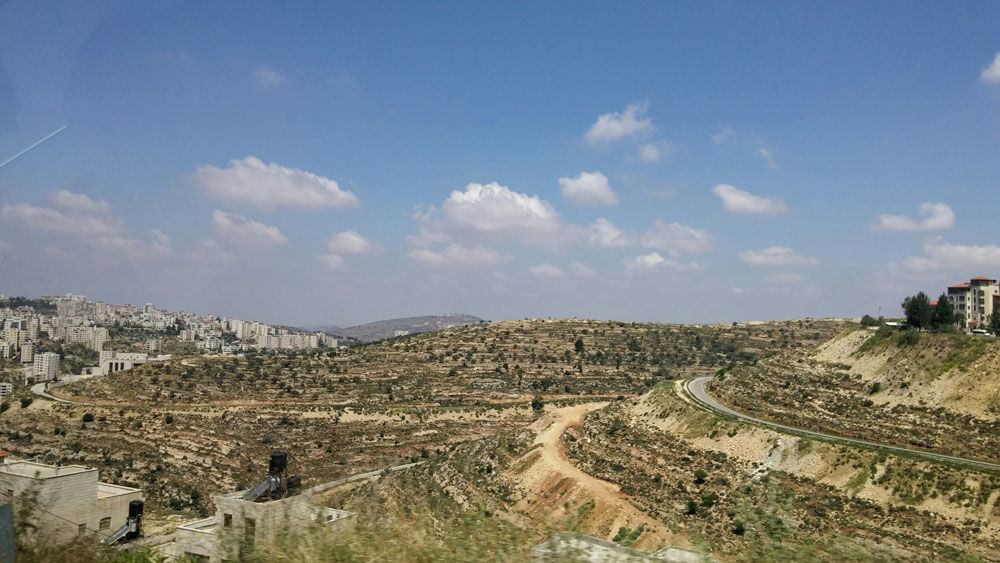
The Florida Legislature is about to approve a bill that forbids all state agencies and school materials from referring to the Israeli-occupied West Bank as the West Bank. House Bill 31 (HB 31) requires the name to be changed to “Judea and Samaria,” names that, in historical terms, briefly applied a few thousand years ago.
The bill states, falsely, that the land was “annexed by Israel from Jordan during the 1967 Six-Day War.” Even Israel does not claim that it has annexed the land, which is under Israeli military occupation. The legislative analysis lawmakers use to inform themselves refers to the West Bank as land “liberated by Israel from Jordan during the 1967 Six-Day War.” Palestinians have been feeling liberated, in the Israeli sense, ever since.

Historical lies don’t get more blatant than this. According to international law, the United Nations and American policy until the current regime, the West Bank is illegally occupied. But starting July 1, Florida students will be systematically lied to about the West Bank, as they have been increasingly lied to with sanitized histories of slavery, immigrants and other minorities in Ron DeSantis’s memory hole.
I suspect most Americans could not point to the West Bank on a map. But most people in Flagler County don’t know where Espanola is, either. So when a legislature declares that from now on the West Bank will be referred to as “Judea and Samaria,” it doesn’t seem any less reasonable than when a developer renames a huge expanse of west Bunnell as “the Reserve at Haw Creek.” But the developer is not violating international law, rewriting history or erasing a people.
It helps to distill fact from biblical fog. What came to be known as Judea (or Judah) and Samaria were established as the Kingdom of Israel around 1,000 BCE. The Babylonian empire took over 400 years later. A Jewish kingdom again prevailed for a few generations under the Maccabeans in the second century BCE until Roman rule. Those Jewish interregnums were blips in a history of conquests stretching over millennia. Jericho, the Palestinian town in the West Bank, is among the oldest human settlements on Earth. Its earliest dwellers were Neolithic contemporaries of the cave painters of Lascaux. We don’t know what they called their settlement. We can assume they did not call it Judea.
Before and after those blips, that tiny scrap of the Levant–“the coast which had so long resounded with the world’s debate,” in Edward Gibbon’s phrase[1]–at one time or another and often for far longer periods than the Jewish kingdoms belonged, in this order, to Akkadians, Amorites, Assyrians, Babylonians, Hittites, Persians, Philistines, Ammonites, Egyptians, Greeks, Seleucids, Nabataeans, Romans, Egyptians again, Umayyads (the first Muslim Arab dynasty), Byzantines, Fatimids (Egyptian Arabs), Christian crusaders, Seljuks, Ottomans, and finally the British Empire, all of whom controlled indigenous Arabs going back to the Akkadians.
Not since Rome had an empire toyed with local fates as if it were an Olympian god. The Levant’s Zeus was Arthur Balfour, the British foreign secretary. “Balfour was careless of facts, unsafe with figures, and memory was not his strong point,” the historian Barbara Tuchman wrote.[2] She could have been describing the sponsor of HB 31. Balfour was looking for a refuge for Jews fleeing European and Russian pogroms. With that imperious arrogance used to drawing boundaries on a whim, he offered Uganda to the land-prospecting Zionist Chaim Weizmann. Weizmann declined, demanding Palestine.
And so came the infamous Balfour Declaration offering up Palestine as a “national home for the Jewish people.” Balfour acknowledged the existence of Arabs, but as subhumans: “Zionism, be it right or wrong, good or bad,” he wrote in a memo, “is rooted in age-long traditions, in present needs, in future hopes, of far greater import than the desires and prejudices of the 700,000 Arabs who now inhabit that ancient land.”[3]At the turn of the 20th century, Arabs constituted 95 percent of the population, with a few thousand Jews among them.[4]
Balfour’s DNA is all over HB31. Let us not confuse the disproportionate and welcome influence of scripture’s Judaic tradition with land theft, an illegal occupation, and the erasure of a people.
To many Americans, if not to most Floridians, the West Bank is not a place, a territory or a home except to Israeli “settlers,” a word with connotations as deeply problematic as “Judea and Samaria.” Otherwise, the West Bank is a headline, an age-old problem (as opposed to Balfour’s “age-long traditions”) packed with terrorists, would-be terrorists and Arabs who belong elsewhere. At least that’s how Israel’s reigning right-wing version of Zionism sees it. Pre-1967 Zionism, and pre-1948 Zionism especially, had an element of Arab accommodation, notably mirroring the way the first generation of crusaders sought accommodation with local Arabs, as subsequent generations increasingly chose belligerence, though it did not serve them well.[5]
Since 1967, when Israel invaded and occupied the West Bank, Gaza, the Sinai and Syria’s Golan Heights, the more expansionist, supremacist version of Zionism has prevailed. It is projected in designs of a “greater Israel,” graduating the old Christian Zionist slogan “A land without a people for a people without a land” to Israeli ideology as Israel delegitimized the idea of a Palestinian nation or a Palestinian people and effectively denied Palestinians the right to exist as anything but a burden to be dealt with later.
So what do you do with “a land without a people”? Why, you “settle” it. You erase those thousands of years, you disappear the Arab farmers who can trace their DNA to Jericho, and you declare yourselves “settlers,” conflating previous inhabitants with the animals and insects that come with the land. You will not treat them much better than that anyway.
Israel traded the Sinai for a peace treaty with Egypt in 1979, but it annexed the Golan Heights in 1981, illegally of course (it is still an occupation), made a show of removing Jewish colonies from Gaza in 2005, but only to turn Gaza into the largest open-air prison in the world, and now the most genocidally assaulted sliver of land of this century. (The entirety of Gaza is exactly the size of geographical Bunnell, but with 2 million people, most of whom have now been shoved into an area about half that size by Israel’s latest war, with American support.)
The West Bank remains occupied, with a few slivers of its own supposedly, but really, under the control of the Palestinian Authority. The PA are the remnants of the 1995 Oslo Accords that were supposed to be the first step toward an independent Palestinian state, and that proved to be another empty promise enabling Palestinian annihilation. There were about 110,000 Jewish colonists in the West Bank in 1993 (about 275,000 when including Arab East Jerusalem). There are now 750,000, including Arab East Jerusalem.
The West Bank is the size of Delaware. It is split into three so-called “Areas.” Area A, B and C. The part where 3 million Palestinians may live is only 40 percent of that, in Areas A and B.
Area C accounts for 60 percent of the West Bank. It is off limits to Palestinians. That’s where all the “settlements” are, where Israel’s military oils its occupation machinery and imprisons Palestinians, and where it manages so-called nature preserves that magically turn into more settlements as land theft continues.
Areas A and B together are the size of Flagler County plus Ormond Beach and maybe the St. Johns County side of Flagler Estates. That’s where 3 million Palestinians are crammed.
The two Palestinian zones have been further whittled by handsome Israeli highways and roads–built with American tax dollars–connecting the colonies to Israel proper. The roads cut through Palestinian zones. Palestinians are forbidden from using them. The zones have also been diminished by the wall separating the West Bank from Israel, all of it built on Palestinian land. Finally, in this holy land of sneaky euphemisms, Areas A and B are not, as you might assume from their official names, two expanses of contiguous land, like American Indian reservations. They are made up of a few hundred intentionally disconnected pods of land spread around the West Bank into bantustans, as Ariel Sharon, architect of the mutilation, described it. (Bantustans, or “homelands,” were apartheid South Africa’s 10 areas where Blacks were herded to keep them from mingling with whites or living in cities.) Here’s what the map of the West Bank and its three areas looks like:
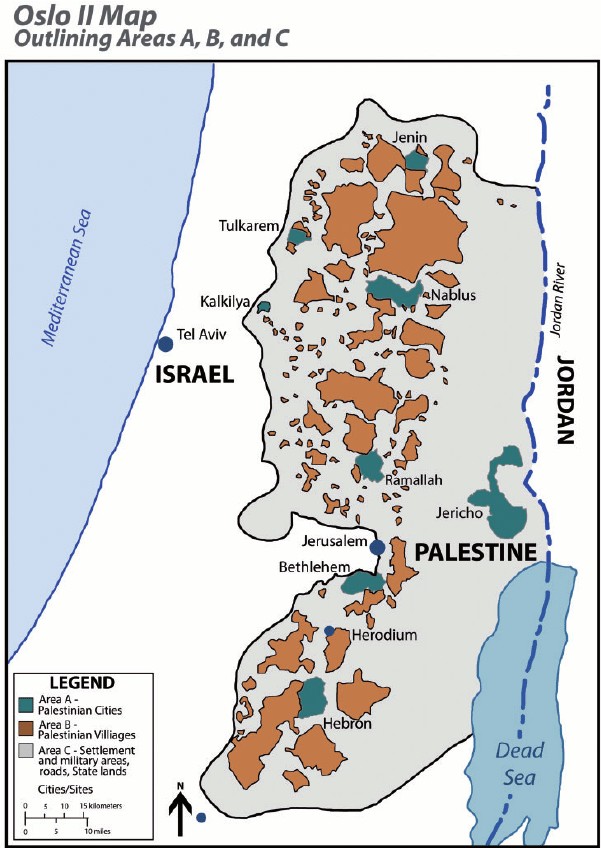
If it normally takes you 15 minutes to drive from Palm Coast’s P-Section to downtown Flagler Beach, it would take you two hours to travel the same distance in your own Palestinian area of the West Bank, assuming your destination is still yours to reach. More often than not, it is not. Your roads, unlike Israeli roads, are mud, and may be closed to you any time a bunch of Israeli soldiers–or, increasingly, vigilante colonists–want to close them: “The other day I had to plead with a soldier to be allowed to return home,” writes Raja Shehadeh in Palestinian Walks:
I was getting back from our winter house in Jericho, where I had spent a relaxing day. I had to implore the Israeli soldier. I told him that I really did not know a curfew had been imposed on Ramallah. I was away all day and hadn’t listened to the news. “I’m tired,” I said, “please let me through.” Oh, the humiliation of pleading with a stranger for something so basic. Why should I endure all these hardships? Why should I spend so much of my time thinking about the dismal future? Living as a hunted, haunted human with a terrible sense of doom pervading my life?
Area C keeps growing. Areas A and B keep shrinking. There are also over 200 illegal “outposts” built by Israeli colonists in violation even of Israeli law, many of them in the Palestinian zones. The Israeli government’s attitude toward these vigilantes is roughly the same as Jim Crow-era police toward whites who terrorized and murdered Blacks: indifference or complicity.
If there were to be a more fitting biblical metaphor for the West Bank’s “legal twilight zone,” as the Israeli historian Idith Zertal and political analyst Akiva Eldar put it in Lords of the Land,[6] it would not be Judea and Samaria, but “the process of the transformation of the territories into Sodom and Gomorrah.”
This transformation is what Raja Shehadeh’s Palestinian Walks is about.
You might fairly ask: why these 1,600 words before the first mention of what is ostensibly a piece about Palestinian Walks? Because the book is as much about those walks as it is about restoring context, reversing Israel’s eradication of all things Palestinian by walking back through a sodomized land. That context makes up a good portion of the book. I’ve essentially given you a summary of Palestinian Walks’s framing structure and purpose, if not a good deal of its more prosaic details: explaining the hopes and disillusion of the Oslo Accords takes up many pages.
Shehadeh knows his audience. He writes for the lay person, for the Flagler County resident, more than for the specialist. The book is the story of six walks he took alone or with friends in the 26 years between 1978 and 2006 around his home in Ramallah, the 500-year-old Palestinian West Bank town of about 360,000 people a little north of Jerusalem.
It is the story of a vanishing as his ancestral land, Israeli-occupied for 11 years by the time of the first walk, is deliberately, methodically shrunk by Israeli appropriations almost always masked behind the mucous excretions of legality. It is also a story that, but for its cruelties and lawbreaking, might not be unfamiliar to Floridians who, also before their eyes, see development’s transformation of landscapes from scrub and grassland and forest to sprawls of concrete and asphalt and canopies of solar panels, if still with a nod to “smart growth,” and without redlining on crack, as in the West Bank.
In Palestine, dense, poorly regulated, architecturally crass and gray “settlements” are replacing the hills and valleys of millennia, and the people who inhabited them for those millennia. Looking at the lights from illegal outposts at night from his rooftop, Shehadeh sees “an illuminated noose around the city.” The subtitle of Shehadeh’s book is Forays Into a Vanishing Landscape. He is doing for the West Bank what the Yiddish novelist and short story writer Isaac Bashevis Singer did for Krochmalna Street and the Warsaw ghetto before the Holocaust:
In the uneasy first years of the new millennium I felt that my days in Palestine were numbered. But whether Palestine or myself would slip away first was an open question. Cities were being erected in its midst, as were industrial and theme parks, and wide, many-laned highways more suited to the plains of the Midwest of America than to the undulating hills of Palestine. In two and a half decades one of the world’s treasures, this biblical landscape that would have seemed familiar to a contemporary of Christ, was being changed, in some parts beyond recognition. The biography of these hills is in many ways my own, the victories and failures of the struggle to save this land also mine. But the persistent pain at the failure of that struggle would in time be shared by Arabs, Jews and lovers of nature anywhere in the world. All would grieve, as I have, at the continuing destruction of an exquisitely beautiful place.
One of the book’s paradoxical pleasures, like a beautiful elegy at a funeral, are descriptions of what is disappearing, though Shehadeh’s landscapes are not just physical. His sarhas, the Arabic term for roaming or hiking, have the transcendent feel of Thoreau’s inner discovery of the soul through nature or–not to take the Americentric references too far–Wendell Berry’s reverence for the deep roots of genealogy through places as common as a riverside or the slope of a hill. Shehadeh traces his family history and its immersion in the land through landmarks like the ruin of a “qasr,” or a stone house that had once belonged to a stonemason cousin, before the walk is elevated to a form of resistance: to step where his ancestors stepped reclaims the soil from the Israeli occupation.
The euphoria of the walks, like the euphoria the book evokes, is ephemeral. The invader keeps coming. Israeli law, arbitrarily applied in the Occupied Territories, sees all Palestinian ownership of land as terminal: “A Palestinian,” Shehadeh writes, “only has the right to the property he resides in. Once he leaves it for whatever reason it ceases to be his, it ‘reverts back’ to those whom the Israeli system considers the original, rightful owners of ‘Judea and Samaria,’ the Jewish people, wherever they may be.” So we’re back to that “Judea and Samaria” construct as decree.
All Israeli laws and procedures regarding land ownership in one form or another lead to the legal chicanery of expropriation, of theft. Shehadeh, a lawyer, describes the deceits in “The Albina Case,” his chapter-long account of battling on behalf of a client for a few acres, a Sisyphean task that ends where you knew it would, with expropriation and conveyance of the land to “settlers” despite documented rights in the Palestinian landowner’s hands.
All it takes is a decree or the interpretation of a law favoring Israeli land seizure. The chicanery dates back to cynical misappropriations and interpretations of British Mandate and Jordanian law. According to one interpretation of land law, “the only nonregistered land that truly belonged to Palestinians was that over which they could prove use either by living on it or continuously cultivating it for a period of not less than ten years. All the rest was public land. This would render Palestinians living in the West Bank squatters, not rightful owners. The only rightful owners, according to the Israeli government’s version of law and history, were the Jews, who could trace their entitlement to the land from time immemorial, just after the dinosaurs became extinct. Legally this position was not sustainable. And yet it was not being challenged.”
Shehadeh would challenge it, even as he feared “lending legitimacy to an illegal court,” and lose: “Not only had the court found a way to justify the takeover of my client’s land–it did not even order that my client be paid any compensation.”
There is a walk with a former PLO member, a chapter that summarizes the defeat of Oslo–”a surrender document, a false promise for a better future”–and the growing desecration of the land at settlers’ hands, symbolized here by the slow disappearance, like the now vanished Aral Sea, of the vanishing Dead Sea, from development and over-exploitation. There are further humiliations at Israeli checkpoints, the encounter with members of a bedouin tribe that previously been expelled from the Negev desert and was now being expelled from its West Bank grounds, and a visit to a monastery whose monks “who have lived here over the centuries have succeeded in secluding themselves from the successive waves of conquerors, some more rural than others.” But the monastery was on land declared a “nature preserve” by the Israelis, a first step toward expropriation for “settlers.”
The more you read of the legal treacheries, the expropriations, degradation at every encounter with an Israeli soldier, settlers’ killings of Palestinians with impunity and that vise closing in on what’s left of Areas A and B and the corruption, inaction and accommodations of the Palestinian Authority, the more you think: of course Palestinians are embracing Hamas as the only alternative. You might do the same, in the circumstances. And that was 20 years ago, when Palestinian Walks was published and the ramped-up assaults on the West Bank and genocidal wars on Gaza hadn’t happened yet.
There’s been no new edition of the book. I don’t know where Shehadeh could walk now for anything that could amount to a hike, a sarha. Even Palestinians’ souls are now shackled as if in the antechamber of their annihilation.
Shehadeh ended Palestinian Walks with a chapter imagining a conversation with an armed settler. But was it really imagined? I could not tell. Nor could I tell if Shehadeh was playing on the ambiguity. The conversation creates the illusion that a conversation is possible. But in the end the two men do nothing more communal than smoke hashish together. All the rest is a divide, unbridgeable but for their love of the land. Or because of their love of the land.
“I was fully aware of the looming tragedy and war that lay ahead for both of us, Palestinian Arab and Israeli Jew,” Shehadeh writes. “But for now, he and I could sit together for a respite, for a smoke, joined temporarily by our mutual love of the land. Shots could be heard in the distance, which made us both shiver. ‘Yours or ours?’ I asked. But how could we tell? We agreed to disregard them for now and for a while the only sound that we could hear was the comforting gurgle of the nergila and the soft murmur of the precious water trickling between the rocks.”
The settler was in Judea. Shehadeh was in Palestine.

Notes and Amplifications:
[1] Edward Gibbon, The Decline and Fall of the Roman Empire, vol. 6 (Knopf/Everyman), p. 151.
[2] Barbara Tuchman, The Proud Tower (MacMillan, 1966), p. 52.
[3] Cited in Rashid Khalidi, The Iron Cage: The Story of the Palestinian Struggle for Statehood (Beacon, 2007), pp. 36-7.
[4] “When political Zionism began in earnest in the late nineteenth century, there were only about fifteen thousand to seventeen thousand Jews living in Palestine. In 1893, for example, the Arabs comprised roughly 95 percent of the population, and though under Ottoman control, they had been in continuous possession of this territory for thirteen hundred years.” John Mearsheimer and Stephen M. Walt, The Israel Lobby and U.S. Foreign Policy (FSG 2007), p. 92.
[5] Steven Runciman, A History of the Crusades, vol. II: The Kingdom of Jerusalem (Cambridge 1952, Penguin paperback 2016), p. 383.
[6] Idith Zertal and Akiva Eldar, tr. from Hebrew by Vivian Eden, Lords of the Land: The War Over Israel’s Settlements in the Occupied Territories, 1967-2007 (Dvir 2005, Nations Books 2007), p. 355.
Pierre Tristam is the editor of FlaglerLive.



























Jim says
Pierre, it is obvious this really is an irritant to you.
I only have one question/comment: WHY is the Florida legislature wasting time discussing the name of ANY piece of land outside of the Free State of Florida??????
This crap makes me ashamed of our government. When the legislature actually does a decent job of governing this state, perhaps they might start wandering the globe looking for other things to stick their nose in. But since that hasn’t happened yet, please just try to keep your pea brains on the needs of the people of Florida…..
Dusty says
Offered peace six times and then chose war anyway. Reap what you sow
Keenan Hreib says
Netanyahu and Israel never offered peace to anyone. Stop lying. In the sbsequent months since the “so called” October 10 ceasefire, over a thousand people have been killed. More than likely an undercount. Even if Hamas was not will to budge on peace plan, you dont kill over 100,000 civilians, mostly children that had nothing to do with October 7th. can’t believe i have to spoon feed facts and humanity to RUBES like you.
Stephen Smith says
So our next Democrat president can say we never had a president named Donald Trump and remove from history. Insane.