



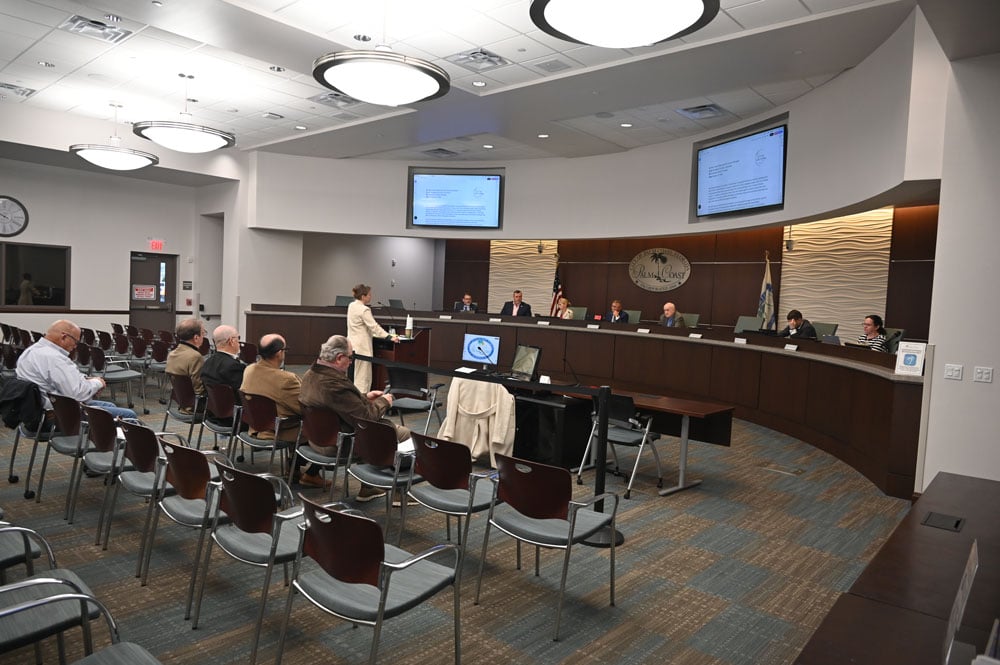
The Palm Coast City Council today refined language for three city charter amendments that will appear on the November ballot. City Attorney Marcus Duffy has been drafting and redrafting the proposals at the council’s direction.
Today’s discussion cleared the three amendment proposals to appear before the council for the first of two readings before the amendments are ready for the ballot.
Amendment 1 defines methods of removing a council member. A council member forfeits the office if found to have violated the state’s ethics laws or the city’s standard of conduct and has been suspended by the governor. The council itself cannot remove a member. Only the governor may do so. The amendment would add the violations of the city’s standard of conduct to the mix.
A member also forfeits the seat if absent without an excuse either for three consecutive meetings or workshops or for six meetings and workshops in a calendar year. Calling in for a meeting or a workshop is allowed. The council may request from the governor to remove a member subsequent to three censures of that member within a single calendar year. The censures must win simple-majority approval.
Amendment 2 has been the most problematic so far. It seeks to clarify how vacancies are filled, avoiding the sort of controversies–and the mayor’s lawsuit–surrounding the appointment of Charles Gambaro after the resignation of Council member Cathy Heighter. The council has been stumbling over the timeline that would be set out in the amendment.
The council agreed to the version Duffy presented today, with some wordsmithing. The proposal would set out an “18-month rule” requiring a special election if a vacancy occurs with more than 18 months remaining in that member’s term. Such special elections can cost upwards of $100,000. The election must be held no later than 90 days from the resignation.
“There’s not really a precedent for this,” Supervisor of Elections Kaiti Lenhart said. “A lot of them actually do the same thing as the city’s current charter requires, which is an appointment until the next regularly scheduled election.” Lenhart was part of the discussion only as an advisory voice. She has no opinions on the city’s decisions or the language of the charter. Her only concern is that the city’s arrangements don’t disrupt set elections.
Under the proposed wording, Dave Sullivan would not have been appointed to the seat that Ray Stevens resigned within weeks of his election. The council would have had to hold a special election. The winner would have served less than two years, and another election would have been held (as is being held) to elect someone for a four-year term and keep the five council terms staggered.
To address issues regarding the supervisor’s deadline to get a ballot to the printer–the issue that prevented the council from holding a special election in Gambaro’s case, because it was so close to a scheduled election–the council may make an appointment but must hold a special election within 90 days either after the regularly scheduled election, or on that general election ballot, but with a different qualifying period. Candidates would still have to qualify as they would for any election. The council set that qualifying window either way. There would be no primary for that special election, even if it falls on the general election ballot. It would be winner takes all.
Amendment 3 was worked out previously. It raises the allowable limit on city debt to $30 million and borrowing terms to 30 years, without voter approval. The current limit is $15 million and 36 months, past which voters would have to approve in a referendum. The restriction is on debt backed by the general fund only. The city may and does borrow against its utility, stormwater and other funds backed by fees rather than property taxes.
But for one commenters, the proposal drew no public reaction.




























Brad W says
Absolutely NO to raising the debt limit and then length of debt! No to Amendment 3! Norris already has already raised our utility rates and put us in a boat load of utility debt. Norris does not need anymore spending ability.
Slippery Slope says
Vote NO on raising the debt limit!
john stove says
Hell No on raising debt limit…these clowns cant stay within their budget now and cant do any proper Capital Planning….
NO ON RAISING DEBT LIMIT WITHOUT A VOTE
Deborah Coffey says
There’s no way I can support this crowd in office to raise our debt by $30 million without everyone’s consent. Just because Trump is doing this by trillions, doesn’t mean local MAGAs can, too. NO!
Jeani Duarte says
They have made unauthorized changes to our Charter in 2018 and again April 25, 2022 without the vote of the electors. Our current Charter is defective and invalid.
FlaglerLive says
The commenter, a candidate for the council, is inaccurate. Again.
Taxpayer says
NOOOOOOOOOOOOOOOOOOOOOOOOOOOOOOOOOOOOOOO on raising debt limit without a public vote. But knowing the City of PC Officials as usual they don’t listen to the taxpayers that pay their salaries and put things in place without a vote.