



Though some are less ready for print than others, three proposed amendments to Palm Coast’s charter are taking shape to appear on the November ballot. That’s a significant reduction from the more than a dozen proposals the Charter Review Committee forwarded to the council in January, though the three proposals were also the committee’s priorities.
Neither the committee nor the council wanted to overload the ballot, or risk having to pay the Supervisor of Elections tens of thousands of dollars to accommodate an extra ballot sheet.
The proposals would establish a method for removing a council member from office; revise the method of council appointments and elections following a vacancy; and double–rather than eliminate–the allowable limit on city debt backed by the general fund. They would be listed as Amendments 1, 2 and 3.
Amendment 2 is the least ready for the ballot. “I don’t think that we are fixing any problems with this amendment just yet,” Council member Theresa Pontieri said. “I think that we are potentially creating ambiguity in a different way.”
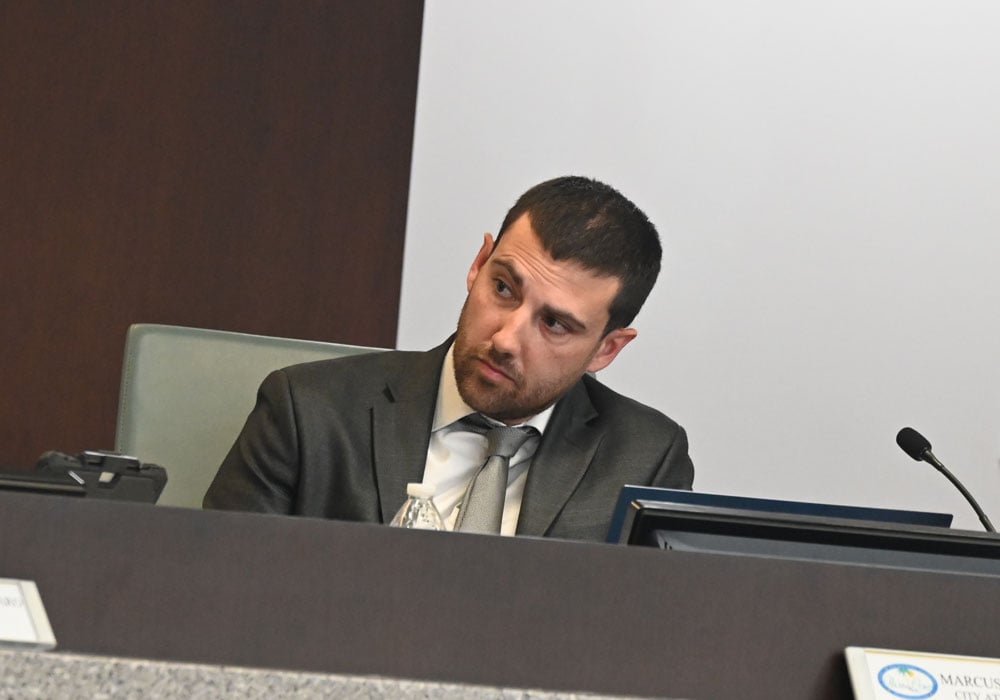
City Attorney Marcus Duffy drafted the ballot language based on council guidance. The council took an editing pen to the proposals during a workshop discussion earlier this month.
Amendment 1 sets the procedure for a council request to the governor to remove a council member or the mayor from office. There is no detailed procedure in place now. The proposal would require the council to have censured the council member at least three times by a super majority vote (at least four of the five council members) before the council forwards a request letter to the governor.
A local government may not remove an elected member from office. Only the governor may do that.
The censures must find that the council member has been convicted of a felony, or has admitted to it even if adjudication is withheld; has been convicted of a first-degree misdemeanor that arises out of the council member’s official duties; or has violated city standards of conduct or the state code of ethics. The latter sets up the possibility that a council member could be removed if the Florida Ethics Commission rules that the member has committed a violation.
The member may also be removed for missing three consecutive meetings or workshops–or six meetings or workshops in a 12 month period–without a council excuse.
The city attorney clarified that if a council member is convicted of a crime, three censures would not be necessary for a request for removal. The governor generally removes local officials soon after they are convicted of a felony, suspending them first pending the outcome of the case.
“The governor does not have to wait for any of you five to write him or her to remove,” Duffy said. “If the governor sees something that he thinks under the statute, he can remove you for a cause.”
Or not: The proposal leaves open the possibility that the governor will not act to remove a member even after a request for removal–as indeed Gov. Ron DeSantis did not act after receiving a letter from the council last July asking him to remove Mayor Mike Norris. The council has since quietly let that request fade.
“I have a problem with the three censures and the removal,” Council member Dave Sullivan said. “Does this in any way hinder us if there’s an egregious” offense. But there’s no hindrance, Sullivan’s colleagues and the attorney told him. “This is just an added process,” Duffy said.
Still, the wording of the proposal was problematic also for Council member Ty Miller, who doesn’t see the council having to go through three meetings and three censure votes when a fellow council member has committed a felony. To Council member Theresa Pontieri, the section referring to city violations is too vague.
Amendment 2 seeks to eliminate further controversies when a council vacancy opens, and the council makes an appointment, as was the case with the appointment of Charles Gambaro. The amendment also seeks to eliminate the possibility that a member would serve 20 months, as is the case with Sullivan, who was appointed soon after the resignation of Ray Stevens, who got ill within weeks of winning election.
Mayor Mike Norris and some members of the public were so opposed to that appointment that Norris sued in an effort to remove Gambaro. Norris had the letter of the law on his side: the council had a very short window of time to hold an election for the seat, but Circuit Judge Chris France ruled in favor of the city’s argument: it would have been impractical, unrealistic and possibly unfair, if only moneyed candidates who could afford the election qualifying fee could run.
The proposed amendment attempts to create sharper timelines. It does not necessarily eliminate the potential for controversies. It also does not address special election primaries, if there were to be any. “I don’t think any of this is going to rectify the situation that we had last election,” Supervisor of Elections Kaiti Lenhart said. “If you want to preserve the candidates’ ability to collect petitions and avoid paying the qualifying fee, the timing there is difficult.”
In other words, it would replicate some of the problems that preceded the decision not to hold an election for the Gambaro seat. There is no charter amendment proposal addressing qualifying costs. The Charter Review Committee had recommended lowering those costs significantly. There is no precedent for simply waiving the qualifying fee, Lenhart said.
“I researched this topic a lot, and what we currently have is kind of standard trouble,” Duffy said.
As written by Duffy, the proposal states that if a vacancy occurs more than six months from the day of a general election, then a special election must be held to fill the seat within 90 days. The cost is not relevant. (A special election can cost the city around $150,000.) If a vacancy occurs with less than six months before the next general election, then the council shall appoint a member within 90 days.
No special election is to be held in election years between April 1 (or April 15) and Nov. 30. If necessary, the council will hold a special election within 90 days of the seating of a new council after a general election, to ensure that the appointed seat converts to an elected seat. All this applies assuming the vacated seat is not itself up for a scheduled election anyway, in which case a subsequent special election is moot.
“We kind of added extra parameters here that I think are muddying the waters a little bit with timelines of six months,” Council member Ty Miller said.
Duffy will rewrite the proposed amendment in such a way that staggered elections are preserved and potential controversies minimized. What that will look like will be clarified at a subsequent workshop.
Amendment 3 would raise the cap on the amount of money the city may borrow against its general fund, from $15 million currently to $30 million; it would add an annual inflation adjustment; and it would lengthen loan or leasing terms from 36 months (in current charter language) to 30 years.
The limits don’t apply to special funds, like the utility fund and the stormwater fund: those may borrow in larger amounts since they’re backed by user fees. The city is not barred from taking on debt against its general fund exceeding $15 million even today, but it would have to win approval in a popular referendum first. The proposed allowance would enable it to take on debt of up to $30 million and for terms of 30 years without voter approval. Only four cities in Florida have those limits in place (Key West, Longboat and Northport are the others.)
The council in 2024 attempted to repeal that limit entirely with a charter amendment proposal. The proposal was poorly written and possibly deceptive. The initiative failed after even a majority of the council spoke against it.
The proposal Duffey drafted for the 2026 ballot was clear, drew strong support from the council, and no edits. The council has until August to vote to approve proposals and send ballot language to the supervisor of elections.




























Marilyn says
Please stop referring to Duffy, in your articles, as the COPC City Attorney, as it makes residents think he is a government city staff hired city employee, when he is not.
He is an outside independent contract hire via the solicitation process.
FYI – the COPC has 3 to 4 hired outside law firms, who are paid $30 to $40k per month, plus expenses!
FlaglerLive says
The person representing a local government board is referred to, even in state law, as that board’s attorney–the city attorney, the school board attorney, the county commission attorney–regardless of whether the person is in-house or contracted. Marcus Duffy is the city attorney. Had his partner, Jeremiah Blocker, been sitting in that seat that day, then Blocker would have been referred to as the city attorney.
Ed Danko, former Vice-Mayor, PC says
Vote NO on Amendment 3. This is nothing more than “Alfin Bonds” disguised as a pig with lipstick. Don’t be fooled again by flip-flopping “Tax & Spend Pontieri” who was in favor of Alfin Bonds, before she was against Alfin Bonds, before she was in favor of Alfin Bonds! It was Pontieri, along with Alfin and Klufas, who voted in a legal “shade meeting” to waste taxpayer dollars in court to keep Alfin Bonds on the ballot. I voted against their shameful attempt to bankrupt our city at that “shade” meeting, and voters overwhelmingly killed it at the ballot. Yet, here we go again, same old product in a new box!