



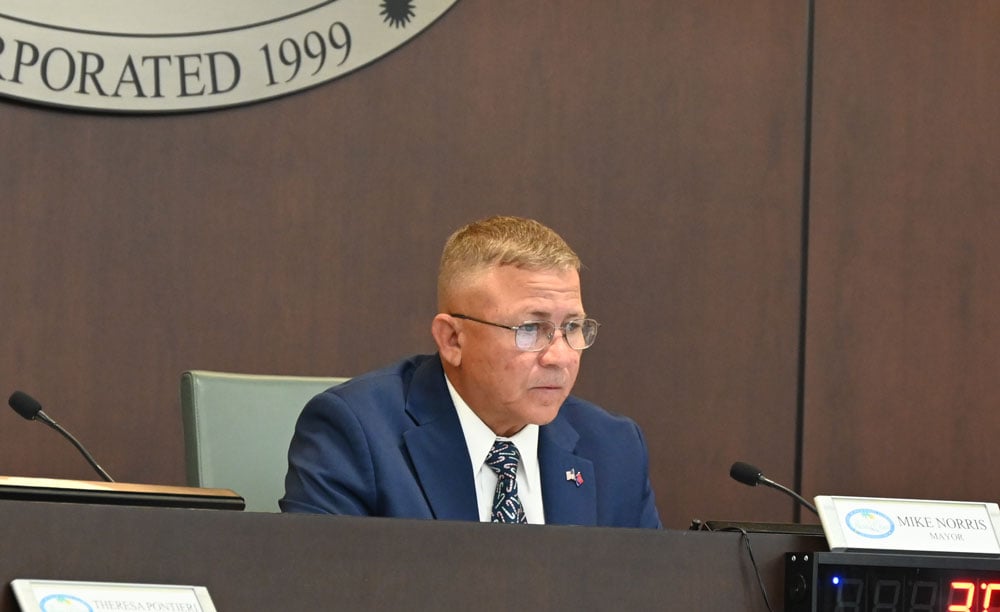
Palm Coast Mayor Mike Norris is calling for an “austerity budget resolution” that would spell out what the city is doing to prepare for an expected sharp reduction in property tax revenue if voters on Nov. 3 approve a constitutional amendment that would raise the homestead exemption to $250,000 by 2028 and reduce revenue from non-homesteaded properties.
“I think we should go shoot for a full rollback, because we’ve got to start prepping now,” Norris said, referring to the rollback tax rate that limits the city’s revenue next year to the amount it took in this year, excluding revenue from new construction. “We can’t wait to see what’s going to happen in Tallahassee, because the chances of people voting to get rid of the property tax is going to happen, and it’s going to hurt. It’s going to hurt us, our city, especially since we’re a 90-10 city. When I say 90-10, I mean 90 percent of our [property tax revenue] comes from residential housing, 10 percent from industry and commercial.”
“Most of those properties are homesteaded as well,” Council member Ty Miller said, “so this exemption will hit us harder than perhaps the communities that this legislation is actually targeted at, and so that’s an unfortunate byproduct.”
Norris spoke of the austerity resolution at the end of a discussion on the coming budget during a council workshop this morning, which was the council members’ first occasion to react to the constitutional amendment proposal. The legislature adopted HJR 1 on June 2. It does not require the governor’s signature to be on the ballot.
The proposal exempts school taxes from the reductions, and differs in other respects from the measure Gov. Ron DeSantis had favored–a full elimination of homestead taxes and the creation of a state fund to help local governments with grants. “That said, the proposal will increase constitutional protection against taxes for homestead properties and will be the biggest property tax cut in Florida history,” DeSantis said in an X post on Sunday.
Council member Dave Sullivan may have misinterpreted the governor’s intention. “He’s not happy with what the legislature did, and did not sign off on it,” Sullivan said of what he referred to as a “letter” by the governor. “He had some specific thoughts concerning it that to me may throw some jeopardy into the whole process.” But unless the governor campaigns against the measure, it does not appear to be in jeopardy, especially in light of the governor’s conclusion about the size of the tax cut.
Council member Charles Gambaro wasn’t sure whether a resolution was necessary to get done what the council does anyway. Norris agreed that “a lot of the work is already happening now behind the scenes. It’s happening now, but it’s putting down what we expect to happen in the city, and we can go through it.” The resolution would amount to a guidance.
“You can make recommendations to Mr. McGlothlin on how things should be changed or how the structure of the city should change in a shortfall with this property tax bill,” City Attorney Marcus Duffy said. “But your powers of the city council are limited to approving a budget and making recommendations when it comes to any type of position or employee or anything like that, that stays with Mr. McGlothlin as the city manager.”
The administration is still gathering information about the expected impact of the cut.
To Council member Theresa Pontieri, the city clearly has to prepare for the effects of the amendment. But aside from it, “we have some work to do, based on our budget, based on the slowing of construction, based on the reduction in property values,” she said. In other words, the city would have had to account for a sharp slowdown in revenue regardless.
“Residential construction is not industry,” she said, recalling cautions she’d spoken when first elected about how reliance on construction makes the city vulnerable to sudden drops in new residents–and the consequent decline in revenue from new construction. The budget, she said, grew “exponentially” since Covid, as did the city’s population, though the tax rate stayed flat and the city has continued to run the city “very well” on 23 cents for every property tax dollar collected in the county (the schools and the county, among others, take the rest).
Now that growth has leveled out, Pontieri said, “How big are we, and how big do we need to be? And I’m not talking about having mass layoffs or anything like that. What I’m saying is possibly a hiring freeze, looking at whether or not we need to hire new.”
Pontieri provided a list of asks to the administration: a full breakdown of the $2.375 million in settlement money the city received at the end of litigation over the splash pad at Holland Park and what its intended uses are (despite the settlement, the city came out at a loss when repairs and legal fees are calculated); where the city’s reserves stand (they were around $26 million at one point last year) and what the city policy on reserves requires (typically, local governments must have two months’ worth of operational reserves). Pontieri also asked to know what programs previously supported by grants are now supported by local dollars.
The city is operating on a current budget of nearly $700 million, though the figure is deceptive. It includes almost $300 million in revenue (and debt) from a bond issue to finance water and sewer infrastructure improvements and $150 million in charges for services such as water sewer, garbage and stormwater.
The general fund, which finances the government’s day to day operations, including policing, fire, parks and the city administration, is just $67.7 million of that. Property taxes account for just $43.2 million. Policing (the city contracts with the Sheriff’s Office) and fire account for half the spending out of the general fund.
Taxable value in the city is projected to increase by 3.58 percent. Taxable value of new construction increased by 4.83 percent. That means existing properties experienced a decrease in taxable value of 1.25 percent. That means in order for the property tax rate to be at rollback–to take in the same amount of revenue next year as it did this year–it would have to increase by about 1.25 percent. Under Florida law, that would not be considered a tax increase.
The city can keep the tax rate where it is now, at $4.0893 per $1,000 in taxable value, and–without new construction–take in slightly less than it would if it were to increase the rate. New construction will generate $2 million in revenue. Due to the decreased values of existing properties, the net increase in revenue at the current tax rate, once new construction revenue is included, would be $1.5 million, for a total of $44.7 million. It would be the smallest nominal increase in at least a decade.
Palm Coast still has one of the lowest tax rates in the region, when compared to St. Johns and Flagler counties, St. Augustine, Daytona Beach, Ormond Beach, Bunnell, Flagler Beach, Deltona and Port Orange.
“Developing the fiscal year 2027 budget to meet community needs will be particularly challenging this year since we are not experiencing the same growth level in revenue as in previous years,” Gwen Ragsdale, the city’s budget and procurement manager, told the council. “We are already reviewing budget requests with the respective directors and the city manager to determine the implications of this reduction.”
Council members repeatedly credited the administration for running the city as it has, an keeping the tax rate level for several years in a row.





















Pogo says
“Depend upon it, sir, when a man knows he is to be hanged in a fortnight, it concentrates his mind wonderfully.”
― Samuel Johnson, The Life of Samuel Johnson LL.D. Vol 3
Come to Floriduh’s Lord of the Flies Experience, and live the dream!
Davis says
And as some say they live here and get the exemption which in my opinion is fraudulent.
Deborah Coffey says
Yeah, sounds like being a 90-10 city is a lot of the problem. Tax the wealthy.
Donna Kahler says
Mayor Norris said the quiet part out loud! We’re a 90/10 community. Council has turned down business after business, confident that taxpayers would happily keep paying…and paying. This short-sighted thinking has dug us a deep hole, and I shudder to think how they’ll get out of it.
Ed Danko, former Vice-Mayor PC says
I never voted to raise taxes, never, and I have called repeatedly for budget cuts at both City Hall and Flagler County. Mayor Norris voted for a tax increase last year, along with Pontieri, but now that his roosters have come home to roost he’s flip-flopping. He has done nothing, along with his “ moratorium” girlfriend “Tax & Spend Pontieri” to bring jobs to Palm coast. In fact, together they have repeatedly opposed industrial development that would have created new jobs. Mr. and Mrs.”Dumb & Dumber” have no clue what they are doing, which is wasting your hard earned tax dollars and hurting our city.
Shelton Kleinfelder says
Time for council members to take a pay cut. Time for department heads to take a pay cut. Time for departments to eliminate 1 employee position each. Everyone is hurt!!
Wasteful spending says
Maybe now we realize a 90 – 10 city is unstainable ? These numbers should be flipped !
Oh wait……. We have rezoned the majority of our commercial land into residential……
Now what ?
No more spending like drunk sailors
The piggy bank is getting taken away
Callmeishmael says
Hey, Danko, how much commercial investment and job opportunities did YOU bring to Palm Coast before, during and after you were APPOINTED vice mayor by your grifting associates on the council at the time?
Residential construction jobs don’t count.
As vice mayor, weren’t you aware of the state of our utilities and roads? Why didn’t you do anything about it? I can answer for you: You believed that stepping up the pace of residential development would solve the city’s fiscal dilemma. You believed, probably still do, that growth pays for itself. As you said at one particular council meeting, “That’s what we do. We grow.”
Your hypocrisy and ignorance are breathtaking. You really should seek help.