



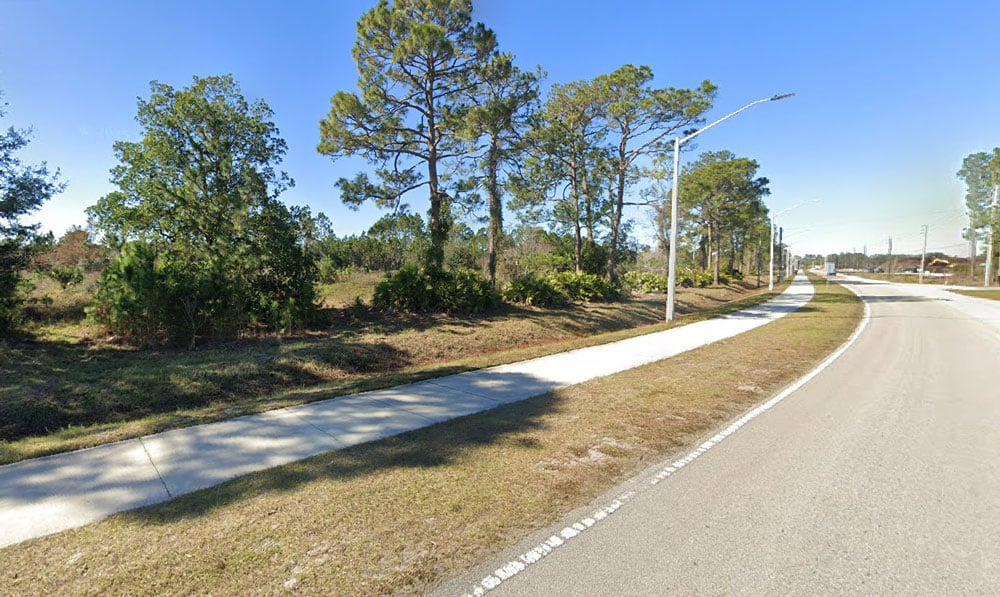
When is a viewshed on a former golf course protected from development? When may a developer exercise property rights, override the protections and build there? The question has bedeviled residents around the old Matanzas Golf Course in Palm Coast’s L-Section since 2021. The Palm Coast City Council tried to settle it today, but a legal question remains.
Two months ago some 120 people filled the cafeteria at Indian Trails Middle School largely in opposition of a plan by the developer of the 268-home golf course property to shift 39 houses from one tract to another.
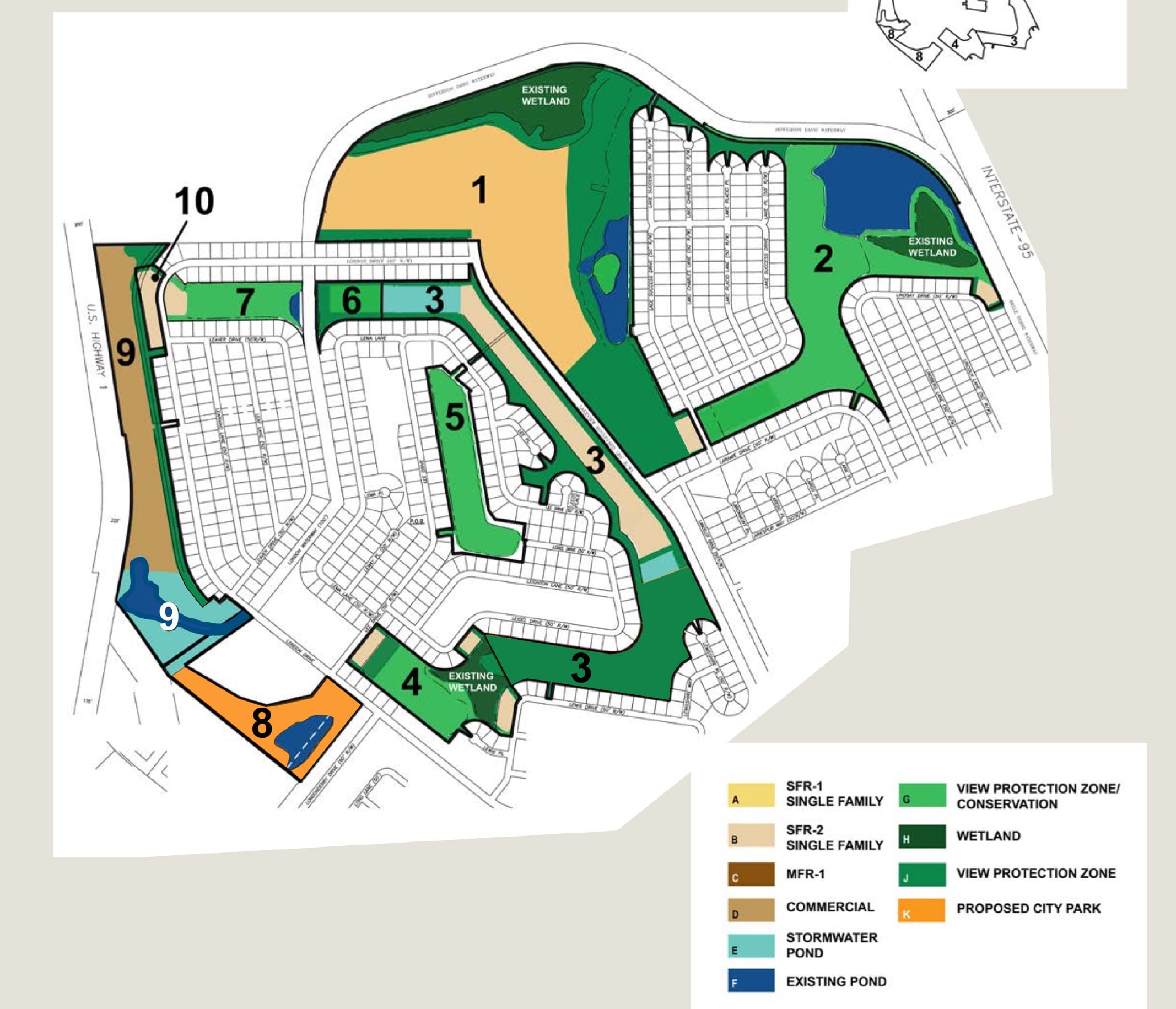
The proposal was to build the 39 houses on a tract along the west side of Lakeview Boulevard that serves as a viewshed for current residents. The City Council had stopped just such a plan in 2021, and came close to rejecting the entire development if that viewshed was not protected. The developer backed down–only to re-apply for that development plan this year. The proposal went before the Planning Board last month but was rescheduled from a council appearance in June and July to Sept. 1 and Oct. 20.
“It could come back. It likely will,” Palm Coast City Council member Theresa Pontieri said during a workshop on the city’s Land Development Code today. Pontieri was at the neighborhood meeting in April, as was County Commission Chair Leann Pennington. Both had concerns about residents losing the viewshed.
They also heard conflicting statements about whether the viewshed could be built on. Residents said it couldn’t. But city planners said a master-planned development order could override the restriction–if the council approved it.
Today, Pontieri sought to clarify the issue through the LDC, whose language she found vague. The language states: Existing golf course views from existing platted lots located within any residentially zoned area located across a right of way or a water body from the site shall be maintained to the maximum extent possible.”
“I have an issue with this language,” Pontieri said. She referred to the pending development. “Are they asking for an override of this portion of the LDC?” she asked Senior Planner Michael Hanson. “And do we need to make a change here to prevent those view protection zones from being affected?”
The language, Hanson said, was put in place specifically to address the Matanzas Golf Course. “There was no definition as far as the depth of these view protection zones, and that was loosely interpreted even in the original MPD development agreement that was created,” Hanson said.
“View protection zones are vested.” Pontieri said. “I think that’s a vested interest that a homeowner, when they purchase their home, it should not ever be affected. It should be into perpetuity.”
That may run into developers’ property rights issues, Hanson said, “if it doesn’t allow someone due process to even go ahead and ask for potential changes,” as happens to be the case with the Matanzas Woods developer. That might open the city up to a legal challenge, he said.
Planning Manager Phong T. Nguyen said it’s the council’s call. To specify the language, he said, “We would add that if an existing golf course has basically a view protection zone, it must remain so, basically,” he said.
But in that case, would the owner of that view protection zone be responsible for maintaining the land, to mow it, and not develop it, Hanson asked.
“I don’t think the intent is that it needs to be maintained as a clean fairway, just a natural view,” Council member Ty Miller said. “I support this completely, as long as legally we’re not in some way fouling ourselves up with the entitlements that they have. Because a lot of these golf courses technically have entitlements to be other uses within them. I just want to make sure we’re not getting sued, because we’ve somehow basically prevented that other development with the view protection zone.” Existing homeowners have their own property values to protect–values built on the assumption that they would have that view.
Pontieri proposed a single line: “If a pre-existing golf course had view protection zones, those shall be maintained.”
The council agreed “as long as it’s legal,” Council member Charles Gambaro said. That will be up to City Attorney Marcus Duffy to confirm.
If he does, the council’s action today, in a matter of minutes, may have made moot any attempt by the developer, Alexander Ustilovsky, to seek to build those 39 homes on what all residents around that golf course know as Tract 3. On the other hand, it may also prompt him to challenge the council’s action–or pre-empt it before it is written and approved: all changes to the LDC must win council approval by vote.
Corrections: An earlier version of this article had incorrectly stated that the developer’s application for Tract 3 development had not gone before the Planning Board. It did so in May. The article also misidentified the titles of Senior Panner Michael Hanson and Planning Manager Phong Nguyen.

























Darlene Shelley says
Palm Coast Mayor Mike, City Council members, especially those that were actually ELECTED by the VOTERS, and Concerned Local Residents, In an attempt to listen to the Concerned Citizens of Palm Coast and in a valiant effort to Protect the Environment, Fragile EcoSystems, Property Rights of Local Homeowners (many of whom pay higher property taxes and a premium for oversized properties with protected golf course and natural views) prevent increased density and intensity, avoid unnecessary demands on limited infrastructure, water, and drainage capacity , protect green space, habitat and ecology for local wildlife, flora, and fauna, please, consider the following: “WHEREAS, the City of Palm Coast, Florida, recognizes the critical ecological, flood control, water quality, and habitat functions provided by wetlands and green space within its jurisdiction; and
WHEREAS, wetlands and protected green space in Palm Coast and surrounding areas help mitigate flooding, filter pollutants and toxins, recharge aquifers, support biodiversity, and provide recreational and aesthetic benefits to residents; and
WHEREAS, rapid or incompatible growth and development have led to increased pressure to fill wetlands for construction, which can result in loss of these functions, increased flooding risks, degradation of water quality, and harm to wildlife habitats; and
WHEREAS, the City seeks to pause certain activities to allow for comprehensive review and potential updates to its Land Development Code (LDC), Comprehensive Plan, and related regulations to better manage growth in a manner compatible with wetland protection; and
WHEREAS, Florida law and the City’s authority under its home rule powers, Charter, and existing codes (including environmental and land use provisions) authorize local governments to adopt reasonable temporary moratoria and regulations to protect public health, safety, and welfare, consistent with state and federal wetland regulations (e.g., those administered by the Florida Department of Environmental Protection, Environmental Protection Agency, and U.S. Army Corps of Engineers); and
WHEREAS, this moratorium is intended to be temporary and does not prohibit all development but targets filling activities that could cause irreversible harm during the review period; and
WHEREAS, the City Council finds that this ordinance is necessary, reasonable, and in the public interest.”
Thank you for your serious consideration. DarleneforPalmCoast.com Concerned Citizens of Palm Coast. AnnaforFlagler.com. PeaceforPalm.com
Brad W says
The City was wrong 6 years ago and the “view protection zones” were a stretch. The reality is that the view of many of those properties is shrubs and trees. Others that cleared the buffer see natural growth and trees. So if the owner develops the land within their rights and puts up trees as a buffer they have protected the view of those owners. Bottom line is the owner has the right to develop that land and the City is wrong to try and deny them that right.
Dennis C Rathsam says
No more homes!!!!! Make it a 9 hole,pitch & putt, a park with a community pool, & a miniature golf course for the kids.
No Sir says
Mr. West was given conservation in perpetuity behind his home – while at the time this came up he was a city employee. No other land owner abutting this property was afforded that right to their property that abuts this golf course. Upsetting to see he thinks the rest of it should developed.