



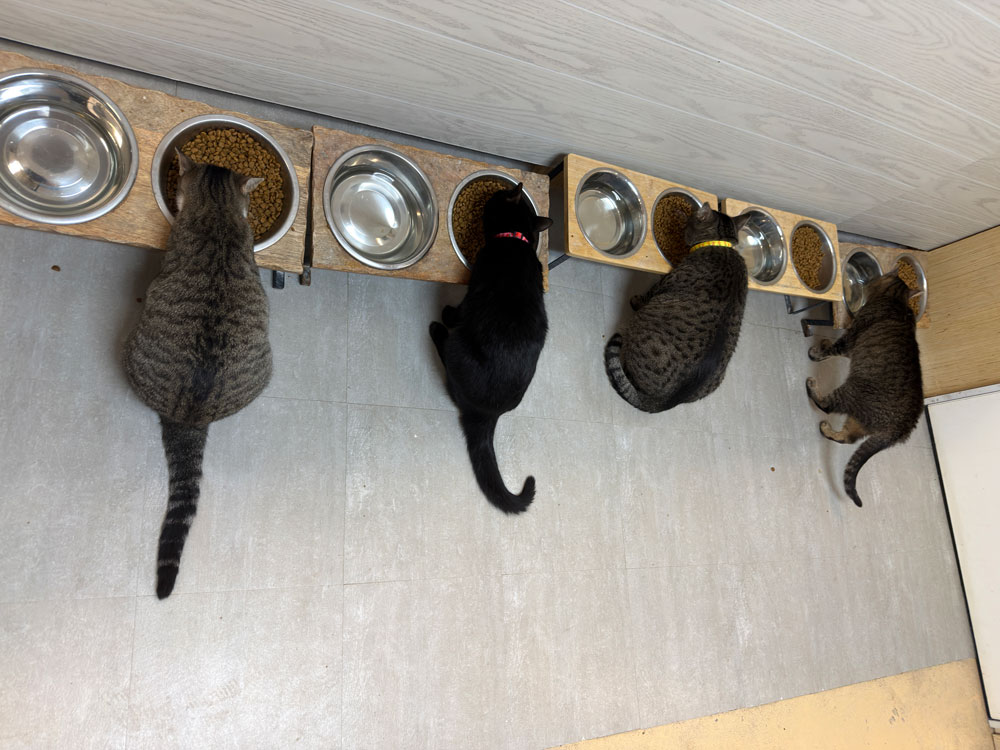
A joint Palm Coast-Flagler County government task force created last summer is recommending building a $2.1 million, 9,500-square-foot animal shelter on 4 acres of city-owned land off Commerce Boulevard. Groundbreaking would be slated for Oct. 1.
The facility would not replace the Flagler Humane Society’s shelter but would operate independently of it as the intake facility for a joint city-county animal control services operation, shifting such intakes from the society to the new facility, severing a decades-old relationship and reflecting disenchantment by Palm Coast government especially with the society’s services.
The task force anticipates that Bunnell and Flagler Beach animal control services intake would also shift to the new facility, as would the two cities’ annual contributions.
The facility would accommodate 96 dogs and 80 cats in modular kennels modeled after the $890,000 Putnam County Animal Control Services facility that opened last November in Palatka. A legislative appropriation covered $500,000 of that cost, according to the Palatka Daily News.
The Palm Coast City Council and the Flagler County Commission are holding a joint workshop on Jan. 29 to discuss the task force’s findings and recommendations. The task force included Flagler County’s and Palm Coast’s top government executives and their deputies, plus Palm Coast Community Development Director John Zobler and Cameron Orr of Animal Refuge of Flagler. It consulted with more than half a dozen individuals and organizations, including Community Cats and Putnam County staff but, notably, no one from the Humane Society.
The county and all its municipalities contract with the society for sheltering services. The county also contracts with the society for animal control services. Palm Coast has its own division. The society has weathered criticism from county and city governments for lack of transparency, for its allegedly poor handling and euthanizing of certain animals, and for not planning for an expansion despite chronic and at times severe animal overcrowding.
The society’s executive director and members of its board have attempted to refute much of the criticism, but the county has continued its push for a joint animal control services operation with Palm Coast Animal Control: That proposal is also on the Jan. 29 agenda.
The proposed facility would operate eight hours a day, seven days a week as a nonprofit jointly overseen by the city and the county, and would seek to “become a leading no-kill shelter in Florida,” according to its vision statement. It would provide shelter, “limited medical care” and adoption services. But it would not accept surrenders, though surrenders account for a large part of animals handled at the society. It would handle intakes of lost pets and strays, provide triage care and adoption services, and would conduct outreach and education.
The task force’s presentation prepared for the Jan. 29 meeting includes various options and capital costs, but does not include operational or personnel costs. It does not specify the number of personnel necessary to run the facility. It does not provide a secure source of money for the capital cost nor operational costs. But it proposes to request a $500,000 legislative appropriation that the county would match, with Palm Coast donating the land. The current amounts local governments are paying the Humane Society for services would presumably be shifted to the new facility, underwriting a substantial portion of operating costs.
At this stage, the task force is seeking direction from the two governments to develop a cost-sharing methodology and draft a joint agreement for capital costs. The task force is also proposing that a request for information seeking shelter management companies be issued as early as February. Meanwhile, the relationship with the society would be maintained until the governments are ready to open the new facility.
The task force considered several sites, including locating the shelter on the grounds of the Humane Society, which owns almost 20 acres off of U.S. 1 just north of Palm Coast Parkway. The advantage would have been to have all sheltering services in one place, the task force found, and would enable continuing current contracts with the society. But the site may not be viable for expansion for various reasons, the task force found.
Four sites were explored elsewhere along U.S. 1, including the public works facility Palm Coast will be vacating, and a fifth site on Utility Drive. The 3.9-acre site off Commerce Boulevard proved most conducive to the plan, though it is a proposed wellsite, it has no utilities, and it would subtract precious industrial land from the city’s inventory.
The task force also studied four building options before finding the hybrid modular-building approach best suited to the plan. The structure would include 3,000 square feet of reception and medical offices and 6,480 square feet of kennel and cage space. It would not accommodate animals other than cats and dogs. The society accommodates many types of animals beyond cats and dogs.
Separately at the Jan. 29 meeting, the two governments will discuss the findings of an administrative cost study about a joint county-city animal control operation–or rather, an expansion of Palm Coast’s existing operation to the 485 square miles of the county.
Bottom line: First-year operating costs would be $1.37 million, falling to between $1.2 million and $1.4 million over the following five years. Palm Coast’s current operation costs $800,000. That’s in addition to the $712,000 the city pays for sheltering services at the society. The county pays $215,000 for sheltering services, Flagler Beach and Bunnell pay $46,000 between them. The numbers as presented by the Palm Coast administration for the Jan. 29 workshop do not appear cost-effective, compared to current services, and clash directly with a direction by the County Commission earlier this month to look for cutting government costs, not adding to them. The commission elected to end its funding of adult day care services in view of the possible elimination of homesteaded property taxes and their revenue to local governments.
























Leave a Reply