



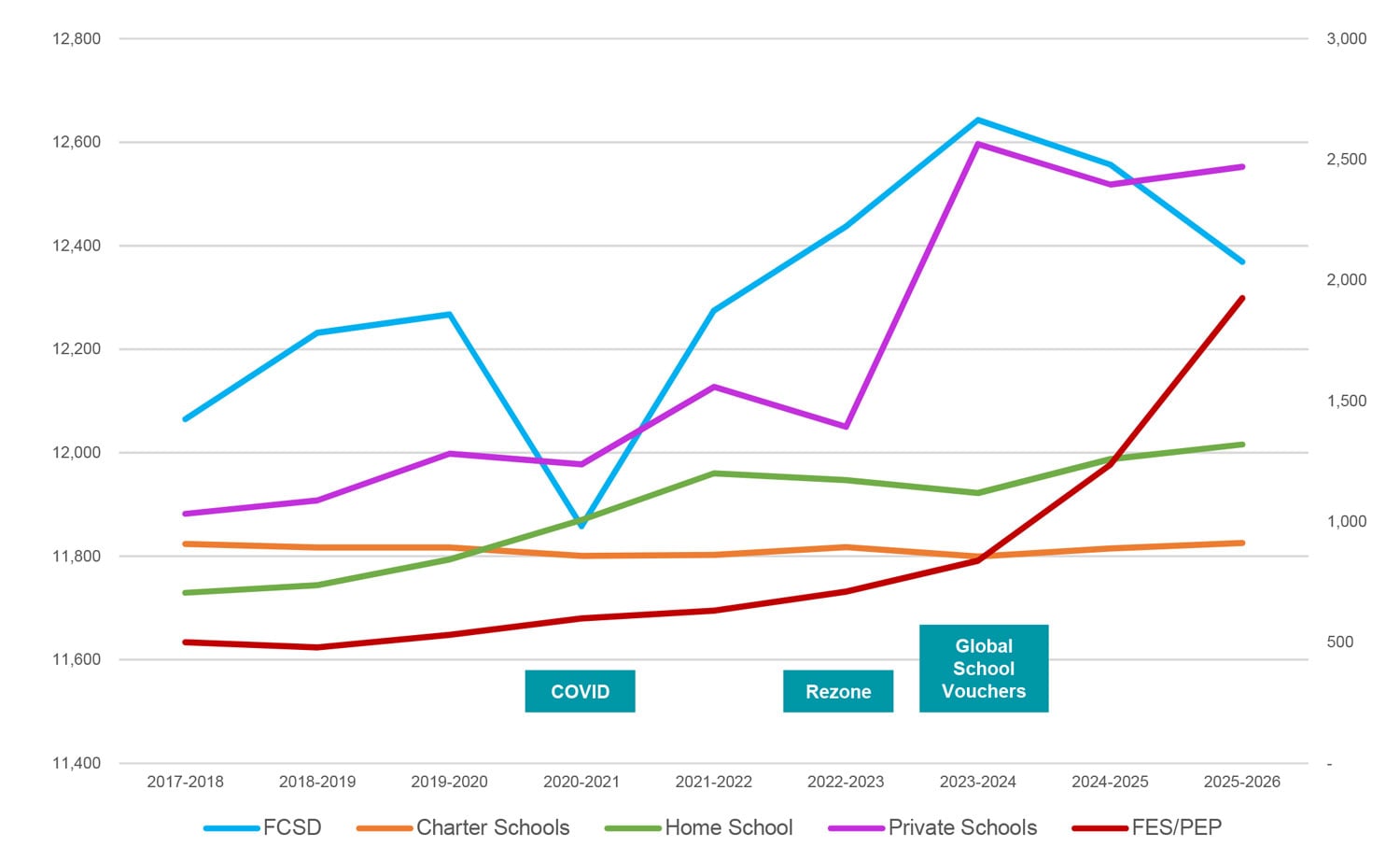
Since 2018, Flagler County has seen an increase of 2,359 school-age children. Hardly any have enrolled in public schools.
Private school enrollment since 2018 has increased 139 percent, state figures show.
Homeschool enrollment has increased 86 percent.
Flagler school enrollment increased 2.5 percent. That gain was wiped out in the last two years, as more students are leaving the district.
Based on the same figures, the district is projecting a further 14 percent decline in the district’s enrollment by 2035, to just 10,434 students.
Most of its nine traditional public schools, with the notable exceptions of Flagler Palm Coast High School and Buddy Taylor Middle School, are under capacity and getting emptier. Rymfire Elementary is at 70 percent capacity. Wadsworth Elementary is at 82 percent capacity. Fewer elementary school students are enrolling–not just in Flagler County, but across the country, as fertility rates have been falling since 2007.
Now, for the first time since 2021, the Flagler County school district is acknowledging to local governments that it is no longer planning to build a new middle school and a new high school, as it had been planning to do by decade’s end.
“Right now we do not have a recommendation to build,” Lisa Divina, the district’s school planner, told an annual gathering of elected officials from the county and its cities Thursday in Bunnell. She even mentioned a word dreaded in public school circles: “consolidation,” though she didn’t do so in connection with local schools. “It’s happening across Florida, and most of the consolidations and closings that you are hearing about,” she said, have to do wither with aged schools or “some are the enrollment are not coming in as expected before, and so some are consolidating and some are closing.”
Flagler schools are not there yet. But a new “decision threshold” has replaced plans for the two new schools. The “decision threshold” is a complicated checklist of new realities that the district would have to overcome before it considers building a new school.
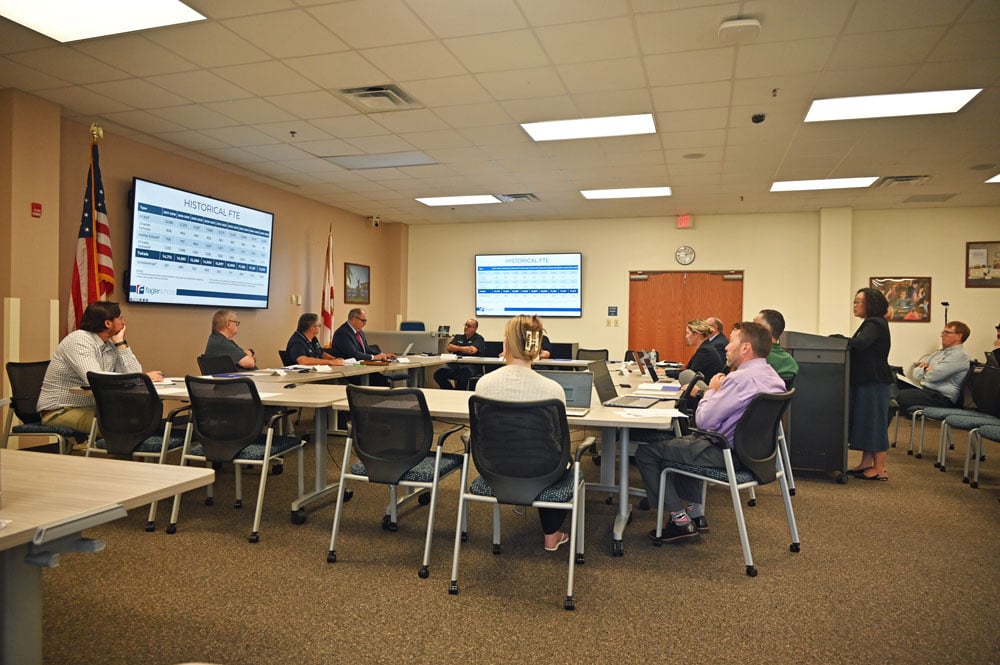
It is a stark admission that contrary to its projections in 2021, when it was forecasting an increase of almost 2,500 students by decade’s end, the district’s enrollment is shrinking, after remaining flat since the housing crash of 2007 even though Flagler County’s population has increased 35 percent since then. Divina showed on overhead screens a startling graph illustrating the projected enrollment decline.
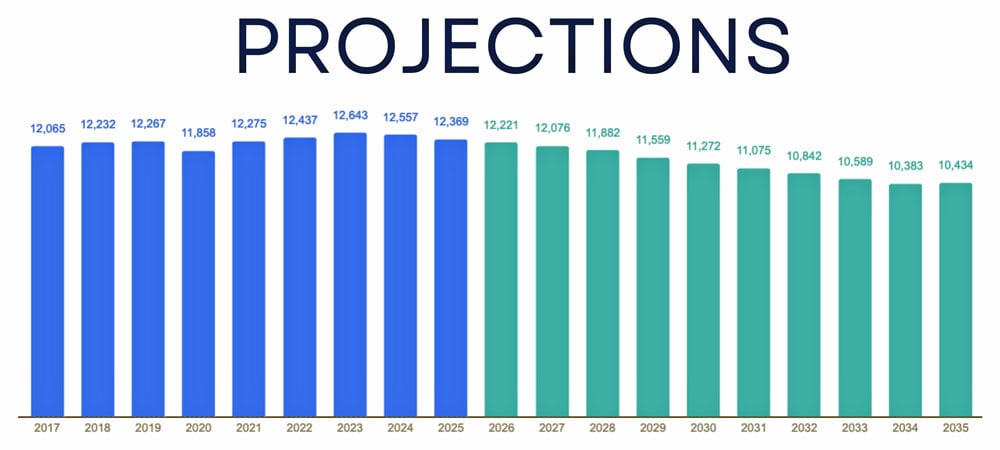
Yet the district’s student projections were not wrong. If anything, they were an undercount. A 2021 district study forecast an increase of 2,328 students by 2030. Based on figures reported to the state, student counts in Flagler County as a whole did in fact grow 2,359 between 2018 and this year, and is projected to overshoot the 2030 projection perhaps by 1,000 students. But almost all those students are going to private schools and homeschooling.
“Maybe this requires a change in how we report the student projections,” said Andy Dance, the county commissioner who chairs the intergovernmental committee that met Thursday to review school enrollment figures and construction projections. “We really need to break those overall projections down, in my opinion, into where they’re actually going, because it gives us a false idea of those going into seats in our schools, and really that’s the complex part of our reporting now, is in microschools and different designations of where students are going. I see a drastic change in six years from the reports that this is still the same report that we’re looking at from six years ago. Things have changed drastically.” Dance was previously a Flagler County School Board member.
Microschools, or learning pods, are a new form of schooling that enrolls a small number of students–it can be as few as five or a dozen–often at different grade levels. The district is considering running a microschool or two.
The state-reported figures also put the lie to the claim that the erosion of public school students began only with the expansion of the school voucher program, which since 2023 has made available $8,000 per student to families wishing to homeschool or pay for private school. The erosion began long before that. But it has accelerated with the advent of universal vouchers. In Flagler County, 1,926 students are receiving vouchers this year, according to state and local figures.
Will Furry, the Flagler County School Board member and one of three members who participated in Thursday’s meeting–Janie Ruddy and Lauren Ramirez also participated–was likely misinterpreting the numbers when he claimed that “there’s going to be a point here where we see some things level off with vouchers.”
He repeated a frequent, misleading rationalization of vouchers’ effects on schools: “Some of those students never actually enrolled in Flagler schools, they went straight to those vouchers, and so that is not a true reflection of a say, hey, 1,900 students left Flagler schools,” he said. He’s right in so far as the students may have never left Flagler schools. But because of vouchers, many of those students never enrolled in Flagler schools to start with, and were in essence diverted to other options.
There is no evidence that those diversions are about to “level off.”
“I think that what we’re trying to do is assume that student enrollment is linear, as it was in the past, directly correlated with population density,” Ruddy said. “But this is the new normal. And where we’re struggling with Flagler County is we’re on the cusp of our enrollment capacities. But if you look at just the study that was completed for us two years ago, we’re already, as a county, off. The numbers that were projected were lower, because there are lower birth rates, there are lower numbers due to immigration policies, and for our county specifically, the new developments have not brought in younger families. So what’s happening is we’re looking for a definitive answer of should we build a school based upon what’s happening in the future and what traditionally we could count on—we can’t necessarily do that right now.”
It is not just about whether the district will build new schools or not. The district is acknowledging that it won’t build any for now. But the unspoken acknowledgement is that the amount of development impact fees it is collecting to defray the cost of new construction is not as critical as the district claimed it was in 2021, when it pushed for a doubling of the impact fees, and got an increase of about a third.
In the 10 months to March 2026 alone, the district collected $5.1 million in development impact fees, $4.5 million of that from Palm Coast. How much has the district collected in total since 2021? You won’t find that figure disclosed individually in any publicly available documents that clearly indicate the source of the money as impact fees, including on the district’s “transparency” dashboard. The figures are wrapped in with all “Other Capital Outlay” funds, which include revenue from the half-cent sales tax. The current budget was estimating that the district would have a capital fund reserve of $81.6 million this month.
According to District Chief Financial Officer Patty Wormeck, the district currently has $43.4 million in accumulated impact fee revenue alone. It collected an average of $10 million a year in the five years between 2021 and 2025. (See annual impact fee revenue since 2007 here.)
Impact fees are one-time levies on new home construction that builders must pay once the house is completed.
In 2021, the Flagler Home Builders Association and some county commissioners objected to the size of the school district’s impact fee increase, arguing that the evidence was not there to justify it. The evidence was there, as enrollment figures now show. It just wasn’t interpreted correctly in light of the rapidly changing trends of homeschooling and vouchers. That doesn’t lessen the home builders’ argument that the changing trends are not reflected in the district’s continued collection of impact fees, currently at $3,600 per house.
The so-called “Oversight Committee on the Interlocal Agreement on Public School Facility Planning,” as the joint government committee overseeing the impact fee system is called, with impenetrable clunkiness, was set up as a result of the controversy that emerged out of the district’s 2021 impact fee increase. The committee was to enable the district to increase those fees in $500 increments for every increase of 500 students.
That has never been necessary. The committee has kept meeting once a year (a working committee at staff levels meets more frequently). But if Thursday’s meeting formalized a sharp retreat from previous school-construction plans, it also made new projections based on housing development plans that point to some needed school construction in the distant future.
Those projections are based on several large developments that have either recently been approved or may soon be approved. They include:
- Bunnell’s Reserve at Haw Creek, a 6,100-home development projected to generate 1,131 new students, with nearly 2,000 new students expected from Bunnell developments.
- Flagler Beach’s Veranda Bay and Summertown developments, expected to add 435 students.
- Palm Coast’s so-called “western expansion,” a planned 22,000-home development west of U.S. 1 that would add 4,383 students by build-out in 2056, for a total of 5,760 new students from the combined developments in Palm Coast’s pipeline. (Palm Coast was represented by Council member Charles Gambaro and Flagler Beach by Commissioner James Sherman, but both cities failed to send their staff representatives to the meeting, which drew an extended plaint from Dance: “I am disappointed. I think the largest growth sector is not here today,” he said. “It’s disappointing that we didn’t have the opportunity to have a deeper discussion with staff, and I don’t know that there’s anything we can do about it.”)
But again: the student projections are based on the old model of assuming that most of those students will enroll in public schools, which is no longer the case. The projections are also based on optimistic assumptions that all three major developments and the more than two dozen other smaller developments will all go forward as planned, as if recessions, demographic trends and immigration crackdowns don’t exist, which does not align with current realities (Flagler County this year experienced its first decline in property values in 14 years).
Officials around the table on Thursday acknowledged that projections are not necessarily what they seem.
I understand the state is still mandating that we show all students in new developments as if they’re coming to the school district,” Dance said. “The impact fees are based on that. But we know now there’s a different distribution based on choice on where they’re going, and so when we see the developments that are coming online, I think we’re falsely seeing that that’s all impacting the school district.”
He added, by way of a conclusion that others echoed: “I just am glad that this is still an integral part in our intergovernmental coordination. It’s important that we assist the school district as much as we can, and that we get together to see the impacts of growth on the community.”
See a slide presentation of the meeting’s figures here, and the full annual report of school planning and concurrency below.



























Deborah Coffey says
And, we see just one more way that today’s Republicans are destroying our country…and, we all get to pay for that destruction.
JimboXYZ says
Republicans destroying the USA ? Count this taxpayer as one that is ecstatic we aren’t floating another $ 1/2 billion in debt to build 2 more schools. If the 28K new residential approvals for Bunnell & Westward Expansion are considered residential classrooms, that is more efficient use of space on planet Earth, less gasoline to bus students county wide for 9 months out of the year. Unaffordable Housing coupled with Unaffordable Schools is just more Bidenomics of unaffordable. That was Biden-Harris (D’s) ushering in that era of the inflationary economy. This has nothing to do with improving education or learning, it has to do with money & profits. Learning is done anywhere. Instead we all see the “Learing & Feeding” programs for that fraud & abuse that went down in Minnesota. Will that ever happen in FL, even locally here in Flagler County specifically ?
That’s what all the noise is from the Home Builder’s Association objected to. How much they had to pay for impact fees vs what their profits are. One thing we’ve learned from Covid, that there are more than enough frauds & abusers out there that will fabricate a new number for the next gouges for creating fictitious shortages as their rational to inflate the CPI & Cost of Living to a new growth of unaffordable. growth for the sake of growth greed for the sake of what the motive truly is, greed doesn’t work, it’s not a better quality of life, it’s not improved services, it’s just not better anything.
Besides, who wants the next school riot of a mass shooting here in Flagler County or who wants the next FPC-Matanzas HS athletic athletic event to become a stabbing or shooting incident ? The home schooling thing ? Nobody wants the next batch of 911 Domestic Violence call(s) to really be that level of bullying or riot in a residential ? The budgeting process is evolving, whether it was Covid & growth as the excuse or it is the upcoming property tax vote.
The dude says
Jimbo whining about Biden’s economy when by every metric it smokes the orange shit stain’s.
Classic.
Here’s a little hint to all of you MAGA morons still gargling the orange balls… unemployment and inflation are like golf. Lower numbers are better.
Jim says
Trump has been president for almost 17 months. Inflation when Trump took over was 3%. Current inflation rate is 4.25%. Keep blaming Biden for inflation. It might upset your fixation on a president who has done nothing to help the vast majority of Americans. (PS – inflation going UP is NOT a good thing.)
Please elaborate on how building a new school will possibly create “the next school riot of a mass shooting here” or a stabbing or shooting at an athletic event. Please. I guess by your logic, if we don’t ever build a new school there can’t be a shooting, stabbing or riot. That is a unique conclusion.
I can not follow your logic and, to be truthful, I am thankful for that! Whenever I contemplate what kind of person votes for Trump and continues to support him despite the lies, damage, grift and added costs we all are feeling, I see one of your missives in Flagler Live and it becomes all too clear.
Jason says
Good teachers are not taken care of and bad teachers are brought along for a ride by the teachers union. America’s not just Flaglers education crisis is not primarily a funding problem. The United States already spends more per student than many countries that achieve better academic outcomes. The real issue is accountability, bureaucracy, and the decline of academic standards. Too often, schools prioritize administrative growth, political agendas, and standardized testing strategies over teaching students essential skills like reading, writing, mathematics, and critical thinking.
Teachers and schools should be held accountable for student performance, and parents should have greater control over their children’s education through school choice programs, charter schools, and educational savings accounts. Competition encourages improvement, while monopolistic public-school systems often lack incentives to innovate or address persistent failures.
The decline in educational outcomes also reflects broader cultural issues. Student discipline has weakened, parental involvement has declined, and expectations for academic excellence have been lowered. Restoring high standards, supporting parental rights, and focusing on core educational fundamentals would do far more to improve American schools than simply increasing spending.
Cookie says
As long as the state of Florida continues to pay up to $9k per child tax free, for home schooling, you’ll see the public school enrollment drop. Same goes for private school enrollment. My daughter teaches in Orange County public schools. At the end of 2025, 811 teachers received non appointment letter indicating their contracts would not be renewed due to lower enrollment. Giving those vouchers was a terrible idea. It should be a choice if parents choose to educate their kids privately or at home, not a paid position.
Nancy N. says
You have a VAST misunderstanding of how the scholarship programs work. No one is getting “paid” to homeschool. The money is held in an education savings account at the scholarship funding organization and only released to the parent when they file a reimbursement showing they’ve spent money on an eligible expense. Spend $50 on curriculum? They’ll reimburse you that $50 if you provide the proper documentation. And so on. There’s a very specific list of eligible expenses and documentation requirements are very strict as well.
Deborah Coffey says
Home schooling needs to be banned, period. This is not the 1600’s.
Pogo says
Anarchy and feudalism; the horse is in a trailer pulled by the carriage, pulled by the poor and their children — and their grand parents too.
Was all the prating about who struck John when and where, what John identifies as, hearts on sleeves over micro offenses, pretending ephemisims for life’s cruelest realities change them — all the fractures of the unity needed to oppose this destruction; was it worth it?
I don’t believe it was.
Oh, well. The wealthy waste nothing, the eat everything.
Atwp says
Republicans! Bad for the country.
Dennis C Rathsam says
PLEASE….If the school board, didn’t fight like DODGE CITY, & the teachers actually taught reading, writing, & math, in stead of woke views of history, & trans America Tom foolery.Looks to me the mothers do a better job. Less interuptions, no class clowns, better learning invirment. And most importantly a mother who TRUELY cares.
Deborah Coffey says
And tons of homeschooled kids that need a shrink for the rest of their lives because when the mothers finally give up and send them to public school, they realize they don’t know very much, can’t keep up with their peers, and they’re socially inept. How many children and teenagers have you taught in public school? You don’t seem to know much about it. My 28 years teaching high school disproves every single thing you’ve written.
Flagleronceuponatime says
Awww gaslit much, maggat? I get calls all day long from parents of kids homeschooled for years who cannot READ nor WRITE, nor have any social skills to make it in the big wide world today. 18 years old. Pitiful. Of course republicans got ahold of education 40 years ago and started ruining it too. The Koch Brothers infiltrated colleges and the public education system to make it all about business, not knowledge. The maga crowd has done their dirty work for them. DeSantis, who help found the ultra-conservative Freedom Caucus in Congress, which did nothing for the people but repress, regress, recess, ruin progress, along with his co-horts in Congress and the Florida Legislature, like Randy Fine, has had a huge hand in underminding the will of the people and what the U.S. stands for.
Disgusted parent says
St. Johns County just laid off 60 teachers.
Sarasota County lay off 136 teacher positions in April 2026.
People don’t want the government “educating” their children any longer.
A lot of the high school kids enrolled and on-site in Flagler County Schools can’t read and don’t know their multiplication tables, can’t spell, and spend the majority of their time looking at their phones while in class even though it’s state law that cell phones are banned in the classroom.
Flagler County Schools students are being taught in class via their government dispersed laptops. Their assignments are in “Schoology” and the teachers do very little teaching. Why send my child to school just to sit looking at a laptop and being taught by Schoology? The students know nothing by the time they graduate. Some of them think America is a state, Italy is a town, can’t find anything on a map of the world. That’s in addition to not being able to read, write, sign their names with a legal signature, add, subtract, divide or multiply.
Why would I want to send my child to a Flagler County school? Some of the students tell me their parents make them go to school just for the free meals and to babysit them while their parents work.
Again, why would I want to send my child to a public school?
Jill Woolbright, running for school board (AGAIN) was an elementary school teacher until she retired a few years ago. As an elementary school teacher, what was she doing in Flagler Schools? . . . because the high school students of today who can’t read, write, spell, do any kind of math were her students in elementary school.
Why should a government school have a monopoly on learning???? Parents are voting with their vouchers.
Laurel says
Here’s where I disagree. There are plenty of good Republicans out there, I married one. The problem is, the extremists (and both parties have them) hijacked the party, and turned it into something unrecognizable. Actually, others tapped into the extremists, and manipulate them. The use of fear manipulates those who know better. That is what we are seeing now.
Trump, with his little fist in the air, is a user in my opinion. The kicker is, there are those who are using him. Therein lies the swamp. The deep state.
Dennis C Rathsam says
Explain to me, Laurel….How is TRUMP responsable for these 1/2 ass teachers, And the school board YOU voted for! Place the blame where it belongs…
JD says
I suggest you get your volunteer credentials and go volunteer in Flagler schools and see what really goes on in classrooms. You’re so out of touch it’s utterly amazing. I’m in the trenches 10 months a year. Come visit.
Samuel L. Bronkowitz says
I have two kiddos in the Flagler school system and honestly, big surprise here. I love the idea of public education, but what I don’t love is the product. Get rid of the electronics in the classroom and use physical books, notes, and pen/pencils. See for example:
https://journals.sagepub.com/doi/10.1177/0956797614524581
https://www.frontiersin.org/journals/psychology/articles/10.3389/fpsyg.2023.1219945/full
https://www.theguardian.com/books/2014/aug/19/readers-absorb-less-kindles-paper-study-plot-ereader-digitisation
So why doesn’t Flagler county do what’s proven to work?
Homer says
Homeschool parent here- we found our children to be struggling with learning in school and had to teach them the material at home. There wasn’t much point to sending them to school if we then have to teach them after a long day at school.