



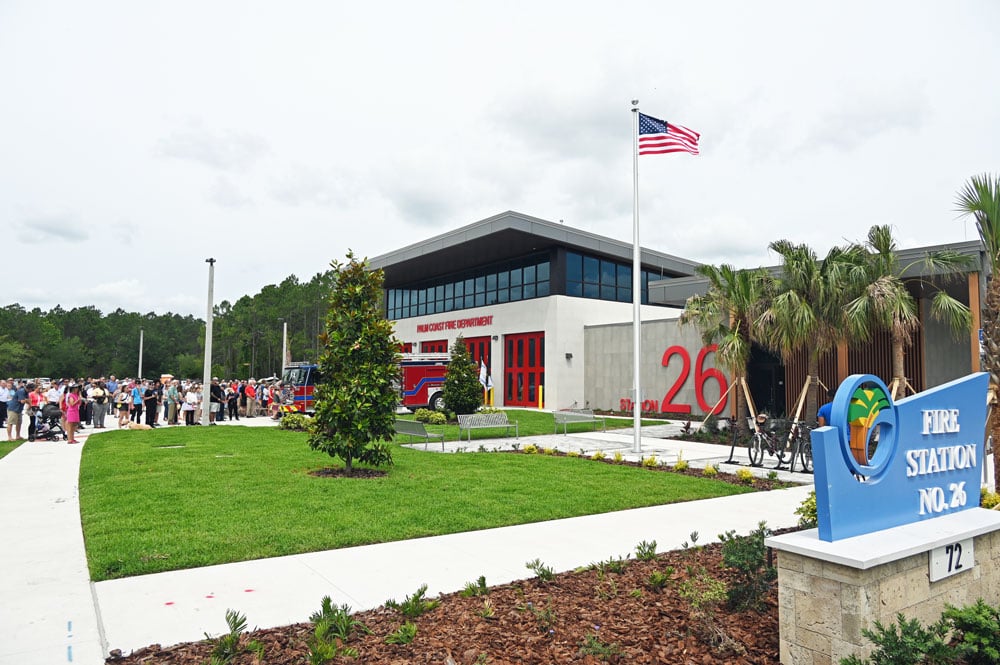
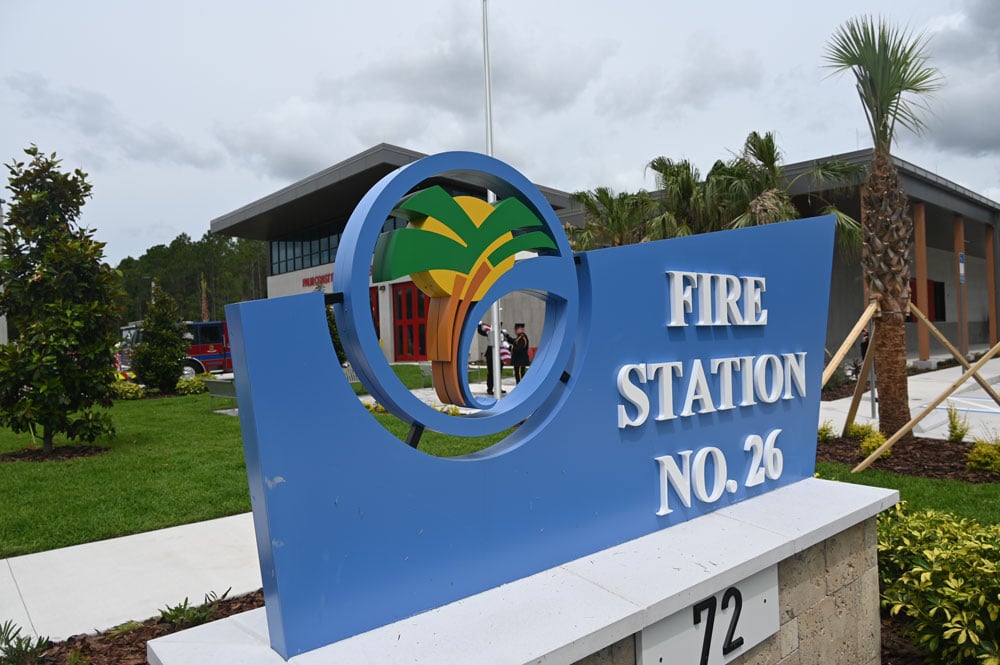
You could understand at today’s grand opening of Palm Coast Fire Station 26 in Seminole Woods why Fire Chief Kyle Berryhill considers it “a quasi-religious experience,” why at times tears mixed with sweat as a crowd of some 200 heard the speeches, and why the voices of Berryhill and Theresa Pontieri, the vice mayor whose husband is a firefighter, almost broke as they spoke.
When they spoke of family, and of the meaning of house in “firehouse,” when even the architect spoke of fostering caring among the troops, they did not mean it metaphorically.
“A few years ago, my father suffered a fatal heart attack,” Berryhill, today back in full uniform and on a morning’s hiatus from his job as interim deputy city manager, told the audience, “this station would have responded to my dad. This station wouldn’t have changed the outcome for my dad. The people who responded did a great job. I was there. But someday, because of this station, somebody’s outcome is going to be different. It’s going to be. Someone else’s dad is going to have another Thanksgiving dinner, or someone else’s mom, or someone else’s spouse or someone’s child.”
Because it’s Berryhill, life’s cheers are the flipside of its calamities: “And also we’re going to pick grandma up off the ground 150 times between now and then, and that’s going to be important too,” he continued. “That’s why this matters so much. Because this station isn’t just a building. It’s about people’s lives, it’s trained professionals arriving faster with equipment, training, and compassion, and determination to help people on the worst day of their lives.”
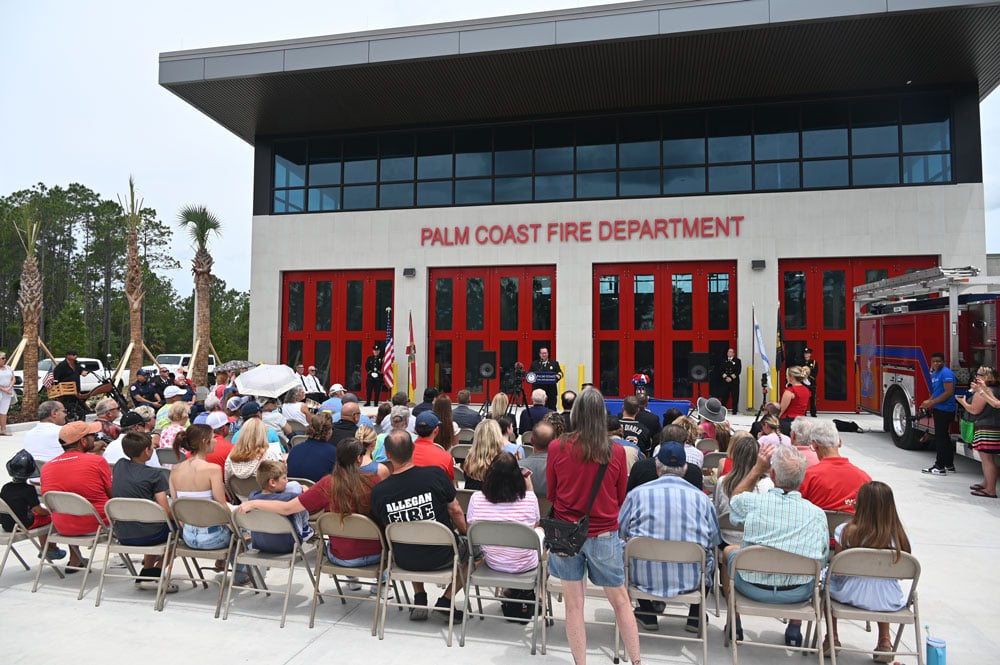
To be specific: three-person crews covering three shifts, budgeted this year already and stationed until now at the fire station at the airport. They’re being shifted down to Seminole Woods, along with required “floaters” when a firefighter-paramedic is off or sick or in training. They’ll be responding to an expected 3,000 calls a year–the total number of calls in the city, Berryhill said, when he started as a city firefighter 21 years ago.
What will be missing, notably, is the Flagler County Fire Rescue ambulance that is usually paired with city stations. That may not happen for a while.
“I’ve got a bay for them, I’ve got a closet for them to put their medical equipment in, and I’ve got a set of bedrooms for them,” Acting Fire Chief Bradd Clark said.
Flagler County Fire Chief Michael Tucker, who was out of town for the holiday weekend and could not attend the ceremony, said in an interview that right now the closest ambulances to Seminole Woods are Rescue 55 at Palm Coast Fire Station 25 on Belle Terre Parkway, and Rescue 52 at Station 52 at the county airport.
“If I would have moved either of those to the new fire station it would have imbalanced all the other stations,” Tucker said. “We plan on adding a new rescue every three years, so hopefully we’ll be adding one in 2027.” At that point, the county will decide where to station it, based on call volume. There are nine rescues, or ambulances, on 24-hour duty currently, spread throughout the county and the city.
Meanwhile, Palm Coast’s firefighters are all trained to provide advanced life support regardless. “We provide paramedic level care until they get there,” Clark said, referring to county rescues.
It would be their house, too, as that seems to have been the day’s theme.
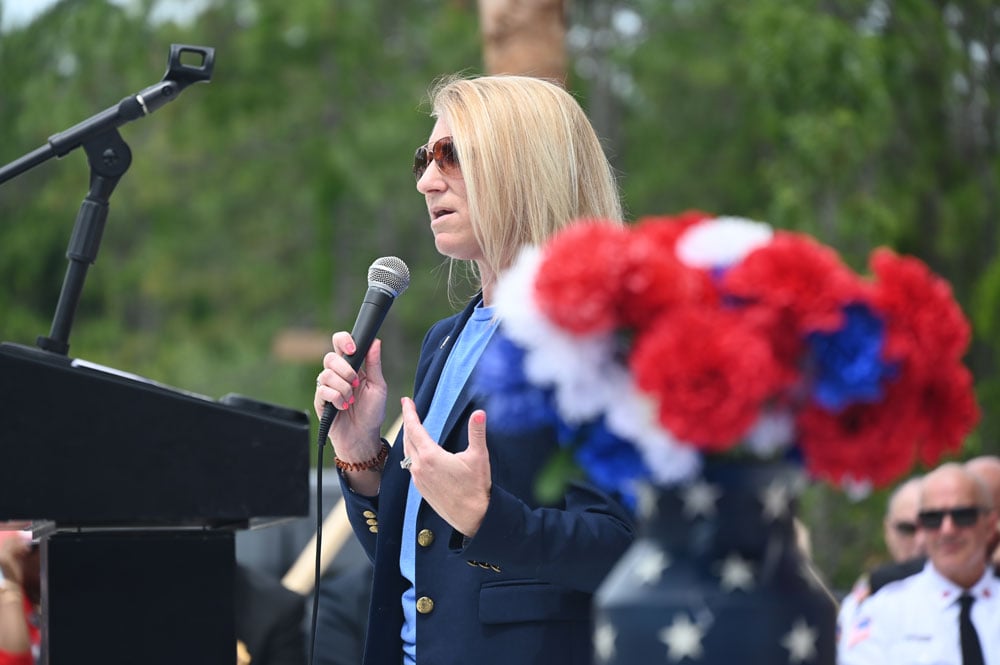
“As a wife of a firefighter, this hits on a personal level,” Pontieri told the audience. (Her husband is a firefighter in another county.) “I feel very strongly that fire stations are called fire houses for a reason, because this building is a home away from home for our men and women who serve us every day. When they’re missing birthdays, holidays, even regular dinners with their own families around the table, they’re here, they’re sitting around much larger tables when the tones aren’t dropping.” (When an emergency call comes in, firehouses echo with “dropping tones” that are essentially personalized to each firehouse.)
“So this is a house, this is their home, and it’s really important to me that the community recognizes how much of a role you play in giving them this, because it’s important, it matters,” Pontieri said. “I can’t tell you how many times I’ve had a Thanksgiving or a Christmas in the Bay of a fire station, and I’m telling you, as a family member, it matters, and I’m so grateful that you all dived into this with us. You have supported this fire department unequivocally.”
She was referring to the crowd as representative of the larger population of a city that has, for decades of broad surveys, rated its satisfaction with theFire Department in the 90th percentile, higher than any other municipal service or amenity. Pontieri also singled out previous council members for securing the money to pay for the $12 million station (that figure includes design and other costs in addition to construction), of which $5 million was a state appropriation during the two years that Paul Renner was Speaker of the House.
“I pray every single day that the Lord keeps our firefighters and all of our first responders safe, and I don’t say it in passing,” Pontieri said. “I say it because I never want to hear the bell ring for any of our men or women. This house keeps them safe.”
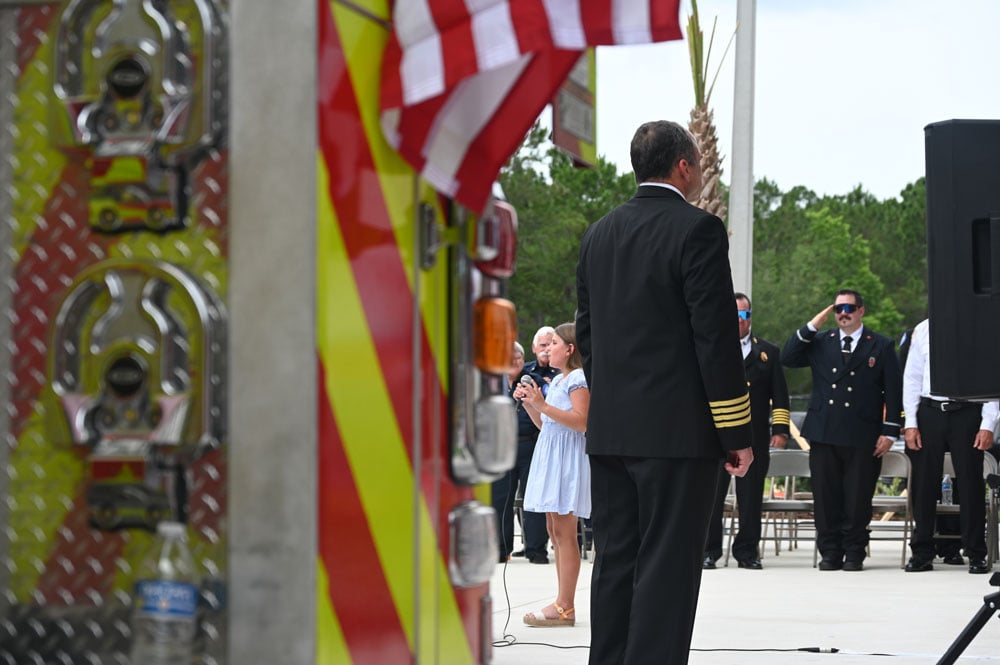
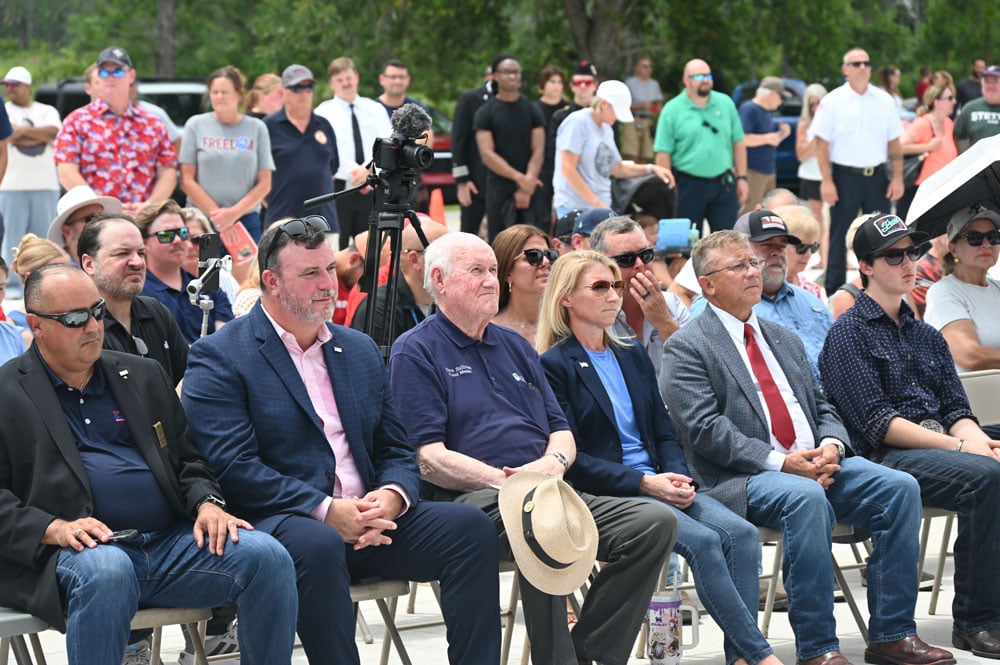
Every member of the City Council attended, sweating it out in the first of many rows of chairs on the white-hot concrete of the station’s front bay, with many more people standing in a semi-circle behind and around the chairs, taking pictures or selfies, chatting it up with firefighters and others, and whooping it up after Laurel Duffy, the 9-year-old daughter of City Attorney Marcus Duffy, belted the Star-Spangled Banner.
It’s been almost 20 years since the city opened a fire station. It will open two in a matter of two months: the next grand opening will be the new Fire Station 22 on Colbert Lane, down from its historic current location, which will be converted into a museum and visitor center. In those 20 years, several elements have changed in the construction of firehouses, from swifter-opening and more reliable bay doors to the location of decontamination bays to the arrangement of sleeping quarters. “We modified the bunk rooms to be more consolidated and quicker access to the bays before we had a long row,” Carl Cote, the city’s director of stormwater and engineering who oversees all construction projects, said. “So we kind of brought those into an area and kind of cornered them off too for quietness.”
Even–if not especially– Zoran Lozanovski, the Schenkel Schultz architect who designed the firehouse, was in sync with the vice mayor’s and chief’s sense of a firehouse as a house beyond sustainability, long lasting quality materials and efficiency, all of which were also important.
“We received a charge from the fire department when we were designing the layout of the interior of the building to ensure that there is as much mingling of the staff as possible,” the architect said, “so that when somebody is going through a difficult day or a challenging day, or maybe they had a different call in the middle of the night, somebody else, whether it’s a supervisor or another brother, another firefighter, can see and say, ‘Hey, how are you doing? Let’s talk, let’s encourage each other.’ And they just wanted the building not just to be a building where people come together, but to be a building that fosters caring for one another, supporting one another in the everyday line of work.”




























Shark says
I guess they need more people to change batteries in residents smoke detectors !!
YankeeExPat says
What an Idiotic thing to say !
Don’t worry though, the firefighters will be there to put you out when you spontaneously combust.
Shark says
YankeeExPat – On my street there are two homes where they come out with two trucks every year to change the batteries in their smoke detectors – a total waste of manpower and equipment !!! It would be interesting to find out how many homes in Palm Coast use this service !!!
YankeeExPat says
Mr. Shark
The Firefighters function is to save Lives and Property, and if checking on a citizens request to inspect a life saving devise ie, ( Smoke detector ) , so be it.
If a firefighter helps a citizen rid of a toxic or flammable material in the home that could cause harm or death , so be it.
If a Firefighter assists a citizen who is dependent to an auxiliary oxygen source , so be it.
First Responders, Firefighters, Police EMS, Lifeguards, Doctors and Nurses, Military are there to promote safety , educate for safety , and when the need arises Save Lives even if it imperials their own!
You should get off your High Horse and contemplate how all these Professionals risk there own lives to protect you and your fellow citizens.
Remember this holiday is “Memorial Day ” and it was not intended to be a day to kick back and drink from a kegger or shop for mattresses and bedding. It is to acknowledge, give respect and to educate future generations as to the Ultimate Sacrifice Men and Women, who are citizens just like you and I gave.
TR says
It’s not a waste as you think. It’s a service that is offered by the fire dept. and there are plenty of elderly people in this county that live by themselves and can’t change the batteries in their smoke detectors, or have no one that can do it for them. It’s called better safe than sorry. Not to mention, some of the smoke detectors are really high up on the ceiling especially if the ceiling is a vaulted ceiling. My neighbor has two that are approx. 12′ to 15′ and she’s 89 years old. Fortunately I do it for her. Maybe instead of complaining, you should go to all your elderly neighbors on you block and offer to change the batteries for them. Then you won’t have to worry that the fire dept. is wasting there time. Oh and I question that two trucks show up for one house.
No skoke says
The fire department doesn’t provide this service any longer
To busy to help us 😂
TR says
Wrong.
I’m trying to sleep says
I can’t wait for the complaints to come rolling in due the loud siren noise the homeowners of the “U” section will be experiencing at 2 o’clock in the morning whenever the company gets a call.
Atwp says
If it is going to help the community then I say good job. Money well spent.
TR says
Well with all the amount of people that have moved to this area. I think this is money well spend just based on the added population in the past 5 years.
Question says
Not to be pedantic, but didn’t fire station 24 open in 2010? That would only be ~16 years.