



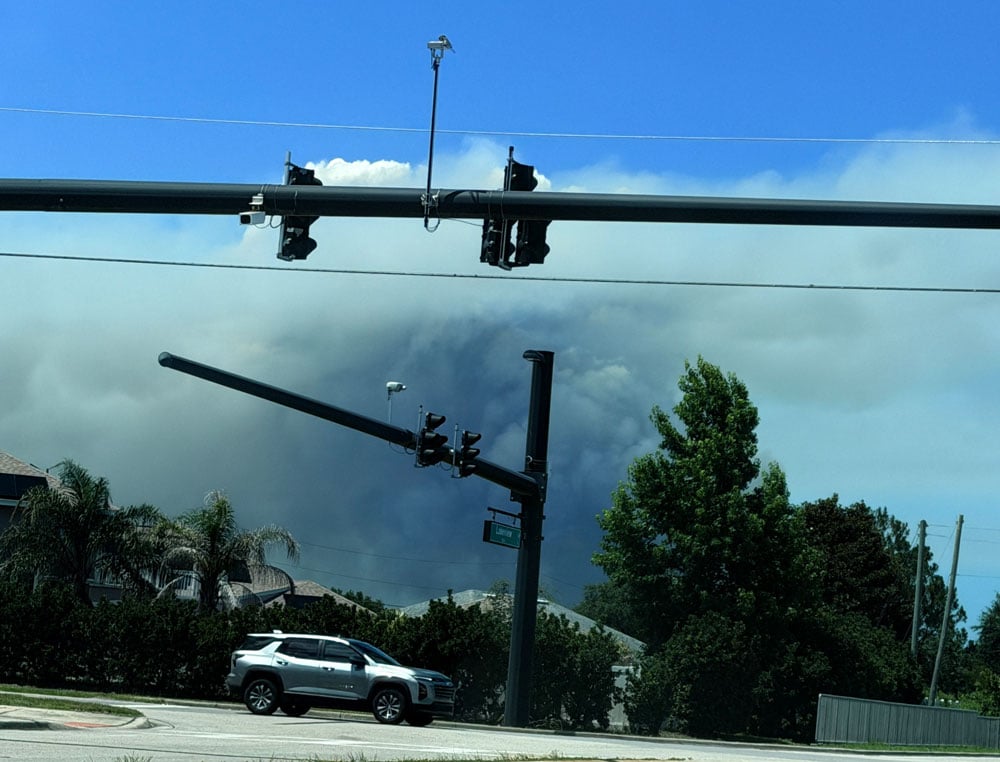
That thick black smoke rising north of Palm Coast is a 470-acre controlled burn at Faver-Dykes State Park, says Flagler County Fire Chief Mike Tucker. The size of the burn is as large as some of the more concerning wildfires of recent years.
“It is impressive looking, you can see it all the way down here in Bunnell,” Flagler County Emergency Management Director Jonathan Lord said. “It’s literally across the creek,” meaning Pellicer Creek at the northern edge of the county. “It’s also part of natural forest management. It happens all the time. It’s just very impressive in the sky, particularly when you have a crystal clear blue day.”
The burn, Florida Forest Service Operations Administrator Mike Work said, is being carried out by the Florida Park Service. The Forest Service issued the permit. All burning operations are expected to be “dead out” by 10:25 p.m. this evening, Work said.
“It can start at 9 a.m., it has to be dead out, no more fire moving across the landscape, two hours after sunset,” Work said. There are no road closures.
A Faver-Dykes park ranger said in mid-afternoon that none of the park’s main attractions and operations, including boat ramps, the camping area and day use areas, are affected by the burn. “The whole thing was planned so the wind and everything is blowing away” from activity areas, the ranger said.
Faver-Dykes–named for the parents of a former St. Johns Clerk of Court who donated the original portion of the land to the state, Alexander Hall Faver and Florida Dykes Faver–is a 6,045-acre park just north of the Flagler-St. Johns County line, near the intersection of U.S. 1 and I-95. Smoke from the controlled burn, rising thick and dark into a dome above the Matanzas River, was clearly visible as far south as Bunnell and from many parts of Palm Coast, prompting concerns about an unexpected emergency.
Controlled burns are a normal part of forest and park management. They are intended to burn up thickening underbrush that, left to grow, could provide rapid fuel for uncontrolled burns triggered by lightning or unintended reasons. “We’re definitely a fan of prescribed burns,” Tucker said. “It allows us to keep the fires manageable, and we don’t have the big fires that sometimes happen.”
Recent rains have also helped create better conditions for controlled burns. “The humidity levels are where they need to be right now. We’ve had a little bit of moisture, so it’s a decent time for them to do this,” the fire chief said. Flagler County Fire Rescue has previously assisted state agencies in controlled burns, but not in this case. There are no concerns that the burn would breach its limits. “They use a lot of equipment, they’ll cut fire lines, they have plenty of staff in place,” Tucker said. “They’re well trained.”
The Forest Service issues burn authorizations. “Burn authorizations issued by our agency are for a one-day period,” Work said.



























Joe D says
Do they ever make a public announcement when they are doing this…I know it’s kind of last minute ( based on moisture/staffing/ brush growth density), but even an AM announcement that they are doing it that day would keep people from flooding 911 or local government offices with emergency calls. Of course, if they give out too much of an advanced notice….they’ll have “burn party” spectators who might impede the process.
Doug says
Some states should take notice (California comes to mind) that controlled burns are a method for controlling wildfires. But we all know you can’t fix stupid.
Skibum says
Can’t fix stupid is right… especially stupid insinuations which are completely wrong like the one you just made, Dougie! You probably are totally in with the nonsensical, maga mush brain announcement from the orange faced idiot in the WH who said CA officials should “sweep” the forests with brooms to prevent wildfires, huh? Yeah, that would work wouldn’t it??? LOL!
Guess what? I was born and raised in CA, and you might be surprised since you are so clueless that CA has in fact heard of, and has practiced for many decades, tried and true fire prevention strategies such as controlled burns… DUH!
If you were looking for chuckles, you failed. Don’t quit your day job… you are no comedian.
DaleL says
For those who are interested, AirNow has a Fire and Smoke Map. Besides fire and smoke, the map shows air quality monitors.
https://fire.airnow.gov/
It is produced by the Interagency Wildland Fire Air Quality Response Program, USDA Forest Service Fire and Aviation Management
Washington, DC.
https://www.wildlandfiresmoke.net/
The burn, west/northwest of Marineland, is designated on the map as “Satellite Fire Detection, NOAA 20”.
CallMike Carter says
Burning natural lands is a travesty, especially in Florida. And the reasoning they use to do so is a lie. Florida is one of the rainiest states, with only Hawaii and Louisiana receiving more. Florida’s lush vegetation is less likely to burn, so the only real wildfire threat comes during extreme drought. Most prescribed burns are taxpayer-funded, and there are 2 actual reasons they use to prescribe a burn. One is to get rid of pesky nutrient-consuming underbrush for the tree farm industry; the other is to maintain a false narrative about the type of land, as in burning woody shrubs in a dried-up wetland to keep it looking like a wetland. Conservation land should be a natural sanctuary and a haven for wildlife. We should tread lightly; it is home to thousands of wildlife species and a place to enjoy the natural world. Steps should be taken to protect wildlife. Wildflowers, nuts, acorns, trees, and fungi are all essential food for birds, bees, and deer. The more natural the forest, the greater the range of natural wildlife. Birds, mammals, insects, lichen, fungi, and spiders should all be found on conservation land. Fallen wood is home to many insects; please leave it where it is. We should leave nothing and take nothing from conservation land. Please don’t burn the natural lands; instead, be inspired by their history, beauty, and wildlife. Please love it as I do, and remember to tread lightly in the natural world.
DaleL says
Florida’s lush vegetation is unlikely to burn, until there is a drought. The fires of 1998 were the result of this. An unusually wet winter and early spring produced a lot of lush undergrowth in the forests and on wooded lots. Then the rains stopped in April. As the temperatures climbed and the drought set in, the underbrush dried and became highly flammable. The fires and resulting smoke became so intense that by June the governor declared a state of emergency. By July, everyone in Flagler County was ordered to evacuate.
Wildfires, of the intensity of 1998, are far more destructive to wildlife than are controlled burns. Let us not repeat the mistakes which resulted in the devastating wildfires of 1998.