



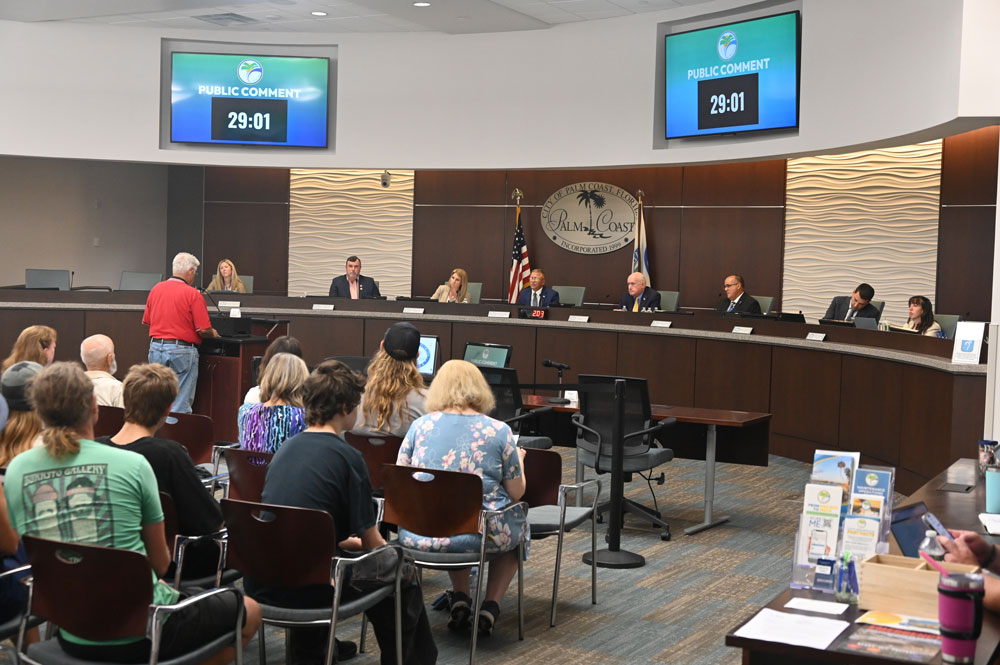
The Palm Coast City Council is changing a few of its procedures: Fewer meetings. A more formalized allowance for remote participation in meetings (by council members, not the public). No votes on anything not on the agenda. The council approved the changes Tuesday.
The council will revert to three meetings a month instead of four, with just one workshop a month, adding a second on an as-needed basis at the city manager’s discretion. The council is borrowing a page from the meeting schedule under former Mayor Milissa Holland and City Manager Matt Morton, who had ended the four-meeting approach that had prevailed for a decade and a half before 2018.
The evening workshop usually scheduled on the second Tuesday of the month will shift to 9 a.m., while the morning workshop scheduled on the fourth Tuesday will be optional. That means no workshops for the remainder of December: the new schedule has already kicked in.
The council will retain its schedule of a business meeting on the first and third Tuesday, the first starting at 6 p.m., the third starting at 9 a.m. By convention, the council takes votes only at business meetings, never at workshops, though it’s not legally barred from voting at workshops. City policy specifies that no votes will be taken at workshops. Consensus is a different matter.
The new schedule was part of a revised set of meeting policies and procedures the council approved Tuesday.
The council also approved a significant change that, Chantal Preuninger’s objections aside, will formally allow members to participate remotely—by Zoom, by phone, or by other means: the policy only specifies “remotely”—as long as a quorum of three council members is present, in person, and as long as the member has notified the city manager in advance. Remote attendance is limited to “extraordinary circumstances,” which, the policy states, “include illness, personal or family matter, or other good reason.”
Preuninger, an alternate member of the council’s Charter Review Committee who almost unfailingly attends council meetings and workshops, has campaigned for ending remote attendance. “I want them to be in the room when they’re working, no remote meetings for them,” Preuninger said in a no-soup-for-you tone at an October Charter Review meeting. She has repeated the plea since, hoping to see the provision added to the list of recommended charter changes. But Preuninger, who tends to have an Ancien Régime air about her, was going against the grain.
“We’re kind of in a new technology age, so people are able to appear virtually,” Council member Theresa Pontieri said at a workshop last month. “I think all of us have appeared virtually if we didn’t want to completely miss a meeting before, but I think we should somehow address it in our policies and procedures.” The caution was against such a policy lending itself to abuse. “I do think it’s important that we try to be here, that we’re here for the public, that we’re here for each other, that we’re showing that commitment. But things happen, things come up, so something reasonable that holds us accountable, but also allows for that flexibility.”
State rules changed during Covid, opening the way to entirely virtual meetings. The allowance remained for remote appearance by individual elected officials after the pandemic—as it does in judicial circuits across the state: in Flagler County criminal and civil court, judges routinely allow lawyers’ and witnesses’ remote appearances and, in rare cases, defendants’ appearances. The Flagler County courthouse was a pioneer in the state in that regard—Circuit Judge Terence Perkins in particular pushed for that modernization—and continues to hone its remote system, with now four camera angles in its felony courtroom and a sound system. It is far superior to the City Council’s, which continues to be plagued by glitches, hums, clicks, and other gremlins that diminish confidence in the system, even though the city prizes itself on technological savviness and cutting edges.
An Attorney General opinion still allows remote attendance of elected officials, City Attorney Marcus Duffy said.
Preuninger got support from members of the Charter Review Committee against allowing council members to vote remotely. Pontieri flatly rebuffed that proposition, too. “I in no way think that people should not be able to vote just because they’re appearing virtually,” the vice mayor said. Council member Ty Miller, who attends Transportation Planning Organization meetings as the council’s liaison there, said the TPO routinely votes to allow remote attendance and voting.
What the council did not discuss, and is still not allowing, is remote participation at public comment time by members of the public. The public, of course, has long had access to live meetings, first through meetings televised on cable channels, then by audio, then by YouTube, as is now the case. But the access is one-way, with no remote public participation allowed.
In other changes, the council formally recognized Robert’s Rules of Order as the guiding method for parliamentary procedures at meetings, with the city attorney as the parliamentarian. That includes arbitrating the meetings’ decorum, both from the floor and on the dais: the attorney will “Call to order any member of the City Council who violates any of these procedures,” the policy states.
There was also a one-word change recognizing changing law regarding who members of the public may or may not address. Until recently, public boards required members of the public to address only the mayor or the chair. The 11th Circuit Court of Appeals ruled in 2022 that such restrictions were impermissible, and that members of the public could address any elected official on the dais singly or as a whole.


























Palm Coast Citizen says
I love “Ancien Régime.” May I admit I had to look it up?
Chef’s kiss. We are entering a modern era. The Vice Mayor’s input is prudent. Remote attendance could go sideways without accountability, but adding accountability may increase attendance.
Mark Webb says
Lets not forget Dave Sullivan’s remote vote during the City Manager effort.
Most of the time Palm Coast struggles with technology.
Thoughts?
Avon says
Remote voting concerns me as there is room for abuse. I am unfamiliar with the charter but would say that any member who has to vote remotely more than 2-3 times should be required to step down. Just my opinion.
Understanding that life happens, your primary responsibility must be to the voters.
Ken says
Afraid to face the people while focusing on other income sources. They need to step down.