


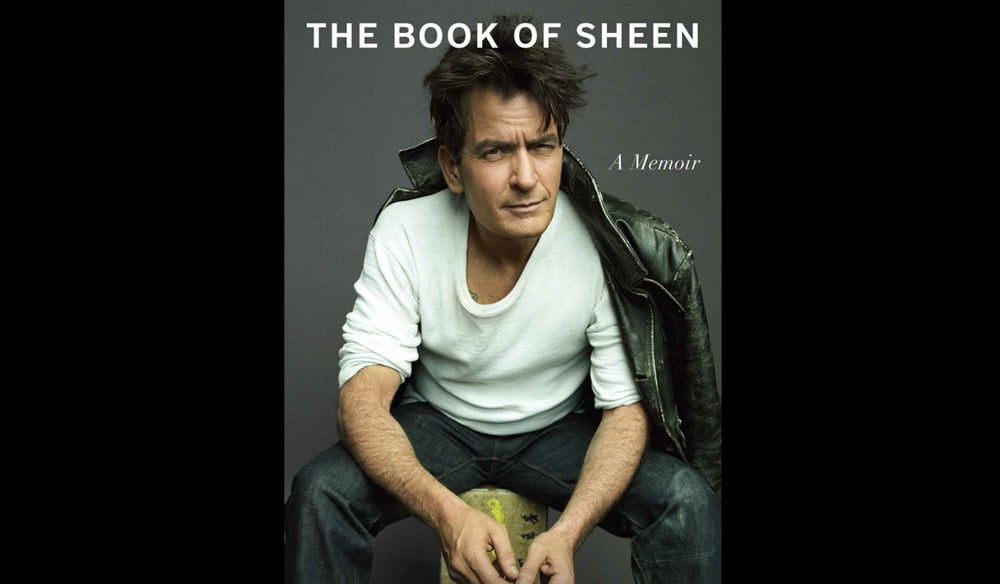
The Book of Sheen is probably the book people like John Belushi, Carrie Fisher, Matthew Perry, Elvis, Janis Joplin and so many other stars stilled by overdose wish they could have written. It is probably the book any of the 100,000 ordinary men and women who die by overdose every year wish they could’ve written. They did not survive to tell their story. Charlie Sheen did. It is probably the book many of us tamer Bartelbys of quiet desperation wish we had reason to write, if survival was guaranteed. He had so much fame. So much money. So, so much sex, so much of it so fabulous.
 Now he’s making more millions writing about it from the plenitude of his grandfatherly happiness, eight or nine years sober, finally, exclusively devoted to his children and grandchildren as his father Martin Sheen was so heroically devoted to him in spite of the decades of pain Charlie inflicted on everyone around him (“Saint Martin to the fukken rescue”). He doesn’t claim it was all worth it. But for a rearview mirror glance of his teenage daughter’s anguish during a car ride, when she knew he was yet again drunk, regret isn’t a theme in The Book of Sheen. The word barely appears. Gratefulness, yes. Amazement that he survived, yes. But not regret. “There’s a fine line between regret and rejoice, but sometimes ya gotta just do what you’re told,” he writes of jumping in bed with a naked girl and her crack pipe in 1992.
That December 10, 2017 car ride with his daughter–a friend was driving since he wasn’t sober–marked the end of his self-destruction. For the first time, he would be making the choice to go to rehab, as opposed to others making it for him. For the first time, it stuck. We are to think it is sticking still, even past the book tour, the Netflix special, the tell mostly-all interviews. We thought likewise with Prince and Philip Seymour Hoffman and Amy Winehouse and Matthew Perry, until each became a necrological headline. But to think Sheen owes us staying alive for our narrative arcs’ emotional convenience makes us the pricks, not him. We can only wish him the best and enjoy his book, keeping moral judgments from behind our glass houses to a minimum: he never pretended to be a choir boy and doesn’t pretend to be one now. Aesthetic judgments are a different story. Sheen can worry about those less than the moral ones.
I read The Book of Sheen as a three-voice fugue: the biography of a star, the confessions of a drug-addled debaucher, and the reckoning of a latter-day Casanova. It is that last that lifts the book from what would have been just another narcissistic mash of Hollywood solipsism toward something closer to literary art, at least in a few parts.
He grew up in a family of actors. His parents Martin and Janet Sheen were getting established as he and his two brothers and a sister burned miles of Super 8 film in their self-taught apprenticeship–those 10,000 hours Malcolm Gladwell told us about–though Renée and Ramon are more background players to Charlie’s story than Emilio, his partner in film, never in crime. Emilio would more calmly find fame through his family’s original name: Estevez.
Martin liked to take his family with him on location, including the Philippines for “Apocalypse Now” and Rome for “The Cassandra Crossing.” The kids didn’t see much of the stars, but there were moments that shaped Sheen’s character.
In Rome a 10-year-old Sheen ended up in a pingpong duel against O.J. Simpson: “The volleys were furious, we were tied at 21-all, it was many hours past my bedtime. O.J. was extremely competitive and clearly didn’t give a fuck that his opponent was a shy ten-year-old child. We had a superstar audience of Dad’s other costars: Ava Gardner, Richard Harris, Sophia Loren, Burt Lancaster, and a very Method Lee Strasberg. Most of the Italian crew had drifted in as well to see what all the commozione was about.”
OJ’s vanity always fit him better than a glove. He wouldn’t let him have his win. He’d been playing with his less daggered hand. The paddle sneakily switched to his power hand, and in two points the game was over. Charlie was crushed. Sophia Loren kissed Charlie. “O.J. and I shared a secret that night,” he writes. “He knew that I knew, and for whatever reason it stayed right there, between the two of us. The more I thought about it, the more I felt like I was set up. Lured in with the off hand, only to be crushed like a bug when it mattered most. What a tool. Last I checked, Sophia Loren didn’t kiss him that night.”
In the Philippines, “The closest I came to seeing a performance from [Robert] Duvall,” Charlie writes, “was when he barged into our bungalow one night in his underwear while Renée and I were watching TV. He was playfully drunk and doing a bad impression of a Comanche war cry. He saw that it was two kids on the couch and realized he was in the wrong unit. Duvall sheepishly apologized and left as quickly as he showed up. Not exactly smell of napalm in the morning, but if that’s all I was gonna get, I’ll take it.” (The the is missing in a text that, like Charlie at school, refuses to recite the pledge to grammatical norms, hence the many fukkens.)
That was the time when Martin was himself an alcoholic whose binges and overwork in the Philippines led to a heart attack. Charlie was not yet 12. He describes seeing his father after the attack: “He still had color, he still had a gleam. Very carefully we all embraced, wanting to hug him while not wanting to break him. He looked older. Not in a withered way, more in a way that befitted the survivor of a tragic crash. It was still Dad and we were still us: a family.” He does not reflect on those words, which describe how his father would come to see him, near death, on so many occasions. That self-absorption even so many years after the fact–the inability to spot the irony–is the addict’s illness still speaking in recovery.
His stardom came easy to him. No waiting tables at a pastrami deli on Broadway, no dues-paying in some bumfuck summer stock in West Virginia, and lots of luck. His audition for “Platoon” was “a disaster.” His brother Emilio landed the role. Oliver Stone’s original location deal in the Philippines collapsed. By the time production could begin months later, Emilio was on another set. Stone cast Charlie. He was 21. “‘Platoon’ would change everything for me,” he writes. “It picked a fight with fame. The likes of which would spend the next thirty years trying to kill me.”
Note the absolving it and the moat-like period after “fame.” That demonic, Stephen King-like it implies Sheen saw himself as a misdirected actor in his own life, though it doesn’t jibe with his willfulness. He was more responsible than he lets on, because he is at heart a compulsively responsible person, if also an instinctively rebellious one. What started as the existential rebellion of an elementary school kid refusing to stand up for the Pledge (“My chief complaint was the God part. Didn’t seem fair that I wasn’t given a choice”) became the narcissist’s revolt against anything and anyone who interfered with his hedonism.
On sets the professionalism he inherited from his father and his screen presence for the most part–despite drugs, booze and torrents of testosterone cream–guaranteed him work. Choice work at first: that fabulous scene with Jennifer Grey in “Ferris Bueller’s Day Off” and his career’s best performance in “Platoon,” his clunkier Bud Fox in “Wall Street,” the joy of “Major League.” That was it for memorable movie roles but not movies. The tirelessness he devoted to flesh and substances he also devoted to work. His filmography is impressive, necessary as it became to pay for alimony, mortgages, drugs, enough sex workers for an Ottoman caliph, then hush money after he contracted HIV.
His star turn on TV helped: “Spin City,” “Two and a Half Men,” when he became the highest paid television actor in the world, then the descent into “Anger Management” and worse. By then his often scabrous life offstage was centerstage, as it is in too many pages of The Book of Sheen. I got lost in the Odyssean sail through the rollercoaster of binges and orgies and interventions and rehabs and escapes from rehabs and his close calls with federal agents or prison or death, all overlaid with wives and women back to wives. Odyssean, because he was making his way back home to father and dog and grandchildren, bearing his self-inflicted scars.
“I’ve been married a total of three times,” Sheen writes toward the end of the book, “and I need to clarify that I never cheated on any of them. Others may claim different, but I don’t care about those muck-vendors or the fiction they spew; I know the number and it’s zero. (That said, the “addendum” to that zero are the times when I was legally separated. That number was not zero. It was numbers with zeroes.)” This is why I love Charlie Sheen.
You’d never think any human being could survive the abuse he inflicted on his body, often with others, at times on others. Neither does he. His memoir in these drug-soaked pages becomes a tribute to the power of memory of a life spent mostly out of it, a hallucinogenic Tristram Shandy who looks back at the wreckage clearly aware that he had no business surviving. Maybe his prose is an indication of his secret. It never flags. It never disappoints. It just brims with wit and energy any of us would envy, and an unexpected occasional affinity for style. (“Her pleasant voice the shiny spoon to a wineglass pre-toast at a banquet,” he writes of his third-grade teacher).
The macabre in his hilarity is usually factual and as gut-busting as John Mulaney’s standup, starting with his opening lines: “On September 3, 1965, in New York City, at 10:58 p.m., I was born dead. We’re talking toe-tag, meat-wagon fukken dead. The delivering doctor had already sprung into code blue-baby, umbilical-strangulation 1960s ass-whoop action. […] The man beat on me like I owed him money.” The tone lends his confessions a confiding intimacy that disappears distance between him and you and gives the book an energy that I suspect fuses in Sheen’s veins and played at least a supporting role, alongside his father, his brothers, his therapists, his wealth and his luck, in keeping him alive.
There is losing his virginity to “a gorgeous red-headed Vegas escort named Candy” on a trip to Vegas and charging it to his father’s credit card (“It was everything I’d hoped for, it was neverything I could have imagined,” even though the swipe of the credit card “took longer than the sex.” “When she saw the name on the credit card, she asked if I could wake Dad for an autograph”). They actually hugged afterward, an entirely Sheen move. There is hanging out with Reggie Jackson at the Playboy Mansion and finding Mr. October a lot more interesting than the flesh on parade.
There is having to deal with Gov. Bill Clinton trying to fuck Sheen’s girlfriend Dolly during a visit to Little Rock (“Find out what you can do about the brunette,” Clinton had whispered to an aide loud enough for a colleague of Sheen’s to hear what he described as “that slice of creepy history”). There is, to his unfortunately nonexistent shame, selling out Heidi Fleiss, the “Hollywood Madam,” in a deal with the FBI to stay out of prison after Fleiss had so generously if lucratively and discreetly shared her harem. (“We’ve never spoken since.” No kidding.) There is his admiration for Michael J. Fox, whose shoes he had to, and did not quite, fill on “Spin City” after Fox revealed his Parkinson’s diagnosis. Fox returned the compliment in a recent interview, pithily describing The Book of Sheen as a “gripping cautionary tale, and surprisingly one of the funniest memoirs I’ve ever read. Charlie’s just that good and deliciously twisted.” Just enumerating all these episodes reminds me of how right Fox is.
Sheen wrote his memoir on the verge of elderly from his “Sober Valley Lodge” the way Casanova in full decrepitude wrote his from Dux castle in the present-day Czech Republic. I was floored by the similarities with Casanova’s Story of My Life, written almost 200 years ago. The two memoirs share an unceasing verve and optimism, a love of life, of women, of occasional men, of fame, showmanship, daring and vanity, of travel, of a playfulness as irreverent with language as it was with all other authorities, of escapes from the law and indulgence in addictions: alcohol, cocaine, heroin, steroids and sex for Sheen, gambling, Cabbalism, food, spying and sex for Casanova. Both were among the most sought-after and richest celebrities of their day.
Their tales are not part of a 12-step road to atonement or accountability. They want us to know: they owe us nothing. They are retelling their tales to live them again now that debauchery is beyond reach, making you, the reader, at most a consort or a voyeur. Both occasionally stray into the sinister, however inadvertent their violence toward women may have been (Sheen’s was more inadvertent than Casanova’s, just as Sheen never slept with underage girls, or with his own daughter, as Casanova did). If instances of the sinister are rare, they are not nothing, and like Casanova, Sheen has a way of minimizing brutality with drugs-made-me-do-it excuses or cheer.
The absence of self-abnegation is a blessing and a rarity from that time zone. The word “forgiveness” doesn’t appear in the book. The self-reflection is revealing, not moralizing, saving it from becoming a mawkish confessional and joining the trash pile of Hollywood vainglories screaming “my bad!” Rousseau’s Confessions would have been more tolerable with a bit more Sheen. The “Sober Valley Lodge” wild thing who spent his career chasing fame and approval is not asking for either now, least of all from you or me. It’s an unspoken restraint in the book, the most invisible of its qualities.

Pierre Tristam is the editor of FlaglerLive.



























Pogo says
Thank you.
Laurel says
I love biographies. I can relate, a tiny bit, to Sheen’s independence. Always during group prayers, I kept my head up and my eyes open. I often saw people sneak a peek at me before they put their heads back down. Amusing.