



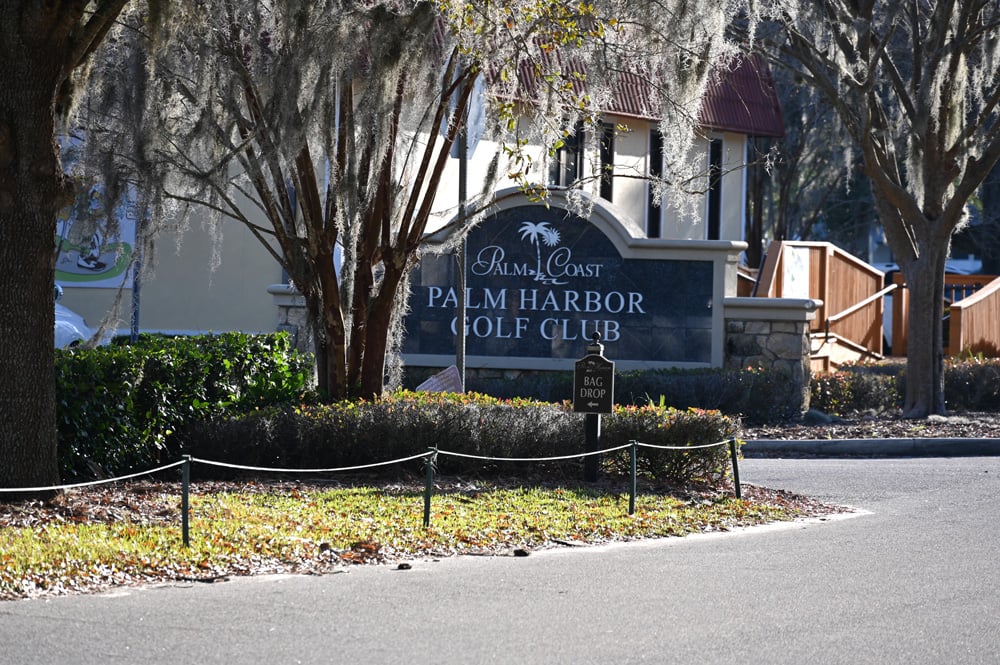
Palm Coast’s perennially embattled Palm Harbor Golf Course today yet again escaped privatization as three City Council members rejected inviting companies to bid on the property even to manage it for the city.
The city had issued a non-binding “request for information” in February and March–the first step in the process–and received eight interested responses from companies prepared to lease or manage the facility, or both.
“We saw a wide, wide range of experience in both private and municipal golf courses,” Park and Recreation Director James Hirst said. “We saw continued support for resident access and affordability and their commitment to maintain that access and affordability. We saw a number of different recommendations for partnerships. We saw public, private, full management, hybrid partnership, and then also a lease agreement.”
Council members Charles Gambaro last year had initiated discussion toward a sale. He’s no longer there, saying he’s “come full circle” to now oppose a sale. But he still thought issuing an RFP was “a smart move” if it were tailored to a management company with long-term lease, as with a company that could invest $4 million and turn the club into an entertainment venue, not just for golfers.
“If we look at how we visualize a golf course for the future, we need investment to make it better,” Gambaro said, “and it doesn’t all have to be taxpayer dollars. And so for me, I think sending out the RFP to see what we can get… could be helpful.” Council member Dave Sullivan was not interested in selling the course, either.
Mayor Mike Norris and Council members Theresa Pontieri and Ty Miller were not interested in leasing or an RFP–if with varying degrees of opposition. Miller, for example, is not closing the door on a better defined request for proposal, if it is narrowly tailored to serve the city’s interests The council was especially encouraged by a financial report on the first two quarters of the fiscal year, which show substantial revenue growth and a year-to-date surplus of $349,000 on Recreation Manager Dennis Redican’s watch.
“I don’t think it’s necessary to say, hey, every year we’re going to put the screws to Dennis and his team and make sure that they’re operating in the black,” Pontieri said. “So let’s just take it off the table, and then know that, hey, this is always a possibility. It’s always a possibility, right? And it’s incumbent upon future councils to look at the budgets very carefully and make sure that we’re operating the way we should in all areas.”
The council agreed to reinvest all the course’s revenue in the course to help future growth. Miller wants the city to run the golf course as an “enterprise fund,” meaning as an operation separate from the general fund, responsible for its own revenue, like the city utility, the city’s stormwater fund and its garbage fund. The city attorney will explore that possibility.
But shor memories were at work with that proposal. The city ran the golf course as an enterprise fund from its inception in 2009 until 2017, when recurring deficits pushed the administration of then-City Manager Jim Landon to convince the council to end the method and fold the course into the city’s parks and recreation department. Landon’s point back then was that the city should see the course as it does all its other park amenities. The city doesn;t expect to make money with Holland and Waterfront parks. It shouldn’t expect to make money with Palm Harbor.
The reasoning is flawed, however: city parks are actual amenities that are free for all to use. Palm Harbor is not. It is a fee-based club, as is the city’s tennis club at the Southern Recreation center. Still, the city may well be returning to that previous method, which Pontieri is willing to explore though she is is not “leaning one way or the other right now.”
“Tremendous, tremendous job turning it around,” Norris told Redican, “and I want you to keep doing the same thing. I have every confidence that you’re going to do the right thing for that golf course.”
The council had directed Parks and Recreation essentially to get in the black or face a possible sale of the course. Redican summarized the changes he implemented. Those include 33 percent higher average fees, limiting 9-hole play to the morning, issuing flexible passes (one such pass generated $30,000 in revenue), increasing summer hours, tournaments and community events, and so on. The course had year-to-date revenue of $1.2 million against expenses of $812,000, and projects a modest surplus by the end of the year. The golf course financial figures have often been a kaleidoscope of creative shifting, with capital costs especially often getting excluded from the bottom line. Redican outlined numerous maintenance needs, including ongoing repairs to the irrigation system (a $278,000 hit) and future needs to replace 72 golf carts and renovate all the grounds. It’s not clear how those capital needs will affect the bottom line. In the past, the full accounting of the course’s expenditures resulted in seas of red.
“We’re on our way, but we are one major maintenance issue away from not being cost recovery,” Gambaro said. “We’ve got to think through that, and more importantly, how we can generate revenue to posture us in a position to keep us in the black if a major maintenance issue were to pop up.”
“Next level up of recovery is being able to use your revenues to cover those future capital costs,” Gambaro said, “so that we don’t have to necessarily pay for it with our budget or tax dollars.”
The red sea today was, ironically (as Pontieri pointed out) the golf course’s supporters, who wore red as they assembled to once again advocate for the facility and beat back the attempt to issue a request for proposal. Several spoke, as they have before, in support of keeping Palm Harbor a city facility. They applauded when the council moved on.
Corrections: An earlier version of this article misattributed a quote by Council member Charles Gambaro to Recreation Manager Dennis Redican, and misspelled Redican’s name.





















Using Common Sense says
This is why voting for candidates that support quality of life for local residents is so important. Register to vote, show up or vote by mail for local candidates that reflect what is important to YOU and YOUR FAMILY. Your safety, health, and welfare matter. The value of your home MATTERS. Mr. Gambaro and Mr. Sullivan, we did not elect you, and we will never elect you based off your voting record for Growth at Any Cost and betraying the local residents. Thank you Mr. Dennis Radican for your fiscally responsible management, leadership, listening to the local residents and golf course clients and turning things around at Palm Harbor Golf Club! Great job and keep up the good work.
celia pugliese says
Big appreciation and applause to Dennis Radican for our beloved PHGC financial turn around! Also applause to all those golfers and adjacent residents homeowners very much affected by the permanence or not of our PHGC. We do not need another Matanzas Golf Course tragedy to happen in this city. Our PHGC is historical as ITT build Palm Coast around it and we battle for its conservation! The suggestion made by Protect Palm Coast member Mr. Dennis McDonald and agreed by council regarding to make the PHGC a “perpetual covenant” that will protect the 147 acres to be forever just recreation land and that could never be sold.
JC says
Why should I trust Mr. Dennis McDonald on anything when he can’t even balance his bills?
celia pugliese says
Our city resident and Protect Palm Coast leader Mr Dennis McDonald has done for our community much more than your distorting line could ever taint. And he does it without anonymity unlike you do. Are you maybe one of those in the payroll’s that Palmcoaste’rs sustain attacking biting the very hand that feeds you?
JC says
Hey, if you want to support the guy who wasted everyone times including the country of not paying his bills, be my guess: https://flaglerlive.com/mcdonald-contempt/
Also sounds like you are angry, you can’t even spell and already went on an angry stereotypical boomer rant with your previous comment. Since you side with Mr. McDonald, no one should be paying attention to what you are saying because people think you are crazy for coco puffs.
Furthermore, I think you got fucked up priorities. I remember you went into a city counsel meeting WHEN YOUR HUSBAND WAS IN HOSPICE! https://flaglerlive.com/builders-turn-out-in-show-of-force/
Sorry, but nothing is more important than being next to you love one when their time is near. I wouldn’t give two shits about what happen with the city when my other half is near the end and I want to spend all my time with them.
Tee off says
Cut the losses. & Dump the course.
Do the math. IF a foursome tees off on a fully booked schedule how many foursomes play per day ? X green fees & cart revenue = maximum gross income.
Can we operate below that # ?
BUT we know the course isn’t played to capacity 365 days a year. So cut the gross revenue in half ? Now we loss money
Sell it now says
Common sense approach….. Something the elected clowns don’t do
ShakingMyHead says
Where do you propose that Palm Coasts youth, middle class families, and retirees play golf if Palm Harbor is “cut”?
celia says
Why when is in black now? Do you here bashing our PHGC permanence in the city’s hands have any graft promised by some special interest to buy the land and turn it into multifamily housing or wanting to lease it and run it into the ground like the former contractor did, with same final intentions? Our PHGC is here to stay as if we are funding other amenities and sport courses why to exempt this one? Because seats in 148 acres of potential housing land to satisfy greed and further overwhelm our infrastructure and generate floods like is happening with Matanzas Golf Course demise affected areas now? No way!
James says
“… The city ran the golf course as an enterprise fund from its inception in 2009 until 2017, when…”
From its inception in 2009? Was the course incorporated into Palm Coast then, or is it that the date should be 1999?
Just a correction needed?
FlaglerLive says
From its inception as a city golf course. The city took it over.