



The Flagler Beach City Commission approved for the first time levying substantial transportation impact fees on new homes and businesses, now calling them “mobility fees,” to reduce the emphasis on a car-only-centered culture.
The commission also spoke approvingly of an ambitious, multi-decade, $38 million “mobility plan” that would use revenue from the fees to transform the city into a more pedestrian and “multi-modal” city–meaning a place where cars, bicycles, scooters, golf carts, water taxis, shuttles and pedestrians are all accommodated.
The entire mobility plan projects $229 million in project costs at today’s dollars, including widened roads, multi-use trails, intersection improvements and two roundabouts, but the plan expects state Department of Transportation dollars to account for some of those.
“Long overdue,” Commissioner Scott Spradley said of the mobility plan. “I enjoy hearing not only the content but tenor of how a lot of what is being suggested here has been implemented in other communities.” He called it a great start.
“We don’t have a people problem. We have a car problem,” Commissioner James Sherman said, quoting fellow-Commissioner Eric Cooley at last week’s goal-setting session. “Putting these fees into place will help move people throughout the city.”
The fee for residential homes and apartments would be $2,981 per 1,000 square feet. A 1,500 square-foot house would pay $4,472. Hotels and short-term rentals pay $3,843 per room, mobile homes pay $3,524 per lot. Office space pays $7,311 per 1,000 square feet, retail pays $10,621, restaurants, big box stores and pharmacies pay $18,511 per 1,000 square feet, and car washes, gas stations and fast food chains pay just under $30,000 per 1,000 square feet. Commissioners repeatedly noted that the fees are lower than Palm Coast’s. See the full schedule here. (For comparison, see Palm Coast’s fees here.)
“If I were coming in as a small business,” Mayor Patti King said, “these fees on top of building permits, it’s a little frightening. Just in my opinion. But other than that, I think it’s a great idea.”
Commissioners Eric Cooley and R.J. Santore had some worries as well about discouraging new businesses, but the mayor added: “Once I sit back and listen and think and see what these fees can produce for our community, it makes perfect sense. I just have to get over that initial something we’ve never had before, and as a small business owner, it’s like, wow. But look at what it’s going to provide our community. And that’s what our community is about. We’re about walkable and bicycles and golf carting, and we want everybody to travel together safely, and if we all have to pay for it in this fashion, that makes the most sense. So I’m on board.”
The city hired NueUrban Concepts, a Florida-based urban planning and design company, to provide the required study justifying the new fees, and an extensive plan reimagining how people get around in Flagler Beach.
“This is the first step to help fund design and sort of start laying out your vision of how you want people to move around your community,” Jonathan Paul, the company’s founder, told the commission. “These are not taxes on existing residents. These are not taxes on your existing home. You’re not going to receive a bill from the city or from the county for mobility fee. This is if you are building a brand new development.” If a homeowner tears down a 2,000 square-foot house and builds a 3,000-square-foot house, the homeowner will pay a mobility fee on only the new 1,000 square feet.
“This is really the first cut at it, setting a vision for what the city would like to see, only setting the groundwork for it, then providing a funding source” to start implementing the projects, Paul said. The plan incorporates the recent annexations of Summertown and Veranda Bay along John Anderson Highway–which remains a county road, not a city road–though the more immediate focus is John Anderson’s intersection with State Road 100, where signals and turn lanes will have to be upgraded. “This mobility plan helps to give you some funds to make that first step into figuring out what is most appropriate for that corridor,” Paul said.
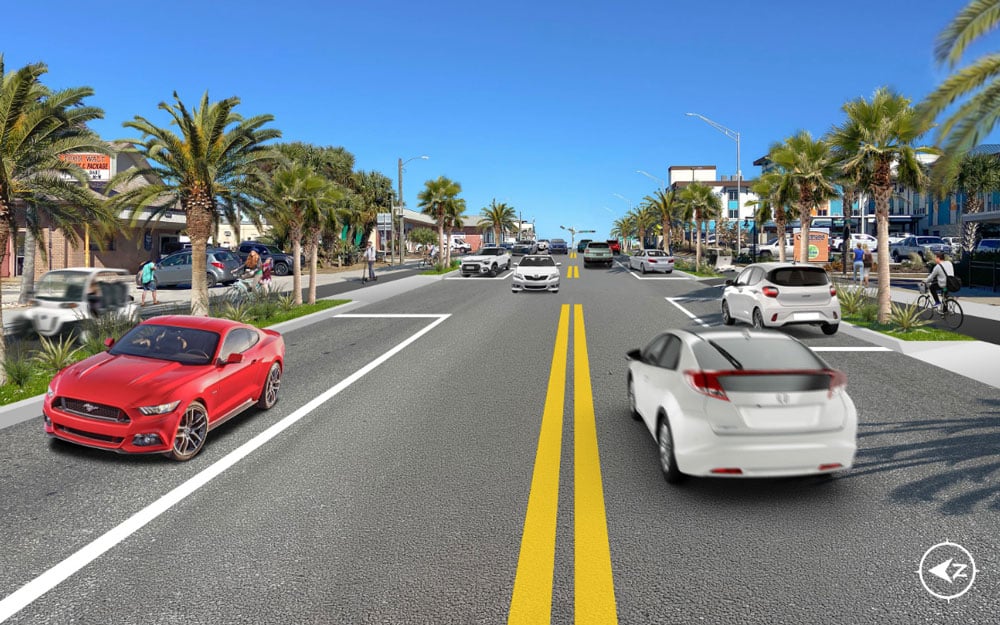
One proposal would reengineer and widen State Road 100 (Old Moody Boulevard) to have bike lanes, multi-modal lanes, medians and roundabouts along with on-street parking, all to encourage people to slow down. The plan includes a roundabout at the foot of the bridge, where State Road A1A and Flagler Avenue meet.
“The thought process is to get the discussion going, not to throw anything off the table,” Paul said. “We don’t really like to come down and take a top down approach.”
The longer they discussed it, the warmer the commissioners felt about the plan.
“This is a huge potential quality of life play for the city in terms of changing aesthetics,” Cooley said, “in terms of changing the downtown corridors and helping to manage and balance traffic and get people where they’re supposed to go, in cars, where they’re supposed to go, and everything in the right spot, which we absolutely do not have.” He favored higher mobility fees for residential construction, at least in comparison with Palm Coast, but slightly lower mobility fees for businesses.
Spradley did not see the Palm Coast comparisons as applicable.
The Palm Coast comparison usually resonates with Cooley, “If anyone needs massive amounts of money put into improving mobility, it’s this city, even far more so than Palm Coast,” Cooley said. “I’m not inclined to entertain anything to lower the fees that we’re talking about here. I mean, I just don’t see it again. It goes to what we were talking about, the quality of life improvement.”
After a discussion about whether to increase or decrease the fees, the commissioners, despite Cooley’s push for higher fees, agreed–on first reading–to go with the fee schedule devised by the consultant.
Mark Imhoof, a resident of Ocean Palm Drive, was among the few naysayers on the plan. “That’s an amazing sales pitch this guy is doing,” he said of Paul. “But personally, all those cities that he talked about totally suck to drive in. There is no mobility, exciting part of driving in St Augustine or Palm Coast or anywhere. I personally like the way it is now.”
The commissioners approved the new fees unanimously.
The full report, including the long-term mobility plan, is accessible here.























Richard Wielder says
Flagler Beach can’t get out of its own way.
Taxi anyone says
I see Flagler Beach is getting like Palm Coast & the county. Spend before you know how to pay.
Unfortunately everyone currently living in this county will never see a water taxi service in operation.
Hell this county can’t even get a regularly scheduled bus route going
Just a way to puss away more $$
Why not just dump more sand into the ocean
Lance Carroll says
Robbery in place of poor city planning. Imagine what a parking garage in place of the Margaritaville Hotel would have done for the community of Flagler Beach ..
Michael Wallman says
Are you kidding me wow another brilliant idea that nobody knows what the hell it means just get your budget under control quit pissing money away
Sayit'snotso says
Ron DeSantis, is trying to get ahead of what is coming! Across America, property taxes are going away. Why are, highest court ,is getting ready to hear texas court case . On property taxes. That it has been illegal, all these years. Not only the tax was illegal. But how it has been done. Two low courts ,say they are right . But the fraud in taxing property, is so massive. They don’t know how to move forward. This is way they passed it on to, the high court. Town’s , county, city’s! Need to cut everything they can.
Sunny says
And where will money come from for your multimillion sheriff & huge fire stations. Roads etc etc for all this ill planned building? DeathSantis hasn’t a clue just throws it on the wall & all you greedy people get in line like good little sheep! Look
Where the nation is!
Nancy says
You’ve got to be kidding! More construction, more fees. You can’t even get the Pier done. Leave Flagler alone. It is not Palm Coast. New people just want to make changes. Get done what you have started and stop increasing taxes. Get the utilities straightened out. No more motels or businesses that don’t get used and take away from the beauty of Flagler Beach. And you wonder why all the people from nearby other cities come visit Flagler Beach rather than stay in their own cities. Stop the changes and get done with what has been started, the Pier. We all miss the wooden Pier. It could have been repaired!
SW says
We the People should be able to vote on anything that the City of Flagler Beach wants to spend (borrow) money for!
The car issue is not our doing, but from every one from Palm Coast,Bunnell and the rest.
Parking Meters sounds like a money maker to me. But who am I to say!
The City is broken. It’s lost its VIBE!
SW says
I’ll even start a Meter Maid service so it would not cost the City anything.
I just want 30% of all the Parking tickets I write!!
Sammygk says
The city can’t fix the water treatment plant and they wanna do what! Focus commissioners on what you do well. Oops forgot what that was.
James says
Reimagine all ya want, but I’m not chancing getting stopped and ticketed for riding a bike there.
Dumb, dumber or dumbest… which is it?
Just wonder’n.
smells fishy says
Narrow 100 down to just one lane after the bridge coming into the “city”, add wide sidewalks and landscaping along 100, spend millions of dollars in the process pushing dirt around. And the rest of the “cities” streets, including A1A, remain exactly the same. This is a GREAT plan! (NOT)
Question: Did Margaritaville have any influence on this idea??? That’s the only business this plan adds any appeal to with deep enough pockets to get what they want.
Richard Wielder, and many others, from above are spot on with the comments. Wow. Way to go FB! Like the Titanic, except you guys happily ripped that hole yourself – no iceberg needed.
Laurel says
Flagler Beach, now starting to look like Anywhere, USA.
Op says
Very poorly managed. No clear plan but spending money ravishingly. They are destroying this quaint town.