



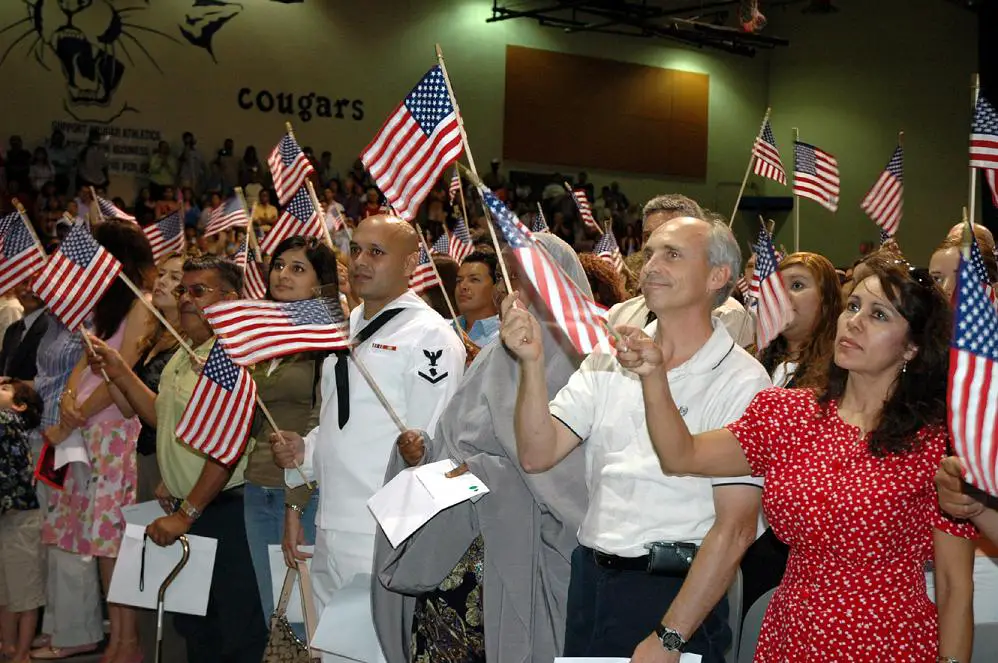

On Jan. 20, 2025, President Donald Trump signed an executive order that would end birthright citizenship – the guarantee of U.S. citizenship to virtually everyone born in this country. Trump’s order has never gone into effect; since then, every federal court that has considered a challenge to the order has struck it down. After just over two hours of oral arguments on Wednesday, before an audience that included (at least for part of the morning) Trump himself, a majority of the Supreme Court seemed likely to do the same.
Ratified in 1868, the 14th Amendment includes a provision known as the citizenship clause, which confers citizenship on anyone “born … in the United States, and subject to the jurisdiction thereof.” The provision was originally added to the Constitution to overrule the Supreme Court’s infamous 1857 decision in Dred Scott v. Sandford, holding that Black people whose ancestors were brought to this country and sold as enslaved persons was not entitled to any protection from the federal courts because they were not U.S. citizens. But for more than a century, the clause has been understood to confer citizenship on almost everyone born in the United States, subject to only a few narrow exceptions.
Trump floated the prospect of ending birthright citizenship during his first term in office, but he encountered resistance even within his own party. Trump did not give up on the idea, and on the first day of his second term he signed an executive order, Protecting the Meaning and Value of American Citizenship, to do so. The order ended birthright citizenship for the children of undocumented immigrants, as well as those of immigrants who are in the United States legally but temporarily – for example, on a student or work visa.
Challenges to the executive order followed around the country. The first federal judge to weigh in on the legality of the executive order, Senior U.S. District Judge John Coughenour of Seattle, called it “blatantly unconstitutional.” Other judges followed Coughenour in blocking the Trump administration from enforcing the order.
That prompted the Trump administration to come to the Supreme Court last year, asking the justices to weigh in on the propriety of so-called universal or nationwide injunctions – orders by federal district judges that bar the government from implementing a policy anywhere in the United States.
By a vote of 6-3, the Supreme Court in Trump v. CASA limited the ability of lower courts to issue universal injunctions. The challenges to the legality of the executive order then continued to move forward in the lower courts – including in New Hampshire, where a federal judge issued an order that temporarily barred the Trump administration from enforcing the order against a group of babies who are or would be denied U.S. citizenship by the order. U.S. District Judge Joseph Laplante wrote “that the Executive Order likely ‘contradicts the text of the Fourteenth Amendment and the century-old untouched precedent that interprets it.’”
The Trump administration then came to the Supreme Court in that case, Trump v. Barbara, asking the justices to weigh in on the legality of the president’s order ending birthright citizenship.
Representing the Trump administration, U.S. Solicitor General D. John Sauer told the justices that the 14th Amendment’s citizenship clause was adopted to give newly freed enslaved people and their children citizenship. For decades after the adoption of the clause, he said, commentators recognized that the children of temporary visitors were not citizens. Moreover, he added, most countries do not have birthright citizenship – which, he argued, rewards illegal immigration. And he contended that “birth tourism” – the practice of women coming to the United States specifically to give birth so that their children have U.S. citizenship – is “creating a whole generation of American citizens abroad with no meaningful ties to the United States.”
Cecillia Wang, who represented the challengers on Wednesday, pointed to the longstanding agreement in the United States that “everyone born here is a citizen.” The 14th Amendment, she said, established a “fixed bright-line” rule for citizenship that is “workable” and “prevents manipulation.”
Much of Wednesday’s argument focused on the court’s 1898 decision in the case of Wong Kim Ark, who was born in San Francisco to parents of Chinese descent. When he tried to return to the United States from a visit to China, immigration officials challenged his citizenship.
A majority of the Supreme Court in that case agreed that Wong Kim Ark was a U.S. citizen. Writing for the majority, Justice Horace Gray explained that although the “main purpose” of the 14th Amendment had been to establish the citizenship of Black people, including former enslaved persons born in the United States, the amendment applies more broadly and is not restricted “by color or race.” Instead, he wrote, the amendment “affirms the ancient and fundamental rule of citizenship by birth within the territory, in the allegiance and under the protection of the country, including all children here born of resident aliens.”
Both sides in Trump v. Barbara contend that the court’s decision in Wong Kim Ark’s case supports their position. In a question for Sauer, Justice Clarence Thomas noted that in Wong Kim Ark, there was no question that his parents were domiciled – that is, had a permanent home in or connection with – the United States.
Sauer agreed, noting that the majority in that case had indicated that (unlike the people who would be covered by Trump’s executive order) Wong Kim Ark’s parents were lawful permanent residents in the United States and domiciled there, even if they were not U.S. citizens.
Justice Neil Gorsuch expressed skepticism, telling Sauer that the United States did not have strict immigration laws when the 14th Amendment was ratified. Anyone, he suggested, could show up in the United States in 1868 and establish domicile. Gorsuch later observed that Justice John Marshall Harlan, who dissented in Wong Kim Ark, had indicated that, under that decision, the child of English visitors in the United States would be a U.S. citizen – an interpretation that supported the challengers.
Justice Elena Kagan challenged Sauer’s reliance on Wong Kim Ark’s case, telling him that the case had a “very clear rationale”: The majority indicated, she said, that there was a historical tradition of citizenship by birth that had carried over to the United States. The 14th Amendment, she continued, accepted that tradition without “limitations.”
 Wang pointed to what she characterized as a “fatal concession” by the government – the fact that it was not asking the court to overrule its decision in Wong Kim Ark. The sweeping language in that decision, she argued, indicated that the parents’ domicile was not important in determining a child’s citizenship; all that matters is whether the child is born in the United States.
But several justices pressed Wang on whether the concept of “domicile” was truly irrelevant to the court’s ruling in Wong Kim Ark. The word “domicile” appears “20 different times” in the decision, Chief Justice John Roberts observed. “Isn’t it at least something to be concerned about?”
Justice Samuel Alito echoed Roberts’ question. Wong Kim Ark “begins” and “ends” with the question presented, which refers to his parents’ domicile. Why would the court include that, Alito asked, “if it’s irrelevant?”
Wang countered that the court’s opinion in Wong Kim Ark indicates six times that domicile is not relevant.
Alito and Justice Ketanji Brown Jackson later offered a possible explanation for the court’s use of the term domicile, which was that Gray had wanted to help the public accept the outcome of the case by emphasizing that Wong Kim Ark’s parents were settled members of society, rather than the single men who came to work on the transcontinental railroad projects.
Toward the end of Wang’s time at the lectern, Justice Brett Kavanaugh suggested to her that, if the court accepted the challengers’ interpretation of Wong Kim Ark, her clients would prevail, and the court could write a fairly short opinion to resolve the case.
Wang agreed with Kavanaugh’s suggestion.
In a separate line of questioning, Roberts challenged Sauer’s emphasis on the problem of “birth tourism,” asking him how common it actually is. Sauer acknowledged that “no one knows for sure” how widespread it is. Roberts then asked Sauer whether he agreed that, in any event, any problems that birth tourism might pose would have “no impact on the legal analysis before us.” Birth tourism, Roberts suggested, certainly wasn’t a problem when the 14th Amendment was ratified in the 19th century.
Sauer countered that we are living in a “new world.” But that prompted Roberts to respond that, although we may have a “new world,” we have “the same Constitution.”
In a similar vein, Kavanaugh pushed back against Sauer’s invocation of the practice of other countries, many of which do not have birthright citizenship. Kavanaugh dismissed the issue as “a policy matter,” stressing that “we try to interpret American law with American precedent based on American history.” “[W]hy should we be thinking about,” he asked, the “many other countries in the world [that] don’t have this?”
Justice Sonia Sotomayor expressed concern about the broader implications of a ruling for the government. When the Supreme Court ruled that Native Americans could not become citizens, she noted, the federal government began to de-naturalize even the Native Americans who had already become citizens. Under the logic of your position, she said to Sauer, Trump (or someone else) could decide to make the order retroactive.
Sauer emphasized that the Trump administration was only seeking to apply the executive order going forward, but he did not indicate that his theory could not also apply retroactively – which may give the justices pause.
Gorsuch also pointed to the similarities in language between the citizenship clause and a provision of the Immigration and Nationality Act, enacted in 1940 and again in 1952, which provides that anyone “born in the United States, and subject to the jurisdiction thereof” is a U.S. citizen. He asked Sauer whether, if the court were to look at the plain meaning of that law, it would conclude that anyone born in this country is a U.S. citizen.
Sauer countered that it should not, because the citizenship clause and the law should mean the same thing.
Kavanaugh later asked Wang why the court needed to decide whether the executive order violates the citizenship clause if it could resolve the case based only on the Immigration and Nationality Act, citing the court’s general presumption that it will avoid deciding constitutional questions if possible.
Wang acknowledged that she was “happy to win on either” ground, but she urged the court to “reaffirm” its decision in Wong Kim Ark, calling it “a landmark decision about the definition of national citizenship in this country.”
A decision in the case is expected by late June or early July.
–Amy Howe, Scotus Blog



























Truth says
Trump hates the US Constitution and as usual wasting taxpayers money and the courts trying to change it to his liking. Judges should start throwing his cases out before they even get to the court rooms.
Keenan Hreib says
We are a non serious country that now engages in un Constitutional and illegal behavior like the Mafia. If this rank stupidity were to stand, then by almost any rubric…. unless your name were Running Bear or Kicking Bird? Then we should all leave. This Administration is CRAZY.
Lunatic Nation says
At what point does all this stop? When he drops a nuke on Iran? When he destroys what’s left of the value of the dollar? When he strips all people of their constitutional rights by creating the thought police (the FBI just created a pre-crime division)? He’s openly xenophobic (unless you praise him or have money). He’s openly racist (unless you praise him or have money). He’s openly sexist and misogynistic (unless you praise him, have money, or is someone he’d like to…). He’s a demented old narcissistic fool who would burn the world down if it meant his name was in the history books.
The constitution is clear—people born here are citizens. Know where else this happens? In over 30 countries. It’s not unique to America. If SCOTUS were to side with him on this, think about what it would mean for you. My grandmother was born here, but her mother was not a US citizen at birth. Based on what Trump wants passed, I would no longer be a citizen. Why? Since my great grandmother wasn’t a citizen at the time of my grandmother’s birth that means my grandmother isn’t a citizen. It also means my mother isn’t a citizen which then applies to me as well. How many Americans would this affect? Depending on how many generations it would go back, all of us, including Native Americans as they weren’t technically citizens of the established US until much later. Even Trump would be affected. It’s lunacy. He’s a genocidal lunatic and so are his enablers and supporters. Oh, and those of you who didn’t vote or cast a protest vote, you’re even more to blame, but continue to rationalize why you did what you did. You only sound foolish and ignorant. Not to mention easily persuadable by propaganda.