



By Diane Roberts
Florida has a budget.
Finally.
It is not, however, a thing of beauty.
There’s $725,000 for an “education” company connected to former Florida Man and current ambassador to Israel Mike Huckabee for materials preaching anti-communism.
Propaganda, in other words. This outfit also produces lessons called “The Kids’ Guide to How the Bible Built America.”
There’s $78 million for projects that will likely enrich big campaign donors’ businesses, including shiny new sports facilities, road-widenings and ramp-construction, high tech police equipment and AI “interview” platforms so state agencies won’t have to actually speak to job applicants.
You, ordinary citizen, get a three-year tax break on tickets to the Miami Open Tennis Tournament, and a four-month tax break on gun silencers.
I know you’re excited.
Farmers and ranchers certainly are: The Legislature has earmarked $425 million for them to not develop their land.
But there’s no money for Florida Forever, even though a mere three years ago legislators committed to spending $100 million on conservation lands.
By now, Floridians are all too familiar with our Legislature’s misplaced priorities, posturing, point-scoring, hissy fit-pitching, and fiscal profligacy.
So, it may come as a surprise to hear they’ve actually done something good.
Really good.
At almost the last possible minute, the House and Senate agreed to appropriate $4 million to compensate the families of the four young Black men known as the Groveland Boys, victims of historic racial injustice.
On July 16, 1949, 17-year-old Norma Padgett and her husband Willie claimed they were waylaid on a deserted Lake County road by Walter Irvin, Charles Greenlee, Samuel Shepherd, and Ernest Thomas. The Padgetts accused the four of roughing up Willie and taking turns raping Norma.
Lake County Sheriff Willis McCall was soon in hot pursuit, accompanied by a large posse of white men.
Farce
Thomas initially escaped to Madison County, but the mob caught up with him and shot him 400 times.
Irvin, Shepherd, and Greenlee were arrested and chained to pipes in the county jail where officers beat and tortured them, trying to force them to confess.
They proclaimed their innocence.
Meanwhile, a white mob burned Black-owned houses and businesses.
The trial was a farce, the verdict a foregone conclusion.
In Jim Crow Florida, Black men accused of raping a white woman were almost always convicted — if they weren’t lynched first.
Greenlee, who was 16 at the time, got life in prison. Irvin and Shepherd got the death penalty.
Their lawyers, one of whom was future Supreme Court justice Thurgood Marshall, appealed to the high court and got them a new trial in 1951.
Willis McCall was not going to take that from a bunch of radicals in Washington. While Irvin and Shepherd were in his custody, he shot them both, claiming they tried to run away.
Shepherd died; Irvin survived by playing dead.
Lying in a pool of blood, Irvin said he heard McCall on police radio, boasting he’d “got rid” of them.
Irvin was re-tried, convicted by an all-white jury, and once again sentenced to death.
 In his Pulitzer Prize-winning book The Devil in the Grove, Gilbert King reports Grovelanders who knew Norma and Willie Padgett doubted their story from the beginning. She was estranged from Willie at the time: He was notoriously abusive.
Many thought the Padgetts concocted the rape story to cover up the fact that he was brutalizing her.
Medical evidence indicating she was not raped was never presented at the trial.
His finest hour
Gov. LeRoy Collins, who thought the whole thing stunk to high heaven, commuted Irvin’s death sentence in 1955. He was paroled in 1968 and died the next year.
Greenlee was paroled in 1960 and died in 2012.
King, as well as surviving family members of the Four, worked for years to prove they were innocent.
Then-Gov. Rick Scott refused to trouble himself with the case. But just days after his first inauguration, Ron DeSantis spoke of the 70-year-old miscarriage of justice and pardoned them.
That might go down in history as his finest hour.
The Groveland Boys are all dead now. They’ll never get justice.
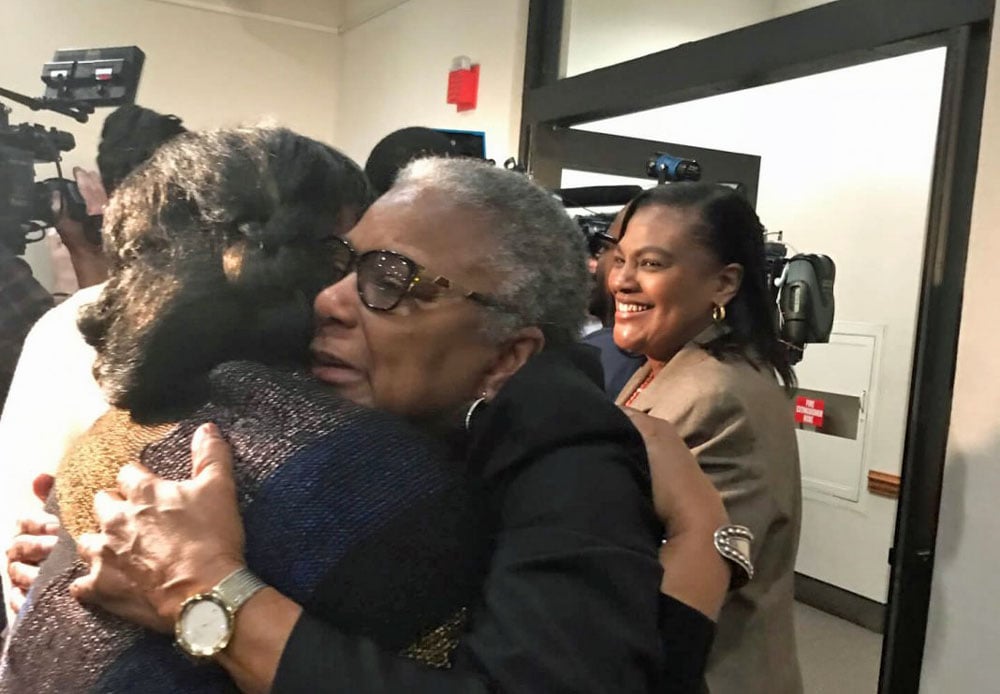
But their families, who’ve long lived with the legacy of state violence and institutionalized racism, get to split that $4 million.
Now, lest you think that’s an awful lot of taxpayer dollars, the total budget is about $115 billion.
And, to put it mildly, the money is not always well spent.
“Alligator Alcatraz” may be in the process of shutting down, but that environmental and human rights atrocity costs us more than $1 million per day.
The federal government has finally paid for some operational costs, but there will be no reimbursement for the structures.
You, dear Florida taxpayer, get to make up the difference.
As if that weren’t bad enough, the place is poisonous, its vast number of diesel generators and diesel-powered lighting towers vomiting hundreds of tons of carbon monoxide and nitrous oxides into the atmosphere.
The Center for Biological Diversity just filed a new environmental lawsuit, asking judges to fine Florida $120K per violation per day.
If they succeed, it’ll cost the state a pretty penny.
But then, we’re constantly budgeting for absurd legal actions that do not benefit Floridians in any way, shape, or form.
‘Principle’ at stake
For example, there’s $675,000 for Cooper & Kirk PLLC of Washington D.C., so the law firm can continue fighting a lawsuit from 2021.
When some social media platforms banned Donald Trump and other politicians given to overtly racist, fascist, and flat-out lying posts, the state reared up on its hind legs to protect their right to gaslight the world, never mind the First Amendment’s protections against government-compelled speech.
Given that X and Facebook no longer check facts or restrict vile speech, you’d think this was moot.
I guess the state thinks there’s a “principle” at stake.
Plus, you don’t want to stand between the state under its current management and anything that enables hatred.
And how about the $123 million to other private law firms to pursue (or settle) suits over the state’s denying public records to the public, flying asylum seekers to Martha’s Vineyard, and making other end-runs around the Florida Constitution?
We have little reason to be proud of our lawmakers. They spent so much time posturing and feuding during the 2026 regular session, they had to call a special session to deal with the budget.
Now they’re in Tallahassee for another one, this time to fight about the governor’s proposal to gut local services by ending most taxes on homesteaded property.
Special sessions are estimated to cost anywhere between 30 and 50 grand a day.
And you wonder why Florida can’t have nice things.
Nevertheless, the state’s small, but significant, gesture to the Groveland Boys and their families is a positive step in a state that struggles to confront our past.
Maybe there’s hope for us yet.

 Diane Roberts is an 8th-generation Floridian, born and bred in Tallahassee. Educated at Florida State University and Oxford University in England, she has been writing for newspapers since 1983, when she began producing columns on the legislature for the Florida Flambeau. Her work has appeared in the New York Times, the Times of London, the Guardian, the Washington Post, the Oxford American, and Flamingo. She has been a member of the Editorial Board of the St. Petersburg Times–back when that was the Tampa Bay Times’s name–and a long-time columnist for the paper in both its iterations. She was a commentator on NPR for 22 years and continues to contribute radio essays and opinion pieces to the BBC. Roberts is also the author of four books.



























Deborah Coffey says
Good one, Diane. It reminds me that someone special once tossed us a challenge: “Keep hope alive.”
RobdaSlob says
The Devil in the Grove is a fascinating book and if you haven’t read it I highly recommend it. It is a fascinating look into Florida back in the 1940’s. Sheriff McCall’s may have executed his basic responsibility to investigate a reported crime. However, he will overwhelmingly be remembered for the alleged coercion, racial injustice, and shootings associated with the case rather than for routine police work. But one thing that stuck out to me was how he had to balance his duties around the crime, demands of the land owners (aka the voters) and concern about losing their labor, the African american community, the Klan, and the general white population and throw in there his own maybe not so legal actions. In general I don’t think he managed the investigation properly but it stuck out in my mind that he stood up to the Klan – knowing if they ran rampant, the county would lose their labor base and in turn the farms would collapse. Which reinforces to me the one thing that gets an elected officials attention is anything that may cost them their re-election.
Pogo says
WTF!!!
https://www.youtube.com/watch?v=Q1RckRfO6vQ&t=2s
Pogo says
Blood on the badge
https://www.youtube.com/watch?v=Q1RckRfO6vQ&t=2s
Sarah says
Did we read different books by the same name?
The Sheriff did not stand up to the Klan, he was a member of the Klan. Not just a member but belonged to the same group that is responsible for the bombing of Harry and Harriette Moore’s home on Christmas day 1951 in Mims. Harry was the director of the NAACP and was reaching out to Thurgood Marshall about the case, so the two that received the death penalty could get a new trial.
The 4 million for the Groveland Four is the best thing to come of this years budget. The justice is long overdue for Greenlee, Irvin, Shepherd and Thomas.
RobdaSlob says
Sarah says-
Chat forum is probably not the best for discussing a book review but in an attempt to clarify the intent of my comment:
There is no doubt McCall was a racist and a central figure in one of the most notorious injustices in Florida history. The evidence in the book leads me to believe he out and out murdered Shepard and but for the grace God he would have murdered Irvin. He is a bad guy. I will note the following not in an attempt to make him any better but in an effort for precision – claims that he was a Klan member were not proven in the book nor by the historical record.
The episode that made me stop and think about the role of the Sheriff at that time period was one incident in particular. In this incident where McCall and the Klan clashed occurred after the 1949 accusation that led to the Groveland Four case.
After the accusation, large white mobs—including Klan members—gathered in and around Groveland. A mob burned homes in the Black community and sought vigilante justice. Accounts both in this book and elsewhere indicate that McCall and other law-enforcement officers acted to prevent mobs from seizing prisoners or carrying out lynchings directly.
What resonated to me from this incident is his actions were not motivated by justice or racial equity but rather protecting his position. Had he and other officers not stopped total annihilation of the Black community then there would be no labor to work the farms. The farms were owned by land owners – who voted and no doubt would have held him accountable for their inevitable demise had there been no labor. Other than quelling the labor force those land owners evidently could have cared less what he did – which as the evidence presented in the book showed was no where near the boundaries of what would remotely acceptable.
Come forward to 2026 – occasionally our politicians still listen to the voters and occasionally we voters need to change seats to remind them who is the boss.
Atwp says
So Laurel I’m suppose to forget the demonic history of the white man. I’m suppose to feel good. I don’t. All it take is a white B to lie on men of color and the white community go crazy and destroy what little people of color have. The 4 men are dead and will never enjoy any of the money. About the money will the family get anything or is this just a story to make men like me feel good. If the story is true will the republicans find a way to take the money and give to white folks or their rich friends. Trump in office isn’t good for families getting their just due especially people of color. Good story but people if you expect anything from the government don’t hold your breath. What happen to the dividend check we were supposed to get last year, and what about this year. Don’t trust the government and people of color protect yourself. Men of color watch where you go a white B will call and lie again. The cops say I thought he had a weapon, I feared for my life. White women will call and say he fit the description, he look suspicious and I feel uncomfortable. These calls are about African American Men and men of color. Things are somewhat better for my people but not as good as it is for the whites. It will never be that good for African American people. To sum it up, don’t expect any good things from the Government, and I don’t trust white people especially white women. That is just me.