



By James Densley
Active shootings represent a very small percentage of on-campus university violence.
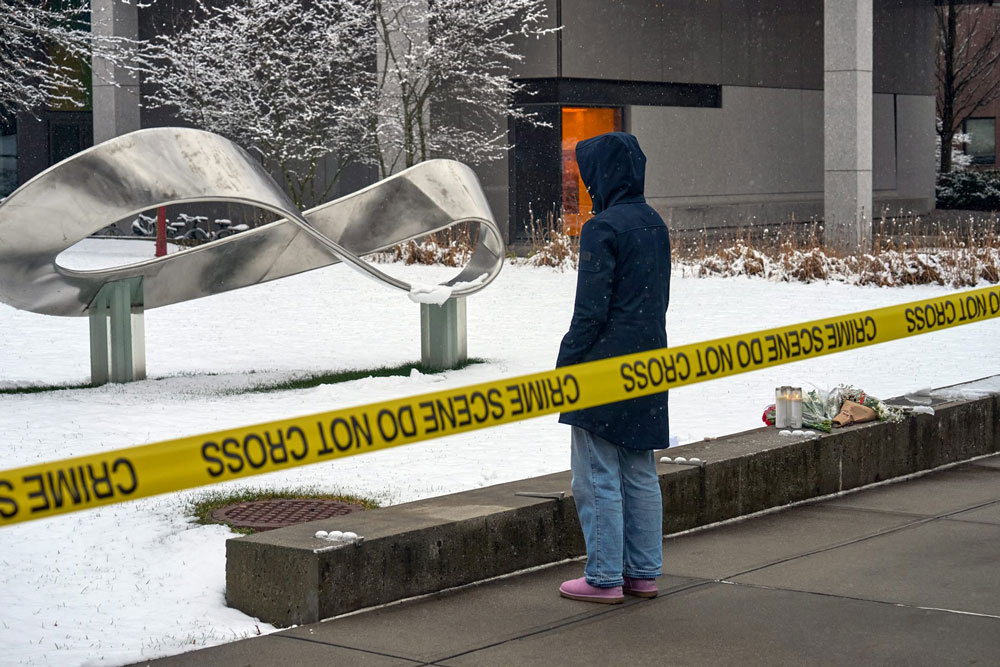
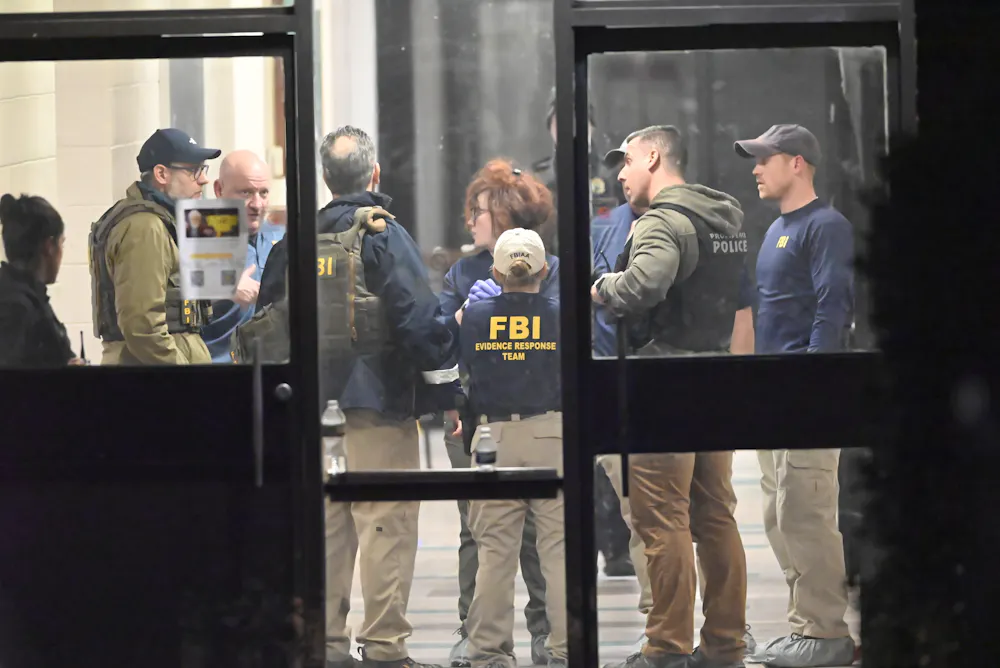
But among those that do happen, there are patterns. And as law enforcement officials continue to investigate the Dec. 13, 2025, Brown University shooting, similarities can be seen with other active shooter cases on college campuses that scholar James Densley has studied. “They tend to happen inside a classroom, and there tends to be multiple victims,” Densley explains.
The Brown University tragedy, in which a shooter killed two students and injured nine more, marks the fourth deadly shooting at a U.S. university in 2025.
The Department of Education in Rhode Island, where Brown University is located, said on Dec. 16 that it is urging local elementary and secondary schools to review safety protocols.
Amy Lieberman, the education editor at The Conversation U.S., spoke with Densley about how schools have been given what he describes as an “impossible mandate” to try to prevent shootings.
Kyle Mazza/Anadolu via Getty Images
What is the overall trajectory of school shootings over the past few years?
K-12 school shootings appear to be trending downward, at least in the past two years. But we actually saw the largest jumps in this type of violence in the three to five years leading up to 2024, which trends closely with the broader rise in homicide and violent crime we saw in the pandemic era.
In 2025, there have been 230 school shooting incidents in the U.S. – still a staggeringly high number. This compares with 336 school shootings in 2024, 352 in 2023, 308 in 2022, and 257 in 2021.
How this relates to an increase in schools trying to institute security measures to prevent shootings is an open question. But it’s true that many schools are experimenting with certain solutions, like cameras, drones, AI threat detection, weapons scanners, panic apps and facial recognition, even if there is only weak or emerging evidence about how well they work.
Schools are treated as the front line, because the larger, structural solutions are too difficult to confront. It is much easier to blame schools after a tragedy than to actually address firearm access, grievance pathways – meaning how a person becomes a school shooter – and the other societal problems that are creating these tragedies.
How have schools responded to the rise of school shootings in recent years?
Schools are being asked to solve a societal gun violence problem that they didn’t create and they cannot control. Even the best-run school cannot eliminate all risks when causes accumulate outside of their purview. These attacks are rare but catastrophic, and they create an impossible mandate for schools because when they occur, schools are told it reflects a failure in their preparation. Educators are expected to be teachers, social workers, threat assessors and first responders. It normalizes fear and shifts the responsibility downward.
There is a growing school safety industry that markets fear as a solvable, technical problem. It promises faster ways to detect weapons, for example, but the evidence base for those products is thin, proprietary or nonexistent. One example is an AI detection software that mistook a bag of Doritos for a gun, resulting in a large police response.
Schools are pressured to buy something from these companies to show they are doing something. But some of these systems create false positives, and, more importantly, they shift attention away from human relationships. Technology alone cannot resolve grievances, replace trust and create belonging, but most schools are focused on technology as a means of prevention.
How effective are other prevention systems schools have put in place?
If a school shooter is an outsider trying to attack the building, having a single point of entry, access control or multiple locks on doors creates time and space, which are essential for delaying an attacker until law enforcement can arrive, thus mitigating casualties.
But the evidence shows that nearly all school shooters are either current or former students at the school. They are very familiar with entry and exit points, and they are potentially already inside the building before the school can act on a potential threat of violence.
So, what happens if a school locks down, but you are actually locking the shooter in a room with their potential victims? What if students are forced to hide when it would be safer to run? What if you have a door that locks only from the inside and a student or staff member uses that room to bully or sexually assault another student? We’re building schools to protect against the rare events, but we are not mitigating the more common problems they face.
Students are being asked to practice preventing their own deaths in active shooter drills and learn in environments designed around worst-case scenarios. In general, interpersonal violence and spillover of community violence, like gang-related shootings, are the most common form of school shooting. Most shootings at schools occur in parking lots or at sports events, but we do very little to prepare for those types of scenarios.
Are there any benefits, then, to schools having certain non-tech safety measures in place, like making sure every person has an ID?
Of course, you don’t want strangers walking around in a school building. The fact that someone coming to the school has to get their ID scanned and wear a badge makes perfect sense, not just to prevent shootings but to also prevent theft and assaults and other risks.
The paradox is that school shooters tend to be children already affiliated with the school, and when someone walks in already firing, checkpoints and metal detectors are useless. Historically, several mass shootings in K-12 schools have started outside of the building then moved inside. The issue is not slipping past barriers but overwhelming them in seconds with irresistible force.

Ben Pennington/The Boston Globe via Getty Images
Absent policy change, what is the clearest way to prevent school shootings, according to current evidence?
Evidence shows that we often see signs of a crisis or withdrawal beforehand from school attackers. And that is why school-based behavioral threat assessment and management is so important. It is really about noticing changes in behavior and having the authority to intervene early. This is not about profiling people or relying on law enforcement alone. It is about having a structured, team-based process for identifying concerning behavior, assessing risk and coordinating appropriate supports – such as counseling – to prevent harm before it occurs. So often in these cases, people had a gut feeling that something was off with a particular student, but they didn’t know what to share or who to share it with.
For decades we’ve invested far more in responding to school shootings once they occur rather than in preventing them. You can lock doors and run drills, but no school can become a fortress.
Attackers leak warning signs in advance. Real prevention is about creating human systems that get upstream of this.

James Densley is Professor of Criminal Justice at Metropolitan State University.


























JimboXYZ says
Taking anyone’s right to have a gun to defend their castle or SYG is not a solution. More often than not the Castle & SYG types are underarmed with what they go up against anyway. Ask yourself why it takes a SWAT team to storm a drug house in Flagler County. It’s because the drug dealer types are potentially armed as well or better than the police SWAT teams. For home defense alone, any of us are that family that moves in & rents to sell drugs on our own streets. And the police have a response time to arrive at a crime scene for a home invasion, one needs whatever it takes to protect anything family or “Castle”. That’s just the human race in a nutshell.
As for schools, going back to who brings the guns ? Students, the children are the next generational criminals. That’s a problem over there. I wouldn’t buy a home in a school zone for that very reason. I also wouldn’t want the trespassing & vandalism that might be a potential for crime.
What prevention means is that the law abiding would be lambs for the slaughter. Criminals should be handled accordingly. Active shooters should not ever get a insanity/mental health defense. Death penalty and it shouldn’t take several years to make that happen. The Charlie Kirk thing ? if they have the evidence, speedy trial & conviction, guilty verdict and the put down should be quickly executed too. Why we’re all wasting time & resources when they catch an active shooter is just mind boggling. 8 billion plus & the handful of them that perpetrate their act, nobody will miss them. They knew what they were doing. Put them down for it.
Laurel says
I went to South Side Elementary, in Ft. Lauderdale, in the late 50’s, early 60’s, which later became a special needs school, and now, a historical landmark building (geez!). The most controversial thing that happened to me, was, I got kicked out of class for wearing a Beatles sweatshirt! I had to turn it inside out before wearing it back in class.
In junior high, and high school, I just don’t remember any bullying whatsoever. A couple of friends say there was, but I just didn’t experience it. Later, as an adult, it was shocking to me to see South Side had a fence around it! My junior high, now a middle school, has one too. So, this violence stuff seems to have started around, maybe the late 80’s or 90’s. What happened? In Ft Lauderdale, excessive, fast growth was a major problem, but how does that effect how children are raised?
Somehow, we are no longer teaching children manners, respect and confidence. One man, in a restaurant, called his kids “feral.” So, why are they “feral”? Why are they now allowed to run loose and scream in public places? Why are there bullies? Why are kids nasty to each other on social media? Why are they in need of being loud constantly? Why are they so needy? Are we not listening, or are we accepting just, plain noise? Are we just too busy to raise solid, confident kids into adults? Do parents want to be best friends with their kids instead of being parents?
I don’t have the answer other than the kids today are definitely behaving in a manner that suggests they are not heading towards a confident adulthood. It’s as if adults, parents, have no clue as to how to raise a child anymore. They are producing “feral” humans.
Skibum says
Schools and college campuses are not impenetrable fortresses! Even “closed” school campuses have outdoor athletic fields and common grounds, which make them easily accessible to someone with bad intentions to toss a gun over an exterior fence to hide in the many areas within the perimeter of any school in this country. So, for all of the “hardening” measures that good intentioned but worthless ideas are thrown about trying to prevent the next, and the next, and the next school shootings… NOTHING will stop these school shootings as long as our incompetent and political minded elected officials bow down to gun manufacturers and the powerful gun lobby that pays big bucks in political donations to those who turn their backs on vulnerable school students!
Coming from someone with a whole lot of law enforcement experience, and may I say… “common sense”, the answer never was, never is, and never will be more and more and more guns! Until the majority of citizens are able to either convince, or get rid of bad elected officials and replace them with people who are willing and able to stand up to the gun crazies and instead prioritize human lives over guns, nothing will change, and more kids will continue to needlessly die. It really is that simple!