



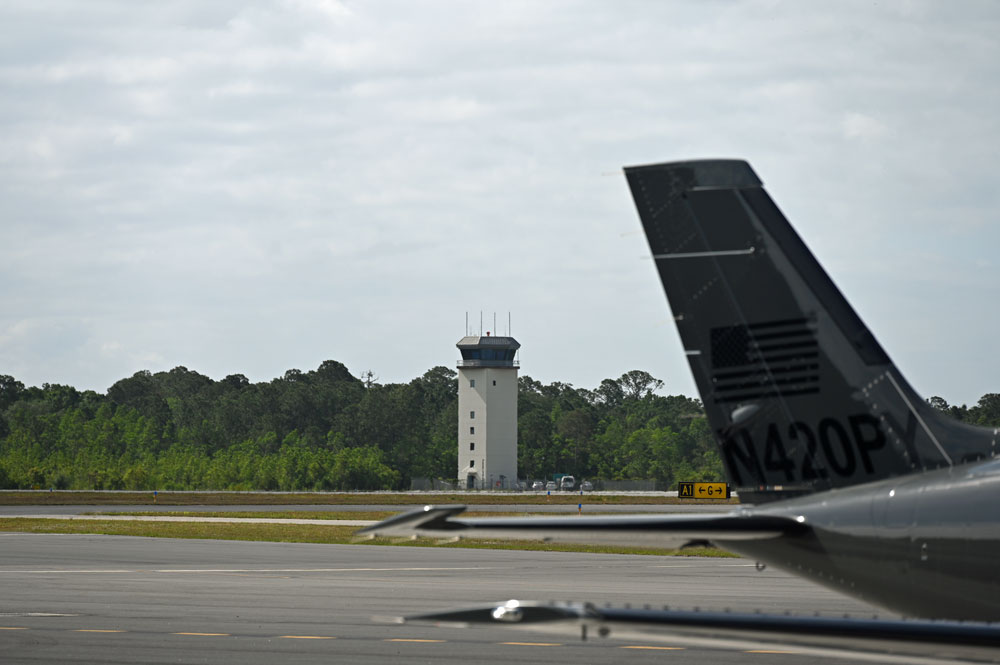
An analysis of lead levels at Flagler County airport yielded insignificant levels in the air and in the soil at four locations, according to the county attorney’s office.
“In the case of lead concentration levels at the airport, both the ambient testing and soil samples concluded that there was no exposure risk to residents, airport users, or to the surrounding communities,” County Attorney Michael Rodriguez wrote in a Nov. 24 letter to Darlene Shelley, a Kathleen Trail resident and a candidate for the Palm Coast City Council in next year’s election.
Shelley had written county officials a week earlier, describing the grounds at the airport as “contaminated” with lead. Shelley has been among a group of residents who have insistently complained to the county and to Palm Coast officials about the airport’s noise, pollution and risk of crashes from its innumerable touch-and-go flights conducted by students enrolled in flight schools that use the airport.
The county in turn has just as insistently said, for years, that it does not–and may not, by law–control the air space and the noise while dismissing concerns about pollution.
The concerns about lead are not quite alarmist: in October 2023, the federal Environmental Protection Agency “announced its final determination that emissions of lead from aircraft that operate on leaded fuel cause or contribute to air pollution which may reasonably be anticipated to endanger public health and welfare under the Clean Air Act.” Leaded-fueled aircraft typically operate in smaller airports. Commercial jets don’t use leaded fuel.
“Levels of airborne lead in the United States have declined 99% since 1980,” the EPA reported in 2023, “but emissions from aircraft that operate on leaded fuel may still pose risks to nearby communities, including those with environmental justice concerns.” The findings were the result of a Biden Administration initiative and were intended to be followed-up with regulatory steps. That has not happened.
Flagler County last winter commissioned the lead analysis from Timothy Scott of Melbourne-based Consolidated Environmental Engineering, what appears to be a one-man shop. His LinkedIn profile describes him as a “Certified Mold Inspector and Certified Mold Remediation Contractor with over 30 years[‘] experience in the environmental and safety fields.” From 1984 to 2002 he worked for Lockheed/Martin [sic] and Tyco International “as a Chemist, Engineer and Corporate Director for Safety and Environmental Engineering,” and was a liaison to the Florida Department of Environmental Protection.
The tests he conducted at the far edges of each runway at the airport showed “levels of lead exposure to be well below the permissible exposure limits established by the United States Occupational Safety and Health Administration (OSHA),” or less than 1.1 to 1.3 micrograms per cubic meter. The permissible exposure is 50 micrograms in an eight-hour period. Soil samples produced results of 1.5 to 2.6 milligrams per kilogram. The cited FDEP commercial/industrial target is 1,400 milligrams.
“The reports conclude that the measured levels of lead are de minimis as previously stated by Commissioner Andy Dance,” Rodriguez wrote. “In scientific terms, de minimis refers to a principle that allows risks deemed sufficiently small to be disregarded, used in fields like risk analysis, toxicology, and research ethics.” Rodriguez urged Shelley to provide evidence of “contamination,” saying the information she had provided was “incomplete or anecdotal.” Shelley did not respond to an email before this article initially published.
Rodriguez cited various authorities in a summary of legal constraints the county operates under as if must defer most air and noise regulations to the Federal Aviation Administration.
The airport was again a subject of brief discussion at the County Commission meeting this morning, when Commissioner Kim Carney said she has been at the receiving end of renewed complaints.
“We’re not particularly able to make major changes, but it seems like the response is pretty much the same over and over again,” Carney said. “It’s FAA jurisdiction. We can’t stop certain things. We can’t do certain things, but we’re kind of sitting here complacent.” She added: “We need to start to get some public relations out on this airport. We need to do something. We need to change the image of that airport. As hard as it is going to be, it’s part of who we are, and the airport is part of the county. So we’ve got to embrace it and get some of this negativism down.”
County Administrator Heidi Petito said the administration was working on updating its information campaign on the airport, and working with the advisory board developing the airport master plan. Palm Coast City Council member Theresa Pontieri had posed a set of questions to the administration about the airport and its flight schools.
“There are things we can do, we just have to be creative about it,” Pontieri said today. The county controls the schools’ hangar leases, for instance, which gives the county some regulatory authority. In the air, nothing stops the county from issuing voluntary noise recommendations, with which most pilots tend to comply without infringing on FAA authority.
Pontieri met with county officials for an hour last week to discuss concerns and possibilities. “We started a good dialogue,” she said, noting that Deputy County Attorney Sean Moylan was looking into a few possibilities as well.
“There is a lot of stuff going on behind the scene to really address some of the concerns,” Petito said today, “with the understanding that we are limited on what we can do. And so I think it kind of speaks to the questions that Councilwoman Pontiery had. She understands that we do have limitations on what we can do. And so I think it’s more of educating the public.”

























Kelly Remington says
I spoke about this at one of the commissioners meeting many years ago. There needs to be at least one more independent study done and not by just one single person or entity.
First officer tim says
You mean a study that will come out on your side of this? I live by the airport and I don t even hear the plains anymore . I hear I 95 more the then the airport .
Greg says
I’m sure the airport was there WAY before you moved there. Quit your crying and move out if you don’t like where you moved.
Gina says
Here is Dr. Hudda’s final report on air quality monitoring at Hanscom Field.
The following LEAD STUDY was done for a period of 161 days at different locations : Impacts of Aviation Emissions on Air Quality Near Hanscom Field, Bedford, Massachusetts
https://www.bedfordma.gov/DocumentCenter/View/5847/Hanscom-Air-Quality-Report—Ultra-Fine-Particles—August-2025
http://www.who.int/news/item/17-10-2025-no-safe-level...
Oct 17, 2025 · As the thirteenth International Lead Poisoning Prevention Week (ILPPW) approaches from 19 to 25 October 2025, the World Health Organization (WHO) and partners are issuing a clear warning: there is no safe level of lead, and immediate action is needed to eliminate exposure and protect future generations.
Lead Poisoning and Health
There is no known safe blood lead concentration; even blood…
Did this one man shop go out into the surrounding communities, how many samples were collected for lead analysis, when this study was done did they go out into the closest surrounding communities (the downwind and the up wind sites).
There is no known safe blood lead concentration; even blood…
Message to Kim Carney: the only good PR that needs to be done to to get rid of the flight schools that are bombarding
residents homes, highschool, hospital and businesses this causing safety, health and quality of life issues, the city is getting
tons and tons of complaints which is why a huge tax base will be lost of people selling their homes and new homes that are
not selling and once again the homeowners who are left will be the ones paying the taxes that are lost. You and your constituents have done nothing to regulate, curtail nor control the rogue flight school mills that operate , some with close calls, yes we can see them, out of this airport which was one of your campaign promises to us to gain our support. We will not be voting for you, Richardson nor Pennington on your next go rounds as many other residents in this county are fed up with other callous voting decisions.
And last but not least what else does one expect from this current administration which allows industries to OPT OUT
of environmental regulations by sending an email to the current administration, this is the the most deregulated environmental
regulations in environmental history of heavy metals in our water, air and soil as this administration ROLLED BACK environmental protections and SHUT DOWN EPA SCIENTIFIC RESEARCH!
Thomas Oelsner says
Gina, your point being what by referencing an airport study in a different state? This report is specific to a totally different scenario. Different types of planes, fuels, frequency of use, wind patterns, soil type. It’s not even a case of comparing apples to oranges. I stand by my previous comment that if you want to question the validity of the report, send it to a well known, highly regarded environmental engineering firm.
Gina says
To the FCBOCC: Your man Trump is a NIMBY, further proof that flight paths can be moved:
Neighbors complain after Trump altered flight routes over Mar …
http://www.independent.co.uk/news/world/americas/us...
3 days ago · Peace and quiet of Trump’s Mar-a-Lago neighbors shattered after he altered flight routes ‘It’s as if they’re accelerating when they’re right over me,’ one neighbor said of the planes
Trump sues for $100M over flights above ritzy Florida club
apnews.com/article/—–9f6cd206c24f47a68458fdcc…
Jan 12, 2015 · Trump filed the suit against Palm Beach County last week, claiming his history of conflict with Palm Beach International Airport has led officials to spitefully redirect air traffic over his historic Mar-a-Lago estate in south Florida.
Donald Trump Sues Palm Beach County for Flying Airplanes Over …
http://www.browardpalmbeach.com/news/donald-trump-sues...
Jan 13, 2015 · Donald Trump says the Palm Beach International Airport is routing planes over his Mar-a-Lago club just to spite the millionaire mogul, so he’s suing the county for a whopping $100 million.
Thomas Oelsner says
There is a simple way to address this. Take the findings and send it to a known reputable firm such as Jacobs, Tetra Tech, etc. for a peer review. These are amongst the top environmental firms in the industry. If they say something should have been done and wasn’t, they’ll say so. What they say is the 100% truth and in no way will they skew their findings.
Skibum says
It doesn’t matter what scientific evidence is obtained, or which qualified individual or company is hired to do the samplings. If the results are not favorable to the few constant complainers who persist in the fantasy that our local airport is dangerous to the health and safety of Palm Coast residents, they will just ignore the findings and complain that not enough testing or research is being done until they hope that the answer they want will somehow magically appear to support their beliefs.
As far as I am concerned, the city has given them their 15 minutes of attention, reporting the lead sampling results from someone who, by all accounts, knows what he is doing. I hope the city moves on to other more important issues.
The Hangar-Side Household says
The concerns about lead caught my attention because my family lives right beside the airport. I reviewed the report, and the findings are sound. A one-person environmental operation is not a problem. This type of sampling does not require a large team. What matters is adherence to the approved methods, proper collection, and certified laboratory analysis. Those elements were all present.
There are many factors that influence whether a small-aircraft airport accumulates measurable lead. They include runway orientation, distance to nearby homes, the share of piston aircraft, wind patterns, vegetation, and the layout of surrounding land. Many of those conditions simply do not exist here, and the results reflect that reality.
My family chose this area partly because my son loved watching planes at the old Hijackers restaurant. Living near the airport has always been a positive part of our experience. The airport brings activity, jobs, and a sense of place that is unique within the county. It has the potential to strengthen our local identity. I would love to see nearby shops carry aviator jackets and other airport-related items. Families already come here to watch aircraft, and that interest can easily grow into something that benefits the whole community.
The airport is more than a set of runways. It is an economic driver, a source of community pride, and a familiar landmark for residents who have lived here for years. If the environmental data shows no cause for concern, it makes sense to focus on what the airport contributes rather than treating it as a threat.
Anna Jones says
At Reid-Hillview Airport in Palo Alto, they tested the blood in the children at the nearby elementary school for LEAD and the levels were higher than the children in Flint, Michigan!
It’s not rocket science! These planes use lead fuel and they are flying above our heads hundreds of times a day! There’s no safe level of lead!
Furthermore, the FAA (in Orlando and Atlanta) and DOT have emailed me saying the “Airport Sponsor” (Flagler County) controls the airport! We have demands on our website, PeaceforPalm.com that they could adhere to, but we are ignored by Mr. Seiger, Mrs. Petito, Mr. Rodrigues, and Mr. Dance. We have documented 14 near misses this year alone!
Thomas Oelsner says
Anna Jones. You reference Reid Hillview. Did you care to mention it is only 6 miles from San Jose Minetta lntl Airport, the busiest airport in Silicon Valley? And not too far away is SFO, Oakland, and the smaller Hillview Airport. Cherry picking one’s data is a disservice to all.
Closys.. says
I wish you people would move.
I lived next to the train in NY, under the glide path to La Guardia airport and the busses stop wasting the front of my house.
I didn’t move, Stopped hearing the planes trains and automobiles.
Just fcking move!
Using Common Sense says
Since when is Andy Dance qualified to determine safe levels of lead? Bottom line, the excessive flight school training aircraft operations at Flagler County Airport emit hundreds of pounds of toxic lead onto our cities every single year. Lead is toxic to humans in ANY amount, and especially harmful to children under 6 years old. There are no “de minimis” levels for lead. Piston engine aircraft still use Avgas that contains lead and many other toxic chemicals. Why did Flagler County waste taxpayer dollars to perform a beyond basic “lead test” conducted by a one-man mold remediation guy? We the People will not be gaslighted, silenced, or bullied any longer. We have the rights to a high quality of life, safety, health, and welfare and these rights are under attack. PISTON ENGINE TRAINING AIRCRAFT EMIT TOXIC LEAD AND CHEMICALS. LEAD IS HARMFUL TO HUMANS, (especially children) IN ANY AMOUNT! Palm Coast and Flagler County have allowed this to happen for FAR too long. Excessive flight school training operations are preventing Flagler Airport from peacefully coexisting with local communities, violating our rights, and threatening the airport’s ability to comply with FAA safe minimum altitude requirements. These unmitigated conditions are ripe for continued degradation of property values, bird strike concerns, harm to local wildlife including endangered species, environmental issues, and the next aviation catastrophe is likely to be right here in Palm Coast or Bunnell. We are a DENSELY POPULATED and NOISE SENSITIVE city that is incompatible with this type of aviation use. It is time to STOP THE MADNESS!
Andy Dance says
In response to “Using Common Sense,” I want to clarify a few things.
I’m not the person who determines what is or isn’t a safe level of lead, which is exactly why the Airport hired an independent environmental expert with more than 30 years of experience in the field. His analysis showed that the air and soil samples around the airport contained very low, safe levels of lead.
Here’s what the results told us:
• Soil around the airport had lower lead levels than typical Florida soils
• There was no sign of any buildup from aviation activity
Scientifically and legally, those findings fall into what’s called de minimis — meaning the amounts are too small to pose a risk.
It’s also important to remember that lead occurs naturally in soil, water, and air, even in places with no pollution sources at all. The EPA and U.S. Geological Survey have documented that most soils contain some lead simply from nature and from historical uses. Because of that, it’s not realistic to expect any environmental test to show “zero lead.”
At the same time, the Airport is not ignoring the broader national discussion about leaded aviation fuel. The EPA and FAA have acknowledged the issue on a nationwide scale, and the federal government is already working toward a transition to unleaded aviation fuels. We understand that many residents are following that process closely, and the County will continue to monitor federal guidance and industry developments.
I also want to explain why these tests were done.
We asked for independent testing to get real, science-based data so the County could either respond to an actual problem or put to rest some of the misinformation circulating in the community. The findings reassure us that our neighborhoods, our airport users, and the surrounding area are safe, and that the airport is not harming the environment.
Regarding the consultant, the Airport selected Dr. Scott because of his broad background in environmental testing and engineering. Beyond what was mentioned in the article, he is a Registered Environmental Manager and Registered Environmental Property Assessor, and he holds Bachelor’s degrees in Biology and Chemistry, as well as a Master’s and Doctorate in Environmental Engineering. That is a substantial foundation for this kind of work. His samples were analyzed by an accredited, independent laboratory, which is an important part of ensuring accuracy. Referring to him simply as “a mold contractor” doesn’t reflect the full scope of his training or his decades of experience in environmental engineering.
Anna Jones says
The test conducted was an OSHA 8 hour grab sample on a windy day, 14 Feb 2025 (look it up). It’s not the proper test for this. You need an environmental EPA FRM 3 month study, but you won’t do that because you are in the pocket of the powerful aviation industy. They have thrown a lot of money at you at our expense so these planes can have carte blanche over our heads and then claim it’s FAA! The Clean Air Act for vehicles has been in effect over 25 years because LEADED FUEL IS BAD! These planes use AVGAS, that’s LEADED FUEL! But the fact that YOU (representing US) are trying to TRIVIALIZE, SHAME, and SILENCE this issue speaks volumes. Just look at your response! You’re an expert now? The skullduggery is obvious. Your ‘expertise’ is a slimy politician!
Darlene Shelley says
For the record, I did not see any email from Flagler Live or Pierre, nor have I been contacted by either for comment. The definition of contaminated is- “having been made impure by exposure to or addition of a poisonous or polluting substance.” There are no safe levels for lead for our children and families. Period. Please reach out to me if you would like a comment, interview, links to the EPA reports on the harmful effects of piston engine aircraft emissions on humans, or any other information. Thank you.
Pierre Tristam says
That Ms. Shelley did not see FlaglerLive’s email does not, of course, mean that I did not send it. (See it here.) We do not fabricate. Though emails do get lost or fail to get delivered.
Anna Jones says
You sent her an email at 2:05pm and put this article out minutes later claiming she did not reply? That’s fabricating!
feddy says
Great point if the story did come out with minimal time for a response.
Marco Simone says
The FAA is in the process of eliminating leaded fuel by 2030.
https://www.faa.gov/unleaded
Gina says
JUST EFFIN MOVE COMES WITH A PRICE!
The growth of this airport is being shoved down the community’s throats
without the proper due process compromising pubic and pilots safety.
Look up the Uniform Land Acquisition Act , under the FAA, the county
is not only required to get an AVIGATION EASEMENT to impact residents
homes in a way that it changes the land use but if residents decide to be
relocated they must pay for not only the market rate of their properties
but the entire relocation cost. “JUST MOVE” is the FAA’S financial burden
to pay! I strongly suggest that the “JUST MOVE” people read the most recent
version of the document : https://www.faa.gov/airports/airport_compliance/relocation_assistance/land_acquisition_under_aip/overview
http://www.faa.gov
Less then 500 feet over peoples roofs necessary for departure and arrival as
this airport failed to get an AVIGATION EASEMENT , here’s the form:
https://www.faa.gov/sites/faa.gov/files/airports/central/airports_resources/forms/RPZeasement.pdf
http://www.faa.gov
There was no due process and a failure to obtain this which is a failure of residents property rights
under federal and state law. Its also a failure to adhere to the Airport Sponsor Assurances
which should disquality this airport from any future FAA grants for improvements.
Irwin M. Fletcher says
Councilor Pontieri and Commissioner Carney have some good points. The county as the landlord for the school should be able to impose regulations regarding the schools impact on the community. Surely a tenant of the county property signs a lease that stipulates what is or is not acceptable for the tenant. As a registered business in the county why are they allowed to violate noise limits other businesses must adhere too? Has anyone from the city or county spoken with the two flight schools and asked them to stop the daily assault of touch and goes. Can they self regulate to be good neighbors to help change the narrative and all the negativity that surrounds the airport? A professional partnership between the county, city, community, and schools would be an amazing step to get this nonsense under control. Every time this topic comes up the go to statement is that the FAA regulates the activity. I have yet to read anything from the FAA that says the airport, schools and community cannot work together to solve the problem. No other local airport has this problem, they have worked it out.
The airport and normal traffic is not the issue. It’s the schools that abuse it with impunity.
Anna Jones says
Thank you, Sir, for this elooquent and sensible response! The answer is NO. The airport manager, Roy Seiger, claims he cannot reach out to Embry-Riddle, yet they send volunteers to work events such as Warbirds Over Flagler. And according to his LinkedIn, he attended ERAU. He also claimed at the last “Airport Advisory Meeting” that ERAU is the ‘best’ good neigbor, but according to my data, they’re the worst. Phoenix East is the best, but when they’re in the flight pattern with ERAU, they have to ‘keep up’, as ERAU has too many planes/students. And no, the county refuses to have a professional partnership with the community, as you can see here in this article. You can see on the website, PeaceforPalm, where they have yet to respond. There are 521 signatures on that petition, that I have submitted to them in person, yet we are ignored. This article appears to be a means to silence the citizens of this city. You are absolutely correct, thank you!
Retired says
Its more than just the lead. Its the constant buzzing and circling of my house. I live in Bunnell out by rhe farms. Should not have to hear so much of this. One night last week we had constant buzzing. Using flight aware we looked up the plane and its path. They were embry riddle drawing pictures. One a plane, a star and even mens private parts. Thats how you train !
Skibum says
If the one plane last week was continuing to circle and buzz your house, and you were able to look up the flight path on a computer and see the exact patterns the plane was “drawing” above your house… maybe they could tell you were annoyed and were giving you a piece of their mind.
However, I’m of the mind that it takes planning as well as precise maneuvers to artfully make any type of discernable drawing or pattern in the sky while flying a plane at a couple hundred miles per hour. Do you think you would be capable of completing such a feat in a speeding car without any guide markers???
Practice makes perfect, which, in the profession of becoming a proficient AND safe pilot, is the difference between staying up in the air where planes belong as opposed to a poorly trained pilot crashing down through the roof of your house and ruining your day. I don’t know about YOU, but I’d definitely rather be a proponent for those flight training lessons you don’t much care for.
Irwin M. Fletcher says
I’ve been reading the comments about our airport for years and the only thing noisier than the terrible flight schools is the “just move”people. Your intellect is astonishing and words cannot describe your problem solving skills. The ability to stand tall representing the 80th percentile on the mediocrity bell curve is a lonely place, and you have earned your stripes and represent well. Your fellow citizens are grappling with an issue that is important to them. Your advice is sure to inspire them and gives them hope in the midst of all their adversity.
RobdaSlob says
Irwin the same could be said about the anti-flight school crowd. That is a discriminatory approach and attempting to hide behind fake environmentalism, fake safety claims , and fake accusations of violations is not productive and places people on defensive which then becomes further barriers to a solution.
The answer is to have dialogue with the parties and collaborate to drive answer that tries to appease as many as possible within the legal bounds of the system. It must be recognized that not everyone will be happy with where it ends up. It also must be accepted that the airport infrastructure is important not just to Flagler but the broader country, pilot’s need to be good citizens, flight schools are not going away, the county is obligated to promote the airport as a good citizen and they need to stop issuing housing permits within the airport area. And for those houses that they did issue permits to they may have to work with the FAA to provide some level of mitigation.
What was of note to me in this article was a tone of the county leadership that sends a message of being willing to collaborate to a solution – this has not always been the case.
Just because politicians take a winner takes all approach doesn’t mean we should lead our lives that way.
Irwin M. Fletcher says
RobdaSlob,I agree that there needs to be concessions on both sides to come to an amicable agreement. Safety in the skies is nothing to take lightly and even the hint of a potential issue needs to be investigated. There have been a number of near misses in this area and it is too densely populated to assume those types of risks. The significant number of repetitive operations only increases the chances of a crash or major incident.
Respectfully I don’t agree with the fake environmentalism comment, there needs to be some shred of truth or facts to warrant an investigation of the claim. The feds have already conducted the research, and published it. The airport maybe an economic driver for some funding sources within the county. Short of the flight schools paying rent and buying a few gallons of fuel here and there, they bring absolutely nothing to the tax base nor are they a driving factor in our economy. Ther are and end user with no benefits. The general aviation community that pays for hangers in fuel and maintenance and taxes are the positive source of revenue for the airport.
The flight schools don’t have to go away, they just need to be held accountable for their actions because right now they operate with impunity. All parties involved in the issue have a serious lack of leadership, which is painfully evident every time this topic comes up.
The endless back and forth playing the blame game is not going to solve this issue. The airports that surround us don’t have the same issue, they have worked it out. The county’s soul has already been sold to these flight schools for some reason, and it will take work and compromise to get it back. It’s staggering to think that our little airport is one of the busiest in the state and country, and it’s all flight school operations that bolster those numbers on the backs of our citizens.
You are right that pilots need to be good citizens. The fight schools need to stop being so entitled and hiding behind the FAA and start to develop the students into responsible pilots and not flying lemmings. Currently they have little to no character and it is validated by their actions daily. One of the culprits is an international school that is thought of as the highest standard in aviation. Each careless flight they complete just degrades their reputation. I’m not saying they need to be empathetic but maybe some institutional integrity is in order.
Retied says
Wow. You hi it right on the head! Well done!
RobdaSlob says
Irwin I appreciate the response but you didn’t like the “just move crowd” and I agree. I also don’t like the “I don’t like airplanes so I am going whip my narrative and claim they are environmentally unfriendly, unsafe, lead is bad they all need to go away crowd.”
There are people who don’t like propeller noise. Nails on a chalk board to them. I get it, we are not all wired the same and we can work to mitigate it but it is not going away, at least not in our lifetime. That has to be accepted.
Flight schools impact on the economy – I 100% disagree they bring nothing to the tax base. First our benefit of flight schools is a much bigger picture. I think we can agree that being able to travel by air has been game changer for society and opened the world to everyone – no more week long trips on ships to get across the Atlantic. Flight schools generate the pilots that make that happen. The schools are filled with students who pay rents, buy groceries, use local services, etc. Some of those students like the area and settle here, marry locals, buy property – ask me how I know. The schools attract business – e.g. Boeing has opened a center in Daytona that is expected to employ 400 by the end of next year.
Lead – the biggest cause of lead in our lives is the use of paint, then industrial waste. Yes piston powered airplanes contribute to the problem. Because general aviations contribution to the amount of lead is so small, and the cost of removing it has out weighed the benefit the Federal government has only recently (last 10 years or so) put much energy into it. One of the biggest factors of removing leaded fuel from aviation is a lack of infrastructure to support alternatives. So if one really cared about lead and wanted to make a positive difference and reduce aviation lead instead of vilifying the industry, lobby the county commission to fund an unleaded fuel farm at the airport and to provide funds to discount its price to encourage its use. If one really cared about lead they would also be lobbying the commission to fund and install aircraft charging stations at the airport and to take other steps to encourage electric aircraft. Why not offer discount storage fees for electric aircraft?
Safety – The aviation safety record has improved astronomically over the last 20 – 30 years. Because of this improvement, societal expectations of aviation is zero accidents. Even though that is unrealistic the aviation industry understands the assignment. Relative to flight schools their safety record alone has improved by 50% in the last 20 years. If one really cared about aviation safety they would recognize that safety should be first among equals. One of the key elements of aviation safety is properly trained pilots. They would appreciate that flight schools need to train students properly and that entails using airports and airspace. If one really cared about safety they would tolerate that training flights have to occur.
Flight schools operating without impunity – I have spent my career in aviation regulation. Having spent time on government-industry panel who in part benchmarked aviation regulatory oversight to other industry I can say without hesitation that the only other industry that comes close to the level of regulation that aviation has to endure is nuclear power. Every plane, every pilot, every mechanic, every part, every flight, every airport, every school, every instructor, everything has to meet a requirement. And everyone of those requirements has someone whose job is to check and make sure they are met. If one was really worried about a flight school not operating within the bounds they should call their local FAA Flight Standards Office. That office walks the ramps of airports, they conduct audits, in short they are a silent army holding the aviation users accountable. As you once stated “I’m with the Mattress Police. There are no tags on these mattresses,”. Flight Standards checks the tags.
You stated: The airports that surround us don’t have the same issue, they have worked it out. – That is a very naive statement and I can only surmise that you have not lived in other parts of the state or even central Florida. New Smyrna, Vero Beach, Naples etc have all had to walk this journey. If one really wanted a community solution they would learn from those that walked before them.
You stated: “It’s staggering to think that our little airport is one of the busiest in the state and country, and it’s all flight school operations that bolster those numbers on the backs of our citizens.” How did you establish this position? Flagler County airport doesn’t even make the top 10 busiest general aviation airports in the state of Florida let alone the country. Van Nuys is the busiest in the country with up around a half million operations a year. We don’t come close to half that amount. Our flight traffic in this area is pretty quiet compared to the LA basin or the northeast corridor. And in Florida even sleepy little Vero Beach as well as New Smyrna have more traffic than Flagler.
All that being said, even though I have written an overly long diatribe – I do agree the back and forth should stop and a collaborative solution should be found.
Irwin M. Fletcher says
Lots of great information about the aviation community nationally and global travel, but we are looking at it locally at this one airport. Respectfully the accuracy of some of your data is off a little. The airport manager stated that this is one of the busiest airports in Florida with over 180,000 operations annually of which nearly 80% being from students.
The 80% of student operations bring next to nothing to the local tax base nor the local businesses. Aviation my pump a lot of money into the global economy but not much in Flagler.
The comment about being naive is uncalled for. Look at the noise abatement procedures for the airports around us and do some research. Their airports, elected officials and citizen groups have been proactive about creating advisory boards to work towards resolutions and are active about educating the pilots about the voluntary noise abatement procedures.
I am sure your statistics about aviation nationally are accurate. My observations are about what we hear locally and from the residents. Based on the comments here over the years it seems the FAA doesn’t care about the mattresses or the tags. If there was any action by the FAA regarding safety, the pattern would not be over capacity with repetitive operations, there would be fewer near misses, they would follow up on reports to the FSO, the tower would respect the noise abatement procedures and include it in ATIS, and there would be certainly less complaining by the community.
RobdaSlob says
Irwim-
Accuracy of data comment:
I’m not sure which dialogue and the context of the airport manager’s statement but:
FAA OPSNET is the official count of operations at airports. https://www.aspm.faa.gov/opsnet/sys/Airport.asp
In 2024 Florida’s larger commercial airports (Miami, Orlando, Daytona, etc) have between 300 and 400,000+ operations a year. If we just focussed on the heavy general aviation airports in Florida:
Hollywood North Perry – 317,690
Miami excutive – 314,026
Vero Beach – 265,405
Fort Lauderdale – 193,398
New Smyrna – 184,807….got tired of searching…….Flagler had 179,160 operations.
Use the data as you see fit – it appears the Flagler airport manager has his own spin.
I believe part of the Flagler county concern around airplanes has not only to do with the airport area but also to do with aircraft operations in general. Many of these aircraft do not depart / land at Flagler but rather use airspace northwest of the airport for training, maneuvering, maintenance hops,…or are just transitioning through the eastern corridor heading or coming from up north or enjoying a ride up the beach.
Let’s just agree to disagree on the benefit to local economy. However, targeted policy against types of users of the airport is considered discriminatory and would subject the county to legal action.
The comment on learning from other communities – If your point is you have and it appears the county and airport manager are not meeting what they signed up for under 14 CFR part 150, then I agree. But the messaging then needs to target their deficiencies. The airport manager is obligated to promote their noise abatement procedures. ATIS, posters, education programs, etc. The County is not suppose to be issuing residential building permits in the impacted areas from the airport noise compatibility map and should have a map. The other communities that have walked this path have learned the hard way of the failure to meet their obligations and we should be actively ensuring our county does not repeat the same.
You and others have mentioned 10 near misses. I cannot find it in the NTSB, nor the FAA databases. So I would like to understand your source.
I raise a larger global points because in solving this problem it is important to understand that at the Federal level, the perspective is all the 5,000 public use airports in the US form a network that is important to the country. Therefore the rules are written to ensure that a local community does not degrade or negatively impact the network due to a narrow local view or unilateral action. We need to understand that so we don’t repeat costly mistakes other communities have made when they failed to take this into consideration.