



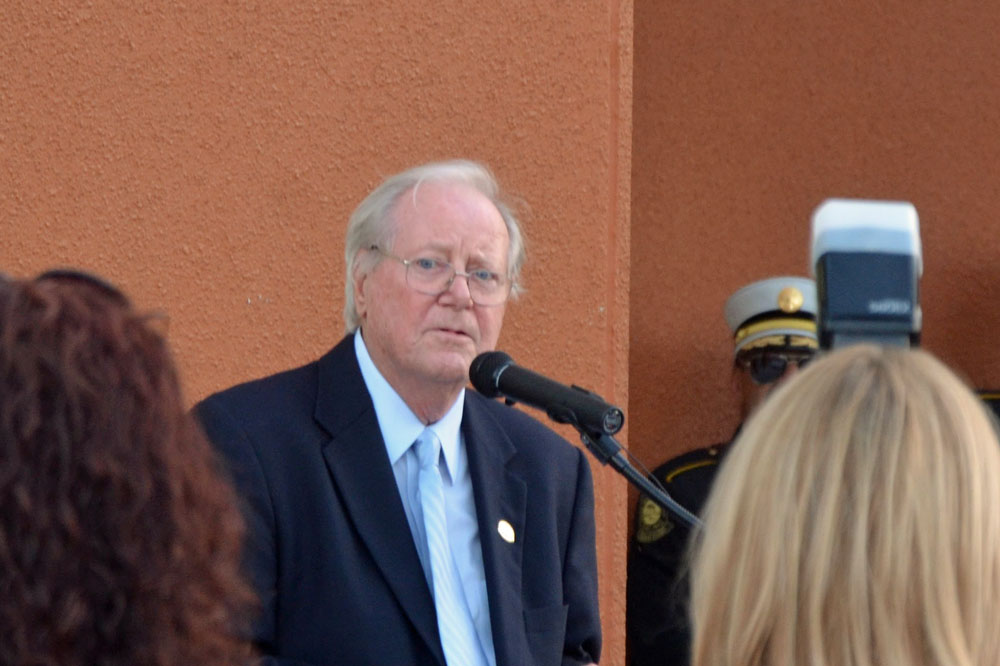
Jim Canfield, the first mayor of Palm Coast and the galvanizing, studiously nonpartisan chair of the Home Rule Executive Committee that led to the city’s incorporation in December 1999, died on Friday. He was 96.
Elaine Studnicki, like Canfield a past president of the Palm Coast Historical Society, announced his death in an email this evening. “An orphan, talented leader, and cherished friend,” Studnicki wrote, he “left a legacy that suggests that potential is formed from adversity, leadership is based on experience, a willingness to endure and embrace differences, and a belief that the challenges of life enlighten the future.”
In a statement this evening, Palm Coast Vice Mayor Theresa Pontieri said: “I did not personally know Mr. Canfield, but I appreciate all who have served our community. I’m very sorry for his family’s loss and pray for their peace and comfort during this time.”
Canfield, a former superintendent of high schools in Manhattan, quickly immersed himself in Flagler County politics in the early 1990s. He was among 15 candidates for the County Commission in 1992. He didn’t win. George Hanns, who’d served on the Palm Coast Service District for 10 years, did (and would remain in office for the next 24 years). The two would remain close.
“I can’t imagine anyone saying anything negative about Jim Canfield,” Hanns said this evening, recalling every instance he’d meet the former mayor, who’d always throw his arms around Hanns. “He was just an honorable man, and I was honored to know him. Throughout my life, I found certain people that I’d like to emulate, and he was one of them.”
By the late 1990s Palm Coast had been growing for almost 30 years. It had close to 29,000 residents. It accounted for 70 percent of the county’s population but had just one of the County Commission’s seats in hand. Palm Coast residents were dissatisfied with the lack of representation. In October 1997, Palm Coast Civic Association President John Eustace launched a monthly meeting to prepare for incorporation. Canfield was appointed chair of the Home Rule Committee, a notoriously unruly bunch.
“We were like a bunch of marauders, but he toned us down,” Vincent Liguori, a member of the committee, recalled. “He was fair, he was diplomatic, totally non-partisan. Didn’t evaluate people or judge people. He just asked them to work and do the best they could. He was a fair man.”
Palm Coast residents were eager to have their own city, but they faced staunch opposition from a political group that feared higher taxes and higher utility rates. A feasibility study prepared at the time showed that a house valued at $87,000 would pay about $123.75 more in property taxes. “We have a lot of people in Palm Coast that don’t want to spend the extra money,” Canfield was quoted as saying at the time. “It is not about money, it is about identity.”
The reporter quoting him was Carl Laundrie, who covered Flagler County for the News-Journal back then. Laundrie this evening recalled those times as if they’d happened last week. “The big controversy was some people didn’t want to form a city because of city taxes, and Canfield kind of smoothed over the whole issue,” Laundrie said. “People were unhappy with the kind of services the county was providing.” Canfield would play a key role in he $83 million acquisition of Florida Water, the water and sewer utility, in 2003.
Canfield, Laundrie said, was a “great guy, easygoing, open to the media, talked to people, he was what a mayor should be–a welcoming person.”
The county agreed to place the incorporation question on a referendum. It was held on Sept. 21, 1999, with 6,994 residents or 60 percent voting for approval and 4,591 voting against.
The election for the Palm Coast City Council was next. Twenty-six candidates qualified, nine of them for mayor, among them Canfield and Liguori. Canfield won overwhelmingly. He was the top vote-getter, with 4,137 votes to Martyna McLean’s 1,594 in the primary, winning the runoff with 69 percent of the vote on Dec. 14, 1999. Two days later Canfield chaired the first meeting of the council, calling Palm Coast a “Millennium City,” though it wasn’t officially a city until Dec. 31.
He headed the founding Council with members Jim Holland, Jerry Full, Bill Venne and Ralph Carter. Holland and Carter would end up having parks named after them. Of those founders, only Venne remains. Canfield easily won reelection in 2003, serving through 2007, when he was term-limited. Jon Netts, who’d been a council member, was elected mayor. Canfield then took the leadership of the Palm Coast Historical Society, winning a home for it at Holland Park in 2013.
He made a few public appearances after that, notably in 2015, when he spoke at the ribbon-cutting for the new City Hall in Town Center. His appearances began to diminish after that.
“I’m saddened to hear it. I’m sorry to hear it,” Liguori said of Canfield’s passing. “He’s a good guy. Although a Democrat. He never, never pulled down a partisan thing on anybody. He was always fair to everybody, and he ran meetings as they should be run. He ran them and looked upon the public as credible individuals who had to be respected.”
“Jim was an advocate for history,” Studnicki wrote in her email. “He understood how important it is to reflect on our future. Thank you, Jim, for your service and dedication to the City of Palm Coast.”














Pogo says
@Sorry I didn’t know you
… RIP
“Let us be poised, and wise, and our own, today. Let us treat men and women well; treat them as if they were real; perhaps they are.”
― Ralph Waldo Emerson, Selected Essays
Taxpayer says
RIP, condolences to the Canfield family.
Marsha Lidskin says
Aside from his calm, caring and honest demeanor, Jim Canfield’s solid leadership ensured that Palm Coast grew to become beautiful, safe and thriving community where people were proud to live. It was my honor to have known with him.
Vincent A. Liguori says
Jim-It was an honor to serve with you. Well done.
JustBeNice says
My condolences. The city should consider naming or renaming something in his honor.
D W Ferguson says
Historical note—Before the Green Lion and Loopers, the Restaurant / Cafe at the Palm Coast City Golf Course ( Palm Harbor ) was called ” CANFIELD’s “