



Even with some of Florida’s best defense lawyers representing him, Kristopher Henriqson would face long odds beating the capital and life felony charges against him.
The state appears to have a recording of him admitting in two phone calls to raping his prepubescent stepdaughter. It has DNA evidence of his skin cells and sperm taken from the victim’s chest within hours of the last alleged assault, which the girl reported to a teacher and a counselor at a Palm Coast middle school the morning after. It has the girl’s own description of assaults alleged to have taken place between the time she was 9 and 12 years old.
Not least, it has Melissa Clark, the assistant state attorney who’s been practicing for almost 25 years, and whose methodical ruthlessness seems to reach its own Draper point when she prosecutes crimes against children.
For all that, Henriqson fired his court-appointed assistant public defender, Spencer O’Neal. He has opted to represent himself, and today discovered for the first time what a steeper hill he has made for himself as Circuit Judge Dawn Nichols went through about 10 motions he had filed. She denied several and granted a few, but with the understanding that it will be up to Henriqson to figure out the logistics, legalities, and costs of his requests.
He wanted to have the venue of the trial, now scheduled for early February, changed because he didn’t like that Sheriff Rick Staly said his crimes made him a candidate for the death penalty. He also didn’t like O’Neal. Denied.
He wanted to have an illegally recorded conversation with the victim admitted so he could impeach her—showing her to be prone to lying. The one precedent in a different Florida district made the recording inadmissible. Denied. But the judge invited Henriqson to find a medical expert who could testify to the available reports.
He wanted to have the girl examined by a gynecologist because he believes in the “intact hymen” theory, though it has long been discredited. “This court is going to have to have an exceptionally good cause for that young victim to be subjected to an examination,” Nichols told him. Denied.
He wanted the Child Protection Team’s medical report introduced into evidence. Denied, though he will have the opportunity to cross-examine the author of the report.
He wanted to have the DNA analysis report rewritten because, in essence, he didn’t like the way it read. “The way it’s originally written, it’s very prejudicial,” Henriqson told the judge.
“Don’t know I have the authority to do that,” Nichols told him. Clark objected, too. “There are limits to things that I can do, and I guess I’m not understanding what it is you’re looking for.”
He complained that the report, in his reading, split the DNA sample into two samples: the epithelial fraction and the sperm-cell fraction. He didn’t think that was right—to have two samples when originally there was just one.
Denied.
Clark had sat in her usual ramrod fashion for much of the process, finding it unnecessary to intervene except in the most glaring instances, knowing that Henriqson was weaving his own rope. She intervened this time. “He doesn’t understand the science,” Clark told the judge. DNA analysts in sex crime cases typically, if not necessarily, split skin cells from sperm cells.
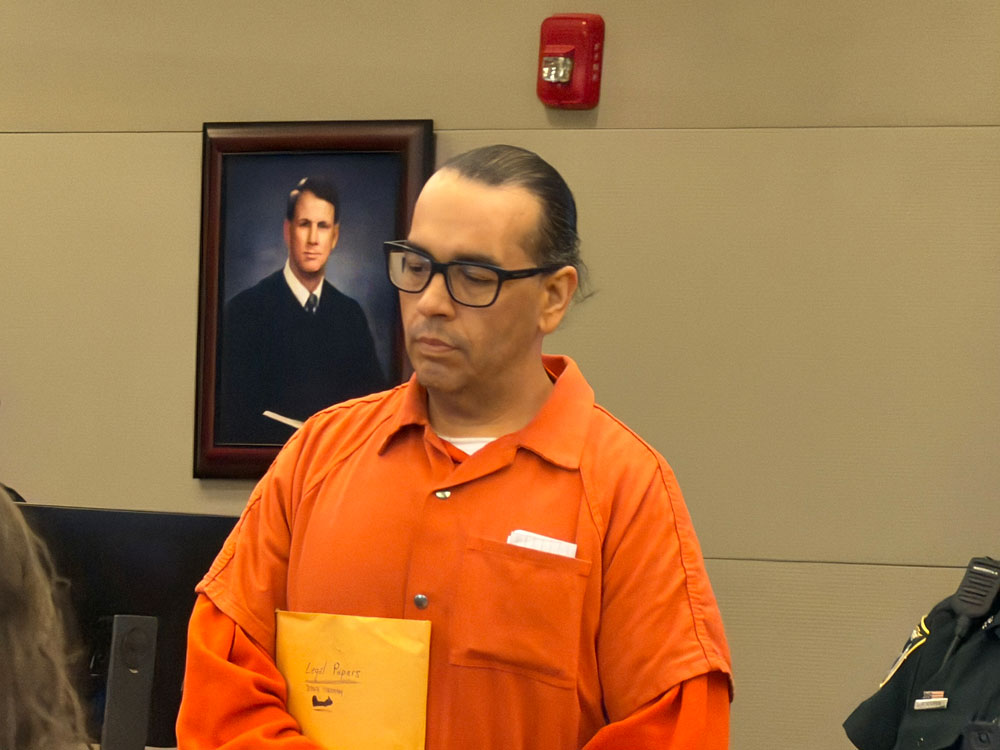
“I understand it,” he said. Henriqson stood before the judge at the lectern in his Flagler jail orange garb, going through papers he had brought in a manila envelope with the words “Legal Papers” handwritten and underlined on the front, clutching it to his chest as he walked in. He asked the judge whether he could have his handcuffs removed. That would be up to the bailiffs, the judge told him. A quick, curt “No” came from one bailiff. Another bailiff stood guard immediately behind Henriqson, as bailiffs always do when the defendant faces charges heavier than the metal restraining him.
The motions continued. He wanted to have a legal advisor assigned. Denied. He wanted a lawyer other than O’Neal. Denied.
A few motions did go his way, but in a more legalistic sense only: he could get a transcript of the DNA tech’s deposition, but it is not clear who will pay for it. If the public defender’s office doesn’t, then he won’t get it. He can depose the nurse who examined the victim, but it will be up to him to figure out how to get a court reporter, set up the deposition, and pay for it. He can get a transcript of the victim’s Child Protection Team interview, but again, paying for it may be an issue.
“It is somewhat wise to have the PD’s office on board, because then their office is paying for those things,” the judge told Henriqson. Henriqson won’t budge. His animus for O’Neal is such that he is willing to diminish his chances at trial by magnitudes over it. (He is upset at O’Neal for refusing to consider the illegal recording, even though O’Neal explained to him precisely what the judge did today—that it is inadmissible—and he is upset with him for not considering the “intact hymen” theory).
The judge told Henriqson he can introduce the illegal recording for appellate purposes—the judge won’t allow it at trial—but by doing so, he risks exposing his friend, who recorded it, to a third-degree felony charge for secretly recording the victim.
With almost every motion, Nichols asked him: Do you really want to keep doing this? He did. He does.
Just in case, O’Neal sat behind him as his “standby attorney.” The two never spoke. Henriqson hardly looked O’Neal’s way, though in fairness bailiffs forbid defendants from looking anywhere but forward so they don’t signal to or intimidate anyone in the gallery. As it was, no one had turned up in support of Henriqson.
He has been on his own in every way but for the judge’s patience, and her repeated questions about his intention to keep representing himself.
“That’s why I was asking those questions, because I have lawyers, four and five year lawyers who’ve been practicing and have three years of law school under their belt that don’t understand” the rules of evidence, the judge told him. “It takes years of practice to understand the rules of evidence.” She complimented his thoroughness and research, but cautioned him that Clark runs rings around even inexperienced lawyers.
He did not change his mind.
Maybe it is because his previous convictions for felonies in state and federal court give him the impression that he knows court now. But those were relatively minor felonies—theft of Louis Vuitton merchandise in the federal case, pot sale in the state case (here in Flagler County in 2011).
The rest of his life wasn’t on the line then. His crimes were almost victimless. He hadn’t shattered a young life, a life that might be shattered again when the alleged victim has to confront him as a witness and withstand his cross-examination. But that, it is clear, is what Henriqson wants.


























Leave a Reply