



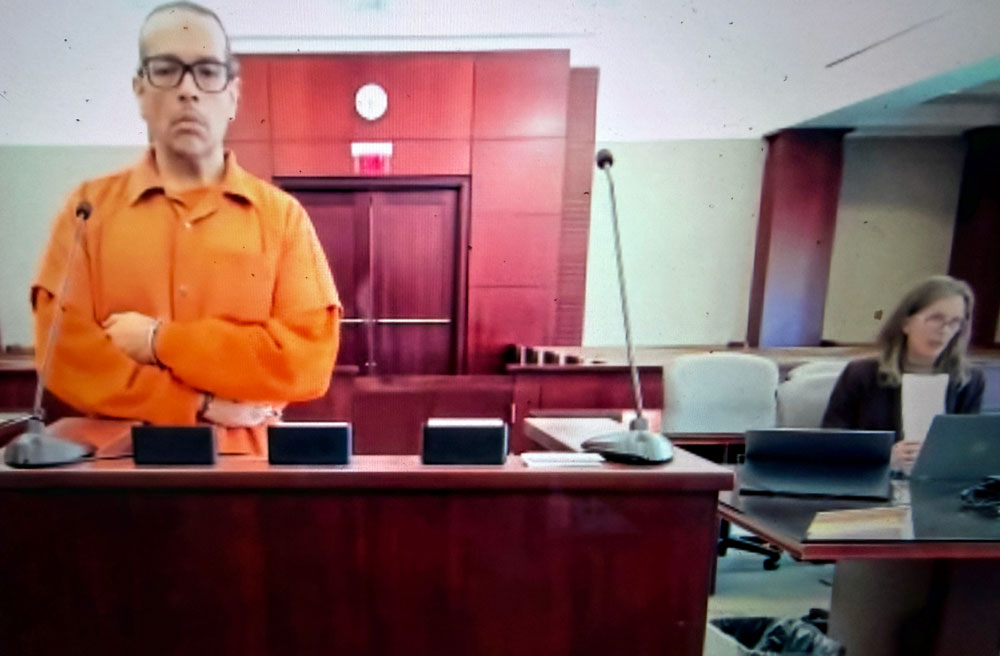
Less than a week from the start of his trial on capital charges that could send him to prison for life, Kristopher Henriqson, who is representing himself, was again in court this morning–as he has frequently been for the past few months–this time arguing for a 60-day delay.
Circuit Judge Dawn Nichols did not grant it. Docket sounding–the last formal step before trial–is scheduled for 8:30 Wednesday morning. But she left a door ajar for a delay, assuming Henriqson is able to secure what the prosecutor says he will not: an expert witness who will testify to his theory that a child who has been the victim of a rape could not have an intact hymen.
Henriqson is looking for a gynecological expert who would review a medical report written after the alleged victim was examined, following the victim’s disclosure that Henriqson, her step-father, had been sexually abusing her since she was 9. She was 12 when she disclosed the alleged assaults to a teacher at her local middle school, then to a counselor, then to a Child Protection Team therapist, a year ago this month.
“Ms. Clark,” the judge told Assistant State Attorney Melissa Clark, “I do want you to know if he does, in fact, secure an expert to review that report, I am likely to grant his motion to continue.”
“I understand that. I don’t know that he’s going to secure one because the medical literature is contrary to, I think, what his theory is,” Clark said. In fact, the current medical consensus is that most children victimized by sexual abuse will not present with abnormal or injured genitals, and that even in cases of damage to the hymen, assuming the damage occurs in the first place, the hymen will heal, leaving no trace of the injury.
A 2014 meta-analysis of 323 studies from around the world, involving 9.9 million affected children, concluded, among other findings, that “the great majority of sexually abused children do not have any abnormal physical findings. The proper determination and documentation of physical findings and their interpretation based on current scientific knowledge are essential for the protection of abused children.”
Spencer O’Neal, the assistant public defender who had been Henriqson’s attorney, had attempted to dissuade his client from arguing the “intact hymen” theory. That was one of the reasons Henriqson got rid of O’Neal. In his motion seeking a 60-day delay, he again made a swipe at O’Neal, even though O’Neal remains on standby as Henriqson’s adviser, when he argued that he “needs time to execute the tasks that his previous court-appointed counsel refused to do.”
Addressing the judge today, Henriqson said it wasn’t a matter of finding someone willing to testify to his theory, but “finding someone that’s willing to travel. There’s no one locally on the vendors’ list.” The judge wasn’t convinced. But she wasn’t going to remove Henriqson’s opportunity to find the witness he is seeking. Even if he does, Clark appears primed to undermine the expert’s theory, if not the expert’s credibility.
Clark had a motion of her own to argue. Henriqson has listed two witnesses for his defense, Obrira Turner and Rhianna Gross. Gross had babysat the victim. “These witnesses are friends of the defendant,” Clark’s motion states. “It is expected that each of these defense witnesses would say that they do not believe the victim’s allegations against the defendant are true; i.e. that the victim is lying.”
Henriqson previously disclosed that Gross had secretly recorded the victim saying things to the effect that she could make things up. The child’s statements could have undermined her credibility. But the recording was illegal. It’s a third-degree felony in Florida to record an individual without the individual’s consent. The exception is when a child victim is recording an abuser. O’Neal told Henriqson that the recording would not be admissible in court, and that Gross was exposing herself to criminal charge if she did not destroy the recording.
Henriqson opted to try to put Gross on the stand.
“So Mr. Henriqson,” the judge told him, recalling a previous interaction, “remember when I talked to you about the rules of evidence, and they said to you that some of the things just don’t make sense for somebody who hasn’t gone to law school, and really, I’ll be honest with you, for people who have gone to law school, so those things that you’re asking are not admissible.”
“Which thing specifically, your honor?” Henriqson asked.
“They think that the victim is lying,” the judge said of the two witnesses. “They can’t testify to that. So any questions that you would ask to elicit those responses would be improper.”
Henriqson did not dispute the decision. The judge had asked him again, as she does at every hearing, whether he intended to continue to represent himself. “Unless you are able to appoint me a new attorney,” he said.
“I’m not appointing another attorney,” the judge said.
Docket sounding is scheduled for 8:30 Wednesday. The trial begins with jury selection, out of a pool of 50 jurors, the morning of Feb. 9. Henriqson faces 11 felony charges, two of them capital felonies, although the prosecution is not seeking the death penalty (and the death penalty remains, despite a Florida law that legalized it, unconstitutional in cases of child sexual abuse). He also faces a life felony and seven first degree felonies.




























Leave a Reply