



By Paul Bierman
President Donald Trump’s insistence that the U.S. will acquire Greenland “whether they like it or not” is just the latest chapter in a codependent and often complicated relationship between America and the Arctic’s largest island – one that stretches back more than a century but has recently been on the rocks.
On Jan. 14, 2026, U.S., Danish and Greenlandic officials met at the White House to discuss Trump’s comments. The foreign minister of Denmark later told reporters that while the two sides had a “fundamental disagreement,” they would “continue to talk.” In Congress, Republican Sen. Mitch McConnell also criticized Trump’s threats, saying seizing Greenland would mean “incinerating the hard-won trust of loyal allies in exchange for no meaningful change in U.S. access to the Arctic.”
Although Americans have long pursued policies in Greenland that U.S. leaders considered strategic and economic imperatives, Trump’s approach is more agressive than any previous president. As I recounted in my 2024 book, “When the Ice is Gone,” about Greenland’s environmental, military and scientific history, some prior American ideas for Greenland were little more than engineering fantasies, while others reflected unfettered military bravado.

NF/SCANPIX/AFP via Getty Images
But today’s world isn’t the same as when the United States last had a significant presence in Greenland, decades ago during the Cold War.
Before charging headlong into this icy island again, the U.S. would be remiss not to learn from past failures and consider how Earth’s rapidly changing climate is fundamentally altering the region.
Early US plundering of Greenland’s metals
In 1909, Robert Peary, a U.S. Navy officer, announced that he had won the race to the North Pole – a spectacular claim debated fiercely at the time. Before that, Peary had spent years exploring Greenland by dogsled, often taking what he found.
In 1894, he convinced six Greenlanders to come with him to New York, reportedly promising them tools and weapons in return. Within a few months, all but two of the Inuit had died from diseases.

Account Of The Discovery And Bringing Home Of The ‘Saviksue’ or Great Cape York Meteorites. New York 1898/Wikimedia Commons
Peary also took three huge fragments of the Cape York iron meteorite, known to Greenlanders as Saviksoah. It was a unique source of metal that Greenlandic Inuit had used for centuries to make tools. The largest piece of the meteorite, Ahnighito, weighed 34 tons. Today, it sits in the American Museum of Natural History, which reportedly paid Peary US$40,000 for the space rocks.
World War II: Strategic location and minerals
World War II put Greenland on the map strategically for the U.S. military. In spring 1941, Denmark’s ambassador signed a treaty giving the U.S. military access to Greenland to help protect the island from Nazi Germany and contribute to the war effort in Europe. That treaty remains in effect today.
The new American bases in western and southern Greenland became crucial refueling stops for planes flying from America to Europe.

A Herblock Cartoon, © The Herb Block Foundation
Hundreds of American soldiers were garrisoned at Ivittuut, a remote town on the southern Greenland coast where they protected the world’s largest cryolite mine. The rare mineral was used for smelting aluminum, critical for building airplanes during the war.
And because Greenland is upwind from Europe, weather data collected on the island proved essential for battlefield forecasts as officers planned their moves during World War II.

U.S. Coast Guard via Wikimedia Commons
Both the Americans and Germans built weather stations on Greenland, starting what historians refer to as the weather war. There was little combat, though allied patrols routinely scoured the east coast of the island for Nazi encampments. The weather war ended in 1944 when the U.S. Coast Guard, and its East Greenland dogsled patrol, found the last of four German weather stations and captured their meteorologists.

U.S. Coast Guard via Wikimedia Commons
Cold War: Fanciful engineering ideas vs the ice
The heyday of U.S. military engineering dreams in Greenland arrived during the Cold War in the 1950s.
To counter the risk of Soviet missiles and bombers coming over the Arctic, the U.S. military transported about 5,000 men, 280,000 tons of supplies, 500 trucks and 129 bulldozers, according to The New York Times, to a barren, northwest Greenland beach – 930 miles (1,500 kilometers) from the North Pole and 2,752 miles (4,430 kilometers) from Moscow.
There, in one top-secret summer, they built the sprawling American air base at Thule. It housed bombers, fighters, nuclear missiles and more than 10,000 soldiers. The whole operation was revealed to the world the following year, on a September 1952 cover of LIFE magazine and by the U.S. Army in its weekly television show, “The Big Picture.”

Keystone-France/Gamma-Keystone via Getty Images
But in the realm of ideas born out of paranoia, Camp Century and Project Iceworm were the pinnacle.
The U.S. Army built Camp Century, a nuclear-powered base, inside the ice sheet by digging deep trenches and then covering them with snow. The base held 200 men in bunkrooms heated to 72 degrees Fahrenheit (22 Celsius). It was the center of U.S. Army research on snow and ice and became a reminder to the USSR that the American military could operate at will in the Arctic.

U.S. Army Corps of Engineers, 1960

US Army
The Army also imagined hundreds of miles of rail lines buried inside Greenland’s ice sheet. On Project Iceworm’s tracks, atomic-powered trains would move nuclear-tipped missiles in snow tunnels between hidden launch stations – a shell game covering an area about the size of Alabama.
In the end, Project Iceworm never got beyond a 1,300-foot (400-meter) tunnel the Army excavated at Camp Century. The soft snow and ice, constantly moving, buckled that track as the tunnel walls closed in. In the early 1960s, first the White House, and then NATO, rejected Project Iceworm.

Robert W. Gerdel Papers, Ohio State University
In 1966, the Army abandoned Camp Century, leaving hundreds of tons of waste inside the ice sheet. Today, the crushed and abandoned camp lies more than 100 feet (30 meters) below the ice sheet surface. But as the climate warms and the ice melts, that waste will resurface: millions of gallons of frozen sewage, asbestos-wrapped pipes, toxic lead paint and carcinogenic PCBs.
Who will clean up the mess and at what cost is an open question.
Greenland remains a tough place to turn a profit
In the past, the American focus in Greenland was on short-term gains with little regard for the future. Abandoned bases, scattered around the island today and in need of cleanup, are one example. Peary’s disregard of the lives of local Greenlanders is another.
History shows that many of the fanciful ideas for Greenland failed because they showed little consideration of the island’s isolation, harsh climate and dynamic ice sheet.

Posnov/Moment via Getty Images
Trump’s demands for American control of the island as a source of wealth and U.S. security are similarly shortsighted. In today’s rapidly warming climate, disregarding the dramatic effects of climate change in Greenland can doom projects to failure as Arctic temperatures climb.
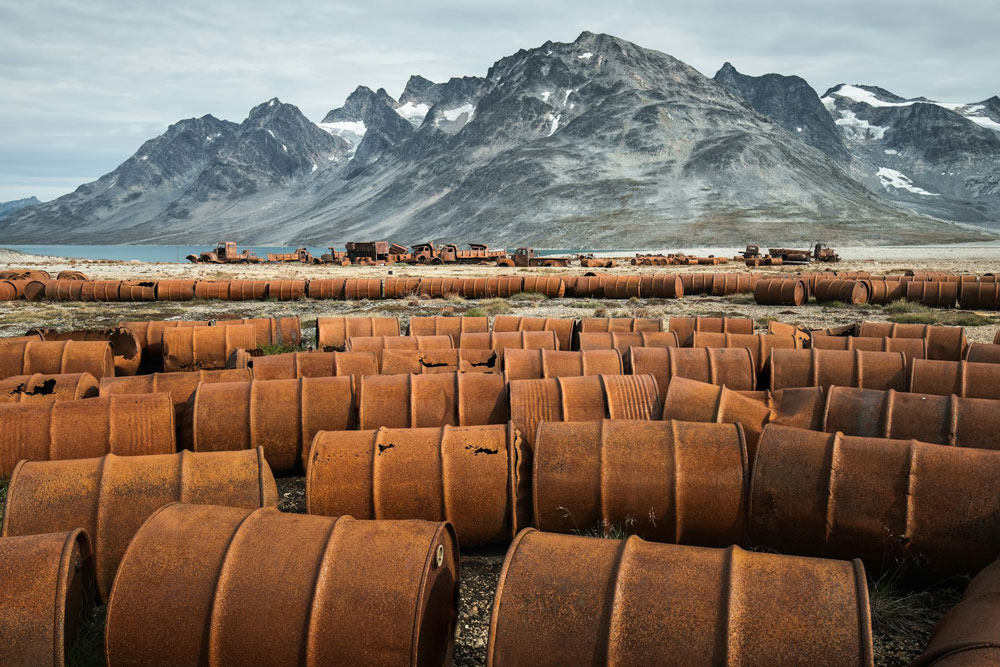
Recent floods, fed by Greenland’s melting ice sheet, have swept away bridges that had stood for half a century. The permafrost that underlies the island is rapidly thawing and destabilizing infrastructure, including the critical radar installation and runway at Thule, renamed Pituffik Space Base in 2022. The island’s mountain sides are crashing into the sea as the ice holding them together melts.
The U.S. and Denmark have conducted geological surveys in Greenland and pinpointed deposits of critical minerals along the rocky, exposed coasts. However, most of the mining so far has been limited to cryolite and some small-scale extraction of lead, iron, copper and zinc. Today, only one small mine extracting the mineral anorthosite, which is useful for its aluminum and silica, is running.
It’s the ice that matters
The greatest value of Greenland for humanity is not its strategic location or potential mineral resources, but its ice.
If human activities continue to heat the planet, melting Greenland’s ice sheet, sea level will rise until the ice is gone. Losing even part of the ice sheet, which holds enough water to raise global sea level 24 feet in all, would have disastrous effects for coastal cities and island nations around the world.
That’s big-time global insecurity. The most forward-looking strategy is to protect Greenland’s ice sheet rather than plundering a remote Arctic island while ramping up fossil fuel production and accelerating climate change around the world.

Paul Bierman is Professor of Natural Resources and Environmental Science at the University of Vermont.




























Laurel says
In my opinion, Trump is incredibly stupid. We already have military bases on Greenland, for security purposes, with agreement. Greenland, and the USA, are NATO allies. We are supposed to support each other, not attack each other. Trump wants to get rid of NATO, much to Putin’s delight, and to Greenland’s, and Europe’s dismay.
His greed is boundless. His “morality” is non-existent.
Ed P says
Laurel,
Actually Trump is in the initial phase of negotiations. Asking for the absurd and willing to settle for just what he wants.
A permanent long range missile defense base with absolute guarantees that China nor Russia can never become our neighbor, living, working or influencing Greenland. Keeping them out of the Western Hemisphere is critical.
There isn’t anything stupid about national security 30-50 years from today. China’s interest in the Arctic is of grave concern to both the United States and Europe.
Laurel says
Trump is bringing Russia and China together.
More to come.
Ed P says
Laurel,
On the surface, one would think their authoritarian regimes would align and mesh. Philosophically they never will. China’s rising strength and shear population creates tension with Russia’s relative decline. There isn’t a deep ideological alignment. The relationship is more of a senior partner (China) and a junior partner who fears termination/destruction.
That said, they continue will work together, but the natural terminus of this dynamic power struggles will ultimately drive them apart. Putin probably sees Xi Jinping a frenemy of sorts.
Laurel says
Canada and China are now making agreements for trade. Good job, Trump!
Denmark fought alongside us, as allies, in Afghanistan and Iraq, with the most casualties per capita, in the process. Trump embarrasses us all, or should.
https://www.military.com/daily-news/investigations-and-features/2026/01/07/denmark-bled-alongside-american-troops-iraq-and-afghanistan-now-trump-wont-rule-out-taking-greenland.html
Ed P says
Laurel,
Last year China imposed retaliatory tariffs on Canadian agricultural goods like canola, pork, and seafood- upwards of 100%. The Chinese were reacting to the Canadian tariffs placed on Chinese EVs. The deal you reference is a preliminary agreement starting about Marxh 2026 to reduce those same tariffs.
Currently about 76% of all Canadian goods flow into the United Stares. We are by far their leading trading partner. The Trump/Canadian dust up will be smoothed over out of pure necessity and the few percentage point of trade with China are over all irrelevant.
Finally, before we point fingers at anyone over fighting in the Middle East, although 50-60 lives lost by Denmark is painful, it certainly pales in comparison to our sons and daughters, all 7,000.
Laurel L says
China has now agreed to buy Canada’s wheat, and Canada has agreed to buy China’s inexpensive EVs.
Canada’s Rrime Minester is no fool.
Laurel L says
Prime Minister. Can’t see the text anymore. Done.
Ed P says
One final note on the Canadian/Chinese reduction of tariffs.
Tesla will be a big initial benefactor of the new agreement, because Musk’s Chinese plant can now sell Chinese produced Teslas in to Canada where they have a dealer network.
Other Chinese EV makers who do not have a marketing network will have to play catch up.
PaulT says
Sorry to say Ed P – while that may be what you think he’s proposing, his rhetoric say’s sometrent so unless you work in the White House!.
According to Mr Trump the US needs to ‘own’ Greenland for strategic reasons, his latest threat is to increase tariffs on any nations that oppose US annexation. Trump has repeatedly said he wants to ‘buy’ Greenland and that he hasn’t rule out a military takeover. Meanwhile his inner circle are keen on the idea because it would very likely destroy NATO which would of course delight DJT’s ‘good friend’ Vladimir Putin.
Yet the US already has a substantial base in northern Greenland, Pittuffik Space Base (formerly Thule airbase) which Denmark has agreed the US can expand so long as they avoid more environmental damage.
And maybe you hadn’t heard that Mr Randy Fine, our District 6 House Rep just announced on Fox News that he’s sponsoring a bill to make Greenland the 51st US state. That may sound like a loke, but its not, but hey, that’s our Randy.
Richard Fay says
I was struck by the actual land mass of Greenland. We see Greenland on the map in a manner that assists sea faring vessels. It is called the Mercator projection map. The following image demonstrates the distortion resulting from Mercator’s adjustment.
https://en.wikipedia.org/wiki/Mercator_projection#/media/File:Worlds_animate.gif
Pogo says
@What trump did for American bourbon and whiskey
Trade War Fallout: The Collapse of U.S. Spirit Exports to Canada in 2025
https://southernagtoday.org/2025/12/18/trade-war-fallout-the-collapse-of-u-s-spirit-exports-to-canada-in-2025/
… he and his favorite Martian have done for the first automaker in space — too:
“Tesla sales decline: After Europe, now Tesla’s sales crash in Canada’s Quebec, Elon Musk’s company sold only 524 cars in 3 months
Tesla’s bumpy ride is no longer just in Europe, the EV maker now has a steep sales decline in Canada, in the province of Québec, in the first quarter of 2025, as per a report…”
https://southernagtoday.org/2025/12/18/trade-war-fallout-the-collapse-of-u-s-spirit-exports-to-canada-in-2025/
Skibum says
The convicted felon prez’ claims about Greenland are not only absurd, they are so transparently false. He thinks everyone is stupid enough to believe the nonsense about him being worried that Putin could invade Greenland and take it for Russia. The reality is that if our own wanna-be emperor was really, really concerned about Russia invading other countries, he wouldn’t be so palsy and friendly with Putin! He wouldn’t be disparaging Ukraine’s president Zelenskyy and taking Putin’s side, refusing to give Ukraine the military weapons it needs to repel the Russian military from that country!
No, our own version of imperialistic aggression currently in the WH has instead invited Putin to join his nonsensical “board of peace”… for a mere $1,000,000,000 payment of course! He would rather create a cabal of other dictatorial, murderous thugs like Putin and disguise the true intent of his cabal by inserting the word “peace” when there is a long history of our horrible, violence loving criminal president loving the violent, aggressive, gestapo-like thugs he has set upon his own citizens in cities all across America!
He is NO man of peace! His aim is to turn Greenland into Trumpland for his own vanity and benefit, regardless of the damage it causes to our international relations with other allies, especially NATO member countries who are all opposed to any thought of the U. S. government interfering in, buying or taking Denmark’s land in Greenland. They are adamant that Greenland is NOT for sale.
Ray W. says
On November 14, 1947, some 16 months before the founding of NATO, Henry Luce, publisher of Churchill’s six-volume history of WWII, wrote Churchill to ask why the pre-war politicians had been so weak in the face of the rise of the authoritarians.
Churchill replied:
“The third question that you raise, namely why were the leaders so stupid and weak, and why did the nations and peoples of Europe throw up such bad leadership, shall certainly receive an answer. The reason is because in those years there happened exactly what is happening today, namely no coherent or persistent policy, even in fundamental matters, among the good peoples, but deadly planning among the bad. The good peoples, as now, drifted hither and thither, to and fro, according to the changing winds of public opinion and the desire of public men of medium stature to gain majorities and office at party elections from electorates, who were absorbed in earning their daily bread, whose memories were short and whose moods changed every few years.
“There was, of course, also a lack of world instrument of government for the prevention of war. This was largely because the United States abandoned the League of Nations at its birth. The League of Nations made a far better start than the present UNO, and the prospects of peace were brighter ten years after the First World War than they are now, only two-and-a-half years after the Second. But the lack of will-power and conscious purpose among the leading states and former allies drew us upon those slippery slopes of weak compromises, seeking the line of least resistance, which led surely to the abyss.
“The same thing is happening now, only with greater speed, and unless there is some moral revival and conscious guidance of the good forces, while time remains, a prolonged eclipse of our civilisation approaches.
“The above is the conclusion to be drawn from all this assembly of facts in Book I, and I shall make this abundantly plain before this part of the work leaves my hands.”
Make of this what you will.