



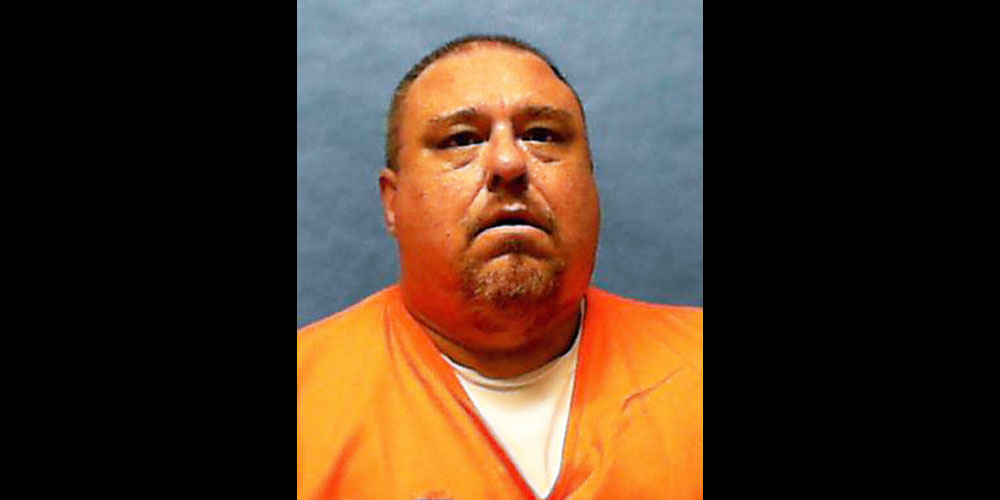
More than 38 years after he murdered two people in Okaloosa County, Frank Walls was executed Thursday evening at Florida State Prison.
Walls, 58, was pronounced dead at 6:11 p.m., according to the Florida Department of Corrections. He became a record 19th inmate executed this year in the state.
The execution came hours after the U.S. Supreme Court rejected last-ditch appeals by Walls’ attorneys. The court, as is common, did not explain its decision.
Gov. Ron DeSantis on Nov. 18 signed a death warrant for Walls, whose attorneys went to the U.S. Supreme Court after the Florida Supreme Court and a three-judge panel of the 11th U.S. Circuit Court of Appeals refused to halt the execution.
A 1992 sentencing document posted on the Florida Supreme Court website with the death warrant said Walls went to the home of Edward Alger and Ann Peterson in the early morning hours of July 22, 1987, and woke them.
The document said Walls forced Peterson to bind Alger’s wrists and ankles. After a struggle, the document said, Walls slashed Alger’s throat and shot him three times in the head and neck. It said Walls then struggled with Peterson before fatally shooting her.
“Prior to the infliction of that (gunshot) wound, the defendant had informed her of the fate of her boyfriend, Edward,” the document said. “She was curled up crying as she was told of what had happened to Edward. By the defendant’s own admission, it was his intent to leave no witnesses. His first shot at her went awry and struck her cheek. Upon being shot the first time, she began crying and screaming, then the defendant fired a second fatal shot into her head.”
In seeking to prevent the execution, Walls’ attorneys raised a series of arguments, including that he is intellectually disabled and that putting him to death would violate the U.S. Constitution’s Eighth Amendment ban on cruel and unusual punishment.
Also, the attorneys raised issues about Walls’ chronic health problems and the state’s lethal-injection procedure. The attorneys contended Walls could be at an increased risk during the execution of suffering pulmonary edema — a condition that involves too much fluid in the lungs — because of his medical problems. They argued that would violate the U.S. Constitution’s Eighth Amendment ban on cruel and unusual punishment.
Florida’s previous modern-era record for executions in a year was eight in 1984 and 2014. The modern era represents the time since the death penalty was reinstated in 1976, after a 1972 U.S. Supreme Court decision halted it.
The state, however, far surpassed that record in 2025. It also executed Mark Allen Geralds on Dec. 9; Richard Randolph on Nov. 20; Bryan Jennings on Nov. 13; Norman Grim on Oct. 28; Samuel Smithers on Oct.14; Victor Jones on Sept. 30; David Pittman on Sept. 17; Curtis Windom on Aug. 28; Kayle Bates on Aug. 19; Edward Zakrzewski on July 31; Michael Bell on July 15; Thomas Gudinas on June 24; Anthony Wainwright on June 10; Glen Rogers on May 15; Jeffrey Hutchinson on May 1; Michael Tanzi on April 8; Edward James on March 20; and James Ford on Feb. 13.

Justices Reject Challenges to Florida Law Allowing Death Sentences Without Unanimous Juries
The Florida Supreme Court on Thursday rejected two challenges to a 2023 law that allows judges to impose death sentences without unanimous jury recommendations.
Ruling in cases from Duval and Bay counties, the Supreme Court backed the constitutionality of the law, which the Legislature and Gov. Ron DeSantis approved after Parkland school shooter Nikolas Cruz was sentenced to life in prison because a jury did not unanimously recommend death.
The Legislature in 2017 required unanimous jury recommendations after rulings by the U.S. Supreme Court and the Florida Supreme Court about the death-penalty process. But the 2023 law undid the unanimity requirement, allowing inmates to be sentenced to death based on the recommendations of eight of 12 jurors.
Attorneys for Death Row inmates Michael James Jackson, who was convicted in the murders of a Duval County couple, and Michael H. Hunt, who was convicted in a Bay County murder, raised a series of arguments at the Florida Supreme Court alleging that the state’s sentencing system is unconstitutional.
But, for example, the Supreme Court in the Hunt case said the system does not violate the U.S. Constitution’s Eighth Amendment ban on cruel and unusual punishment.
“Together, Florida’s death penalty provisions establish the constitutionally required safeguards to ensure that there are no ‘arbitrary, capricious, or freakish’ death sentences. … Thus, there is no support for the argument that the Eighth Amendment requires a unanimous jury recommendation,” Thursday’s main opinion in the Hunt case said, partially quoting from a 1984 U.S. Supreme Court precedent.
The main opinions in both cases were shared by Chief Justice Carlos Muniz and Justices Charles Canady, John Couriel, Jamie Grosshans, Renatha Francis and Meredith Sasso. Justice Jorge Labarga wrote separate opinions, saying he concurred with the results of the main opinions because they were consistent with other court rulings over the past five years.
“However, I write to underscore that the 8-4 threshold renders Florida the absolute outlier among states that impose the death penalty,” Labarga wrote in the Jackson case. “Florida now has the lowest standard in the nation, requiring the fewest number of jurors to recommend the death penalty.”
Labarga wrote that Florida and Alabama are the only states among the 27 states with the death penalty that do not require unanimous jury recommendations. Alabama allows judges to impose death sentences after 10-2 recommendations.
The 2023 law did not affect the requirement that juries reach unanimous verdicts on the guilt of defendants — only the sentencing process that follows.
Florida long allowed death sentences to be imposed based on 7-5 jury recommendations. But that changed after decisions in 2016 by the U.S. Supreme Court and the Florida Supreme Court.
In January 2016, the U.S. Supreme Court in a case known as Hurst v. Florida, ruled that the state’s death-penalty system was unconstitutional. The Florida Supreme Court in October 2016, in a similarly named case of Hurst v. State, interpreted and applied the U.S. Supreme Court ruling and said unanimous jury recommendations were required. The Legislature responded in 2017 by putting such a unanimous requirement in law.
After DeSantis took office in January 2019, he made appointments that created a conservative majority on the Florida Supreme Court. In 2020, the court reversed course and said unanimous jury recommendations were not needed.
The unanimous requirement, however, remained in law until after Cruz received a life sentence for murdering 17 students and faculty members at Parkland’s Marjory Stoneman Douglas High School in 2018. The Republican-controlled Legislature in 2023 overwhelming passed a bill to eliminate the unanimity requirement
“The reason for the 8-4 legislation is clear: three members of a Broward County jury did not vote for death in the case of Nikolas Cruz, who pled guilty to multiple counts of murder in the Parkland school shootings,” Hunt’s attorneys wrote in a Supreme Court brief last year.
Hunt, 60, was sentenced to death in 2024 in the murder of Lexie Peck in 2019 at a Panama City home. The jury voted 10-2 to recommend the death penalty. Thursday’s Supreme Court opinion also upheld Hunt’s conviction.
Jackson, 43, was convicted in the 2005 murders of James and Carol Sumner, who were kidnapped from their Duval County home and buried alive in Georgia, according to Thursday’s opinion in the case. Jackson was initially sentenced to death, but the sentence was later vacated.
He was resentenced to death in 2023 after an 8-4 jury recommendation. The resentencing occurred after the 2023 law took effect eliminating the need for unanimity.
–Jim Saunders, News Service of Florida
























R.S. says
And the rule of idiocracy continues in this state. It is a fact that states WITH the death penalty have more violent crime than states without it. Why does nobody in charge of the procedures in this benighted state think about why that is so? Why are so many guided by rage and revenge, rather than reason and goal-directed thinking? I am baffled.
Bo Peep says
Way to go Ron. Another stain on the fabric of society removed. Only silly liberals complain about killing convicted murderers while advocating abortion.
Kyoshin says
Its rather strange to me that they defend criminals like this who do hainous acts i say if you’re convicted of such crimes and there’s no shadow of a doubt that they did it they should be put down fast like when a rabid animal attacks a person they should not wait on death row that is just my opinion
Land of no turn signals says says
NEXT !!
Doug says
Great job Governor DeSantis! Let’s get 20 before the years end, and then set another record next year!