



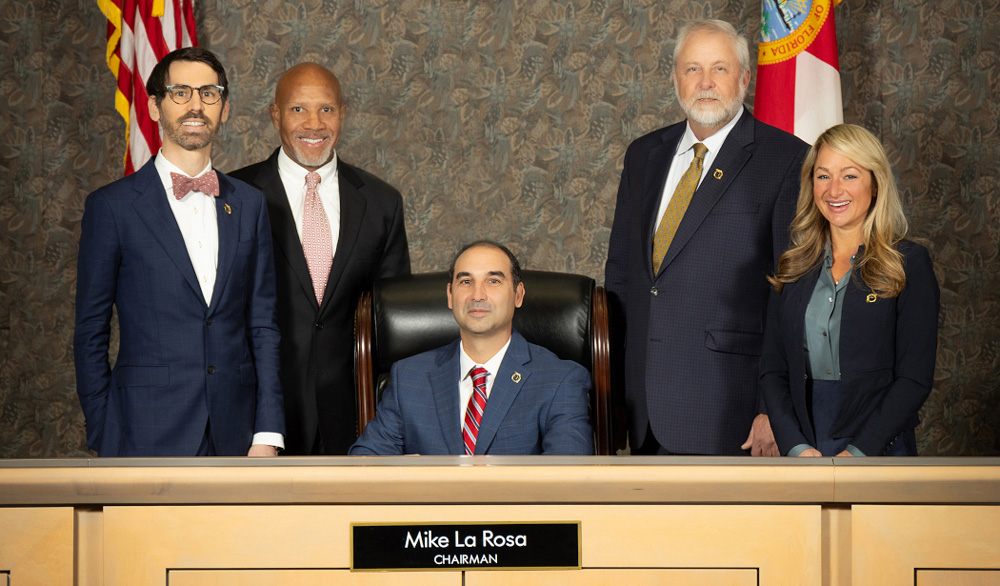
The Florida Public Service Commission (PSC) approved a four-year settlement with Florida Power & Light (FPL) Thursday for about $6.9 billion, which opponents claim is the largest rate hike in U.S. history.
The investor-owned utility, Florida’s largest with approximately six million accounts totaling around 12 million customers, said in a press release that it will enable FPL to continue to make “smart, necessary investments in the grid to power Florida’s growth — while keeping customer bills well below the national average.”
[FPL is the exclusive provider of electricity in Flalger County and its cities.]
The proposed rate hike was met with fierce opposition. More than two dozen local and state elected officials sent a letter to last month to Gov. Ron DeSantis and the PSC, calling on them to reject the proposal.
The rate hike also became an issue in the race for attorney general. Former Democratic state Sen. José Javier Rodriguez, running for the position next year, called on Florida Attorney General James Uthmeier to intervene in the case.
Attorneys general in places like Michigan, Connecticut, and Arizona have challenged proposed rate hikes by public electricity utilities this year, and Republican former Florida attorneys general such as Bill McCollum and Charlie Crist previously intervened in rate hikes proposed by investor-owned utilities.
 However, Uthmeier declined to get involved.
‘Shameful decision’
Bradley Marshall, who represented several groups who opposed the rate hike, insisted the fight isn’t over yet.
“We look forward to reviewing the written decision and expect this case will be appealed to the Florida Supreme Court, where we look forward to presenting our case,” he told the Phoenix. “This decision hurts the people who are already struggling with higher power bills.”
Other critics blasted the PSC.
“Four years ago, FPL was awarded one of the largest rate hikes in U.S. history. Today, they’ve made history again at nearly double that amount. This shameful decision illustrates why our state energy regulators cannot be trusted to ensure that families have reliable, affordable energy,” said Food & Water Watch Senior Florida organizer Brooke Ward in a written statement.
“People are not asking for diamonds or gold — while greedy utilities keep raking in record profits, regular Floridians want to be able to afford running their air conditioners and heaters. The Legislature must pass affordable energy legislation this session to ensure fair electricity prices.”
“By approving this rate hike, the PSC has handed FPL another blank check while Floridians struggle to keep the lights on,” said Alyssa White, climate justice organizer for Florida Student Power. “This is a slap in the face to every family, student, and small business already drowning in high bills. Our communities deserve an energy system that puts people over profit, and we will continue to build the power to make that happen!”
FPL initially wanted bigger rate hike
Originally, FPL proposed a four-year, $9.8 billion rate hike but, shortly before the PSC was scheduled to hold hearings on that proposal in August, FPL announced that it had reached an 11th-hour “agreement in principle” with what it described as a “diverse” group of organizations including Walmart, RaceTrac, Wawa, and the Florida Retail Federation. That proposal reduced the rate increase to about $6.9 billion but still maintained a return on equity of 10.95%. ROE is a measure of a company’s financial performance.
FPL’s revised proposal drew pushback from the Office of Public Counsel (OPC), designated by law to represent Florida consumers. The OPC worked with organizations such as Florida Rising and the League of United Latin American Citizens of Florida (LULAC) and came up with their own counterproposal, which did not include any input from FPL.
Their proposal would cut the base bill by nearly half for the average residential customer compared to FPL’s original proposal, to $5.2 billion. Their proposed ROE for FPL would be 10.6%.
PSC Chairman Mike La Rosa rejected the OPC proposal on Sept. 12, saying FPL was “an indispensable party to any settlement.” He added that while their proposal could not be presented as a settlement agreement, it could be included as part of their testimony in opposition to FPL’s agreement submitted in late August.
FPL says that in 2026, its “typical” 1,000-kWh residential customer bill in most of Florida will increase by $2.50 a month, or about 2%, from the existing $134.14 to $136.64. In Northwest Florida, the typical residential customer bill will remain relatively flat, going from the existing $143.60 to $141.36 in 2026. [There would be additional increases in 2027, 2028 and 2029.]
“We appreciate the Florida Public Service Commission’s thorough review of our rate plan,” said FPL president and CEO Armando Pimentel in a statement.
“Today’s vote enables FPL to continue to deliver some of America’s most reliable electric service and meet the needs of our fast-growing state — and we project will keep customer bills well below the national average through the end of the decade. As we begin our second century of serving Florida, approval of this plan is a win for our customers and a win for the entire state.”
–Mitch Perry, Florida Phoenix

























JimboXYZ says
The $ 9.8 billion over this $ 6.9 billion rate hike is a 42% increase.
“Four years ago, FPL was awarded one of the largest rate hikes in U.S. history. Today, they’ve made history again at nearly double that amount.”
Era of Bidenomics continues into Trump 2025-2029. One assumes the rest of the Florida’s Electricity is also raising their rates ? Duke (Orlando)/Tampa Electrical Company (TECO), Jacksonville, Electrical Authority (JEA) & FPL, As the big 4 ? Arizona Public Services in Hialeah, FL. Didn’t realize that Hialeah, FL was that big , a city of nearly 1/4 million population.
“Hialeah is a large city in Florida with a population of about 223,000. The city is located northwest of Miami. Hialeah is known as the city with the highest percentage of Hispanics at 94%…
Hialeah is the largest economic center in Miami-Dade County.”
Source: https://uselectricgrid.com/electric-companies-in-florida/
An AI table of Inflationary Bidenomics. Sandbagged again by the Delaware Liar.
Overview of FPL Rate Hikes Since 2020
Florida Power & Light (FPL) has implemented significant rate increases since 2020, impacting millions of customers across Florida. The following table summarizes the key rate hikes and their implications.
Year Rate Increase Details Average Monthly Bill Impact
2020 FPL reported net earnings of over $2.65 billion. N/A
2021 Proposed a 20% increase over four years, leading to a settlement. Estimated increase of over $200 annually by 2025.
2022 Continued discussions on rate adjustments amid public outcry. N/A
2023 Ongoing debates about affordability and utility profits. N/A
2026 Approved rate hike of $945 million, increasing average bills by $2.50/month. Average bill rises from $134.14 to $136.64.
2027 Additional increase of $705 million planned. Further increases expected.
Atwp says
Welcome to the world of lay offs, stagnant to no salary increase, now a proposed fpl rate hike. What a beautiful world. We will see what will happen.
LocalDog says
Seems to me the cost of electricity is far less than what is being charged for water.
Al says
The county just raised your property tax and you’re okay with that. The FPL increase is way less but because it’s a private company everyone is up in arms. It’s easy to cut $2.50 off your bill but you can’t cut $100 off your property tax. I guess the county robbing you is fine but damn the private enterprises.
Kath says
The more houses that are built, the high people’s electricity will be . no one looks at it that way but ,more electricity, more water & sewer. = higher bills.. bad roads = look at all the garbage all over the place .and let’s not for get spray painting all over the place.. Yes More Houses = Higher bills &Higher Taxes High Electric Bills..Sorry to say we haven’t seen nothing yet.
Time to stop this! says
There are roughly 6 million FPL customers in Florida. That means each customer will roughly pay $1150 a year for this rate increase. @#@@!! the dirty politicians who approved this! Didn’t FPL already get to simply keep all the miney from the increase that we paid to fund their nuclear plant that was never built?? This state utilities and insurance industry is corrupt and slowly killing seniors and disabled people. We dont need no property tax so they can gouge us on utilities! Quiet are the masses as their opessors slowly squeeze….
t.o. Doug says
The picture looks like they’re all laughing at us.
Ray W. says
FOX News reports that Texas-based Janta Power has developed a vertical solar panel tower alternative to the industry-standard horizontal solar panel array. The new tower can withstand 170 mph winds; it uses modular foundations to simplify construction in a wide range of environments. More than 70 airports all over the world are testing the product, including Munich International Airport and Dallas-Fort Worth International Airport.
The tower design gives each tower a 3D face to the sun, which “gives each site a capacity factor of around 32%, compared to roughly 22% for flat panels. This greater efficiency lowers the Levelized Cost of Energy (LCOE) to about $0.05 per kilowatt-hour, well below the global average of $0.15.
In the reporter’s words:
“Traditional solar panels cover large flat areas on rooftops or open fields. This approach uses a lot of land and misses much of the day’s available sunlight. The Sun moves across the sky, but flat panels capture energy best only when it is directly overhead.”
The vertical panel tower concept, however, uses a stack of pivoting vertical solar panels “to create a compact three-dimensional structure that captures more sunlight throughout the day. Think of it as the solar version of a skyscraper: more power from less ground space.”
Smart tracking software allows the array to adjust its orientation to the sun from sunrise to sunset, which allows the towers to produce some 50% more energy from a third of the land required by “flat-panel systems.”
Writes the reporter:
“Because of their vertical orientation, the towers can capture sunlight during the early morning and late afternoon when flat arrays are least efficient. The result is a steadier flow of electricity across the entire day, reducing stress on power grids and lowering the need for short-term back-up plants.”
Make of this what you will.
Me?
Changes in energy production pile upon changes in energy production. Efficiency improvements abound. What was accepted knowledge in 1960 about “peak oil” became garbage with the onset of the Shale Revolution that began in roughly 2009. Anyone looking backwards at the onset of the Shale Revolution got left behind. Forward looking companies profited.
In 2023, the U.S. annualized average cost for a standard one million BTU’s of natural gas at the well-head was $2.20. The EIA projects that in 2026, the annualized average cost will be $4.00 per million BTU’s.
Does anyone wonder why FP&L is asking for so much more money? FP&L chose a long time ago to pivot from the burning of coal to the burning of natural gas. Natural gas costs money. But natural gas prices fluctuate, sometimes by a lot. $4 in 2026 is nearly double $2.20 in 2023. Is it fair to conclude that FP&L anticipates that it will have to pay more to produce electricity next year simply because its primary source of power will in all likelihood cost the company more money?
Sunlight doesn’t change in price.
When I first began reading about America beginning an industry effort to export liquefied natural gas, likely in 2014, but possibly in 2013, there were zero operating LNG exporting facilities. Cheniere Energy was leading a pack of energy companies seeking to build LNG export plants, but its first plant didn’t open until February 2016. In 2013 or thereabouts, some 30 other companies were in the permitting process, or fresh out of it, but only Cheniere was actually building the necessary structures.
Now, according to the EIA, today, there are seven operating LNG export plants in the U.S., with eight more under construction. We already lead the world in LNG export volumes.
What does any FlaglerLive reader think will happen when American LNG export capacity perhaps doubles in the near future? If American natural gas output doesn’t double to equal the rise in LNG export capacity, will it be accurate to think that natural gas prices of today very will might significantly rise over the long-term? Is this why the EIA is predicting a rise in price in 2026 for natural gas?
If the story on which my comment is based is accurate, this new vertical 3D solar tower prototype offers electricity at one-third the cost of today’s global average Levelized Cost of Electricity (LCOE). The global average cost includes all power sources, i.e., nuclear, geo-thermal, coal, natural gas, hydro, diesel, wind and solar.
Since I have posted comments to FlaglerLive about Texas now allowing the building of data centers in remote locations, I decided to look for a study of how most efficiently businesses could power data centers. At this point, I should explain what levelized cost of energy means, which is that from application to permit to full build-out to actual operation over the expected lifetime of the project, each type of energy source has a unique levelized cost of energy per kilowatt-hour produced. Building a natural gas-fired power plant in West Texas will have a different levelized cost of energy from building the same type of power plant in Iceland.
I found an Energy Report from Elsevier, scheduled for publication in its December 2025 issue, titled:
“Energy solutions for data center: Comparative analysis of levelized cost of electricity (LCOE) and recent developments.”
This is from the report’s conclusion:
“This study explores the intricate dynamics between data center energy demand, cost considerations, technological advancements, and global policy strategies. The LCOE analysis reveals that while natural gas offers a relatively cost-effective solution for powering data centers like Meta’s, the long-term environmental implications necessitate a transition towards renewable and low-carbon alternatives. Solar with battery storage, under provided assumptions, presents the cheapest option along with wind and solar being viable, yet their intermittancy requires innovative grid management and more advance storage solutions to ensure consistent reliability. Nuclear power, despite its high upfront costs, offers a stable and carbon-free energy source that warrants further consideration, particularly with advancements in small modular reactor technology.”
If FlaglerLive readers want lower electricity bills, then FP&L better pivot again, this time away from new natural gas plants and towards solar and wind farms, plus battery storage. Pivoting back to coal will only raise electric bills.
This new 3D solar tower plan is simple. Bore a hole in the ground deep enough and wide enough to permit the tower to withstand 170 mph winds. Pour into the hole a concrete base with hardware sunk into the concrete that permits bolting the tower pole to the base. Attach a mechanism to the pole that allows the panels to pivot throughout the day. Install a motor manipulable by software to ensure that the panels properly track the sun. Connect the tower to transmission lines that go to the grid. Produce energy at a cost one-third the average global annualized cost being paid right now for electricity. Resolve to never ever accept anything typed by JimboXYZ or Dennis C. Rathsam without first exhaustively checking their comments for accuracy. Go on with your life with hopefully lower electricity bills.
Ed P says
All valid points except that some days the wind doesn’t blow hard enough to be productive. About 20- 30% of the time. Even too much wind can be an issue. Some days bad weather like ice storms or snow are issues too.
Solar sleeps at night. In fact it would be a technology breakthrough if any solar system could capture more than 7 hours of peak sunshine for electrical generation. Weather is always a real factor.
Conversion of old coal generation facilities to nuclear is a solid option.
Power 24/7, 365 days for 50-80 years. Even with the governmental regulations ratcheting up the costs, extending construction times, a nuclear power plant can turn a profit in 25-30 years.
Sure a gas natural gas fired plant becomes profitable in 5 years but as Ray points out, it’s held hostage by supply. Not nuclear.
The cost escalation is not universal. China and South Korea have built nuclear power plants with shorter construction times and stable costs.
It can be cost competitive if allowed to be.
Ray W. says
Hello Ed P.
Thank you.
Yes, solar and wind can be intermittent. That’s why battery backup is catching on. Battery storage costs are becoming so inexpensive that solar+battery is cheaper than natural gas, and prices will continue to fall as technological breakthroughs become commercially viable.
Natural gas technology continues to improve, but the gains in efficiency are measured in tenths of a percent. Solar, wind and battery technologies are in their infancy.
This is why I keep repeating Jim Farley’s observation that EVs are in their Model T stage of development. The word of Ford’s CEO carries weight. When he says we need to look forward to an electric vehicle future instead of looking backwards at a gas-engine vehicle past, can it be argued that he means it?
Gas-powered engines are near their theoretical maximum in energy extraction per gallon of gas.
After 125 years of engine development by who knows how many different companies, Nissan just announced an engine that converts 42% of the energy in the gasoline it consumes into productive force; the rest, 58%, is wasted out the exhaust or transferred into the air by the cooling system. Can it be argued that, after the passage of so much time and effort, engines are at or near their theoretical maximum efficiencies?
EV batteries and motors are not yet anywhere near their theoretical maximum efficiencies.
Today’s most advanced liquid-state lithium-ion batteries have a theoretical maximum energy storage capacity of 500 watt-hours per kilogram, yet few of today’s commercial EV batteries can store 300 watt-hours per kilogram of energy. Most are in the 200-250 watt-hours per kilogram storage range.
The theoretical maximum energy storage capacity of aluminum-ion graphene batteries is 1200 watt-hours per kilogram.
Joe D says
Reply to Ed P:
One thing in Flagler Beach’s WIND POWER favor is that it has (according to a “Move to Flagler Beach” Website I saved “somewhere” in my retirement home search) the highest level of COASTAL WINDS of any area along the Eastern Atlantic Coast of Florida.
I can attest to that while trying to do any kind of exterior “touch up” spray painting on my Flagler Beach townhouse 🫤.
Dennis C Rathsam says
Im so happy with the 40 solar panels decorating my roof! FPL,s not my daddy
Deborah Coffey says
No, Florida Power & Light (FPL) is not a public utility; it is a private, investor-owned company that operates as a monopoly in its service area. It is regulated by the Florida Public Service Commission (PSC), which approves its rates, and is a subsidiary of the larger company NextEra Energy.
Company structure: FPL is an investor-owned, for-profit company, not a government-owned entity.
Regulation: It is regulated by the Florida Public Service Commission, which acts as the public’s watchdog, but it is not a public utility in the sense of being owned by the public.
Monopoly status: FPL operates as a monopoly, meaning it is the sole provider of electricity in its service territory and is not subject to direct market competition.
Parent company: FPL is a subsidiary of NextEra Energy, Inc., which is one of the largest electric power and energy infrastructure companies in North America.
Pogo says
@As someone recently noted
We only need about five more planets, like our own planet, to serve those on this one. Your call is important, please remain on hold…
Good night, and good luck.