



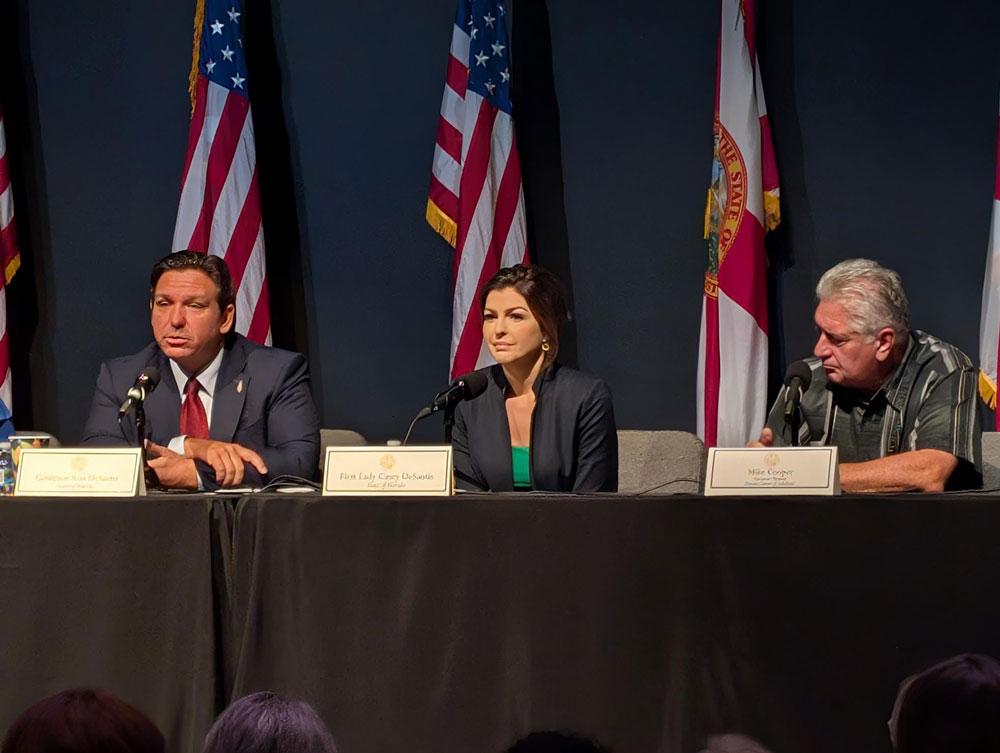
An Analysis
Choosing the top political stories in an “off year” when no statewide elections took place is challenging — although jockeying for the 2026 elections is well under way. Property taxes and gun rights, meanwhile, have emerged as issues likely to dominate the 2026 legislative session, which kicks off in a little more than two weeks.
Donald Trump endorses Byron Donalds (Feb. 20)
With Ron DeSantis now in lame-duck status, one of the biggest stories in Florida politics was to whom would the Republicans run to succeed him. While names like Matt Gaetz, Ashley Moody, Casey DeSantis, Jimmy Patronis, and Jeanette Nuñez were bandied about early on, many of them became no longer viable for various reasons as the year progressed.
Byron Donalds was among those always in the mix, but his candidacy went into the stratosphere after President Trump endorsed him in a Truth Social post, before the Naples Republican had even formally entered the contest. “RUN, BYRON, RUN!” POTUS wrote and, less than a week later, Donalds announced his candidacy.
Since then, he’s never looked back in the polls and, with more than $40 million raised to date, is dwarfing both his Republican and Democratic opponents. Can any candidate catch him? That’ll be the story of the year in Florida politics in 2026.
The Hope Florida story breaks (April 11)
The Tallahassee bureau for the Tampa Bay Times/Miami Herald broke the Hope Florida story during the middle of the legislative session. If nothing else, the affair amplified the already cold war brewing between Gov. Ron DeSantis’ office and the Florida House of Representatives.
The story reported that just weeks after the administration steered $10 million from a Medicaid legal settlement to the Hope Florida Foundation — the entity led by Casey DeSantis designed to connect Floridians in need with government resources, nonprofits, the private sector, and religious organizations — in the fall of 2024.
The foundation moved those funds to two nonprofit groups (Save Our Society from Drugs, or SOS, and Securing Florida’s Future). Those groups then routed those funds to Keep Florida Clean, a political action committee created to beat the proposed constitutional amendment to legalize recreational cannabis in the state.
The story electrified the Capitol, and was immediately denounced as a political hit job by DeSantis designed to hurt him and the first lady. Hearings were held in the House of Representatives, and in October a Leon County grand jury began investigating the allegations. No indictments or final reports have been issued.
DeSantis appoints Ashley Moody to the U.S. Senate (Jan. 16); Blaise Ingoglia as CFO (July 16); Jay Collins as lieutenant governor (Aug. 12)
Call it the DeSantis Legacy Project. While the governor has just a year left in office, he’s been able to appoint people close to him to positions of power in the state that could shape Floridians’ lives long after he moves out of the Governor’s Mansion.
The governor undoubtedly had many worthy Republicans he could have appointed to replace Marco Rubio in the U.S. Senate. He chose a close ideological partner in Attorney General Ashley Moody. He then quickly replaced her in the Cabinet position with his former chief of staff, James Uthmeier.
He took much more time before selecting two of his then-closest allies in the Florida Senate — Blaise Ingoglia and Jay Collins — to succeed Jimmy Patronis as CFO and Jeanette Nuñez as his lieutenant governor, respectively.
DeSantis and Ingoglia have been singing off the same sheet music in the past half-year in their campaign to eliminate or substantially reduce property taxes in Florida in 2026. And while just as conservative as Moody, Uthmeier has embraced picking fights that capture headlines — not a bad strategy as he goes before voters for the first time in his life in 2026. Whether his involvement in the Hope Florida saga lifts his candidacy next year remains to be seen.
And Collins? When DeSantis named him as LG in August in Tampa, the governor hailed him as “the Chuck Norris of Florida politics.” Political observers speculated it was a matter of when, not if, the governor would endorse him to take on Donalds for governor next year.
That DeSantis endorsement hasn’t happened, however, and despite the millions of dollars in TV ads that aired over the past month on college football Saturdays and the Sunday morning political talk shows, Collins apparently still wasn’t ready to announce his candidacy at the end of the year. Will he do so in 2026?
Immigration (Jan. 7)
No governor was more excited about Donald Trump’s campaign pledge for mass deportations during his second go-round at the White House than Ronald Dion DeSantis.
The governor surprised state lawmakers when he said just days into the New Year that he wanted to call a special session on immigration ahead of the regular legislative session.
“We’ve done a lot. We passed a major bill in 2023, but I think that there needs to be some additional legislation to help complement the federal government’s now–newfound appreciation to stop illegal immigration, and to hold people accountable. … We need to be prepared to act. I don’t think that you can wait until April or May to do something in that respect,” he said.
That led to the first of what would be many clashes with the Florida House and Speaker Danny Perez, with Perez declaring he saw no need to hold a special session just then. Senate President Ben Albritton also initially rejected the call.
“It is completely irresponsible to get out ahead of any announcements President Trump will make, especially when uninformed or ill-timed state action could potentially impair or impede the success of President Trump’s forthcoming efforts to end illegal immigration, close our borders, and protect the sovereignty of our nation,” Albritton and Perez wrote in response.
Ultimately, the Legislature and DeSantis did come together on an anti-illegal immigration package in mid-February that included a provision making it a misdemeanor for undocumented immigrants over age 18 to “knowingly” enter Florida “after entering the United States by eluding or avoiding examination or inspection by immigration officers.”
That measure was blocked by a federal judge in Miami, who later found Attorney General James Uthmeier in contempt of court for referring to the court’s order blocking the law as illegitimate and unlawful.
The state made international news in the summer with the unveiling of a federal detention center in the Everglades dubbed “Alligator Alcatraz.” In December, Amnesty International said in a report that facility as well as the federal Krome North Services Processing Center may have violated international standards by imposing conditions that could amount to torture of detainees,
The Florida Legislature passes and Gov. DeSantis signs HB 1205, making it significantly harder to pass citizen-led constitutional amendments (May 2)
“This is the most important bill that we will be hearing in this chamber,” Democratic Senate Leader Lori Berman said about HB 1205 when the bill came before the chamber during the last week of the regularly scheduled legislative session earlier this year. “And as you’ve heard, it’s going to greatly restrict the access of the citizens of the state of Florida to be able to address the system.”
The bill was driven by the zeal of Gov. DeSantis, who announced at the beginning of the year that it was a top legislative priority for him. As the Phoenix reported at the time, the governor and his fellow Republicans in the Legislature argued that the measure was needed to combat signature petition fraud that they alleged had been exposed last year in the campaigns to pass constitutional amendments regarding legalizing recreational marijuana and abortion rights.
Floridians narrowly failed to pass the two constitutional amendments that DeSantis fiercely opposed. The effects have become apparent this year, with groups that had hoped to place amendments on the ballot throwing in the towel because of the tougher requirements. And it’s also threatened a new effort by Trulieve and others in the medical marijuana industry in Florida to get a new constitutional amendment on the ballot in 2026.
Democratic Senate Leader Jason Pizzo quits the Florida Democratic Party (April 24)
It was another difficult year for the Florida Democratic Party, which faces a more than 1.4 million voter registration disadvantage to the Republican Party at year end.
Pizzo stunned his colleagues and the political establishment in Tallahassee when he declared on the Senate floor that he was done with the Democratic Party, proclaiming it was “dead.” “But there are good people that can resuscitate it, but they don’t want it to be me.”
Two months after his departure, Chair Nikki Fried declared that “our message is s***,” during the Florida Democratic Party’s Leadership Blue gala in Broward County. “Our brand is broken. But quitting, hiding, waiting, or whining will not fix it. What will? Showing up.”
So, the question is going into the 2026 cycle is, will Florida Democrats show up at the ballot box a year from now? And can that make a difference? Nationally, the depression surrounding the party following Donald Trump’s election over Kamala Harris has appeared to dissipate, based on the results of the few major elections this fall. But as was the case going back to 2018 during Trump’s first reign in office, will a “blue wave” even make it to the Sunshine State?
Democrats were heartened in the spring when their two candidates running in special congressional elections lost by “only” 15 points in Florida’s First Congressional District and 14 points in the Sixth District.
The Sixth District seat was won by Republican Randy Fine over Democrat Josh Weil, who stunned political observers by raising more than $15 million in a race that the GOP incumbent in November of 2024 (Mike Waltz) had won by 33 points.
Weil announced in June that would run for the party’s nomination for U.S. Senate in 2026 against Moody, and boasted that his team would raise $10 million on its own for voter registration efforts in Florida leading up to the 2026 election, with an emphasis on Miami-Dade and Pinellas counties. Unfortunately for him and the party, Weil announced a little over a month later that he was dropping out of the race because of health concerns.
The party closed out the year on an up note, with Eileen Higgins becoming the first registered Democrat to become mayor of Miami since the 1990s. Fried notably praised Democrats, Republicans, and independents for Higgins’ big victory, because the party is going to need those voters not registered with the party to make an impact at the ballot box next year.
Former GOP U.S. Rep. David Jolly and Orange County Mayor Jerry Demings now look to be in a competitive battle for the party’s nomination for governor in 2026.
Local governments and citizens express revulsion towards Senate Bill 180 (Sept. 29)
The latest blow to local growth management laws in Florida was passage of Senate Bill 180 earlier this year. The measure effectively freezes local land-development regulations and comprehensive plans through October 2027. It didn’t generate much controversy during the legislative session, because for most of its movement through committees it was perceived as a thoughtful measure to help local residents recover from the devastating hurricanes Helene and Milton in the fall of 2024.
Calling it the “largest incursion into local home rule authority” since adoption of the Florida Constitution in 1968, 25 local governments have gone to court to try to block the law that restricts local governments from regulating development.
At the heart of the anger of local governments are two specific parts of the bill that freeze cities and counties from adopting land-use regulations considered “more restrictive or burdensome” than those in place before the recent (or future) hurricanes, even if the changes are unrelated to disaster recovery.
During a Manatee County legislative delegation meeting in Bradenton in late October, several citizens blasted state lawmakers, saying they had “betrayed” them in voting for the legislation.
Pinellas County Republican Sen. Nick DiCeglie said his motivation for the legislation was to ensure that local governments prepare and respond better to natural disasters than they did a year ago. In December, he filed a bill (SB 840) to scale back some the effects of SB 180 that will be heard in the 2026 session.
Gov. DeSantis and CFO Ingoglia make the possibility of reducing/removing property taxes on homestead properties their top goal for 2026 (all year long)
Will Florida become the first state in the country to eliminate property taxes?
That’s the scenario that Gov. DeSantis appears determined to to leave as one of his most important policy achievements before he leaves the governor’s mansion for parts unknown.
The governor made it clear during the 2025 legislative session that he’d prefer Floridians with homesteaded properties receive a tax break at the same time that the House and Senate was debating how big of a sales tax the state could afford as an alternative.
His advocacy picked up steam after he appointed close ally Blaise Ingoglia to replace Jimmy Patronis as the state’s chief financial officer. Ingoglia traveled around the state with his Florida DOGE (later rebranded as FAFO) team to accuse some of the biggest (and not so big) local governments in the state that they had indulged in millions of dollars of wasted spending — in some cases hundreds of millions of dollars.
Ingoglia’s efforts were a prebuttal to expected complaints from local officials that a major reduction in property tax revenues would deplete vital services for their residents. “I think there is more than enough room to cut local budgets, probably by the amount of 15%, and not even worry about taking away any money for essential services,” he said during a debate at the University of South Florida in November.
Reducing or removing property taxes can only be done by the public via a constitutional amendment. The question is, how many bills to do the job? DeSantis said at a press conference in Tampa in late October that he wanted only one to go before the voters next year. He blasted the eight separate proposals (including seven resolutions that would be constitutional amendments) proposed by the Florida House as “milquetoast,” with “not one proposal that would get people excited about.”
House members say they’re still waiting for DeSantis to offer any specific language for property tax relief.
Florida appeals court declares the state’s ban on open carry unconstitutional (Sept. 10)
For having the reputation as being one of the least regulated states in the country when it comes to firearms (“The gunshine state,” anyone?) Florida had been one of just a handful of states that banned the open carrying of firearms in the country.
No longer.
A three-judge panel of the Florida First District Court of Appeal ruled in September that the 1987 law banning open carry was unconstitutional — a ruling cheered by Florida Attorney General James Uthmeier.
“Our office fully supports the Court’s decision,” he said on X. “This is a big win for the Second Amendment rights of Floridians.”
Days after the ruling, Uthmeier said that reinterpreting the law based on the court’s ruling was “not the cleanest solution and there’s likely cleanup that’s going to be needed by the Legislature.”
An implementing bill is likely, but Second Amendment advocates say they’re concerned about how far that might go.
“Members of Florida Gun Rights stand united and strong against any potential infringements on the recent ruling which declared Florida’s ban on open carry as unconstitutional,” Logan Edge of that organization told the Phoenix.
“The Legislature remains a hostile opponent against gun rights and open carry but, after many years of pushback, gun owners gained a massive victory in the courts,” he added. “We will make sure every Tallahassee legislator hears from gun rights activists and oppose any effort to snatch defeat from the jaws of victory.”
Congressional redistricting (Dec. 4)
In advance of the 2020 U.S. Census, the state’s congressional delegation breakdown was 16 Republicans and 11 Democrats.
Gov. Ron DeSantis’ own congressional redistricting map (later declared by the courts to be constitutional) resulted in the GOP gaining four additional seats, taking a 20-8 lead (the state was awarded an additional seat in the Census).
Now, after President Donald Trump called on Texas to redraw its congressional districts to guarantee him an additional five Republican seats as he fears losing the House to the Democrats in 2026, other states have been following suit, with the Sunshine State only now beginning such efforts.
Gov. DeSantis and the Legislature appear to be in lockstep, with the only dispute so far being the timing: The House wants to come up with a new map by time the regular legislative session ends in mid-March, while the governor and now the Senate want them to wait and focus on the matter during a special session later in the spring.
–Mitch Perry, Florida Phoenix

























Merrill Shapiro says
Mitch Perry is too kind by a half when he leaves out the word “corruption” in describing the Hope Florida debacle.
Everyone has a story they think should have been included. Personally, I don’t understand how Perry could have left out the nearly quarter-billion dollars of school vouchers that seems to have been paid to students to attend private, mostly religious schools only to have those students show up in public schools. “Show me, show us, the money!”
Mike P says
I always wonder why people bitch about everything that is wrong here…yet they stay. If it’s so bad, relocate. I moved here 14 years ago from Massachusetts, and it’s the best thing I have ever done.
Deborah Coffey says
Democrats will vote! The question is: Will Republicans stop voting against their own best interests by electing Republicans? Do they want their kids to get polio? How about their kids getting shot at school? What have Republican voters actually gained that was advantageous to them during this entire administration and Republican legislative sessions? It’s time for change…a big change.
David Jolly for governor and throw out the Republicans in Tallahassee…all of them. Byron Donalds will destroy your lives.
Big Sister says
Ah, the old “voting against their own interests” claim, which means “I know what’s good for you better than you know.” Thank you for gracing us with your superior, condescending wisdom.
Laurel says
Big Sister: Explain to us how the poor guy with his truck held together with duct tape, with the Trump bumper sticker, is going to benefit from tax cuts to the wealthy? How does he pay for his insurance? How does he pay for groceries? How does the Trump ballroom effect his daily life? How will he pay for his medical bills? How does the gold kitsch in the Oval Office help? How does the Trump name, glued all over everything help this guy? How does hiding the Epstein files help anyone except those who are guilty? Please explain to me your logic.
Do me a favor, and answer these questions directly, and don’t go off on a tangent about anyone else. Tell me, specifically, how Trump helps him.
Thanks.
Me says
So well said. Trump is financially milking our country blind and into his bank account. He doesn’t care about anyone but himself. He is running scared since his name is all over the Epstein files. Can’t believe any Christians would still support him.
He promised cheaper insurance, cheaper housing and cheaper groceries he only said that to get elected and people need to wake up and be honest about who he really is.
Listen to his words of hate, promoting violence against anyone that doesn’t agree with him. He doesn’t work with anyone, it is his way or no way. He isn’t loyal to anyone but himself.
Nephew Of Uncle Sam says
Big Sister (not),
Deborah asked…
“What have Republican voters actually gained that was advantageous to them during this entire administration and Republican legislative sessions? ”
Easy enough question and you seem to want to reply, what’s holding you back? Or would you have to face facts more than the lies you’ve been fed by the convicted felon grifting America everyday while you and your fellow GOP voters look the other way.
Deborah Coffey says
You are aware that books have been written by economists and historians that include real data on how Ronald Reagan practically destroyed the American middle class. Did you enjoy George W. Bush’s Great Republican Recession in 2008 with Palm Coast families living in their cars in public parks because they lost their homes? Yeah…it’s called voting against YOUR OWN interests, and lots of times…everyone else’s, too!
Point says
To make a point- I worked in elections in the mid-west for about 4 years. During that time, a team would go to nursing homes or aid anyone who came in to pre-vote with marking their ballot. This required at least 2 people of different parties, normally being 1 Republican and 1 Democrat, with a sometimes 3rd party marking the ballot for the person while the other 2 witnessed to ensure it was all correct to the person’s wishes. I was amazed at how many folks wanted to straight party vote without even knowing who the person was running for that office. It was mostly Republicans. Learn about the person before deciding to vote for them. Straight party doesn’t put the most qualified person in that position and it ignore policy.
Ruth says
Look a bunch of republican racist bootlickers! May they burn in hell! Gives us our 35 million back defascist crime family! Don’t let them defund local governments! It’s all part of their fascist authoritarian playbook! Terror is winning! Murikkka is dead.
Jessica says
Republican terror got to go! If ice can harass some guy working on a roof than anyone should be able to harass ice as they are violating human rights with state sanctioned terror. Video them and send to democrat attorney generals for prosecution after this terror regime is eliminated. Orange pedo ring still going strong.