



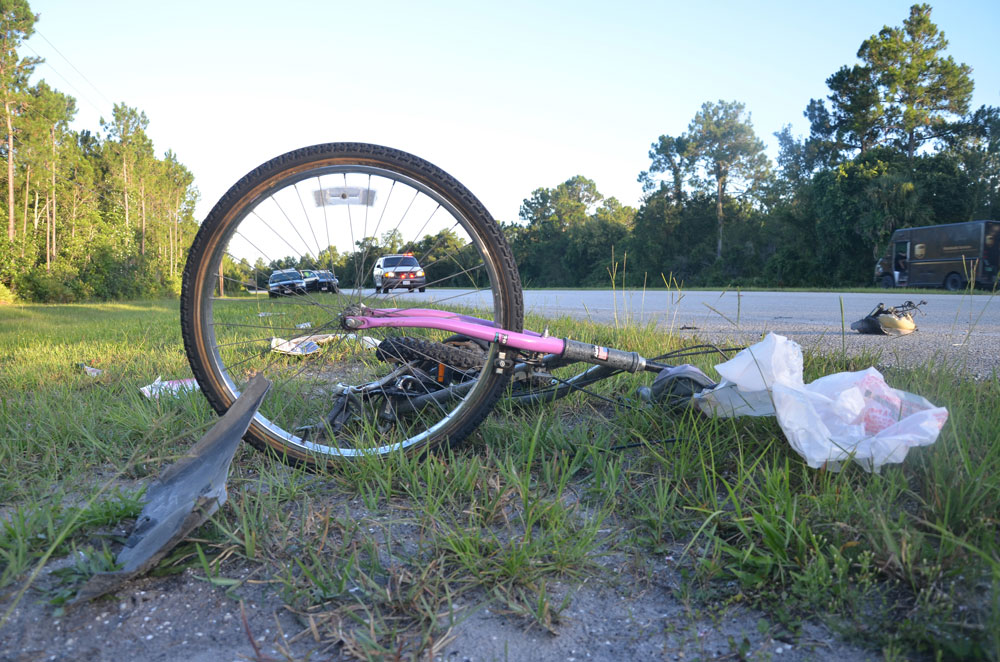
Niki Isaak was approximately 33 miles into the Central Florida Classic bike ride near Brooksville in October when a group of motorcyclists entered the bike path and began riding dangerously close to her.
Despite there being a wide-open road, one motorcyclist narrowly passed Isaak on the right shoulder, another pinned her in on the left, and a third finally hit her from behind.
The sudden impact smashed her body to the ground, puncturing her anal canal and fracturing her tailbone, among other injuries. She was immediately rushed to HCA Florida Bayonet Point Hospital, where she remained in the trauma center for three days before being released to return to her home in Fort Myers.
Two months later, she is still doing physical therapy and has created a GoFundMe page to help with the medical bills now totaling more than $400,000 as she tries to pick up the pieces in her life.
“The impact is so big,” she said in a Zoom conversation last month. “It’s ruined our lives in so many ways, and we don’t even know the outcome. I just hope people can see that it’s just getting worse.”
Despite the seriousness of the accident, the offending motorcyclist was only charged with a citation for careless driving, a moving violation.
Frustration among cycling advocates
“What is the response of the local law enforcement officers? Nothing,” fumes Matt Scarborough, Isaak’s attorney who specializes in defending cyclists involved in accidents. “We’re seeing in my practice that cyclists are just being ignored. If this was a motor vehicle vs. another motor vehicle causing this much damage to somebody, I think it would be a much different story.”
One of Scarborough’s other cases involves pro triathlete Gabrielle Suver, who was cycling along the side of a county road in Lake County on Nov. 15 when a driver sideswiped her, resulting in a broken back, a fractured neck, a broken leg, fractured kneecap, liver laceration, scapula and sternum fractures and concussion, according to WESH-TV. She was released from the hospital this past Sunday after 28 days.
For decades, Florida’s roads have been listed as the most dangerous in the nation for pedestrians and bicyclists, and there has certainly been more awareness regarding safety concerns in the Sunshine State. But observers lament that conditions aren’t getting better.
A recently released report from the Bicycle Accident Lawyers group concluded that Florida remains the most dangerous state in the nation for bicyclists, looking at combined 2022 and 2023 data. And there were another 207 bicycle fatalities in 2024, according to the Florida Department of Highway Safety and Motor Vehicles. (In Flagler County, there was one bicycle fatalities in 2024 and and three in 2023.)
These troubling statistics continue despite the fact that Florida lawmakers in 2006 passed a law requiring motorists to give cyclists at least three feet of space when driving along or passing them.
Cynics question how often that’s being enforced. Just 130 motorists were cited for violating that law in 2024, according to the annual uniform traffic citation report produced by the state.
Florida’s 3 foot rule
“The 3-foot rule is not the 3-foot rule,” says Tampa attorney Steele Olmstead, who has represented injured cyclists. “The statute says that the motorist has to pass at a safe distance. Not less than 3 feet? Well, cops fall back on that and go, ‘Oh, well. I can’t get out and measure it. I couldn’t tell whether it was 3 feet or not.”
Florida statute 316.083 (2) says that that any driver overtaking a bicycle or other nonmotorized vehicle or an electric bicycle occupying the travel lane must pass that vehicle “at a safe distance of not less than 3 feet or, if such movement cannot be safely accomplished, must remain at a safe distance behind the bicycle or other nonmotorized vehicle or electric bicycle until the driver can safely pass at a distance of not less than 3 feet and must safely clear the overtaken bicycle or other nonmotorized vehicle or electric bicycle.”
Olmstead says he “might have” won one case over the past decade in which a motorist received a ticket for unsafe passing.
Officials say increasing bicycle deaths is a national problem but note that there is a greater proximity to higher speed roads in Florida.
“There’s often a transition from a 20-25 miles per hour neighborhood development that’s relatively self-contained or something like a quasi-gated community, and then you’re immediately on a 45 mph road,” said Ken McLeod, policy director for the League of American Bicyclists. “And at 45 mph, any mistake by a driver is more likely to cause a death for a person biking or walking.”
And while more Florida cities have incorporated separated paths for people to bike and walk, there remain plenty of unprotected bike lanes. “All it takes is driver looking down at their phone and drifting down into the bike lane at 45 mph, and you have a crash that could be a fatality, because you have that high speed and that kinetic energy potential is there to cause the death,” McLeod said. “If it was 35 or 30, you have a lower chance of death when that crash occurred.”
The League of American Bicyclists “Benchmarking Report” released in December 2024 showed that the percentages of bicyclist deaths have increased in Florida from an average of 143 between 2014 and 2018 to 197 between 2019 and 2023, a 38% increase.
And, according to preliminary data compiled by the state of Florida, as of Dec. 13, there had been 185 bicycling fatalities this year (along with 9,277 injuries from bicycle crashes).
(A group called “Ghost Bikes” places white-painted bicycles at sites where someone was hit or killed while riding.)
Some law enforcement officials say the fault often lies with cyclists. In a YouTube video posted last month, Pinellas County Sheriff Sgt. Jessica Mackesy said that at least four cyclists were critically injured or killed in crashes with vehicles because they didn’t stop at a stop sign or a red light.
 “Physics doesn’t care if you’ve done it 100 times before. A 4,000-pound vehicle versus a bike, there’s only one outcome,” Mackesy said. “And looking both ways isn’t enough when there’s a driver who has the right of way and expects you to stop. Stop means stop — on the road, on the trail — every time.”
The Florida Department of Transportation last updated its Pedestrian and Bicycle Strategic Safety Plan in October 2021. In it, the agency reported that, between 2016 and 2020, 90% of all pedestrian and bicyclist fatalities and serious injuries on state roadways occurred in just 25 of the state’s 67 counties. (The top five counties for fatalities and serious injuries were Miami-Dade, Broward, Orange, Hillsborough, and Duval).
Potential solutions?
Pinellas County Democratic Rep. Lindsay Cross is a cyclist who can be seen riding her bike to the Capitol during the legislative session. She says there are common-sense things that government can do to enhance safety for pedestrians and cyclists, such as creating more protected bike lanes and pedestrian crosswalks, but she believes part of the problem is with how local governments develop communities.

“They’re all focused on having a car,” she said. “People by and large will choose places that are more walkable, that have mixed uses where you can walk to your grocery store or to a coffee shop. People like that, but a lot of the new development doesn’t have that as an option. You’ve got to drive to get into your community. You probably have to go a couple of miles to get to a grocery store.
“Maybe there’s sidewalks in your community, but they’re not leading to anywhere. They’re just a loop within the community. So, I think fundamentally, we need to shift the way our development is happening, so it’s geared towards people moving at a slower pace. Cars are also going to have to slow down and make it safer. That also helps to just enhance our quality of life, make it more accessible for people who are aging to have those options.”
John Sinibaldi Jr. is president of the St. Petersburg Bicycle Club. He has been hit twice by motorists while biking, the last time in 2010 when a collision with a distracted driver led to two lower-back surgeries and two cervical spinal-fusion surgeries. He offers two changes that he thinks could significantly improve bike safety in Florida.
“I would increase communications dramatically between the state and the people who drive on our roads,” said Sinibaldi, whose late father, John Sinibaldi Sr., was a two-time Olympic cyclist in 1932 and 1936. “That would include visual things like billboards and public service announcements on TV. That would include better driver education before you get your license, [and] driver education when you renew your licenses.”
His other idea is less prescriptive, and more philosophical.
“The second thing is we have to get our local police out of the mindset that if a motorist in a car hits a cyclist, the default option should not be to just assume that the cyclist did something wrong. And yet that’s often the case,” he said.
The Phoenix reached out to law enforcement agencies in Florida for reaction.
Legislation
The Florida Bicycle Association says its top legislative goal is for the state to pass a comprehensive “Hands Free” law that would make it illegal to hold a phone while operating a motor vehicle. The group says such legislation must go beyond “texting and driving” to encompass all activities that take a driver’s hands and attention away from the road, including scrolling through social media, streaming videos, and any other non-driving activity requiring manual interaction with a handheld device.
Sen. Erin Grall, R-Vero Beach, sponsored a bill to do just that during the 2025 session, which passed in the Senate, 37-9. But its House companion never moved at all.
No similar bill has been filed yet for the 2026 session.
Bills addressing bike safety have been introduced for the coming Florida legislative session, but only regarding electric or e-bikes, a relatively new phenomenon resulting in a spike in injuries around the state.
Lots of people — from kids to seniors — began using e-bikes during the COVID pandemic. “A new subculture” of seniors who never rode a bike before are using e-bikes seeking the freedom they’re looking for, Sinibaldi said, adding that he sees younger people who have lost their licenses or can’t drive for whatever reason who are also using these new bikes.
“They’re terrorizing the Pinellas Trail — there’s no other way to put it — because they don’t know anything about trail etiquette,” he said. The trail occupies old railroad right of way between St. Pete and Tarpon Springs.
A bill (HB 243) sponsored by Republicans Yvette Benarroch from Collier County and Kim Kendall from St. Johns County would require a person using or renting a class 3 electric bike to hold a driver’s license or learner’s permit. Class 3 electric bikes are the fastest legal bikes with a maximum speed of 28 miles per hour. Anyone caught purposefully modifying an E-bike to boost its motor-powered speed would face a fine up to $100. Subsequent violations could go up to $250.
And Hillsborough County Republican state Rep. Susan Valdés filed legislation last week (HB 667) that would require anyone under 18 to wear a helmet while operating or riding an e-bike.
–Mitch Perry, Florida Phoenix























Callmeishmael says
Rep. Cross is spot on, and Palm Coast should be listening. It’s time for this city to establish 21st Century planning when it comes to transportation management. That includes incorporating pedestrian and bicycling infrastructure improvements in existing neighborhoods and requiring it in all new developments. We have over 100 miles of multipurpose trails and sidewalks in this city that are afforded only the barest of maintenance. (The first leg of the Lehigh Trail from Colbert to Old Kings is in atrocious shape.) Fix what we have and add on to it. It would be an investment in our community that would provide long-term benefits on many levels, including enhanced public safety, economic stimulus and overall quality of life.
Gail says
I agree. The county should follow PC’s lead on rules of the road for bicycles. Younger riders should be required to wear helmets, I see many kids without them, and blowing by everyone with no respect for their safety.
I hope we start planning new developments to include wider bike/walking lanes; that connect to each other! If we do that we will see people biking/walking to the store, it will be a common sight. Lets get more folks out there knowing there are safe places for them.
Laurel says
Blah, blah, blah! I am so sick of hearing how we should be driving at the speed of a snail. Pinellas County Democratic Rep. Lindsay Cross is absolutely correct. Study the picture here, and see what she means. Very well thought out.
There are sidewalks all over Palm Coast, the city brags about it, yet there is hardly anyone on them. The county does not practice walk-able, bike-able planning, instead requiring car travel anywhere you go, and puts bikes on the street, with very little room for avoidance of vehicles. So, their solution is to bring all vehicles to a crawl. I know damn good and well, that the streets up north are not all 20 mph. People come from all over, to Florida, with different driving styles, and try to change everything. A1A is now 35 mph, with no passing. It was 50 mph, with passing zones. No one on those sidewalks, either. Nuts! It is frustrating, boring and annoying. Now it’s better to take I-95 to get around Flagler.
I recently saw the Pinellas Trail. Everyone was walking, riding, and getting along just fine. I did not see a single person, amongst many people, look agitated or complaining. They were smiling, enjoying, and happy to be out on a nice day. Apparently, there are the squeaky wheels who want to control everything. Geez, those people are tedious!
Ms. Cross has common sense planning, by spacing the bikes away from the vehicles. Also, the bikers need to follow all the same traffic laws (they are supposed to) as the motorized vehicles do, which they very often don’t. Bikers seem to think stop signs and red lights are not meant for them, and love to double up on the side of the road, making it difficult to get around them.
We need better planning, and cooperation from the bikers, to make road access better for everyone, and stop bringing Florida to a crawl.
TR says
Blah, blah, blah yourself. A few corrections. The area of A1A that was refurbished because of all the hurricane damage is 25mph. Bicycle riders are also not bikers. There are also no streets down here (unless in a private community) where the speed limit is 20mph. School zones are the only 20mph times I have seen here in Flagler county. I’ve lived here since 1989 and never seen a street with a speed limit of 20mph. All residential street speed limits are 30mph in Palm Coast. However, if you like Pinellas county so much and the way things are there, then maybe you need to move there. If not, maybe call (or email) your district council person and give him/her some ideas as to what you want to see happen here. You can also do this at a council meeting with talking to the entire council at once. But bragging about what it’s like on the west coast of Fl. and complaining on a message board is nothing but blowing smoke. Want change, get involved instead of just complaining.
Laurel says
Goodness, TR, hostile much? Thanks for the oh, so, necessary correction on the word “bikers.”
Now, if I may, I will correct you on your statement that there are no 20 mph roads in Flagler County other than school zones. All Flagler Beach City owned streets are 20 mph, 24/7/365. Only Moody, and A1A, which are not city owned streets, have higher speed limits.
Deborah Coffey says
Rule #1 should be that ALL local governments ban bike riding on any road that doesn’t have bike lanes. Old Kings Rd. South in Palm Coast is a “death wish” for bicyclists and for drivers of cars trying to avoid head on collisions with cars that just pull out into the oncoming lane in order to avoid a bicyclist…at 55 mph.
R.S. says
That’s rather presumptuous a demand. Bicyclists pay taxes just as you do. Who are you to deny them the right to use public highways. So, you might arrive a few seconds later at your destination; but if you were to join the bicycling crowd, you might save lots of cash for medical needs and help clean our atmosphere.
JimboXYZ says
In every case there is either a cyclist or motorist that hasn’t abided by the law(s). The problem is a human race problem. For every case/example of motorist(s) that done another wrong, there are cyclists that ride like jackasses themselves. That’s why the ordinances for the eBikes. We read about the motorists that can’t be bothered with right of way for other motorists. How can one expect those types to extend that to a bicyclist ? 2 motorcycle officer’s down just earlier in the week ? We had a old guy in a pickup truck having his lane commandeered by a pack of bikers during bike week. So much of it is self inflicted stupidity. Another non-solution for the grossest of offenders. But the laws need to be there, for the sake of accountability & responsibility.
Taxpayer says
The traffic is a nightmare in Palm Coast. The lights aren’t coordinated with each other. Drivers never obey the traffic signs. You hardly ever see the FCSO pulling over drivers. It’s the wild wild west to get around. Very poor planning by city officials and lack of doing anything to correct it.
Ed says
How about giving out stupidity tickets to any biker riding like they own road next to a COMPLEATLY unused bike path. ?
The so called bike paths are there to be used by bicycles not automobiles so roadway shouldn’t be used by bicycle when the alternative is available
Pierre Tristam says
Bicyclists have, and ought to have, an equal to the road if they choose it over paths (just as pedestrians and children have a greater right to neighborhood roads than do cars). Cars and trucks don’t own the road, and if there is to be a hierarchy, cyclists (and to some extent even motorcyclists or ebikers) have a more privileged right to the road if only because they’re not desecrating the environment and depleting limited energy resources as cars and trucks do. (Not that driving or biking is a privilege either way: it’s a right, misinterpreters of licensing aside.)
R.S. says
Most often, drivers do not heed the white stripe that indicates where to stop to observe conflicting traffic. They will look only to the left and not to the bicycle lane that comes at them from the right. And more often than not, they will ignore the white stopping stripe in favor of stopping in the middle of the marked bicycle/pedestrian path. Unfortunately, in some cases, the traffic designers in their inimical wisdom mark the stopping stripe such as to force cars to block the bicycle path completely, although the bicycle path has the right of way. Examples of such stupidity in the design are amply available.