



(© FlaglerLive)
An incantation, from the Latin word for enchant, is a musical style or chant that can cast a spell on its listeners, moving them to a state of mind they might not have imagined, to a thought they might have not entertained.
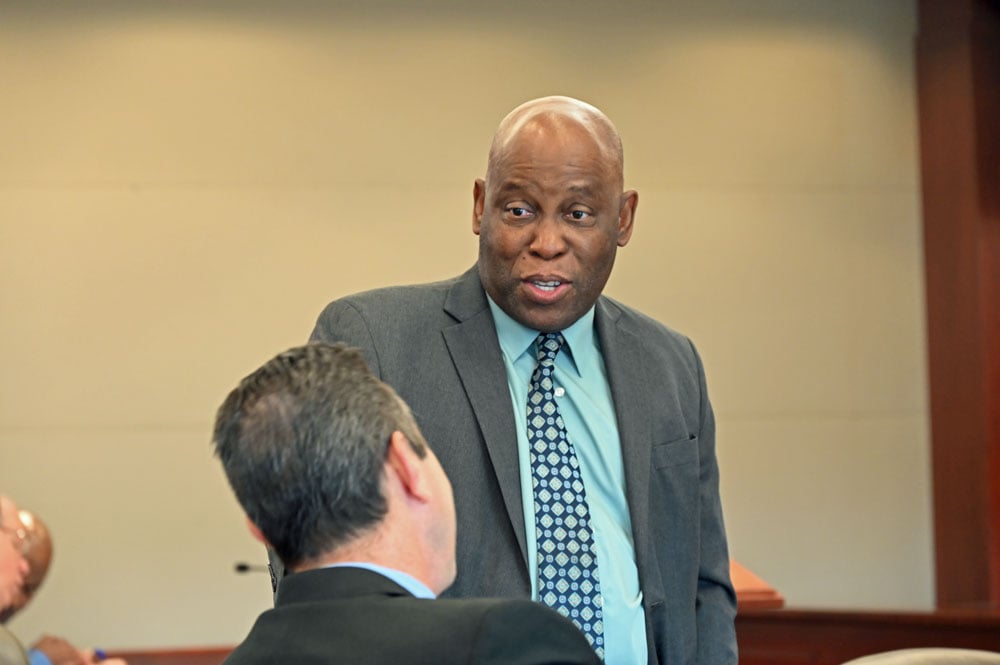
There was a bit of that in Junior Barrett’s method today as he faced what remained of a diminished jury pool in the second day of jury selection in the death penalty trial of Jermaine Williams, who is accused of stabbing his wife Yolonda to death.
Barrett, an experienced death penalty lawyer, is defending Williams, with Anthony Eric Leonard in second chair. Judging from the implications of the questions he posed to the jury, Barrett all but conceded today that he will not be disputing what the jury will see with its own eyes in surveillance footage later this week: that Jermaine stabbed his wife 15, 16, 17, 18, 19 times in their driveway. He had conceded as much in pre-trial revelations that he would try the crime-of-passion defense.
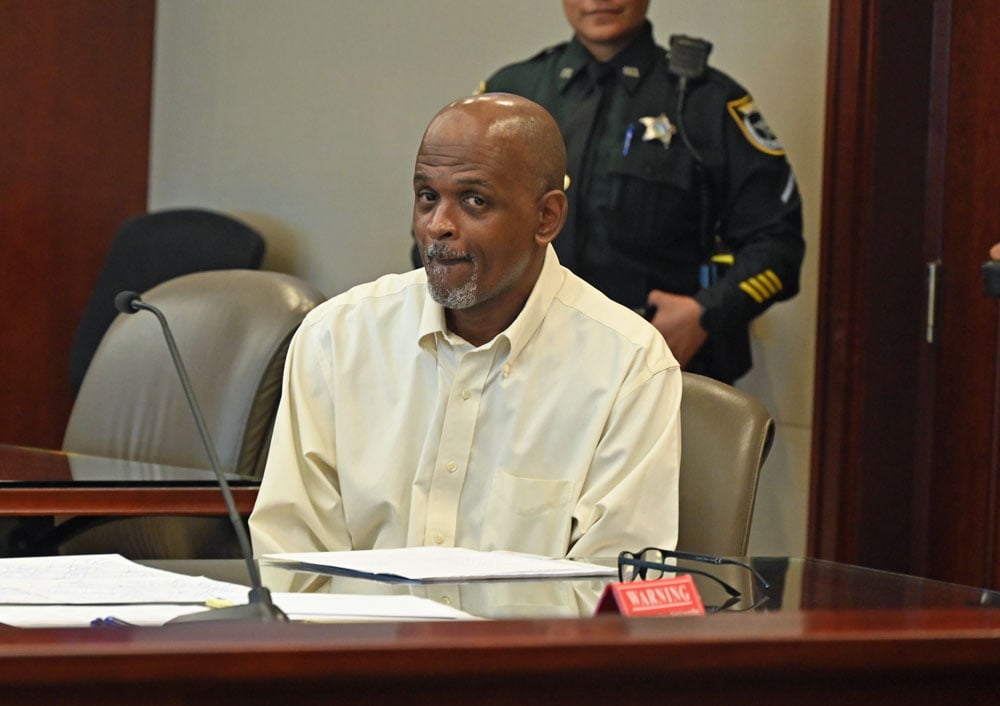
What was clearer today was that for him, or at least for his client, it’ll be victory enough to avoid the death penalty. To Jermaine Williams, life without parole will be his reprieve, if not his last laugh in court: he has a tendency to flash smiles at inopportune moments, as if to say that even now he’s above it all.
A jury pool that had started with 75 potential jurors Monday morning was down to 26 by 8:30 this morning. Assistant State Attorney Jason Lewis had had his voir dire with the jurors, the time he spends questioning them, probing the slightest hint of a prejudice or hesitancy about the death penalty, or perhaps a hint of dreamy idealism, so he and Assistant State Attorney Helen Schwartz could zero in on those they’d strike from the pool (young single woman who’s into reading and “seeing scenery”? Strike; a woman who’s a social media communications director who likes photography? Strike.)
It was Barrett’s turn. He couldn’t do much with reasonable doubt, given the evidence. But he could do plenty with the jurors’ doubts about themselves. That’s where he struck, starting small (“Anyone here who thinks they would have a problem being more analytical as opposed to being emotional?”), then building slowly toward what came close to a closing argument in call-and-response form with incantations in the form of questions.
“You all understand also that each juror has to make an individual moral decision as to whether or not the death penalty should be recommended. Y’all understand that?” Barrett said in his heavy accent “from the Islands,” as he had told the jury at the beginning, his “y’alls” sounding like subversive sendups of his Florida audience.
The 26 jurors responded in a collective Yes.
“Even if you find and you heard the words ‘aggravated’ and you heard the words ‘mitigation,’” he told them, “even if you find that the state has presented at least one aggravator or even more, that does not mean that you have to come back with a recommendation for death. You understand that?”
A collective Yes.
“And even though you will hear about weighing of aggravators, mitigators, do y’all understand that even if you weigh and the scale is tipped for aggravators, that you’re still not required to come back with a recommendation.” A collective yes. (In the likely penalty phase of the trial, should Williams be found guilty of premeditated murder, the prosecution must prove at least one “aggravator.” The defense will present as many “mitigators” as it wishes. The only math that will decide Williams’s fate, however, is whether at least eight of the 12 jurors recommend death.)
“Do you understand that if you come back with a life recommendation, you would have still done your job in this case? You understand that?”
A collective yes.
Barrett’s reference at this point to “12 Angry Men,” the Henry Fonda/Sidney Lumet movie filmed entirely in a New York City jury room on a sweltering day, seemed like another subtle appeal to the impossible. On its face Barrett was asking whether the jurors recalled how there was a lot of heated screaming and yelling and threatening between the jurors, and how “we’re not going to have that, right?”
A collective No.
But anyone who recalled “12 Angry Men” would have remembered how 11 jurors had started with the absolute certainty that the Black “slum kid” was guilty of killing his abusive father and should be sent to the electric chair, only for Fonda’s character to turn the jurors to a unanimous not guilty verdict by the 95th minute. The abuser in this case of course is Williams, who Yolonda wrote in a 2022 petition for an injunction had inflicted a lifetime of abuse on her. He’s Black, and–as in “12 Angry Men”–will likely face an all-white, or near-all-white jury (just eight people in a combined pool of 135 jurors were Black, most were excused, only one has made it among the 11 chosen so far, and she may yet get struck). Barrett is not hoping for acquittal, but for what amounts to a commutation.
“There’s a very good chance that if we get to that part of the trial, the life or death part of the trial, that we will put on evidence that we believe will mitigate, not excuse, but mitigate a death sentence. Y’all understand that?”
A collective yes.
“And even though we may put on some evidence, y’all understand that you can find mitigation even if we don’t present it. You understand?”
A collective yes.
Finally he asked, conceding the murder, that if Williams is guilty of taking his wife’s life, “is there any jurist here who, once that’s established, you just cannot, cannot recommend a sentence of life in prison without a possibility of parole. Anyone here, raise your paddle.” None of the jurors raised a paddle showing their juror number. “Do you understand when we say life in prison without the possibility of parole, that means he will die in prison. Y’all understand that?”
As if rehearsing the verdict he wishes to hear, Barrett got his final collective yes.
By late morning, the 26 jurors had been whittled down to an actual jury panel of 11, with all the others eliminated through the defense’s 10 peremptory strikes (or strikes without cause: the total number of strikes either side gets during jury selection). The state used up five strikes.
There weren’t enough jurors left to fill the box. Circuit Judge Dawn Nichols, who is presiding over the trial, called up 60 more at 1 p.m., and the entire process started over again. It is expected to be complete by Wednesday afternoon, especially since Barrett has no room for strategy anymore, a vulnerability Lewis, who is as genial as he is ruthless, will exploit mercilessly when the thinning resumes Wednesday morning, though he won’t get to pick the retired cop and mother of a judge–a seated judge in the four-county Seventh Judicial Circuit–who’d so wanted to finally be on her first jury. Barrett made sure she was struck, when he still had strikes to spare.
Compared to the first pool the next one of 60 had a distinct dearth of law and order types. It had fewer younger people, an equally few number of Blacks, and at least one outright racist who, explaining his alleged “hardship” to the judge, said: “15 years ago, my mother was in a fender bender in a Walmart parking lot with a Black guy, and he he laid her out. So you’re not going to get an impartial juror from me.” He was excused.
No one’s “hardship” was as brilliantly absurd as the Palm Coast property investor who wanted out because he had a trial beginning on Aug. 14 to try to get back the Lamborghini his dealer had stolen from him. “I’m not going to keep you that long,” the judge told him. “I promise.”
“Are there any other excuses” he could use, the man asked with his Subcontinent ancestry’s deadpan humor. The lawyers and the judge laughed but the judge told him they’d keep him on. By midafternoon, they’d relented and he was among those emancipated from jury duty, back to his Lamborghini-colored anguish.




























Leave a Reply