



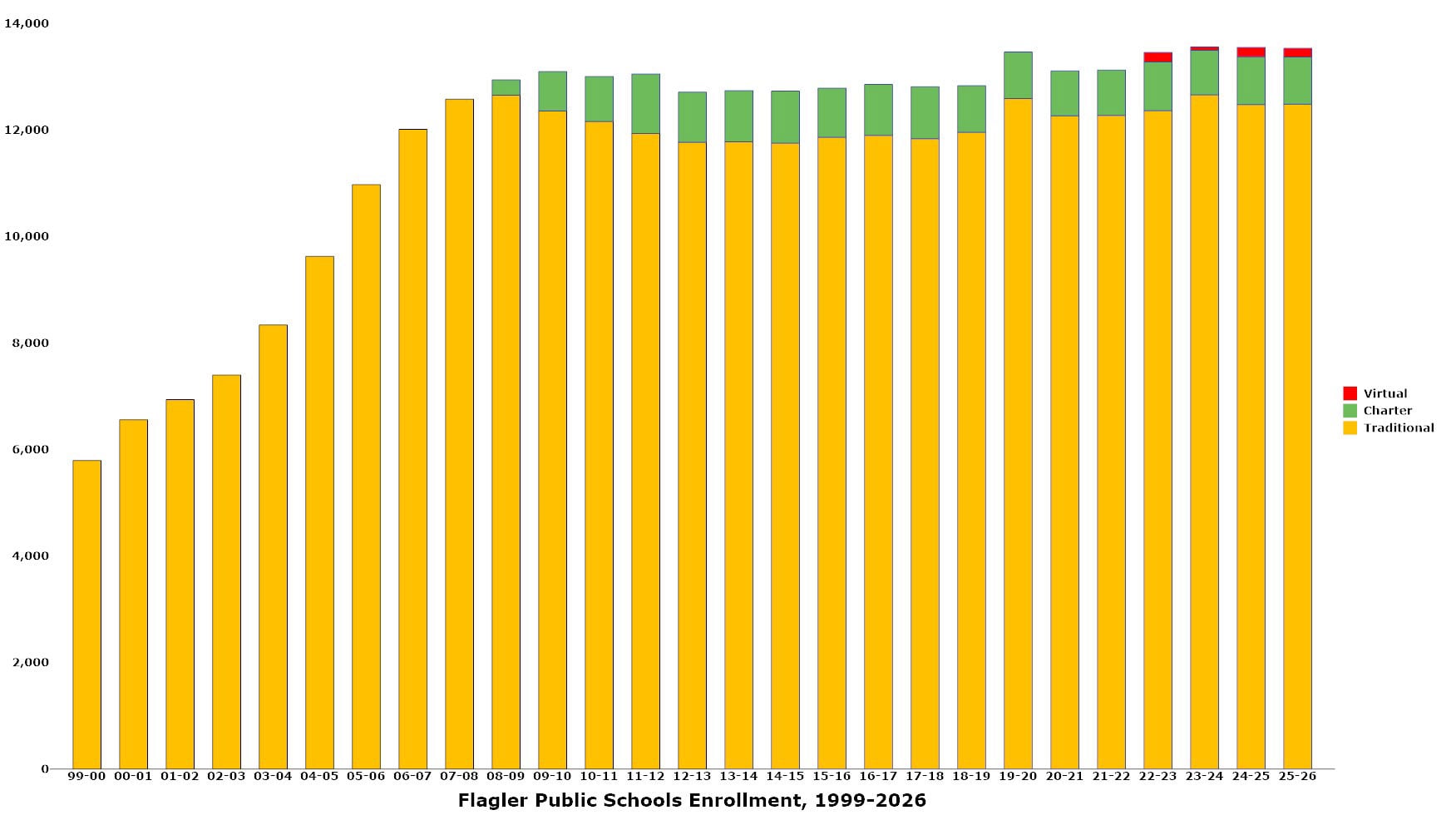
The number of Flagler County school students enrolled in private schools at public expense surged 20 percent from last year, to 1,926 students, compared to 1,600 last year, while enrollment in Flagler County’s traditional public schools again stagnated or declined. For the first time in recent memory, kindergarten enrollment is also declining.
The state financial funding for schools based on the year’s third calculation (which takes October enrollment as a baseline) will cost the district a loss of about $400,000, Patty Wormeck, the district’s finance chief, told the school board this afternoon. There are two more calculations to come this year, but the third calculation drives funding for the rest of the fiscal year, which ends June 30.
The district lost a net 100 students between the year’s second calculations last fall and its third calculation in January.
State funding for Flagler County students cashing in on taxpayer funded vouchers for private school or homeschooling rose this year to $19.2 million, from $14.2 million last year.
Flagler’s public schools have not seen an enrollment increase in two decades. In February, enrollment was below 12,500 for the county’s nine schools, about 300 students fewer than in the 2007-08 school year, even though the county’s population has surged 50 percent in that span. Superintendent LaShakia Moore said only four districts in the state are seeing enrollment increase.
New residents have been disproportionately older residents. But the net loss of students in the district means that while some families with children continue to move to the county, private, online or homeschooling is reaping the enrollment benefits, with the state offering roughly $8,000 per student per year in voucher money–significantly more if the student has special needs.
The implications are vast–from the district reevaluating its school construction program, which is all but on hold for now–to builders and developers questioning whether school development impact fees (levied on new construction to defray the cost of new school construction) are calibrated to the current reality.
In the 2020-21 school year, when eligibility was restricted, just 136 students cashed in on what the state calls “opportunity scholarships,” and what Colleen Conklin, the former long-time Flagler County School Board member, has called a “grift” and “one of the biggest scams ever pulled on American taxpayers.” Starting in the 2021-22 school year, all students regardless of income have been eligible for tax subsidies.
That does not mean that the 1,926 Flagler County students receiving school tax subsidies were all in district schools then moved off to private or homeschooling. Many were already in those settings. But it does mean that more private schools have popped up to siphon off students who would have previously attended traditional public schools, and more parents are choosing the private option.
The voucher system has created confusion about school budgets, because the state still embeds public money earmarked for private-school vouchers in the district’s overall budget. So while the Flagler school district’s bottom line shows total state and local funding of $139.5 million for the third financial calculation of the year, and what appears to be a $1.35 million increase over the second calculation, the increase is deceptive–and is, in fact, a loss, when voucher money is taken out.
“Even though it shows $1.3 million of an increase, it is important to know that the vast majority of that, if not more than that, was due to the increase in scholarship funding,” Wormeck said. “That is not what came directly back to the district’s base funding. In total, the district lost about $400,000 in the third calc.”
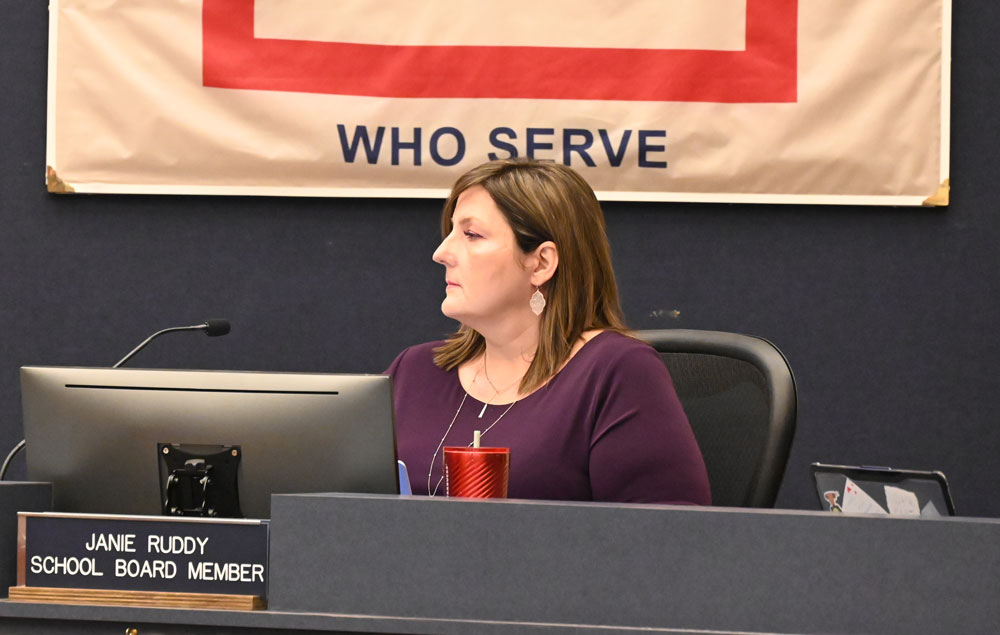
Ruddy noted that even those figures don’t “really reflect the true cost,” with the legislature again this year failing to legislate a fix for hundreds of millions of dollars that are unaccounted for, as thousands of students cash in on vouchers but still attend public schools, and thousands of families cash in with little accountability: the state does not disclose where students receiving public money attend school or how much individual private schools are cashing in from the state.
“We very often are educating students who come back to us, who otherwise took that money or it was paid to another institution,” Ruddy said. “And of course, we will provide their education. But if they’re not there during those FTE counts, we’re not getting that funding.” FTE counts refer to full-time-equivalent student counts conducted periodically in the district to drive state funding to the district proper.
Inexplicably–and frustratingly for local school officials–the state has also made it difficult on local districts to claim the money they are owed by double-dipping parents who took voucher money only to then switch back to public schools. The burden is on the local districts, not on the state–or the parents–to ensure accountability.
“We do have students that may be sitting with us that their family has received a scholarship,” Superintendent LaShakia Moore said during today’s board workshop. “There is a very extensive process that we have to go through in order to get those funds released to us here at the district office, as well as just making sure that we don’t have those duplications present. And so though I think that I would agree there’s still work to be done on that. We appreciate that it is getting better than where it was, but it still continues to be an issue.”
Last year, the district recorded just $96,000 in such double-dipping money–a pittance, compared to existing abuses.
But even local figures mask the true losses to the voucher program: Wormeck’s presentation, as in previous years (when former board members urged better transparency in breaking out voucher dollars from district dollars), still conflated both pots. “It is something that I will note in the future possibly to show a picture of what is the district’s loss versus the scholarships’ gain, like you had just asked,” Wormeck pledged to the board members. But she’d made that pledge to Conklin, too.


























JimboXYZ says
$ 19 million/year is cheap, when the cost of building those 2 new schools was $ 405 million. And the beauty of it all ? It’s state money not Flagler County resident tax money for the vouchers. If we’re already being charged for it, common sense would be to not pay more for any of it again on top of what money is already out there to educate children. Another school or two/few is just an empire build. Other developer(s)/contractor(s) getting rich off saddling the rest of us with that growth BS that nobody wanted anyway. Biden & Alfin era was that with the growth, schools would be over capacity. Obviously, those projections were WRONG ! So instead o raising taxes to pay for unnecessary school capacity, the battle cry is raise taxes because the vouchers are hurting the School Boards budget for building empires that will undoubtedly cost more in labor costs to actually educate children that aren’t any smarter or more educate than human beings ever were for not opening the books & doing the learning process outside the classroom. There’s only so much a brain can absorb in a 50-60 minute class.
Remember, the goal here is to educate, not build empires & infrastructure that is a drag on financials of every family in Flagler County. What hurts most to read is that the Flagler County School Board actually thinks this is their money, that they are losing. How can the voucher schools take in less money & educate these children better than the bloated public school system ? Candidly, I think both are full of nonsense for their claims that either is better/worse for education of children K-12. Show me the proof that any of the educational K-12 has been worth any more than the investment of initial exposure ? Anyone that has ever accomplished has done that outside of a classroom for that hunger for knowledge, to take their accomplishment/mastery/expertise beyond what any teacher or instructor ever did for a set aside time of covering as much theory in a structured hour of a presentation of what the lesson from the textbook chapter(s) were. Anyone walking into that classroom should be prepared enough to have read that much ? Not being that prepared, that child is just cheating themselves for that hour. The syllabus is an outline. Prepare & learn outside on your own is the only way anyone ever learned. Absorbing it for zero exposure for the 1st & only time for any interest in any given subject has always been short of mastering that subject. Repetition, rinse & repeat, nobody ever was excellent at what they never practiced, unless someone gave them the answers. Be the Michael Jordan of learning anything.
https://flaglerlive.com/school-enrollment-december-2024/
nono says
common sense!!
Let’s define
The average IQ of Americans is 100
Genius is defined as an IQ above 132, mentaly retarded is defined as an IQ below 80. So common is dumbass. FLAGLER county is one of the fastest growing countries in America. Do the research,how many children are being home schooled in the mondex by common sense parents………..
STUPID IS STUPID DOSE…………….
Laurel says
Yeah, and some IQs should practice proof reading, spell check and sentence structures before commenting. I mean we all make mistakes, but wow!
You also might want to check your bigotry at the door.
Rudy says
“…empires & infrastructure that is a drag on financials of every family in Flagler County.”
Jimbo, what do you mean? The only infrastructure that is “a drag” is the aging, original ITT infrastructure.
Do you realize that the water/sewer fees you pay are not enough to support the maintenance of these 60 year old pipes?
Without building “empires & infrastructure” to subsidize old pipes and lay new ones, your water/sewer fees would be exorbitantly higher.
x Rudy
Deborah Coffey says
How many red States do you count in the top 10 for the best education? There are lots of rankings out there for 2025 that all say the same thing. This is just one of them.
https://www.theschoolhouse.org/post/best-public-school-systems-states
Endless corruption says
Lowest paid teachers in the nation! Thank a rapeublican! Plenty of money to name monuments after pedophiles though!
billy says
If Democrats stopped allowing illegals to come into this country, where we have to pay their medical bills and God knows what else maybe we will have some extra money for our teachers
Pogo says
All of this shit has a trail that started with J Ellis Bush.
Y’all is ’bout 28 years f ‘ing too late.
ThankfulChooser says
We are so thankful for the School Choice Act vouchers. We did not have a good experience with the public schools here. To each their own. That’s the beauty of the Act.
Laurel says
So you would rather crash public schools than to improve them, by giving our money to private industry?
The selfishness in this county continues to astound me.
JC says
The user above stated they had a bad experience with public school system here for their children, so they made the decision to use the voucher program for a better education in their eyes for their children. Nothing is selfish if you are trying to do what is best for your children, which is called being a parent. Where you ever a parent Laurel? If not, then honestly you wouldn’t get it or even willing to understand.
First hand knowledge says
Why not hold the people accountable who take the vouchers and then return their kids to school…? Tell them to repay the money or don’t allow their kids to re enroll.
Maybe we should get rid of the 6 figure administration in our school system and give it to the teachers! Alot of these “administrators” have never even set foot in a class room. As more and more people move here from blue states ,the problem will only get worse.
We need to completely overhaul our school system from the top down. These people who run our schools have zero common sense .
nono says
common sense
SEE REPLY ABOVE
JIMBO!!!@@@
Laurel says
“As more and more people move here from blue states ,the problem will only get worse.”
Amazing!
nono says
Why do you assume that I moved here frome a blue state. I moved to Flagler in 1993 from Palm Beach County. I moved to Texas in 2004.I still own property in the Hammock and return, on average 2 times a year to fish.I have a vested interest in all thanks Flagler.
P.S. MY FLORIDA no longer exists….
Laurel says
nono: Why do you assume that the comment was aimed at you? The quote (read again and you will see the quotation) was from a comment by First hand knowledge.
There are a lot of jumping to conclusions in these posts. Makes me wonder where they were schooled. Clear your minds and read, people. Too many assumptions; too much defensiveness.
Nutty Professor says
If you ever google salaries of Flagler Schools employees, it’s insane how many of them there are that are making over three figures. I’ve been a teacher in Flagler County for 19 years. I almost make 59,000 a year. I can’t afford to put my children on my insurance because that would cost me one of my two monthly paychecks to cover it. New teachers in the district start around 48k now, but what did veteran teachers get when this was implemented a couple years ago? The proverbial shaft… I don’t even know what most of the administrators in the district actually do. Most of them I’ve never even met. It makes me reminisce on the movie “Office Space,” where Peter and all of the other employees of his company have to go meet with “The Bobs” and explain what they do in their positions at the company and justify keeping their jobs. That’ll never happen. They just add more positions at the top instead of trimming the fat.
Dennis C Rathsam says
Parents aren’t sending the kids to P/C schools because they want a real education for their children.
Deborah Coffey says
Well, they probably won’t get one in most private schools! Over 28 years, I’ve taught in both. Have you?
billy says
part of the problem is this is a growing community and we have a big melting pot of kids from all over the country, different personalities, different family upbringing lots of problems, mental problems. My kids go to the Baptist school and you can without a doubt see the difference in politeness, respect, courtesy, and nice because religion comes into play,
Mark says
The issue isn’t about raising taxes. The issue is that tax dollars are funding private schools. There are no checks and balances. These private schools don’t have to meet any standards. Public money shouldn’t fund private schools. End of story.
Darlene Shelley says
So, some parents are taking voucher money AND sending their children to public school, and nothing is being done about it? This place needs a major Doge, common sense fiscal overhaul and a big change in local government that puts the local residents first! No more wasted money on bogus and unnecessary six figure salaries, utility hikes for harmful incompatible secret development projects hashed out in back room deals, more unnecessary residential development, or new “technology” that releases a whole new level of nuisance noise, threats to the environment, burdens on water and infrastructure, diminished property values, and decreased quality of life, safety, health, and welfare for the residents. Data centers are not even an allowable use??? We the People are tired of being misled, ignored, and even lied to, and this needs to change. DarleneforPalmcoast.com
The Truth says
So what’s the problem? What this article fails to mention is what is going on in public schools right now. Violence and fights nearly every day, kids vaping in bathrooms/hallways/outside, uncontrolled environments because teachers simply don’t care, etc. I grew up in public school, these things aren’t new but they are happening at a much higher rate than ever before.
As someone who utilizes these vouchers, I support them (and I do NOT support Republican policies as a whole). Having a choice of where to send your child and utilize the funds available from the state for your child is a great option. It’s about choice and as long as the private schools are properly regulated and have certain criteria they need to meet to ensure they’re providing a quality education and not just grifting off state tax dollars is also equally important.
Numbers have been declining or stagnant for two decades, this is NOT because of the vouchers. There is clearly a shift in demographics in our area that is contributing to this. Our population is growing but clearly it’s not young families as it was in the 90s and early 2000s. More choices and options for parents and kids is a GOOD thing when implemented properly.
Laurel says
You have always had the option to opt out.
The voucher does not pay full tuition, so the families with lower incomes still cannot use the private schools. The families who cannot afford to have a parent stay home cannot home school either.
Those who can afford, are abusing the system by depleting the public schools, and making it worse for those who are struggling.
Shameless.
Deborah Coffey says
News BULLETIN: The exact same things are going on in private schools, too. It just all gets swept under the rug.
Alistair Elliot says
Rising private school enrollment in Flagler County indicates parents are prioritizing quality alternatives over traditional public schooling. This shift highlights a necessary move toward education competition, breaking the teacher’s union monopoly and empowering families with choice.
from the directors cut says
Standardized testing in education widely became the norm with the no child left behind act 2002 – a top-down government movement to fix education penned by Bush (R). Now, parents are fleeing this testing by vouching for private education. Can one say that the government, specifically the Repubs, got involved in education, not educators, and drove education into the ground? That’s what happened folks. But, the Netflix special coming in 20 years from now once the it really hits the fan.
RobdaSlob says
First not a supporter of this initiative. Why do parents who pull their kids out of school get state money to put them in private school or home school, but I as an empty nester with no kids in school still have to pay all that school tax on my property?!?
Second, if broader society decides that it is OK to use state funds to pay for private schools – as Florida has – then why not implement a better system. For example the Georgia GOAL scholarship approach. The Georgia GOAL Scholarship Program lets individuals and corporations receive a Georgia state tax credit for donations made to approved student scholarship organizations. Those organizations then use the donated funds to provide scholarships that help eligible students attend participating private schools in the state. So same effect of impacting state dollars to fund private schools but it is not fraught with the same corruption because you don’t get your money back (donated funds) until you file your taxes. And in filing your taxes you have to have a qualified education expense form (complete by the Georgia GOAL program and sent to you certifying that you have donated the funds.)