



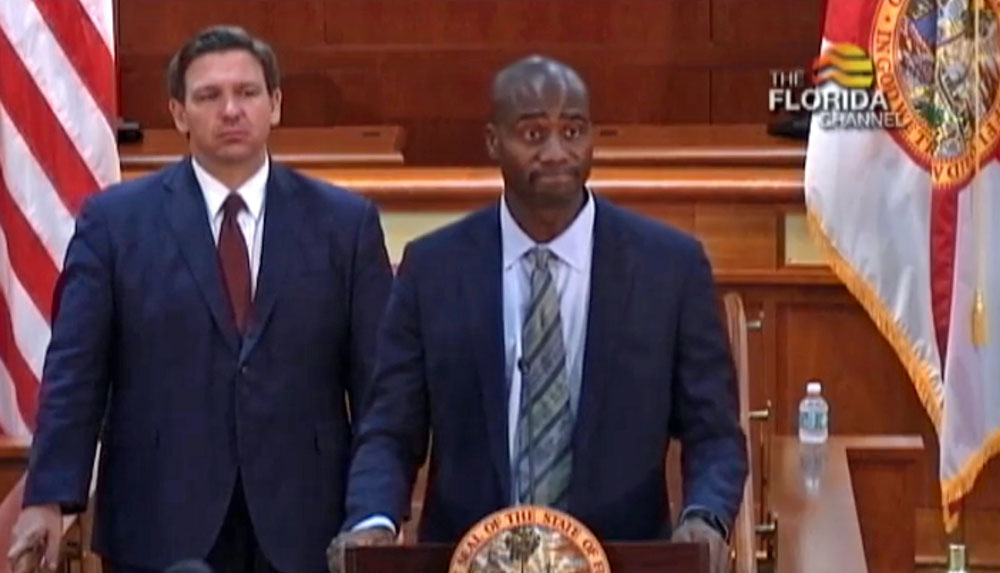
Over the objections of pediatricians and infectious-disease specialists, Florida health officials took initial steps Friday to do away with certain vaccine mandates for schoolchildren.
Physicians and educators spoke out against the proposed repeal of vaccination requirements for diseases such as chickenpox during a Department of Health workshop in Panama City Beach, while vaccine critics applauded Gov. Ron DeSantis’ administration for advancing the plan.
The proposal includes removing vaccination requirements for hepatitis B; varicella, commonly known as chickenpox; Haemophilus influenza type b, or Hib, which can cause meningitis; and pneumococcal conjugate, which can cause pneumonia and meningitis. Other vaccination requirements mandated by state law for school entry — including for polio, diphtheria, rubeola, rubella, mumps and tetanus — would remain in place.
DeSantis and state Surgeon General Joseph Ladapo in September announced the plan to do away with certain vaccine requirements.The requirements targeted in Friday’s proposal are in state rules, which the Department of Health can go through a process to change.
Because the other vaccination requirements are in state law, the Legislature would need to approve any changes. Ladapo has said he would work with the Legislature to eliminate the requirements in law.
The vast majority of health care professionals who appeared at Friday’s meeting vehemently opposed the plan to repeal requirements. Critics said it would turn back the clock on medical advancements.
“I want to make this clear and loud. I want everyone to know how serious matters are. Just in the past six months, we’ve had two patients in the ICU with Hib. One child, unfortunately, succumbed at four months of age. No vaccines,” Panama City pediatrician Eehab Kenawy said.
A two-year-old who was never vaccinated also arrived at the hospital with “abscesses in the brain,” seizures and was “quote, unquote, brain dead,” according to Kenawy. The child’s mother pleaded with doctors to “give my child every vaccine you can,” the pediatrician told a Department of Health panel taking public input on the proposal.
Kenawy said religious exemptions already exist to allow parents and guardians to opt out of vaccinations for their children.
“You’re not forced. But sending a message to the general public that vaccines are not important, vaccines are not needed, is not the way to do it,” Kenawy said.
Opposition to vaccine mandates has surged after the COVID-19 pandemic, with state leaders such as Ladapo and DeSantis among the most high-profile critics of their efficacy. Ladapo in September pledged to eliminate all of the state’s vaccine requirements for schoolchildren.
“All of them. All of them. Every last one of them is wrong and drips with disdain and slavery,” the state’s top doctor said on Sept. 3.
Simone Chriss, a civil-rights attorney for Gainesville-based Southern Legal Counsel, asked health officials Friday whether they had consulted with national medical experts when crafting the proposal.
“The (proposed) rule language is grounded in policy based on considerations that favor parental rights and medical freedom,” Emma Spencer, the Department of Health’s division director for public health statistics and performance management, responded.
The proposal also would expand exemptions for other vaccinations. Currently, parents or guardians can request waivers from vaccination requirements when “immunizations are in conflict with my religious tenets or practices.” The draft rule would add exemptions for “a sincerely held moral or ethical belief.”
Paul Arons, a family medicine physician based in Tallahassee, urged state officials to maintain the status quo and said he was “alarmed” by Ladapo’s advocacy for eliminating all vaccination requirements.
“The surgeon general has likened the obligation to protect oneself and others from vaccine-preventable diseases to slavery, and has cast doubts on the efficacy of some of these vaccines, rather than celebrating their benefits and urging their maximum deployment. … I’m here to beseech you, please do not change this rule which will set in motion the dismantling of the successful lifesaving system of public health,” Arons, a former medical director of the Department of Health’s Bureau of HIV/AIDS, said.
But Susan Sweetin, chief marketing officer for the National Vaccine Information Center, was among speakers in support of the proposal. Sweetin said her son was injured by a vaccine given to him at birth and said some pediatricians are refusing to treat children who are unvaccinated.
“This is not informed consent. That is coercion. Vaccines should never be tied to a child’s education. Nothing that pierces the skin should ever be used as leverage over a child’s opportunity to education and to learn. I thank the Florida health department for proposing the removal of vaccine mandates and for recognizing that parental rights and informed consent must guide these guidelines,” Sweetin said.
The proposal also would allow parents, guardians and college and university applicants ages 18 to 23 to opt out of participating in a statewide database, known as the Florida SHOTS program, that collects vaccination information. Health officials said they would accept public comments on the proposed rule changes until Dec. 22.
Michael Haller, a University of Florida professor who is a pediatrician, submitted a paper and a formal resolution on behalf of the school’s College of Medicine Faculty Council reflecting concerns.
“For pediatricians, this is not partisan. It is a medical and public-health issue with well-documented consequences. Decades of data from the United States and internationally show that weakening or removing school vaccine requirements lead to lower immunization rates. When vaccination rates fall, herd immunity is lost. And when herd immunity is lost, we see the return of serious and sometimes fatal diseases, measles, pertussis, mumps, pneumococcal disease and others,” Haller said. “If Florida removes school vaccine requirements, the outcomes are predictable: increased preventable infectious disease, more hospitalizations, especially among infants, immunocompromised children and medically fragile adults.”
–Dara Kam, News Service of Florida























Jim says
The article states: “…“The (proposed) rule language is grounded in policy based on considerations that favor parental rights and medical freedom,” Emma Spencer, the Department of Health’s division director for public health statistics and performance management, responded.”…
To be clear, the official reason given by the Department of Health for this change is (1) favor parental rights and (2) medical freedom. No medical reasoning, no studies showing vaccinations are bad for anyone, not a single fact-based explanation for this.
Further, the article states: “…But Susan Sweetin, chief marketing officer for the National Vaccine Information Center, was among speakers in support of the proposal. Sweetin said her son was injured by a vaccine given to him at birth and said some pediatricians are refusing to treat children who are unvaccinated….”. Again, no facts, no proof, no explanations to support that statement. Is Sweetin a physician? The article doesn’t say but I’m betting the answer is no.
This is the state government (actually the governor and the State Surgeon General) are condemning who knows how many children to getting some of the worst diseases we’ve known and virtually eliminated over [alledged] “freedoms”. This is just insane. I don’t know if our government has hit rock bottom but we’re headed there at high speed.
When the entire medical establishment says this is wrong, people should listen. And if you think they’re the ones who are wrong, don’t ever go to any doctor again. Heal yourself with herbs and poultices. Take ivermectin and don’t take Tylenol. Drink bleach once a day and swallow tiny flashlights. Drink raw milk. Just follow the guidance of all the current weirdos in power. Get your medical direction from Joe Rogan and Aaron Rodgers.
When I was growing up, we referred to this a weeding out the gene pool.
I feel sorry for the children. I don’t have any pity for the parents. The mother in the article wanting the doctors to give her brain dead 2-year old “every vaccine you can” is an example. I can’t imagine losing a child like that. But I also can’t imagine not giving that child every possible advantage to avoid such a fate. And when you put your “freedoms” above common sense and near universal medical advice, you get to live with your mistakes. “Play stupid games, win stupid prizes”.
The worst part of this is that when the payment come due, neither Ladapo nor DeSantis will pay any price for this pre-mediated murder they are responsible for. But I believe there will be a special place in Hell awaiting….
Laurel says
Perfectly stated.
As kids, we didn’t have the chickenpox vaccine, and we were encouraged to play together, when sick, to spread it around. The theory was to get it over with. So we did. What no one knew back then was that the virus, varicella-zoster (human herpesvirus 3) stays with you for life. It travels along the nervous systems and breaks out on the skin, usually around the person’s midriff, often when the person’s immune system is low. It is extremely painful, too painful to touch. I had it, on my back, as a teenager during a stressful time in my life. Had to go to the doctor for four days in a row, for four inoculations. If the vaccine had been available, this would not have happened. So now, we have a vaccine, that will not kill the virus, but will prevent an outbreak. I recommend it. People in my age group are vulnerable, because of lack of the vaccine up into the 90’s.
Thank goodness we kids had a government parents could trust back then, and we got all the other vaccines available. Saved a lot of lives and a lot of heartaches.This “parental rights” thing is a load of crap that is heaped onto people who are the most vulnerable to the misinformation out there today. People today are picking the noisy politicians over science. That’s a bad move. Sorry, but it’s a stupid move. Maybe we should stop vaccinating our dogs and cats, and have outbreaks of rabies in the streets again.
I am quite certain that chemical, oil and plastics companies are extremely happy to allow people to believe that vaccines are the problem, and not the chemical pollution of our environment. Somebody is being protected, and it’s not our kids.
We currently have the most irresponsible and despicable state and federal administrations. You may not like what Governor Newsom did by fighting fire with fire on redistricting, but at least he asked his constituents what they wanted first. Has DeSantis asked what the people of Florida wanted, regarding vaccines? No, he didn’t. When a noisy, small portion of the population wants something, but the larger portion of the population does not, but is ignored, you really need to ask “Why?” Something is amiss.
Atwp says
Ok, Trump I guess this is a way to make America sick again. People cast their ballots for Republicans this is what you get. The future of our children’s health and the health of America is looking very bleak under Republican control. We are getting poorer and sicker. Thank you Republicans.
JW says
Jim, A lot of words for a simple thing: Floridians (and most Americans) deserve better education. Understanding causation versus correlation is the simple problem: should be taught in English class! Ladapo should know better but is infected by politicians with insufficient knowledge themselves. Shame on them all!
Me says
Please don’t listen to Dr. Quack Quack Surgeon General or Robert Kennedy Jr. another Quack Quack trust your own personal Physician.
Deborah Coffey says
Our children are being condemned to death by a bunch of power hungry quacks.
Joe D says
Ladapo is a National JOKE of a Surgeon General ( in my opinion). As a Master’s prepared Clinical Nurse Specialist, a retired Certified Nurse Case Manager, with 43 years of Nursing experience ( 20 of it with youth ), this legislation is insanity!
If you don’t want to protect your child from life threatening diseases which vaccines have gotten under control since starting in the mid 1950’s ( before which you had a large chance of dying from a childhood disease BEFORE age 10)….then FINE! But keep your child home schooled and away from public places!
Many childhood diseases are spread through the air or hand to hand (or surface) transmission. So if your unvaccinated child comes in contact with my grandchildren who are too young to get some of the immunizations, YOUR CHOICE, has now taken away the choice for my grandchildren.
In many cases, by the time you KNOW your unvaccinated child has the disease, just “keeping them home” isn’t enough…because the INCUBATION PERIOD ( the time between when you are exposed to the disease, to the time you actually SHOW SYMPTOMS), can be 7-10 days or more. You’ve ALREADY INFECTED MY CHILD OR GRANDCHILD, by the time you realize you have the disease! Where is THEIR “CHOICE.”
Some of these diseases can cause blindness, mental retardation, liver damage, brain abscesses, and yes …DEATH! SOME CHOICE!
Within 5 years, I almost guarantee that once this legislation passes, and large groups of parents opt out of vaccines, we are going to see a national resurgence like we haven’t seen in 75 years (through loss of “herd immunity”). And the MEDICAL COSTS to treat or try to preserve some semblance of quality of life after the disease runs its course ( IF THE CHILD even SURVIVES) through REHABILITATION for blindness, mental retardation, etc., is going to be STAGGERING.
ALL for some POLITICAL REASON, with little to no evidence to support it with documented medical research. How incredibly STUPID!
wtf says
The measles are back, so what else are we hoping to put our children through? I would think those breakouts in the news would be enough to show cause and effect, but I suppose it isn’t. What a shame. I’m so very glad my child is old enough to have had all the vaccines (in high school now), as well as other students her age. I weep for the young. I had the chicken pox, get shots to prevent shingles, but I could still get bell’s palsy. I knew someone who had bell’s and she was still drinking from straws almost a year after! That is nothing compared to the horrific effects of other diseases. A parent has always had the right to choose not to vaccinate their children, but sending them to public school should not be an option. Why don’t we get to vote on these issues??
YankeeExPat says
Add Andy Fine together with these two boobs, andd you have a modern ay ” Three Stooges “
Bethechange says
Reminds me of the guy dying from COVID, requesting the vaccine. DR Ladapo, Frontline Doctor! First do no harm.