



By Shannon Fogg
In 1945, an angry mob confronted Aba Mizreh and four of his sons outside their former home in Paris. The Jewish family had hidden in Lyon during World War II, only to learn that their apartment had been looted and rented in their absence. Despite an eviction notice, the new tenants refused to leave, leading to a street fight.
Following the violent confrontation, Mizreh wrote to the French government. “Don’t I have the right, after having suffered so much, to get my property back?” he asked. “Haven’t I really paid enough for this war?”
Mizreh, then 68, was just one of the 160,000 Holocaust survivors from Paris who struggled to rebuild their lives after the devastation of the Nazi occupation. Of his 11 children, five sons had fought for France and six of his children had been deported; at least two were murdered at Auschwitz. Now he simply wanted to return to the two-bedroom apartment that served as his home and furrier workshop in order to support his wife and orphaned grandchildren.
In my research on the looting and restitution of Jewish homes in Paris, I have discovered that property issues are often overlooked in Holocaust studies. But for ordinary Jews in France, attempts to reclaim their homes and furnishings were key to rebuilding their lives. What’s more, they are important for understanding the Holocaust’s lasting financial and emotional impact.
They also reveal the limits of the government’s attempts to repair the past. French laws related to recovering apartments, looted furniture and war damages promised equality to all war victims. Instead, they created bureaucratic barriers and favored non-Jewish war victims. For many who tried to reclaim their property, the answer to Mizreh’s question was “no.” They would continue to “pay” for the war for years to come.
Looting and return
Paris was the largest city under German occupation and home to the largest Jewish population in Western Europe. Tragically, around 75,000 Jews living in France were murdered during the Holocaust. For the 75% of the French Jewish population that survived, rebuilding their lives was a difficult and extended process.

Keystone-France/Gamma-Rapho via Getty Images
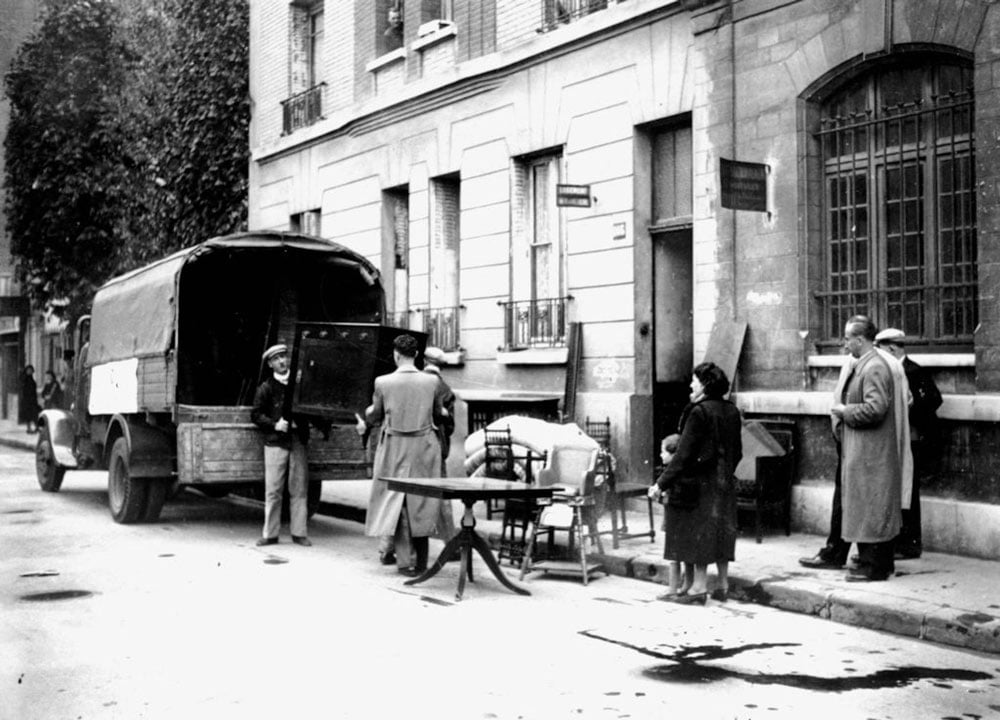
With the aid of French citizens, the Nazis looted more than 38,000 private apartments in the capital, and as many as 25,000 empty apartments that had been home to Jewish families were rented to non-Jewish tenants. Social workers estimated that nearly 100,000 Parisian Jews had been evicted from their apartments during the war. For many surviving Jews, returning home was their first priority.
Memoirs and oral histories recount these first moments of return. As a girl, Rachel Jedinak survived the war by hiding under a false identity after her parents’ arrest. She remembered returning to her family home: “We tore the seals from the door and went in. There was nothing left – nothing. This empty apartment – without furniture, without belongings, without photos that would have allowed us to remember those who were gone, to reconnect us to our parents – made us cry. The loss of our memorabilia was even more painful than the loss of our material goods.”
Reclaiming and then furnishing these apartments was both practical and emotional. Their homes provided a bed to sleep on, as well as the last links to family members lost in the Holocaust. The scale of loss meant that rebuilding would require a coordinated governmental effort.
Restitution and reparations
Two orders issued on Nov. 14, 1944, addressed renters’ rights to return to their prewar homes. Another ordinance, published on April 11, 1945, was meant to help return recovered furniture to its original owners.
These measures largely failed to meet Jewish survivors’ needs, however. The housing laws included exceptions that favored the new, non-Jewish tenants, such as Allied bombing victims and former prisoners of war. Additionally, only about 2,000 pieces of furniture were returned to survivors or heirs.
As a result, many survivors would rely on financial compensation for their losses. Jews whose apartments had been looted could file a claim under the War Damages Law of Oct. 28, 1946. But this long-awaited law proved to be a further disappointment.

Chabe01/Wikimedia Commons, CC BY-SA
Enacted two years after the liberation of Paris, the War Damages Law provided only limited funds for personal items. Eligible victims could receive 90,000 francs – less than US$10,300 or 9,000 Euros today – per household for the total loss of furnishings, or half the insured value of their stolen goods.
Claimants had to file a four-page form and submit documents proving their nationality, family status, legal standing and property rights, as well as witness statements to verify the losses.
If the government approved a survivor’s claim, payment was not immediate. A sample of the 2,750 files held in the Paris Archives reveals that more than 85% of claimants wrote to the government asking for faster payments.
One survivor writing to officials in 1948 summarized the feelings of many looting victims: “I think that we have all paid our dues and suffered enough for you to compensate us for at least a part of what the Germans stole from us almost six years ago.”
But for many, the payment process associated with the War Damages Law dragged on into the 1960s, underlining the long-term economic impact of wartime looting.
Continued exclusion
Only French citizens or foreigners who had fought for France were eligible for payments under the War Damages Law. More than half the Jews living there during the Holocaust, however, were foreigners – including nearly 100,000 refugees who had recently fled Nazi violence.
Arthur Deutsch was born in Vienna to Polish parents and moved to Paris in 1922, where he married and had five children. In 1938, he filed a request for naturalization, but it was not finalized before war broke out. He tried to volunteer for military service but was not called up.
The family fled Paris ahead of the Nazi invasion, ending up in the central city of Limoges, where they were arrested in December 1940. They were eventually transferred to the Rivesaltes internment camp, where Deutsch was assigned to forced labor. When the family returned to Paris after its liberation, they found their apartment completely empty.

German Federal Archive via Wikimedia Commons, CC BY-SA
Deutsch filed a claim for war damages, which was rejected in 1952 due to his citizenship status. He contested his exclusion, writing: “If I am not French on paper, I am in my thoughts because one does not spend thirty years in Paris without being assimilated, and it is not four years of internment or the rejection of my furniture indemnity claim that will make me change my mind.”
As anthropologist Damiana Oţoiu notes, “the psychological damage caused by forced resettlement, seizure of property, and the loss of social and cultural capital cannot be compensated by the mere restitution of property years or decades after the crimes were perpetrated.”
But for Parisian Holocaust survivors, recovering or replacing stolen goods represented their ability to live with dignity and security. The struggle for compensation and for recognition of the persecution they faced continued for decades after the war’s end – and in some cases, continues today.

Shannon Fogg is Professor of History at Missouri University of Science and Technology.




























_-_2024-05-01_-_2.jpg)

Pogo says
Shannon Fogg, well said.
How do you feel about your scholarship being appropriated to make a veiled statement of a personal grievance?
https://www.google.com/search?q=man+is+the+only+animal+that+blushes
Atwp says
Good story. It is sad. We were taught about the Holocaust when i was in school, very little to nothing was taught about the Holocaust my people went through. My people suffered harsh demonic conditions from the country’s systematic racist system. I feel for the Jews but what about my people. I’m not going to say anything else because it make me despise the white society especially the white man. I thank God even the white man can’t stop his own death.Thank God the white man can’t kill, hang, burn, or shoot death. Thank God even the white can’t stop death.