



By John W. Diamond
Every year, the panel overseeing the trust fund for Social Security and Medicare publishes its annual financial report. And every year, its members make clear that the programs’ reserves will be exhausted by the time Gen X retires – meaning they will no longer be able to pay full scheduled benefits by the mid-2030s.
While many media outlets cover this news as a one-day story, this year’s report should be seen as a much more ominous warning. The latest projection, released on June 9, 2026, is that the Social Security trust fund will be depleted by 2032, at which point incoming revenue can pay only about 78% of scheduled benefits. For the 1 in 5 Americans who receive Social Security, that means a potential across-the-board benefit cut of roughly 22% unless Congress acts.
What makes this year’s warning especially troubling is that the deterioration isn’t driven by a temporary downturn but by deeper demographic and policy changes: Fewer expected births, lower immigration, slower growth in the workforce and reduced future revenue from the taxation of Social Security benefits.
The fundamental challenge, though, has been obvious for years. There are too few current and future workers to support the growing number of retirees. And now, there are fresh headwinds that make the math even more daunting. Record debt levels and elevated interest rates are reducing the fiscal resources available for lawmakers to implement solutions, while declining immigration and birth rates mean that the supply of current and future workers is even smaller than previously projected.
These pressures don’t mean Social Security will disappear. It will always exist as long as workers and employers pay into the program. But for anyone who expects to retire starting in the early 2030s, the potential for a cut to benefits is real.
As a scholar of public finance, I argue that this looming deadline recalls the crisis policymakers faced in the early 1980s. Once again, the issue of reform is about to move from a distant worry to an immediate political problem. And failure to reach a bipartisan compromise will bring both economic pain and political damage.
Fresh pressures
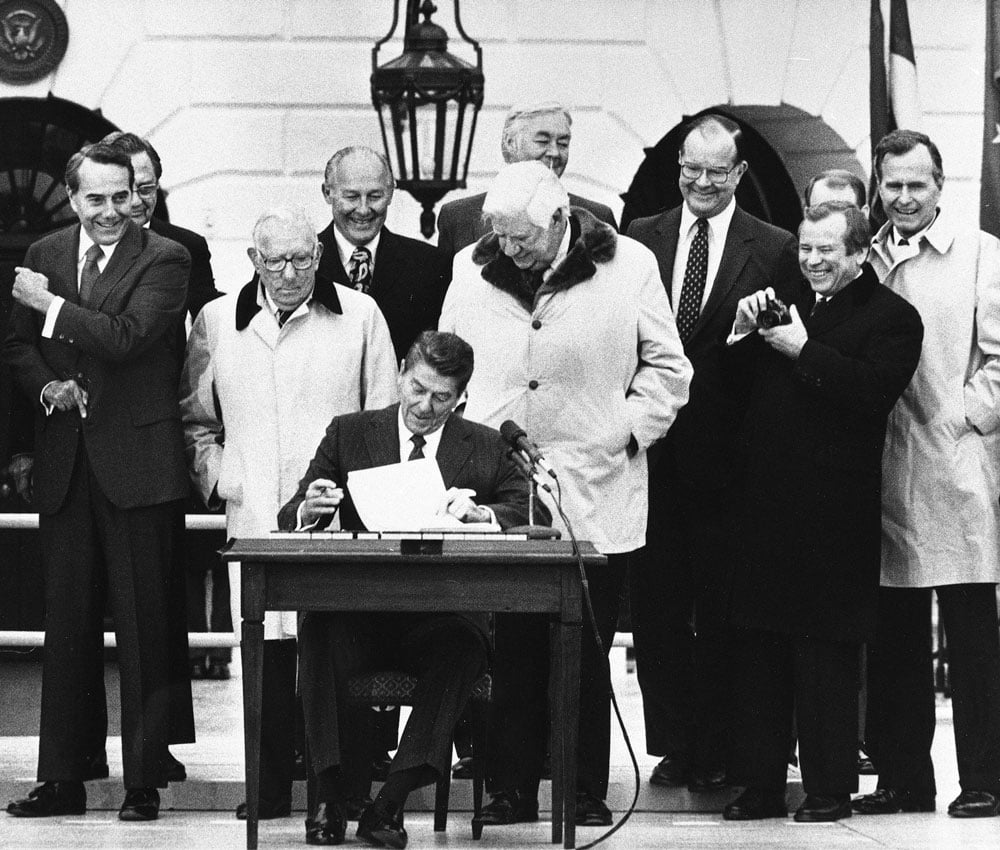
In 1983, President Ronald Reagan and House Speaker Tip O’Neill struck their historic bipartisan compromise to extend the life of the program by raising taxes and the eligibility age. This time, the challenge will be far harder.
To start with, the federal government now carries a much higher debt burden, topping 100% of annual GDP, compared to about 35% in the early 1980s. And the Congressional Budget Office projects large deficits adding to that debt in the coming decades, with the annual budget shortfall rising from US$1.9 trillion in 2026 to $3.1 trillion in 2036 under current tax and spending laws. Public debt is projected to rise to 120% of GDP by 2036, leaving less and less fiscal room to patch Social Security.
Servicing that debt is also becoming more expensive. Although the Federal Reserve trimmed interest rates in 2024 and 2025, the cost of borrowing remains elevated as concerns over inflation grow, exacerbated by oil price spikes and the crisis in the Strait of Hormuz. Markets now expect the Fed to hold rates steady for a while, and some investors are betting it may even raise them later this year.
The demographic picture is also unforgiving. Baby boomers continue to retire, Americans are living longer, and birth rates have fallen sharply. Since 2007, the U.S. birth rate has fallen by 23% and has remained below replacement level for years. The result is fewer future workers paying payroll taxes, even as the number of retirees grows.
A final factor is immigration.
While other aging countries have turned to immigration to shore up public finances and revitalize their labor force, the U.S. has taken the opposite approach. According to the U.S. Census Bureau, net migration to the U.S. is estimated to have fallen by 2.4 million between 2024 and 2026, amid the Trump administration’s crackdown on unauthorized migrants and its efforts to discourage green card applications.
The new report referenced these challenges, noting that lower immigration and fertility estimates will have “a negative projected effect on Social Security’s financial status.” It also addressed the effects of the massive policy bill that President Donald Trump and the Republican Congress pushed through in 2025, which among other things cut the income tax that retirees pay on Social Security benefits.
The near-term economic changes of that legislation will “have a positive effect,” the report said, but in the longer run it will also weaken the program’s finances.
A slow-motion crisis
It’s important to remember that before the 1983 deal was sealed, Social Security was far closer to insolvency than it is today. The program was nearing the point where it could no longer pay full benefits on time.
The problem was caused by a mix of high inflation, weak wage growth, the recessions of the 1970s and early 1980s, and mounting demographic pressure. Americans were living longer, birth rates were falling, and the number of workers supporting each beneficiary was declining.
The 1983 reform was negotiated under Reagan, a Democratic-controlled House and a Republican-controlled Senate, with help from a bipartisan commission led by future Federal Reserve Chair Alan Greenspan. It addressed the program’s immediate financing crisis by accelerating scheduled increases in the payroll tax and phasing in a higher full retirement age, from 65 to 67. It also anticipated the retirement of the baby boomers and the growing burden they would place on future workers.
The historic overhaul, which came only after months of wrangling, bought the country time. Just as important, it showed that with bipartisan support, a Social Security deal is possible. But it also underscored the danger of waiting too long. When policymakers delay, the menu of options gets smaller, the required changes get larger, and the economic and political pain increases.
Social Security’s next crisis won’t arrive suddenly. It’s arriving in slow motion. The question isn’t whether the program can be fixed, but whether elected officials will act while they still have room to choose among less costly options. I believe the real lesson of 1983 is that waiting until the last minute will turn a chance for reform into a political emergency, and little good comes from governing by crisis.

John W. Diamond is Director of the Center for Public Finance at the Baker Institute, Rice University.




























JimboXYZ says
That’s odd, people aren’t living longer. Covid proved that fact. Social Security was projected to run out of money decades ago. The average mortality age of Flagler County alone declined from Covid by months for gender & race demographics. Does anyone actually think the Biden-Harris dreamers were actually paying enough into social security to keep it relatively solvent ? They’ll fund it and make their payments every month if it adds to the debt/deficit. Nobody wants to hear how cheap Congress would get after a lifetime of watching the wastes, the fraud & abuse that has been around for just the decades that I’ve been alive. Always seems to be enough money to give away to illegals and then there’s a whine about deportation. The 4 years of Biden-Harris alone was never a profitable. Anyone else tired of all the BS about what more they’re going to cheat the masses out of for Social Security & Medicare ? Cut those programs back, nobody in the Federal Government should get a single pension payment,we can start with Biden’s $ 400K/year.
Jim says
Covid brought down life expectancy in 2020 and 2021. Since then, mortality rates have essentially returned to pre-pandemic levels.
As far as I know, whatever the “Biden-Harris dreamers” were paying into social security was the same as MAGA and everyone else. Maybe you have some facts to support your statement.
“The 4 years of Biden-Harris alone was never a profitable.” What does that even mean? Are you comparing the Biden crime family profits to the Trump family profits? If so, then I’m in agreement.
“…nobody in the Federal Government should get a single pension payment…” What a stupid statement. Government employees are provided benefits just like most employees of non-government companies. On what basis did you determine they don’t deserve pensions? Is it just because they work for the government?
As far as the solvency of social security, a reasonable proposed solution I’ve heard is to increase the cap level above the current $184,000 salary point. Now, I know you would be upset by this as I’m sure your salary is well above that level. However, for the vast majority of Americans, few are making that kind of money. And I fully believe that the poor people making above $184k will figure out how to survive that hardship. Maybe put off buying that yacht or new Mercedes for a few months or some other painful sacrifice.
Ray W. says
Hello Jim.
In 1983, Congress reformed Social Security. President Reagan signed the bill into law. At the time, with implementation of the reforms, the Social Security fund was projected to be solvent for 75 years.
According to a paper published earlier this year by the Roosevelt Institute, in 1983, 90% of the nation’s labor force earned less in income than the cap on earnings set by the bill. It was assumed that this ratio of earnings equality would remain static. Instead, the Roosevelt Institute researchers now write that a significant shift in income inequality for purposes of funding Social Security has occurred. More and more of the nation’s income now flows to the 6% of the income earners who earn far above the Social Security cap and comparatively less and less money flows to those earning income at a level below the cap.
The researchers conclude:
“The lesson of the past four decades is not that Social Security promised too much. It is that its funding rules failed to keep pace with an economy that grew more unequal.”
Make of this what you will.
Me?
Yes, JimboXYZ is spreading misinformation when he types that Social Security was projected to run out of money decades ago. But there will come a time when the fund does run out of money. After all, at time of reformation in 1983, the fund was projected to remain solvent for 75 years.
I am not claiming to have “an” answer, much less “the” answer. But who among us should ever look to JimboXYZ for answers?
As an aside, Dreamers pay into Social Security and into the federal Treasury, without hope of earning benefits unless they earn citizenship status. According to a recent Cato Institute study, between 1994 and 2023, immigrants, both documented and undocumented, who have not yet been naturalized paid $14.5 trillion more into the nation’s several fiscal purses than they withdrew in benefits. Economically, these immigrants have been a fiscal boon. This documented study disputes the pernicious lie about immigrants that JimboXYZ repeatedly attempts to spread.
Skibum says
Jimbo, you might as well have thrown a plate of spaghetti at the wall to see what stuck (clue: nothing) for all of the nonsensical mishmash you vomited above! It doesn’t even deserve to be countered with facts because it appears to be more of a rant or just delusional BS. So, yes… it certainly could have come straight from the mouths of any of the maga mouthpieces at fauxinfotainment who intentionally vomit disinformation and fabrications disguised as “news”.
At least thanks, I guess, for coming to FlaglerLive where you will find a dose of reality. Maybe one day it will sink in.
Samuel L. Bronkowitz says
Man you old conservative dingbats sure hate socialism right up until that check comes, don’t you?
PaulT says
The ‘funny’ thing, @JimboXYZ, is that most of those undocumented deportees’ paychecks had Social Security and Medicare taxes deducted even though most of the workers stood no chance of receiving benefits from either. So the deportation program makes our ‘benefitd’ programs less viable on top of the $200 billion and change that it’s costing the taxpayers to fund and expand ICE and Border Patrol.
Which really isn’t funny is it.
Jim Netherton says
lol you watching that entertainment news? Thats all misinformation and propaganda by the guardians of pedophiles.
Yes US citizens live on average 12 years less than Canadians or countries with a universal care system.
Immigrants pay tax and are ineligible to receive benefits but your fascist propaganda wont tell you that part. Borders were never open. And the GOP revoked the legal status of millions of people making them “illegal” then spent billions for masked gestapo to kidnap and disappear people in broad daylight . You pedo cucks have given how much for epstein distraction and israel genocides? Almost 30 % of the entire national debt was made by a pedophile felon fraudster. Go work extra hours to pay the pedo tariffs and be a quiet piggy! Sad so many support a pedo terror organization, you will all be burning in hell if there is one!
Laurel says
I’m not buying it.
I have, and the people before me have been paying into the system, along with our employers, all our working lives. What has happened during that time? Corporate welfare, banks too big to fail, pensions killed and replaced with 401Ks, fights against a living wage, inflation, deporting immigrants, tax cuts for the wealthy, anything and everything that would kill a fixable problem.
The Republicans have tried to bleed out Social Security and Medicare for decades. What have the Democrats done? Nothing. This is yet another attempt to increase the divide between the haves and have nots. To kill off the middle class, which is too powerful for some.
Baby boomers are defined as being born between 1946 and 1964. I’ll take issue with that. The “boom” started when American soldiers came home from World War II; I need not explain what occurred, but that initial boom didn’t continue because of soldiers coming home, it continued because of the enjoyment of the financial success of the 50’s and the 60’s. A car in every garage, and a chicken in every pot. Only one spouse needed to work outside the home.
During the 1970’s, that started to change. Corporate greed stepped in. The pay wage was not increasing along with inflation. The minimum wage has stagnated since then, by corporate demand.
“A living wage is the minimum income necessary for a worker to meet their basic needs, including housing, food, healthcare, and transportation, without requiring additional financial assistance. The specific amount varies by location and family size, reflecting local living costs.”
Search Assist – Massachusetts Institute of Technology, California State Portal
The divide began. Tax cuts for the wealthy began. Pensions started to shrink, and by the 1990’s pensions started disappearing, but corporate welfare grows. So what is happening now? Is there a living wage? Are basic needs met? What is the cost of housing, food and healthcare? Why is it all out of control? Yet, we have the world’s first, and one and only, trillionaire. One who gets contracts from our government. Why is this?
All of this is intentional. There is no real reason that we cannot take care of those who took care of us, and I mean the workers, not the corporations, who “are people my friends” (Citizens United). Paul Ryan, running for Vice President with Mitt Romney as President, voted not to raise the Social Security contributions by $0.07 per hour, saving the system. Corporations were against it. The Republicans want to privatize Social Security, so they tried to weaken it. They have been trying ever since. They are succeeding.
Social Security stimulates the economy. Go to any restaurant, and see who is there. People often wait for their “check” and go out and spend it. That will cease, if we allow this to happen.
Speaker of the House, Mike Johnson is already proposing that Social Security, Medicare and Medicaid should be cut right after the upcoming elections.
So, why can’t we save Social Security, Medicare and Medicaid now?
Sherry says
Maga Says: Absolutely Everything is President Biden’s fault!
Meanwhile. . . pay NO attention to trump’s MASSIVE “Grifts”:
1. Cryptocurrency Ventures and “Digital Grift”Cryptocurrency has emerged as the single largest source of new wealth for the Trump family, yielding at least $867 million in profit.World Liberty Financial (WLFI): Trump launched this family-controlled crypto firm, reversing his historical skepticism of digital currencies while his administration aggressively deregulates the sector. The venture takes a direct cut of cash from token trades, sales, and stablecoin interest.
Foreign Crypto Winds: The Goldsmith Awards highlighted a deal where a United Arab Emirates investment firm injected $2 billion into a coin tied to World Liberty Financial. Two weeks later, the administration approved an agreement allowing valuable, U.S.-developed computer chips to be exported to the UAE.
Meme Coins and Public Offerings: Sales and trading fees from “Trumpcoin” and Melania Trump-themed tokens netted over $427 million. Additionally, the public debut of another family venture, American Bitcoin, temporarily generated about $1 billion in paper wealth for Donald Jr. and Eric Trump after the president publicly proposed a national Bitcoin reserve.
2. International Licensing and Policy Alignment :Because the Trump Organization continues to pursue aggressive international expansions during his presidency, foreign entities have frequently aligned major business transactions with U.S. diplomatic changes.
Foreign Branded Projects: The Trump family has secured at least $23 million by licensing the Trump name to over 20 overseas luxury developments. This includes high-profile hotel, residential, and golf projects in Oman, Saudi Arabia, and India.
Tariff and Military Quid Pro Quos: In Vietnam, a $1.5 billion Trump-branded golf resort broke ground shortly before the Trump administration lowered threatened U.S. tariffs on Vietnamese goods from 46% down to 20%.
In Saudi Arabia, news of a new luxury venture overseen by Crown Prince Mohammed bin Salman surfaced just days before the U.S. finalized an agreement to sell F-35 fighter jets to the kingdom.3.
Lavish Foreign Gifts and Endorsements: The Qatari Luxury Jet: The government of Qatar gifted Trump a $400 million luxury Boeing 747. While the administration accepted it under the premise of utilizing it as Air Force One during his term, Trump has explicitly arranged to retain personal ownership of the aircraft after leaving office.
Melania Trump Documentary: Following a high-profile dinner at Mar-a-Lago, Amazon agreed to a $28 million to $40 million licensing deal to distribute a documentary about First Lady Melania Trump.
4. Direct Merchandising and Campaign Co- Branding: Unlike previous presidents who kept campaign fundraising distinct from personal revenue, Trump directly sells branded merchandise through his personal commercial storefronts, routing proceeds to himself and the Trump Organization. These retail lines have yielded tens of millions in personal income through products such as:Trump Watches: $2.8 million in direct revenue.
“God Bless the USA” Bibles: $3 million in royalties from co-branding agreements.Sneakers, Fragrances, and Memorabilia: Upwards of $2.5 million from targeted merchandise drops, including “Victory 47” cologne, which Trump has openly showcased during official diplomatic meetings at the White House.
5. High-Volume Stock Trading and “Settlements”Flurry of Active Trading: Financial disclosures tracked by CBS News revealed that Trump’s personal investment accounts executed over 3,600 active stock trades (2,346 purchases and 1,296 sales) within a single three-month window in early 2026. This active portfolio management while controlling market-moving policy has triggered calls from congressional watchdogs for insider trading investigations.
Corporate Cash Settlements: Major media and technology firms have paid Trump an estimated $90.5 million in private financial settlements. Critics point out these payouts followed direct presidential threats of lawsuits and antitrust investigations, effectively leveraging executive authority for personal legal windfalls.
6. Domestic “Pay-to-Play” Properties and Clubs Political Spending at Trump Resorts: The Republican National Committee, corporate lobbyists, and special interest groups regularly host six-figure fundraisers, galas, and events at Mar-a-Lago, Bedminster, and Trump National Doral. Trump directly profits from the room bookings, catering fees, and facilities charges.
The “Executive Branch” Club: Members of the Trump family established an ultra-exclusive private club in Washington D.C. named “Executive Branch”. Membership fees start at $500,000, offering wealthy donors and corporate executives a literal gateway to socialize directly with Cabinet officials and administration staff.
PaulT says
A very good reason to vote in November against the Republican incumbents who are running for re-electuon to Congress. Both Ashley Moody and Rendy Fine may pay lip service to prorcting the Social Security Trust Fund, but both have a history of party-line voting so are likely to follow the lead of House Speaker Johnson and Senatr Majority Leader Thune, both of whom support slashing Social Security payments.
At the same time the Trump administration wants to increase defense spending hy 50% while reducing non-defense spending so no doubt the ‘fiscal consrvatives’ who voted to support Trump’s astronomical incr.ease in the deficit will once again be clamouring for ‘benefits’ to be cut.
The stock markets may be booming but the economy isn’t and wages (and Social Security) are falling behind inflation.No one except millionaires and billionaires can claim to be better off under Trump, he’s got two more years to play fast and free with government spending but removing the Republican majority from both House and Senate should at least slow down his wild spending spree.
Atwp says
Jimbo you need help.
DaleL says
One issue, which I do not believe was in this story, is the Social Security Fairness Act. It was signed into law on January 5, 2025 with bipartisan support. It eliminated both the Windfall Elimination Provision (WEP) and the Government Pension Offset (GPO). The result increased the depletion of the SS trust fund and shortened the expected insolvency date by about one year.
Illegal immigrants have helped to subsidize Social Security. They frequently use fraudulent SS numbers, which their complicit employers don’t check. The result is that they and their employers pay into the fund money which they will never be able to collect upon retirement.
At the time of the Reagan/O’Neill deal, the average life expectancy in the USA was 74.4 years. Today it is 79.5 years. It is true that Covid caused a slight dip in life expectancy, but that did not last.
The maximum earnings which are subject to the SS tax is already adjusted for inflation. Thus, unlike what many Democrats suggest, the maximum earnings cap is not a cause of the SS fund shortfall.
JimboaXYZ is correct about one issue. The United States is running such a high deficit, mostly because of Trump/Republican tax cuts, that SS cannot (should not) be funded by borrowing. The result would be disastrous.
A logical solution might include:
1. Lowering the SS cost of living increase by one percent each year for a couple of years.
2. Raising the “full” retirement age from 67 to 68.
3. Raising the maximum earnings which is subject to the SS tax.
4. Reintroducing at least a minimal WEP and GPO.
Above all, fully fund the IRS to ensure that tax cheats, especially wealthy ones, pay their fair share of taxes. Mr. Trump famously sued the IRS because a contractor in 2017, while Trump was president, leaked his tax returns. Returns which Mr. Trump, while he was campaigning the year before, also famously promised to release. They showed that the billionaire had paid almost no income taxes. Wealthy individuals are frequently able to manipulate their finances, both legally and illegally, to make it appear they have no taxable income. I strongly suspect that there is a similar underpayment of SS and Medicare payroll taxes by companies run by such people.
Deborah Coffey says
# 3 would do the job! Republicans will never do it, though.
The dude says
All of you should know this by now, but it bears repeating.
Jimbo and Dennis ain’t here for the hunting…
Sherry says
Good morning “The dude”. . . well, I must confess that I have no idea what “for the hunting” means. In any case, IMO, they are only here to mouth off and hear their “empty” heads roar. Some people will simply never stop being a disgrace to humanity!