



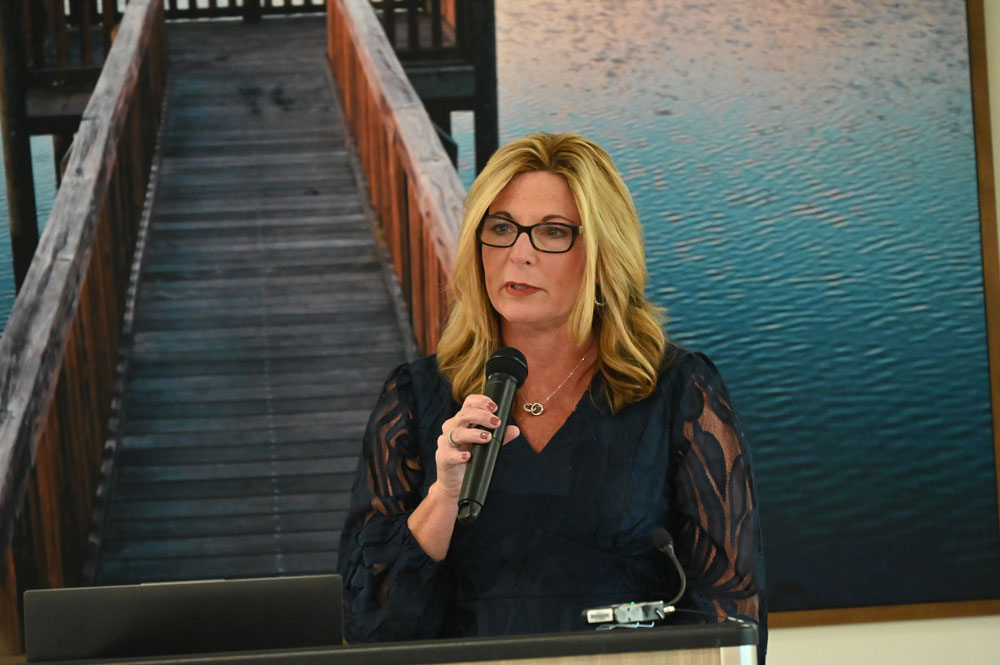
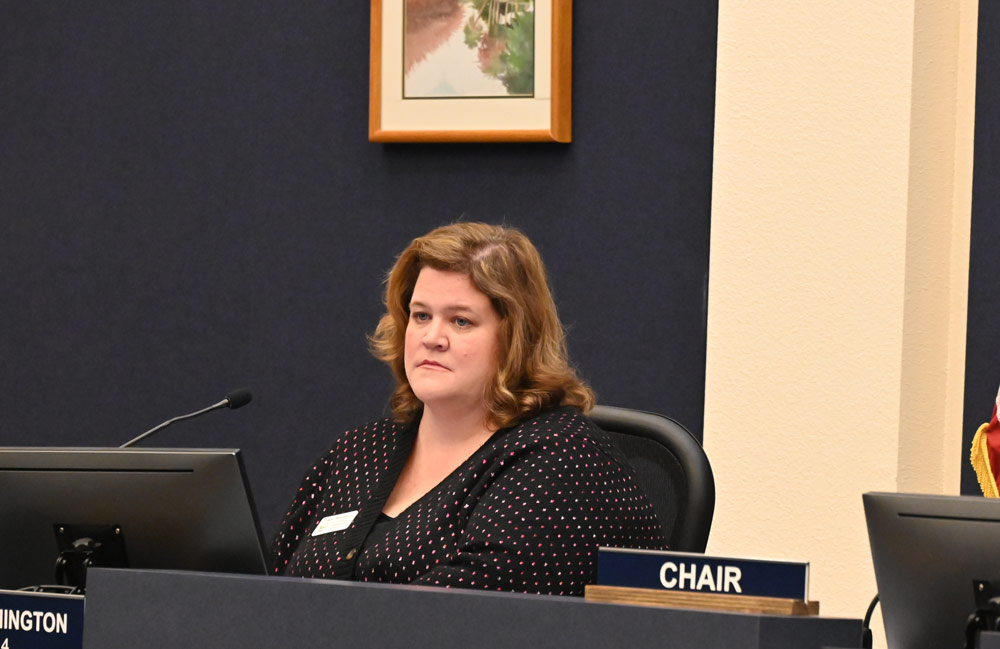
In a set of evaluations potentially devastating to Flagler County Administrator Heidi Petito’s tenure, three of her commissioners—Chair Leann Pennington, Kim Carney, and Pam Richardson—concluded in their evaluations of Petito that she “does not meet expectations.”
They each rated her a failing 2 out of 5, sharply criticized her leadership, and two of them explicitly said Petito is no longer the person for the job.
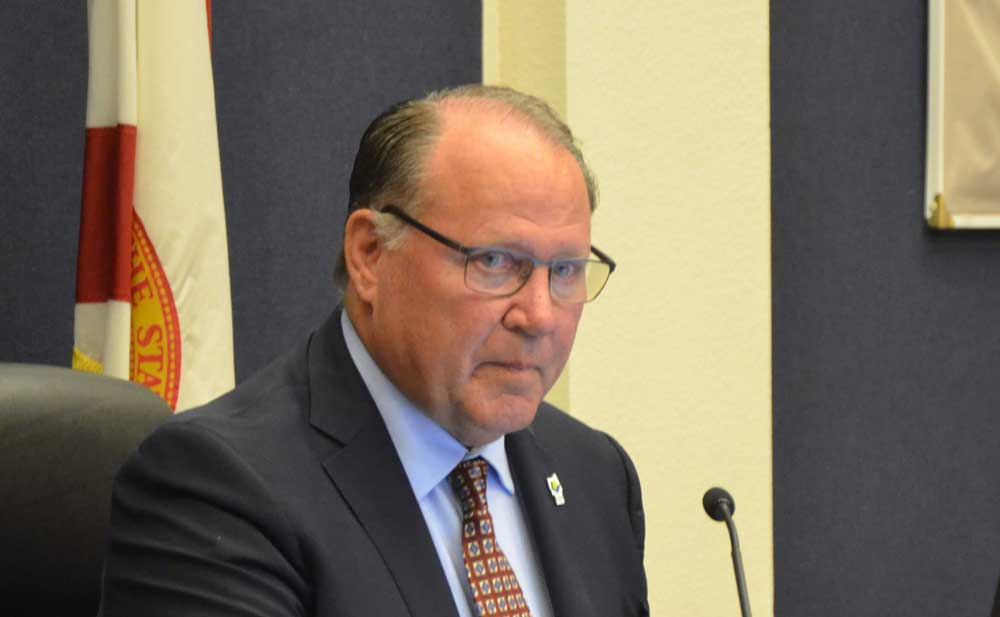
In radical contrast, Commissioner Greg Hansen found Petito to “significantly exceed expectations,” while Andy Dance found her to “exceed expectations.” The latest evaluations also are as radical a departure from the 84 percent confidence she received for last year’s performance, the 78 percent she received for 2023, and glowing reviews for her first full year on the job.
The all but complete annual evaluations—Pennington was meeting with Petito today—are the first set to reflect the judgments of Richardson and Carney, who were elected a year ago. (The administration tagged the evaluations, embedded below, as “draft,” as if they are a work in progress. Commissioners briefly last Monday discussed their evaluations as done. Done or not, the documents reflect the commissioners’ own words.)
To observers of the County Commission, the findings, and the dichotomy between the men and the women, are not a surprise. They put words and grades to a dynamic that has been obvious for most of the year as Hansen and Dance have served as ramparts in defense of Petito’s administration while Pennington, Carney, and Richardson have regularly thrown battering rams against those ramparts.
The evaluations are a major blow to Petito on the heels of the deepest loss she’s experienced, professionally and personally, when Deputy County Administrator Jorge Salinas died in October. The loss of Ansley Wren-Key, the accomplished coastal engineer who’d led the county’s beach management initiatives and just took a job with St. Johns County government, compounds the administrative challenges over a high-profile and increasingly complex part of Petito’s responsibilities.
Petito provided a five-page “evaluation response” that nowhere refutes the criticism or addresses it head-on—she does not refer to any of the evaluations, any of their wording, any of their accusations—but seeks to implicitly answer much of the criticism with numbers, facts, and assertions in positive language. The gulf between that language and the three commissioners’ criticism is gaping.
“Over the past year, we have continued to strengthen the County’s operations and deliver meaningful results for our residents,” “From enhancing organizational effectiveness and reinforcing clear lines of authority, to improving communication both internally and externally, we have built a culture of transparency and accountability. Our leadership team has worked diligently to align priorities with the needs of the community, and our financial stewardship has ensured that resources are managed responsibly while supporting critical initiatives.”
Regarding finances, “She ensures that there is no waste and that we efficiently run the government,” one of the many findings that will be vehemently contradicted in three commissioners’ evaluations.
Dance credits Petito for spearheading and following through with the county’s strategic plan (its annual goals) and pushing through such initiatives as the airport zoning ordinance, which creates an overlay slightly restricting neighboring development, the rebuilding of the Bull Creek restaurant, the launch of an Industrial Development Board, and her continuing working relationships with other governments and constitutional officers.
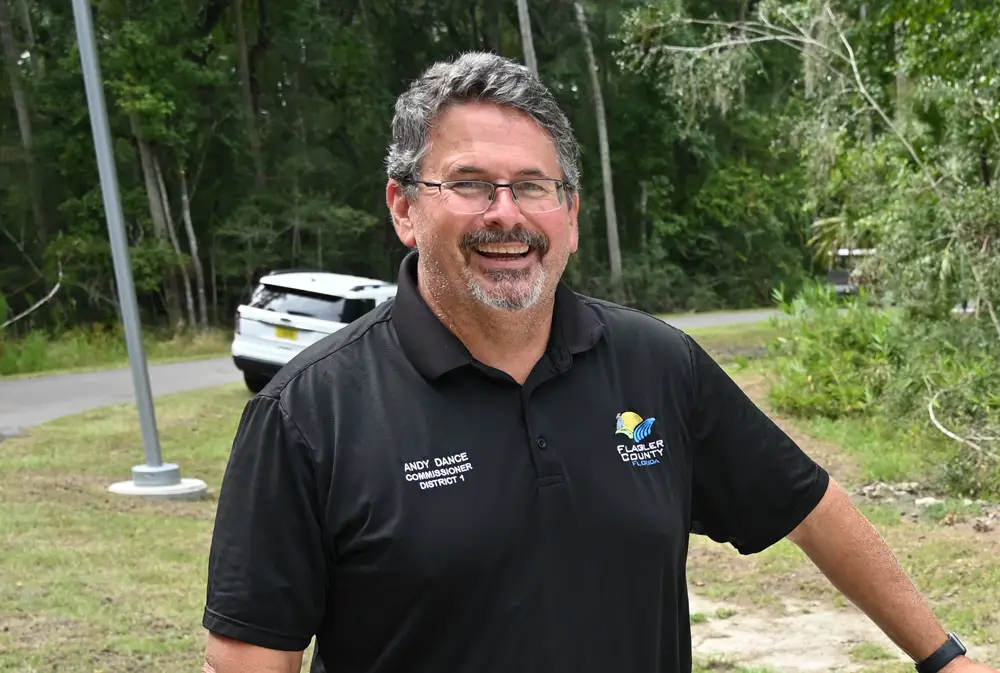
“Additionally,” Dance wrote, “one of the most controversial issues that received a majority of negative news was the debate surrounding the beach funding plan. Much of the discussion from commissioners revolved about not getting adequate information when this issue was discussed at a workshop or meeting. One takeaway from all this is to internally evaluate the criticism and create a process that ensures commissioners are provided various avenues to get information.” The plan marred Petito’s year more than any other initiative and was ultimately defeated by the three disenchanted commissioners. Dance applauded her “herculean effort to get it as far as it did.”
Pennington was scathing, starting with the beach-management plan, its lacking documentation for proposed fees or taxing plans: “the Administration has allowed staff to provide reports that lack the factual basis and substantive detail necessary for the board to make informed decisions,” she wrote, citing other examples (such as the county’s adult day care program, when the administration proposed an approach without “due diligence,” undermining public trust, or eliminating the county’s contribution to Flagler Beach’s lifeguard budget without warning, which was reversed after an outcry.)
“As a board, we have too often found ourselves in the position of having to vet and clarify decisions made by the Administration,” Pennington wrote. “On numerous occasions, we have had to step in to direct, revise, or correct staff presentations and recommendations before they could be considered acceptable for public discussion or board action.” Just as critically: “Over my three years on the board, I have observed a recurring pattern within the Administration, an unwillingness to fully consider or incorporate board input. Too often, it feels as though we are in greater conflict with staff than with the public on important policy matters.”
Much of Pennington’s evaluation is in the same vein, in one case explicitly stating that Petito goes in directions that “differ significantly” from the commission’s—a usually fatal move for any top executive. Judgments such as “lack of accountability,” “concerning pattern of administrative inaction,” “unnecessary controversy, confusion, and internal strife,” and “last-minute adjustments” grate through the evaluation.
Pennington acknowledged Petito’s qualities, her steadfastness and professionalism especially, and “one of the most challenging years the Administration has faced.” But the kindness merely softened the blow of Pennington’s conclusion: to the chair, the administrator is no longer suited for the job.
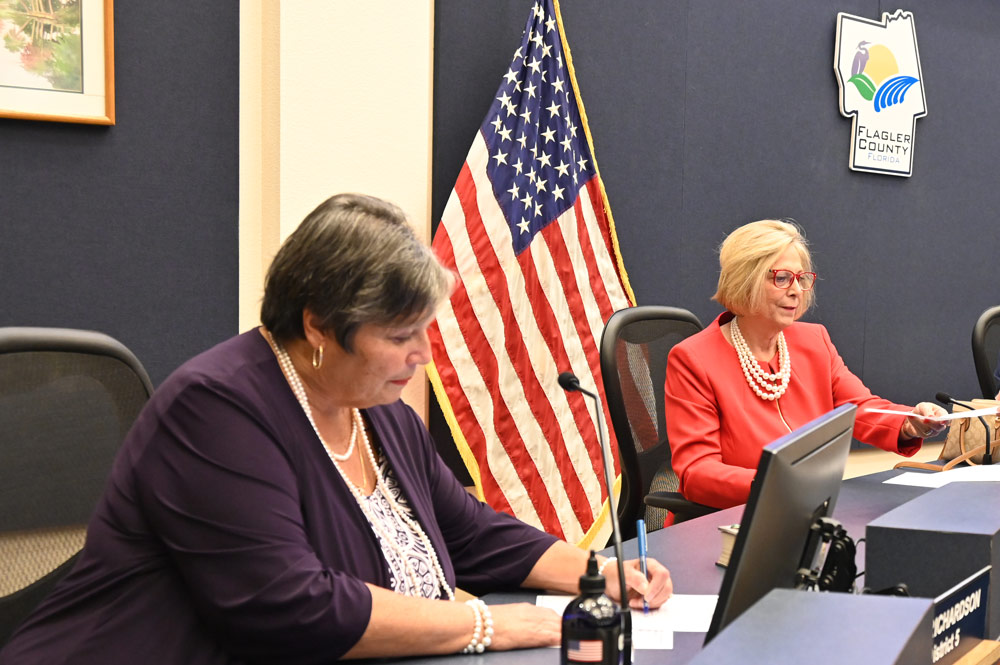
Just as gravely, Carney criticized Petito’s administration for “overbudgeting” in case the funds are needed, before echoing Pennington’s conclusion that Petito is out of step: “We are in a time when this practice, although probably acceptable several years ago, does not work now.” Carney gets into the weeds of the budget and the administration’s practices, including hiring from within, which Carney considers limiting. She acknowledges Petito’s long tenure and institutional knowledge, but sees it almost as a crutch to more current expertise.
“With the number of years Heidi has served the County, I know she is dedicated and committed to Flagler County and the citizens that call it ‘home,’” Carney concluded, before delivering a verdict as damning as Pennington’s: “There are many issues facing Flagler County and I am not confident that Heidi[,] her knowledge base, her experience and her leadership style is able to get us to where we need to go.” She hinted that had the administration properly informed the board of the 60-day notification requirement in Petito’s contract, if the board was to not renew it, Carney would have been opposed to a renewal.
“The deadline passed with no discussion leading to an automatic renewal,” Carney wrote. “Discussion of renewal or nonrenewal should have come up in August.”
Richardson’s evaluation was not as cursive as Hansen’s, but close, in a more negative direction, citing the same blots on Petito’s record as her colleagues did (Ragga Surf, beach management, but also the fuel dump fiasco, and so on). “Administration must do a much better job in conveying accurate and valuable info in a timely manner, to aid in discussions on key decisions,” she wrote. “Administration does listen and welcomes new ideas but does not follow up on discussion after that, which leaves ideas often left on the table.”
Richardson was also critical of what she felt is a different level of information-sharing depending on the commissioner. She criticized the administration for not using “cable” television to disseminate information. And she doesn’t like the workload: “An extreme amount of items are placed on the agendas and in addition, too many meetings on the same issues,” she wrote.
While she refrained from judging Petito’s tenure no longer tenable, as her two colleagues did, her overall grade amounted to the same thing: “Does Not Meet Expectations.”
One word now sums up Petito’s hold on her job: embattled.


























Keep Flagler Beautiful says
She should have gotten the boot a long time ago.
Taxpayer says
She should have been gone, she has cost the taxpayers payers plenty of money due to lawsuits that they keep quiet… Andy Dance is only on her side because his wife works for her.. He’s a liar and a snake as well… Hanson is her do boy always has been… Hanson and Dance needs to go in the next election… she has created the good ol boy system again…. Fire her and Bring someone in who’s not from Flagler County and clean house….
Mort says
Which lawsuits do they keep quiet? Got any details? If not, maybe you need to be reminded that you can be sued by anyone in the community tired of stupid allegations like this one.
Taxpayer says
Mort says: it’s public record with in the last 3 or 4 years there have been several lawsuits that has been settled quietly so that the taxpayers don’t know…. There’s still a few pending… All because of hydie good ol boy system… She will look you right in the face and tell you a bald face lie…. She could have prevented everyone of them, but her leadership is weak and certain departments does whatever they want, because they are part of her click…
Mort says
Details, please. What good old boy system? Everything the county does is on record. Would you like to share this corruption with us? The Commissioners vote on this.
In what way is she weak? What lies has she told? Specifics, please.
Gina says
Mort: you said you want an example, here’s one county lawsuit we did here about,
thank you Pierre, when Petito and Sieger testified to attempt to evict Les Abend a pilot of 49 years as a tenant at the county airport and the county LOST THE CASE AS THE JURY CALLED IT AS A RETALIATIORY VIOLATION OF FIRST AMENDMENT:
flaglerlive.com/airport-lease-first-amendment
Oct 18, 2023 · Les Abend with his plane at the county airport, from where the county attempted to evict him in retaliation, a jury said, for Abend’s opinions.
Joe D says
Boy, is Flagler County in trouble….and it’s not from Heidi Petito!
The poor performance in the past few months of the current elected commission ( especially those most recently elected) is sadly disappointing. The changing of positions on issues and the almost “cat fighting” among Commission members and City staff with finger pointing, makes me wonder if my decision to move my LIFE to Flagler Beach 20 years ago for my recent retirement was a BIG MISTAKE? I’m amazed that Ms Petito can function at all with the current make up of our ELECTED Commission. YES, “we” are the ones responsible for voting them into office.
Is Ms. Petito perfect? Of course not, but who on the Commission or within County Government-at the moment is? Were the two problem issues mentioned not well thought out decisions, possibly not. But they should not be used to define her job performance overall. This appears to be more of a war of PERSONALITIES…appearing to be stirred up by Commissioner Carney and Commissioner Richardson( in my opinion), the NEWEST, and LEAST EXPERIENCED Commission members. Who gets to perform THEIR JOB PERFORMANCE REVIEWS? In MY opinion they have done more to disrupt the legislative process since they have come on board, than any positive outcome. Not using available resources or information, and blaming others for them not being informed ( not a sign of a good “the buck stops here” stance of a RESPONSIBLE leader). Again, I personally feel they are in over their heads in their positions ( definitely once they have seen how much actual WORK is required) to meet the LEGISLATIVE JOB REQUIREMENTS.
Any qualified Resident is allowed to run for public office, but it’s not just sitting at the head of the table giving out decisions, it takes negotiation skills, listening skills, patience and DEDICATION…all I have seen with Ms Petito. Not so much with some RECENT members of the County Commission.
That things (financially, politically, environmentally) are difficult at the moment is a given. But finger pointing and blaming is not going to improve the situation in Flagler County. I’m sorry to say, they are starting to look as dysfunctional as the Palm Coast City Council in recent months ( again in my personal opinion).
Ms Petito has my deepest condolences for the lack of respect given her job performance in these trying times. Maybe the NEXT Commission election results will give us a different slate of more MATURE MINDED Commissioners ( in my opinion). Or maybe some of our NEWEST Commission members will learn to GROW UP and “PLAY” NICE? As a former Nursing Division Chief response for dozens of staff and hundreds of patients, I certainly hope so, for the sake of Flagler County!
Larry says
The 3 commissioners are against Beach Renourishment and they are throwing Petito under the bus because she has a good beach renourishment plan with extensive data to back it up. The only way they know how to make beach renourishment go away is to get rid of Petito.
Those 3 commissioners are inept and will be voted out as soon as they are up for reelection. They know Petito is more knowledgeable then they are, so they are trying to get rid of her.
Frank says
Wonder if there is another person who those three commissioners have in mind to replace Heidi. There is probably another friend who wants the job.
Dbhammock says
I couldn’t agree with this comment more. It interesting Petito is the one who put together the recommendation for the .5 cent sales tax increase which appears to be the only solution to the beach management funding issue The three commissioners who don’t like her performance are the same people who voted it down. Yet when asked at the county commission meeting a few months back, if you voted no what’s YOUR solution to the beach finding plan, they had no answer and continue to this day to not have no answer. The three who gave her a bad performance review are basically getting retribution for Petito making them look bad. The three people who should be getting a poor performance review are the ones stopping the beach management funding plan and keeping this county in limbo regarding beach replenishment funding.
RTC says
The real problem is not with Heidi Petito, who is doing a wonderful job. The problem is with our three do nothing commissioners who seem to be against almost everything that needs to get done, but never offer any solutions. They are an anchor weighing down progress in our county. Hopefully they will only serve one term.
Jane Gentile-Youd says
RTC
Do your homework before opening un intentionally ignorant mouth. Accuracy counts not unfounded opinion
Marco Simone says
I’d like to know what expectations she isn’t meeting. To echo what Joe D said, the issues seem to arise from the commissioners. Has Mrs. Petito done every thing perfectly? No, but no one does their job perfectly. Show me someone who does and I’ll show you a liar. Mrs. Petito has done more good for the County than any of her predecessors. She is an actual human being who cares about residents and staff. The same cannot be said about most people in her position. Is she going to make every resident happy? No. No person can accomplish that feat. I hope she is able to weather this storm to continue making Flagler County a better place as much as she can.
About time says
I am happy with the 3 lady commissioners. They are not afraid to go against the good ol boy corrupt system. Thank you ladies! Heidi should have been let go long ago.
Dont stop questioning and demanding. What about Adm Mengel who seems to work with all of the developers to the detriment of our county. You cannot even leave a voicemail message for him for a very longtime. Why is that even allowed?
Mort says
More baseless accusations of corruption. Got any details you would care to share? Without them it’s called slander.
Danielle W says
These evaluations seem lazy. These 3 commissioners want to simply lay Beach Renourishment/management solely at the feet of Ms Petito. Yet, it was Petito who came up with a thorough Beach Renourishment/management plan, these same commissioners opposed that plan, however, came up with no alternative.
Government works when people actually come to the table to discuss ideas that make our county better, not simply pointing fingers, placing blame and hoping to replace a well qualified County administrator who has given many years to this county and its residents. It is sad to say it is almost hard to tell the difference between Palm Coast politics and Flagler county and I can honestly say it is NOT because of Heidi Petito.
Just a thought says
Makes me scratch my whiskers while thinking these three ladies always seem to be on the exact same page on many issues. It would be wrong to accuse them of collusion, but if there is a whiff of smoke you should look for fire. Having said that, I would be shocked if that was the case with Pennington. She has been nothing but a staunch supporter of the County and the west side especially. But Carney? When she went to such great lengths to blame a rape victim, she lost every ounce of credibility. I wouldn’t trust her for a second. I seriously hope they keep Petito right where she is.
Jane Gentile-Youd says
Heidi Petito is incompetent..she is a liar and even refuses to assist over 5,500 Flagler county FGUA water paying residents with the high rates and many water issues. She is an official FGUA BOARD member who legally represents us which she denies and even said to me” They don’t pay me*. She is not entitled to any pay but she is responsible for representing us since that was part of the sale of the water from the county to FGUA
She told Captains BarBQ in Sept 2018 they would have to vacate building at Bings… that it was beyond repair. Fast forward 2024 Petito supports a million dollar ‘settlement ‘ to Captains even though they never had to vacate building….. they were illegally granted use of our land to build a big new restaurant and run boat tours under another company who uses our county owned expensive floating docks for free! Heidi says the docks are free to everyone including private business.
The Old Dixie Hotel was of no concern to her. It was our Building Director Bo Snowden who finally used his own muscle to get the contaminated POS knocked down
Andy Dance has a conflict of interest in voting whether or not to fire the person who can fire his own wife from her office job. Frankly Lucy Dance is far better than Heidi at dealing with the public and responding but voting to keep your wife’s bosses job is a CONFLICT of INTEREST.
Gov De Santis makes $141,000 a year.
Heidi Petito pays herself $208,000 a year. De Santos went to Harvard . Heidib graduated high school
Either put her back in General Services for less than half pay where she was fine or give her walking papers but she is an insult to all of us as Chief County Administrator …
Heidi needs to go . Thanks Kim Leann and Pam
Mort says
Forgive me, Jane, but weren’t you in the process of selling your home “and moving out of this godforsaken place”?
Has a positive thought ever crossed your complicated mind filled with hate and criticism of everything Flagler? I imagine your own neighbors run when they see you coming.
Jane Gentile-Youd says
I have done more as a private citizen on my own time and own dime for 23 years beginning with trees guard rails and landscaping on exit 278 23 years ago..helped get water away from county control..helped knock down 15 year abandoned hotel..no help from Heidi
You are obviously one of her plantd
Mort says
And you have just proved my point. Thank God you were never elected to any public office. Nasty and hateful is all that you know. Don’t break an arm patting yourself on the back for all your perceived “good deeds.”
Gina says
Mort: Practice what you preach dude, you are slandering Jane Gentile Youd
here calling her hateful and nasty! Or is it that your first amendment rights
are for you and you only.
Systems Analyst says
Ms. Youd, your long-standing hostility toward Ms. Petito has been obvious since day one, which is puzzling given that she was appointed by your own favored administrator, Jerry Cameron. You’ve repeatedly held Cameron up as someone who could do no wrong—so what exactly changed? Did Ms. Petito fail to meet some personal expectation, or simply not give you the level of attention you believe you’re owed?
You often conduct yourself as though others must answer to you or jump at your command, yet your commentary is frequently off-base and fueled more by personal grievance than facts. This pattern is also reflected in your repeated attempts at public office, both in and outside Plantation Bay, which have consistently failed to gain support.
It’s time to set aside the personal jabs, character attacks, and emotional theatrics. They don’t contribute to constructive dialogue, and they certainly don’t elevate community discourse.
Yes, Ms. Petito, like any administrator, has managerial shortcomings—no one is denying that. But she is not solely responsible for the issues we’re facing. Much of the dysfunction stems from those surrounding her and the environment created by senior staff. That is where the Board of County Commissioners should be directing its attention if the goal is real improvement rather than political theatre.
Keep Flagler Beautiful says
Gentile-Youd does raise a valid point of concern. Andy Dance should recuse himself from voting on any issue involving his wife’s direct supervisor. This is Law School 101. During the reign of Dirty Joe Mullins, Dance recused himself from voting on the approval of the Kolter monster mega-development on Old Kings Road South because his family — and to be clear, they are good and honorable people — had at one time owned (all or most of) that piece of land. They were not the then-owners of the huge land parcel acquired by Kolter, although they lived on their homestead, which was adjacent to the parcel. Still, Dance recused himself, even though it was not a transaction from which he would have benefited in any way. If he had voted — and it was no secret that he would have voted against the massive Kolter development — it would have been the deciding vote to prevent one of the most egregious and consequential 25-year massacres of native land in Flagler’s history. There is far too much nepotism in the “old boys’ club” that runs Flagler County, and the salaries are insane. No other Florida county lavishes such salaries and retirement packages on its employees, most certainly not any counties the size of Flagler. Our US Senators and US Representatives are each paid $174,000; our governor is paid $141,000; yet County Administrator Petito, a glorified paper-pusher with a high-school education, receives $208,000??? Let’s not even get into how land deals have benefited people like, for example, former Flagler tax collector Suzanne Johnson. The fox has been running the Flagler County henhouse for way too long, and it’s time for a thorough examination and forensic accounting of this county, going back at least 10 years. That should include an investigation of the case involving a lower-echelon employee who retired one day with a full pension, then applied for and was (re)hired shortly thereafter for the SAME job through a head-hunting firm (which cost taxpayers more than $1 million dollars as a “finder’s fee”), only to retire again, quickly and with additional compensation. Whenever there’s access to someone else’s money and no accountability, there will be abuse. Flagler County is the epicenter for this brand of irresponsibility and possible malfeasance.
Mort says
The Commission decides Heidi’s salary. There is so much false information and slander here, it’s sad.
Flagler County receives awards from the state, but you don’t have any idea what they are, do you? The epic enter of irresponsibility is the quality and absolute ignorance in many of these comments.
Using Common Sense says
Well said, Keep Flagler Beautiful. The roots run deep on the good ole boy network in Palm Coast and Flagler County. Together, property owners, shrouded in LLC secrecy, developers, attorneys, city employees, property appraisers, tax collectors, CDD board members and realtors with questionable ethics ran for positions and became “yes men” on planning boards, city council, and county commission. They violated their own Comprehensive Plans and Land Development Codes. They took away the potential for tax base diversity and overwhelmed the city with excessive residential development, storage facilities, dollar stores, and multifamily behemoths where doctor offices, high paying jobs, good restaurants, and quality retail should have been. They ignored the pleas of concerned local residents telling them that they were putting the cart before the horse, allowing urban sprawl, and creating traffic, health, and safety issues. Together, they made each other even richer, received tens of millions in questionable grant funding, all the while reducing the quality of life for local residents, overburdening utilities, lowering home values, filling in our wetlands, harming the environment, decimating fragile ecosystems, allowing unhealthy increases of toxic lead and chemical emissions, gas lighting the citizens, and hiding the “end game” inside consent agenda approvals in fits and spurts. All without an approved master plan, community input, or concern for the consequences. Fox in charge of the hen house indeed!!! If you speak out, question, or push back, be prepared to be attacked by (compensated?) social media trolls calling you every name in the book. Post factual data on some social media platforms? Be prepared to be bullied, harassed, suspended, and removed. (Nextdoor has proven themselves biased and worthless, controlled by lefty loonies fully evidenced by their censorship of fact-based information they do not agree with.) These cohorts, many with connections back to ITT days, contrived and conspired to change zoning, seek grants to increase their own profits, develop incompatible projects, ignored the warnings for water and utility capacity shortfalls, and failed to provide transparency to the public. Together, they failed to implement Airport Zoning Regulations that could have protected local neighborhoods from excessive noise and prohibited incompatible expansion of a rural county airport that now operates as a rogue flight school training mill in an enclave within the center of a densely populated and noise sensitive city. All while losing millions of dollars every year, causing excessive nuisance noise, lowering quality of life and home values, causing stress, sleep deprivation, and health problems, and releasing lead and toxic chemicals into our environment. Multiple loans were needed to cover grants that could have gone to other projects that are overdue, necessary and have benefit for ALL residents, not just for a few elite aircraft owners and those profiting from flight schools. This is the time to END the death march of Palm Coast. We the People need to STAND UP against the destruction of OUR city. We did not move here to watch it degrade before our eyes. Let’s make 2026 the year to TAKE BACK our city, SAY NO to greed and corruption, DEMAND transparency, drop a DOGE bomb, and elect government that represents the RESIDENTS, not developers.
JimboXYZ says
I just thought it funny that the Ragga Surf thing & Marineland are on here. Marineland itself was going bankrupt. Ragga Surf for selling food in the beach park there became the attraction of Marineland, because it surly isn’t the Marine park drawing anyone there ? Someone has to eat that “L” for the last 5 years of didn’t turn out well as they all hoped it would. But that’s what happens top to bottom with government that is duped by the frauds of Biden-Harris.
Leila says
The rumor went out almost immediately after the election that the first action these ladies were going to take was to fire the Administrator. To say these three are a huge disappointment is accurate. None demonstrate the necessary abilities to make decisions without blaming someone else for their extremely disappointing and poor performance. They have made it clear that they will not support long standing plans for beach replenishment, but have yet to fully understand the issue enough to come up with an alternate plan. Their response has simply been “no”. Instead of solutions, they offer blame, not an acceptable quality in leadership, and a very bad sign for the county.
If you do not possess the skills for the job, you should not be running for office. We now have a commission where three very disappointing ladies have complete control over everything in Flagler County. They do everything as a voting bloc, exerting total control over that commission. Have any of these ladies ever had this discussion with Heidi or brought it up in a workshop?
To say the voters are hugely disappointed in this would be putting it mildly. Elections have consequences and the results of adding the recent two ladies to the board have been a disaster. When in disagreement with another commissioner, Ms. Carney threw a tantrum and attempted to leave a public meeting.
Ms. Richardson should never have run for this office, leaving the appearance she has no idea what is going on around her. She repeatedly thanks the staff for their efforts and hasn’t a single productive idea to add to any discussion. She simply doesn’t pack the gear for this position. This not an internship.
So now, what do we do? Do we act like children until we get our way? Very bad precedent to set ladies, as none of you have added any positive or productive results we can see yet.
Blaming others for your own shortcomings doesn’t usually work out well for the voters or the community. Where is that money for beach replenishment going to come from? It’s a simple question with no answers from any of you and that simply is not acceptable for a community which relies on its tourism to survive. You represent the voters and “no” is not going to work.
Currently, the voters give you a zero on that question alone.
Laurel says
Both Mr. Hansen, who is supposed to represent those of us living in the Hammock, and Ms. Petito appear to prefer those, here, who live directly on the beach, have a business directly on the beach, or a private, gated community directly on the beach, while ignoring those of us on the other side of the island. They have failed to provide evidence that the MSBU, a special assessment, would benefit those of us on the west side of the island, directly. A special assessment must benefit the properties assessed with proof of a direct benefit. That has not happened.
Examples of a MSBU assessment would be drainage, such as in Marineland Acres. Another would be the Mosquito District here in the Hammock. Another would be dredging of canals behind homes in a single neighborhood, such as in Treasure Beach in St. Johns County. These non-ad valorem assessment examples are a direct benefit to specific properties. Anyone who does not receive this direct benefit, outside the drainage area, outside the Mosquito District, outside the dredging, should not be included in the MSBU. Ms. Petito and Mr. Hansen have ignored this.
Maybe Mr. Dance would like to explain to those of us who live up to a mile west of the beach, which would not have a direct benefit of beach restocking, and who live on or near the ICW where the Matanzas River water will rise onto properties during a storm, unrelated to the beach problem which would not effect us, would like to explain how we are directly benefiting from the MSBU, and why we are financially included in the special assessment? I’d like to read an explanation. I never saw anything that would protect our properties. There was a vague, suggestion that beach renourishment would prevent the island from washing away. That will never happen. The State of Florida, the Florida Department of Transportation and the Army Corp of Engineers will protect their right of ways. This MSBU is clearly preferential treatment of the properties directly on the ocean.
I am glad that the three commissioners were not taken in by this, and it’s time to come up with a real program, and real policy, instead of one that upsets the largest part of the county while protecting the smallest, wealthiest population directly on the ocean, where the MSBU should only be applied.
” A Municipal Service Benefit Unit (MSBU) is a type of special assessment district created to fund specific projects that benefit properties within that area. Property owners in the MSBU share the costs through a non-ad valorem assessment, which is not part of their property taxes.” AI Assist, monroecounty-fl.gov, brevardfl.gov
Rob says
Wow, very unlike them to have good judgement. She needs to go.
Linda says
Tonight one of the most beautiful new libraries I have ever seen opened at the Government Center. Like all new municipal buildings going up in the city and county here, it will be a multipurpose center. This is the kind of thing Heidi Petito accomplished.
Our two newest commissioners wanted to stop construction to use the money for the beach, which would have been illegal and they didn’t know this. The other demanded a limit to the number of employees. But both showed up tonight to congratulate Heidi on a fabulous job well done.
Fair is fair, ladies. Learn how to write a proper and balanced fitness report, putting your personal feelings aside. That is the least you can do for those who believed in you enough to elect you.
Another good job, Heidi!
Jay Tomm says
No your WRONG on this one. The board & Petito NEVER wanted that building. It was only built cause there was grant funding that covered the majority of it.
Alisha B. says
No, you are wrong. Both Commissioners Dance and Hansen wanted that Library and voted in support of it long before the ladies even ran for election. That issue goes back to 2015.
Are my prayers answered? says
I commend the 3 Commissioners for their actions. I agree that she absolutely needs to go!
It all started during the aftermath of Hurricane Milton where the people on the west side of the county where feet underwater and she showed no compassion. In fact, she said, the folks that live out there knew that it floods, and didn’t want to aid them with the situation. Nor at the bare minimum, provide sand bags as the waters were rising.
Then it’s been one debacle after another, beach nourishment, Raga Surf, I have heard of things that are happening or have happened behind closed doors with her that should probably be public knowledge but aren’t.
I prayed after the Milton mess that she would be voted out. Maybe God actually hears my prayers…
Using Common Sense says
With reviews like that, an unwarranted and grossly bloated salary, and failure to acknowledge, address, or mitigate the valid health, safety, and welfare concerns of local residents, Ms. Petito should be relieved of duty. The same goes for an airport manager that has made a deal with the devil and sold out the peace, safety, and quality of life for Palm Coast and Flagler County residents in exchange for government dollars. Over $70,000,000 and counting, for what? A huge increase in noise, lead emissions, toxic chemicals, health concerns, and environmental damage along with life altering decreases in quality of life, air quality, property values, and the peaceful enjoyment of our homes. Fire them both! Promote an ethical airport manager who can manage the airport as a true “Executive Airport”, listen and respond to community concerns, ensure fiscally responsible operations, stop the burdens on Flagler County residents, enforce airport rules and regulations, and transition the airport a good neighbor for thousands of local residents and businesses. The excessive salaries obtained through questionable circumstances, insane retirement packages, and vacations taken simultaneously are unheard of in any other business and need to cease as soon as possible.
Gina says
Same rhetorical response Petito gives to the airport communities, all practiced,
all measured from the same notebook of those on top
who want her in that position as their “yes gal” at the price of their taxpaying
citizens who they used to build communities and now want to rid them
of their homes and properties all at losses. Hoping the next time around the 3
ladies will have a role in the selection of a the new county administrator.
Check Your Facts says
I think you should be congratulating Holly Albanese for a job well done, not Heidi.
Linda says
@Check your facts,
You are correct. And guess who her director is. In my view, both ladies are irreplaceable.
The very sad thing here is two of the least knowledgeable and productive will be deciding this for an entire county. Yes, elections have very big consequences.
Gina says
Carney, Pennington and Petito may still have a chance to just make this
FCBOCC go in the right direction, totally in agreement with them in not
renewing Petito’s contract.We need a county administrator who remains
nonpartisan with county issues. Dance needs to go too.He is disrespectful
with his awkard face making and laughing at citizens when they present their
comments at meetings, does not have the respect to answer emails, he should
have known before he ran for this seat that it was a conflict of interest since
his spouse is Petitos assistant, HEY ANDY YOU SHOULD ANSWER YOUR EMAILS
AS QUICKLY AS YOU COME ONTO FLAGLER LIVE WHEN YOUR NAME APPEARS
IN AN UNFAVORABLE FASHION , another thought is to never party with those you
can’t fire, Sieger should be very concerned about Petito’s low grades and possible
termination of her duties.
Tired of this broken record says
HEY GINA, Question. Who was there first, you or the airport? Resorting to threats now?
Gina says
Tired of this broken record: and along comes YOU KNOW WHO LURKING FROM THE SHADOWS
FOR SELF INTEREST, what happened to using your name , as of now you are a nonentity
hiding behind your 5 letter title, guess I struck a couple of nerves. By the way the time
machine argument is moot. There lies no bigger threat to people’s lives, health , safety and welfare
then thousands of student flight school planes flying low over residents homes , businesses, high school,
hospital, etc, non stop performing dangerous manuvers ,touch and goes, stalls, if one really
cares or ever cared for your constituents this would never have happenned, you should be
ashamed of yourself for attempting to shut down peoples first amendment rights by calling out
a comment as a threat.
Tired of this broken record says
The airport was there first. Why did you buy a house under the flight path?
Your comment was a threat. Rude and threatening, as always.
Gina says
TIRED OF TIRED RHETORICAL STATEMENTS:
I stand with Pierre POV, I stick by facts, bravery and unintinidated
comments so go fly a kite!
Darlene Shelley says
Gina- I agree with you. The gaslighting needs to end. In my experience, both Ms. Petito and Mr. Sieger have proven themselves to be problematic for local residents, have grossly inflated salaries, and have been a detriment to the quality of life for Palm Coast and Flagler County citizens. Retaliatory behavior, condescending and dismissive attitudes, inability to abide by grant requirements, failure to initiate timely airport zoning regulations, refusal to enforce airport rules and regulations, lack of action on fiscal requirements of an enterprise fund, questionable actions resulting in embarrassment and legal implications for Flagler County, and the repeated dismissal of hundreds of valid environment and public health and safety concerns from concerned local residents are all valid grounds for their replacement.
Ed P says
Truth? Personality conflict? Lack of understanding who really does the heavy lifting for the county? Only 1 Queen to the castle, Kim Carney? Heidi’s frustration with an inept board? Or are they are smarter then the constituents they supposedly serve?
Has anyone besides me attended or watched multiple commissioner’s meetings and heard the questions posed to Heidi? I’m left shaking my head. I’m embarrassed on occasion.
Certainly, the 3 commissioner’s leadership skills are now exposed. Wonder if Heidi saw that bus coming.
Stephen King: If brains was black powder, [they] he couldn’t blow [their] his own [noses] nose . ( The Shining)
Or maybe, no good deed goes unpunished.
My recommendation to the board, if they believe they can appoint a better administrator with the knowledge Heidi possesses, I dare them to try. But remember, you are each elected and the voters decide your evaluations.
I also suspect that any negative criticism posted about the 3 commissioners here on Flagler Live is instantly discounted. Not many in local government are Pierre’s fans.
Michelle, You'll know my name now Heidi LOL says
Oh how the cookie crumbles. This is the definition of KARMA. You do not get to ignore citizens who pay your high $200K salary via email. You do not get to lie to us, get caught lying to us and then ignore facts. Heidi has lied on Federal Grant applications for funding for this hole-in-the-wall airport. Setting Sieger up as the ‘fall’ guy. I agree with the human who commented for Holly, she did more in transition than any of the above administrators.
This is a County you are responsible for your citizens, we deserve transparency and the truth. When you are caught lying, be woman enough to apologize, instead, Heidi will just ignore you & quit responding altogether. She is not worth her salary, this is KARMA at its finest.
Bye, Heidi, I won’t be sad to see you go.
Mort says
Once again, I am asking you for proof of these allegations. ACTUAL PROOF. Karma works both ways. Without actual proof, you are settings yourselves up for a lawsuit, a big one. Most particularly if you cost this lady her job
Gina says
Mort: So now YOU are blaiming citizens for Petito’s low performance grades
by those who have experience with working with her????? That’s some
crazy s**t alright. She needs to be held accountable for her actions and you
are in denial of a system which puts into place and holds a person responsible
for performing his/her duties to a level in which others count on to make
sound decisions????? YOU ARE THE ONE THREATENING PEOPLE BY
ATTEMPTING TO SHUT DOWN THE EXPERIENCES THEY HAD WITH HER.
You should have the tenacity , honesty , unwavering commitment and energy
Jane Gentile Youd has had the past 20 years or so fighting for citizens rights, it is
quite obvious you are one of those bought and sold sheeps who drains our county
while others suffer with flooded homes, rogue airport mills, high water bills due to
past callous decision making and now affected residents west of FB left without the
proper assessment to help with their flooding issues but use them to benefit their
wealthy constituents, Laurel is SPOT ON, so maybe Andy Dance can now
come on here and explain this to all of us. These are the reasons WHY people want to
leave . There is NO RESOLVE , so instead of masking the problems start DEALING
WITH THEM because as it appears people are wise that the rich get richer in this
county and your hard working tax based average citizens get sh**ed on. WE THE PEOPLE
ARE TIRED OF THE SAME “JUST MOVE” remarks , threats, and lack of transparancy
that continues.
Darlene Shelley says
Gina- They say “just move” because they want to keep the faucet of tens of millions of grant dollars flowing into their pockets and do not care about the safety, health, or welfare of the local residents. They deflect attention of these questionable actions with awards and accolades given by groups headed up by their own cronies. They bully, attack, harass, torment, and retaliate against anyone who brings attention to the excessive nuisance noise, lack of avigation easement, known health hazards from piston engine lead and toxic chemical emissions, and violations of our rights. They remove factual posts citing EPA and FAA reports and guidelines as “misinformation” but falsely state that there is “no lead concerns” in Flagler. Lies are allowed, but factual statements are removed on social media platforms. Informed and caring citizens are not what they want. How dare we demand quiet skies? The nerve of us not wanting to breath in toxic contaminates! If you don’t like it, take your $100,000 loss and let our realtor cronies sell your house yet again, hopefully to a conglomerate or rental company this time. How dare you have pride in ownership!
How do you ruin a beautiful and desirable city? Drive it into bankruptcy with bloated government costs. Put the tax burden directly on residents. Approve zone manipulations, land swaps, and annexations to allow multi-story apartment complexes instead of quality health care centers, quality retail, specialty markets, and land uses that could have enhanced quality of life. Deny career and high paying job opportunities by rezoning potential light industrial land to usher in even more unnecessary multifamily residential. Clear cut irreplaceable wild oaks, native palm tree groves and timberland and pave paradise with no plan for the inevitable flooding. Put up parking lots (without regard for the proper preservation of historic sites and cemeteries) lacking in capacity, turn lanes, and adequate safe entry and egress. Cower and cater to every developer want without proper consideration for compatibility and disregard all the potential negative effects for the safety, health, and welfare of the TAX PAYING local residents they are supposed to represent!
How do you save the beautiful city you chose to invest your life savings in? That you have visited, loved, and planned to retire to decades ago? The city that you packed up and chose to move to? That you worked to beautify, volunteer to help clean up and assist your neighbors in? The city in which you have a home where you raised or are raising a family, have your friends and family visit, hoped to build equity in and eventually leave for your heirs to inherit? You save it by GETTING INVOLVED, speaking up, demanding transparency, electing officials that will represent YOUR wants and needs and protect YOUR quality of life, safety, health, and welfare. Yes, you CAN fight City Hall, and must, especially when the very essence of what makes Palm Coast and Flagler County SO SPECIAL is under attack. When they usurp your protected rights, make questionable decisions that lower the value of YOUR home, violate your trust, and attempt to make it seem that you have no choice but take the nuisance noise, poor water quality, high utility bill, flooding of your home, and known threats to public safety, health, and welfare just remember… you DO have a choice. Please join us and TAKE BACK our beautiful city that we call home.
Taxpayer says
Heidi Petito isn’t the problem she is doing a great job. The real problem is Pennington who doesn’t seem to like anyone. Pennington is a very negative force in the County Commissioners. She of all people lacks professionalism.
Taxpayers expect more out of the Commissioners, and it is time for change.
Celia says
Sincere TY to our 3 brave FCBOCC ladies for the very realistic county manager performance review. Palmcoasters are really disgusted of the current situations endured/imposed on them to start with by some in county staff, while in our ad Valorem yearly taxes the county takes 45 cents of every dollar when Palm Coast only receives 23 cents of that. Then we sure and better yet have a say!
The very costly wrong decisions made with our publicly owned parks (Bings Landings, Marineland), our funds into the millions for luxury libraries while to start with threatening to close our only one in Palm Coast until we raised cane? Intended for Palmcoasters to pay for practically private ocean front beach re nourishment north of Van Park? Always applying for the wrong grants to benefit the few on the back of our community. Like FAA grants for KFIN airport while more roads are needed, widen, turn lane or repaved, given growth and the traffic congestion? Grants asked for luxury tourist welcome centers and libraries (trying to close our only Palm Coast one, TG stopped her) when our community being cut services for lifeguards (TG stopped her), the elderly and the community pools closed to the membership use without county compassionate influence and small financial support from the taxes we pay them, to avoid it. Our students as reported, having to walk 2 miles from their homes locations to school, in this city without sidewalks and the crazy speeding traffic, when hazardous exceptions can be made with county positive influence? We Palmcoasters lost 3 membership based pools built by ITT for the community, the first one was The Suns Sport membership ocean front when county exchanged our public parks in the beach for several hundred acres in the bun docks, but this was before Heidi late 90’s. I think is time that county managers and staff and that goes for city as well, they start working for the community that funds their pay! Some in county BOCC need to stop laughing so much and seriously pay attention to those of us that sacrifice in these never ending meetings begging you all for help, whether is Jane Gentile Youd a long time speaker for our community, those volunteers representing our animals welfare, our the affected residents health and quality of life by the airport training field. We need more in county and city that will vote like Pennington, Carney and Richardson voted this time, as Palmcoasters will keep electing for change at the ballot box “as yes we can”.
Charles. says
The mudslinging reminds us of the Flagler County School Board now its our country commissioners. Petito and Dance seem to have their heads screwed on straight but Pennington is very negative and she is the one of all of them that voters need to rethink about electing again.
Laurel says
The county hard at work bringing people together.