



It was a defense on Ambien.
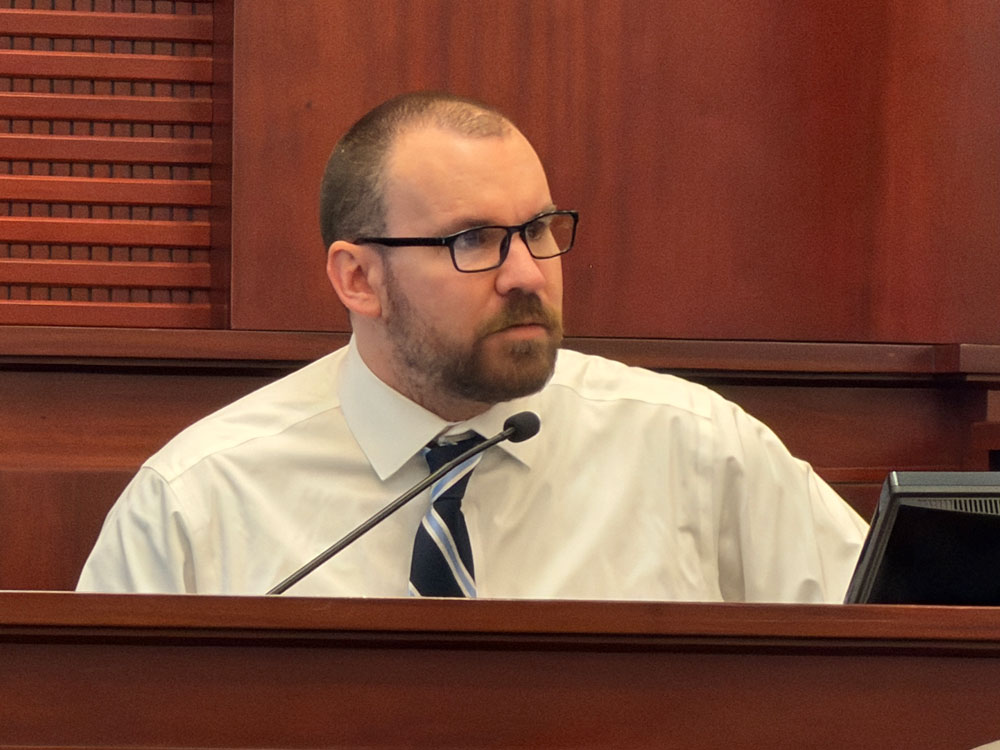
For James Melady, the former Flagler County paramedic on trial for allegedly sexually assaulting an unconscious patient in his ambulance and capturing what he calls a legitimate medical exam on a private, personal video, the jury’s verdict on Wednesday is going to come down to his own believability.
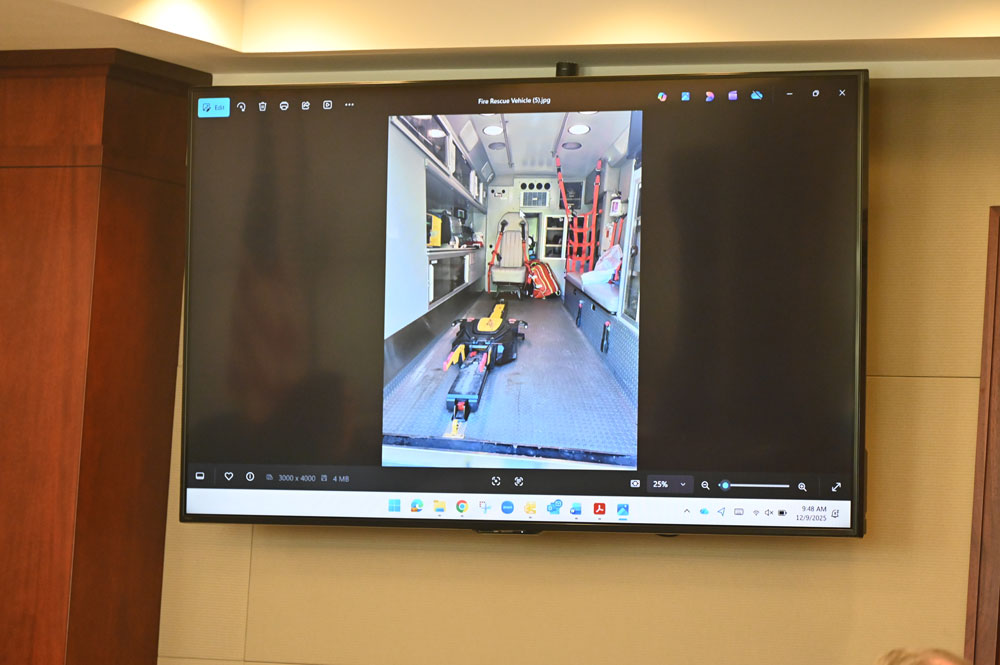
Melady and his partner, Jesse Hunter, had picked up the woman in Flagler Beach in the fall of 2021. She was unconscious and unresponsive from severe alcohol poisoning. Her blood alcohol would register 0.537, and she spent a week in the hospital. She briefly testified today of her struggles with alcohol, and of her complete unawareness of that ambulance ride until she saw on video what Melady had done to her.
The former patient then remained in the courtroom, seated between a victim’s advocate and a friend or a family member. Others had turned up on her behalf, as had three members of Melady’s entourage, who sat on the other side of the courtroom’s divide.
The jury of five women and three men, including two alternates, could believe that Melady had uncovered one of the woman’s breasts and manipulated her vagina out of legitimate medical necessity, even though an emergency room physician testified that there was no medical necessity for that, and that Melady should have been more concerned with her breathing, given her condition. And even though the physician, Terrell John Swanson, testified that in his 17 years in emergency medicine, “I’ve never felt the need to do that myself.”
The jury could believe that a cavity search was necessary even though Melady’s partner, Jesse Hunter, testified that for any sort of exam involving genitals a witness must be present, and that in Hunter’s own 17 years as a paramedic, with innumerable responses to overdoses and other cases, no such exam has ever been necessary and none would have been “appropriate.” (Or that it couldn’t have waited the 11-minute ride from Flagler Beach to AdventHealth Palm Coast on State Road 100, where trained physicians with speculums and ER judgments could have made the call.)
The jury could believe that, having spent several years as a medic in the military, Melady’s training was different from that of his Fire Rescue partner, as Melady’s attorney, Charles Fletcher, put it, and that he might do things differently because of that military training.
“We are all following the same guidelines and protocols. We’re held to the same standard,” Hunter told Fletcher, who dismissed the paramedic’s assertion: “Being held to the same standard doesn’t mean you don’t do different things.”
“My interpretation of my guidelines is, we all do the same thing,” Hunter said, not ceding ground.
Fletcher, playing to a jury in a county thronged with veterans, a few times made reference to Melady’s time in the military, as Melady himself did when he took the stand. The implication is that military service was its own cleansing certificate of virtue and infallibility. In fact, veterans’ difficulties readjusting to civilian life is amply documented.
The jury could believe Melady that even though he’d filled out all sorts of narrative details about the patient, he’d felt no need to mention either in the narrative or in his oral report to the physician at the hospital that he had conducted a pelvic exam, or to ever note that he had a video record of it.
Melady had noted “no abnormalities” in the report next to a line item indicating a general pelvic assessment, a notation Fletcher would hang a disproportionate share of his defense on. But Melady never noted in the longer, more detailed narrative of the exam, which included many other innocuous details, that he did a cavity search to look for—as Melady put it three times on the stand—“foreign objects, bodily fluids, deformities, contusions, abrasions, punctures, lacerations, swelling, any injury, anything that could be placed somewhere.”
The first time Melady enumerated those elements to the jury he sounded like a paramedic on top of his game. By the third time he’d enumerated them, not much later, he sounded like a blowhard flexing muscle memory to make himself sound proficient, his touchiness making him shift in his chair the longer he was on the stand and the longer Clark cross-examined him.
“And you would agree that the information you provided had nothing to do with any injury to her genital area, correct?” the prosecutor asked Melady about his report’s narrative.
He did not agree. He said he’d have been “a very bad paramedic” had he just looked, had he just stuck with appearances, or with what he was told at the scene when picking up the patient.
“Were you searching for drugs?” Clark asked him.
“I was searching for foreign objects, bodily fluids, deformities, contusions, abrasions, punctures, tenderness, lacerations or swelling.”
The jury could believe that Melady took video of the incident to protect himself, even though Flagler County paramedics never take video of their patients, are never told, trained or equipped to do so and don’t have equipment to do so.
The jury could believe Melady that he took the video not for “his own perverse pleasures,” as Clark put it, but because he really was just protecting himself from possible litigation, even though the patient was unresponsive and would have never known what he’d done had Melady’s girlfriend not found the video three years later on his laptop. (Melady’s own video has somehow vanished.)
The jury could believe Melady’s disclaimer even though Melady, directing his own shoot, moved the camera angle a couple of times for a clearer view so that, as one of the two detectives who interviewed him put it, “you pull up her shirt, expose her breast, pull her pants up, manipulate her vagina, and then you smell your fucking finger afterwards. It’s very clear. It’s not for debate. It’s not an interpretation. It’s extremely clear. There’s a video that’s unbiased, okay? It’s not even a point of contention.”
The jury could believe Melady when he told Assistant State Attorney Melissa Clark that no, he did not smell his finger after manipulating the woman’s vagina. The jury had seen the video, seen him smell his finger, as had everyone in the courtroom, as had the detectives. But no. Everyone is wrong. What the video showed is not what it was, Melady said.
“I wouldn’t have done that,” Melady testified.
“So when we see that on video, that’s not what we’re seeing?” Clark asked him.
“No, definitely not what you’re seeing,” he said.
“So when you literally have your hand up underneath your nose, after you just finished examining her, you’re not smelling your hand,” the prosecutor asked again.
“No,” he said.
Attorneys from one side or the other at almost every trial try to impeach key witnesses, meaning they try to catch the witness in a lie, show them to be unreliable, not believable. It happens on television. In actual trials, attorneys rarely get a witness in as explicitly an act of self-impeachment. Melady did not explain what he was doing with his exam finger under his nose. He wasn’t required to, and Clark didn’t ask him.
She didn’t have to. She could just leave it at that and end her cross-examination with the dramatic TV-like line that’s very much part of actual trials: “I don’t have any more questions.”
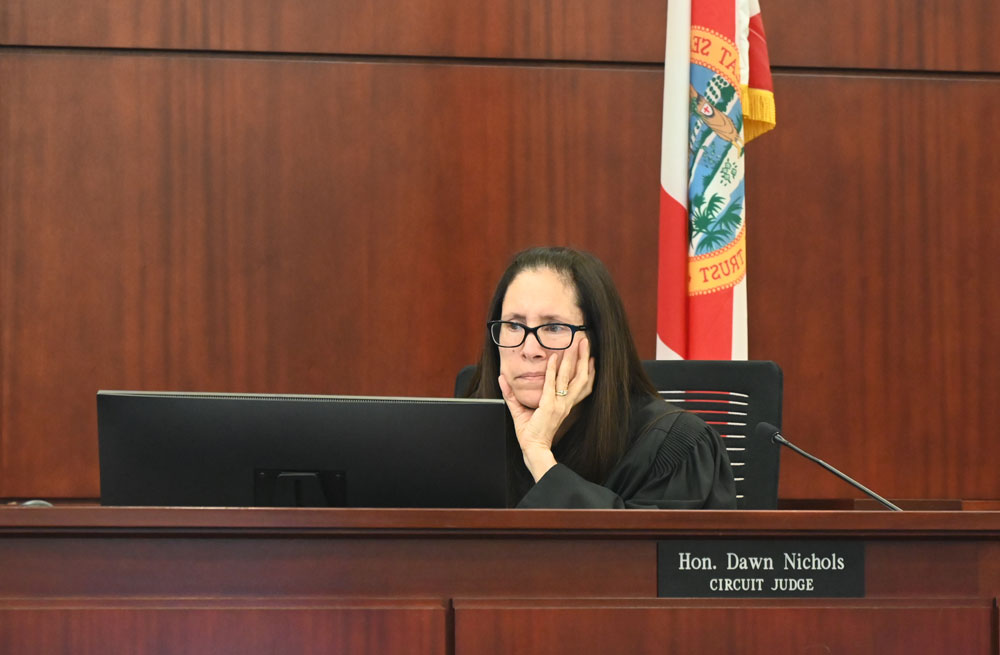
Fletcher in his re-direct should have immediately found a way to neutralize the stunning blow the prosecution had just landed. He ignored it entirely. He’d seen Melady smell his finger, too, of course: perhaps he didn’t want to make a bad situation worse. Or maybe he’d seen a different Melady than everyone else had seen in that moment on the stand. Fletcher asked his client about intubation and the patient’s breathing status, her condition at the scene when the ambulance arrived and an accumulation of similar questions that finally got an objection from Clark, which the judge sustained. It was not the defense’s best sequence in a day with few good sequences for the defense.
The exchange with Melady took place in mid-afternoon, after a day of testimony and near the end of the former paramedic’s nearly one hour on the stand. (He’s been at the Flagler County jail on no bond for the past 15 months.)
By then the jury had also heard the 72-minute long interview, or interrogation, of Melady by Flagler County Sheriff’s detectives James Crosby and Daniel LaVerne (Crosby has since been promoted and assigned a supervisory role on patrol). Melady spent 62 of those 72 minutes denying that the woman in the ambulance was the alleged victim. He claimed it was a former coworker with whom he had a fetish. She’d play patient, he’d play doctor, they’d take video of the interaction, and in his mind, the former co-worker was now out to get him, disseminating those videos.
He insisted: that was his former co-worker in the ambulance, not another woman. The jury did not have to believe him about that, because by the 62nd minute of the interview, he was conceding that he’d made a “mistake,” the mistake being that he’d given an unconscious patient a pelvic exam and recorded it on video, though he went to great lengths to parse what he meant by “mistake.”
“The mistake I made is, I’m involved with somebody who I regret immensely, it is the only place you could get that [meaning the video] because it only exists in one place, and there’s definitely nothing else,” Melady told the detectives. Meaning that there aren’t other such videos of patients he recorded. Meaning that no, he is not a “monster,” as one of the detectives described him. It was just the one “mistake.”
If it sounded like a confession, it wasn’t. Not with Melady.
He testified today that he was on Ambien the whole time he spoke with the detectives. Ambien is a prescription sleeping aid. He said he’d taken it right before the detectives showed up, and that it makes him hallucinate.
The jury could believe that he was under Ambien’s influence when he was being interrogated, that, as he testified today, none of what he told the detectives was true, that he never acted out fetishes with his former co-worker in the back of an ambulance, and that he doesn’t remember a word that he told the detectives during that long interview, including his admission that he’d made a mistake. The jury could believe that he only remembers waking up in jail, after his arrest, and has no memory of that interview with the detectives but from hearing it on the detectives’ recording.
So the jury could believe all that, though it’s generally not a good idea for a defense to rely on the claim that what a jury saw on video and heard in a police interview isn’t what it saw and heard.
All of Melady’s claims may possibly be true, of course. But the jury might also remember Clark’s distinction during jury selection between the possible and the reasonable. That’s what the jury will have to weigh Wednesday morning after hearing the two attorneys’ closing arguments, now that both sides have rested. A verdict is expected Wednesday.

























Deborah Coffey says
Oh boy. Nice try…he sounds just like Donald Trump. What you’re seeing with your own eyes on January 6th isn’t true. What you’re spending at the grocery store isn’t true. Your healthcare premiums aren’t going up no matter what you got in the mail. “I never said I’d release the files,” said Donald Trump. The fake news is making that up even when they play the video of him saying it?
Good luck with that defense, Mr. Melady. On the whole, Americans aren’t stupid.
Sparky says
Suffer from tds much?
JimboXYZ says
Just my prediction for a Tuesday night, he’s found guilty of the charges. From what it sounds like there was no Fentanyl or anything beyond alcohol poisoning that was involved in a patient that didn’t respond to Narcan. But in that ambulance ride nobody knew what the unresponsive patient was on or not ? In that case, would getting some response be better than not to determine anything that they had done would be more effective to save her life ? I wonder if the patient had expired, how that is perceived ? Jury has a tough call to make on what really happened or didn’t. That much alcohol, wonder what they did in the ER or in any room at the hospital, what level of healthcare professional delivered that, to bring the patient back to being responsive ?
JimboXYZ says
Recently learned he woman was a .537 BAC level, she was fortunate to have survived. The ICU machinery & life support for a week saved her bacon that day.
Atwp says
We will see how it turns out. I don’t think he will serve any time after the hearing is done.
Laurel says
The jury could believe, but it won’t. These days, though…
Please tell me the video was not shown in an open courtroom, with the victim sitting there in a repeated state of humiliation!
Concerned Citizen says
Mr. Melady
Retired Fire Rescue/Paramedic here. In my 15 plus years of service. Never did I once conduct a pelvic exam. A pelvic exam is invasive. And beyond our scope of pre-hospital services. You took an oath to do your job. And you violated it raping that poor woman. I hope the jury sees thru your lame excuse. And you get everything that’s coming to you.
Skibum says
Dear Mr. President,
From the bottom of my heart, as one sexual predator to another, you know better than anyone the hell that these swampy prosecutors are putting me through. I am being treated so unfairly! I am pleading with you to direct the FL governor to pardon me and stop this prosecutorial misconduct and harassment over the beautiful medical exam I had to give that woman in the back of the ambulance.
I’ll do anything for you if you help me skate… I mean prove I’m as innocent as you are.
P.S. I have pictures if you would like to see them!
Yours in perineal pleasure, James Melady