



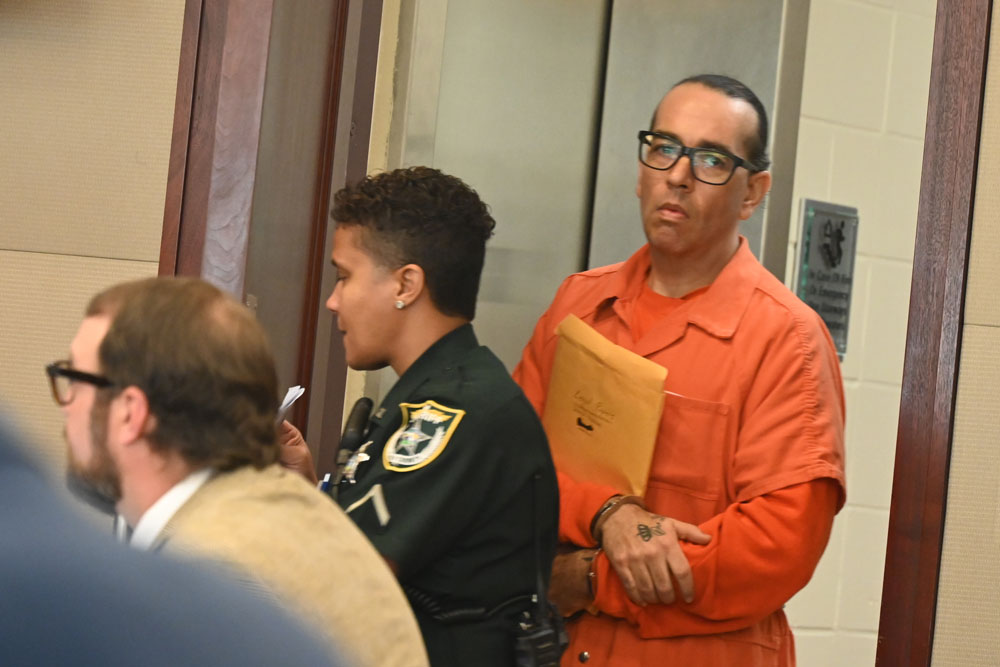
Kristopher Henriqson, the 48-year-old Palm Coast resident facing capital charges of raping his stepdaughter when she was between 9 and 12, wants the alleged victim gynecologically examined, wants to use a secret recording of the victim talking about lying, and wants his trial moved to a different venue.
The requests are among a series of motions Henriqson filed ahead of a trial originally scheduled for January but now likely to be moved to February.
Henriqson faces two capital felony charges, one life felony and seven first-degree felony charges. Henriqson is representing himself. A pre-trial hearing is scheduled for Monday, when Circuit Judge Dawn Nichols may hear the motions. The case is being prosecuted by Assistant State Attorney Melissa Clark.
Henriqson was arrested last February after the girl reported to a teacher, then to a counselor, then to a Child Protection Team forensic interviewer that Henriqson had been sexually assaulting her since she was 9, including intercourse. The assaults are alleged to have taken place in the family home in Palm Coast’s L-Section between August 18, 2021, and February 10, 2025.
“During the course of the investigation,” a motion by the prosecution states, the victim’s “mother participated in controlled communications with the defendant. During those recorded conversations, the defendant admitted to sexually battering [the victim] over the course of a year in 2024 on numerous occasions.”
Henriqson allegedly bribed the girl with money and electronics to get his way. The prosecution has DNA evidence collected from the girl’s chest, where Henriqson had ejaculated the morning or night before the girl reported the assaults at school. (She had not showered afterward, either knowingly or unknowingly preserving the sample authorities collected.)
Henriqson had a falling out with Spencer O’Neal, the assistant public defender he was assigned, and requested that he be allowed to defend himself. The judge, after advising him against it, allowed it, since it’s a defendant’s right. (Henriqson took the same approach in his 2010 federal felony case, claiming he’d been ineffectively represented.
He then said he wanted to depose the alleged victim, and has since filed a motion requesting that the victim be gynecologically examined. Henriqson contends that the girl’s intact hymen is evidence that no penetration could have occurred.
Henriqson blames O’Neal for not wanting to introduce evidence that would allegedly exonerate him. The evidence includes a report by a nurse practitioner said to have found no damage to the hymen.
Henriqson appears unfamiliar with medical research on the subject. A 2019 article in Reproductive Health, an academic journal, concludes that “an examination of the hymen is not an accurate or reliable test of sexual activity, including sexual assault, except in very specific situations. Clinicians who perform forensic sexual assault examinations should avoid descriptions such as “intact hymen” or “broken hymen” in all cases, and describe specific clinical findings using specific medical terminology.”
The state opposes Henriqson’s motion for a gynecological exam. In its response, the state cites the Florida Constitution’s right-to-privacy clause, directing the court to that clause when “weighing a defendant’s request that may infringe on a victim’s right to dignity and privacy.” Between the medical evidence and the constitutional argument, the judge is almost certain to deny Henriqson’s request.
Henriqson also blames O’Neal for not using a secret recording the child’s babysitter made of the child. According to Henriqson’s summary of the recording, “The victim made several statements, related, about her skills at lying and making people believe anything that she wants them to believe, and that she knew how to act in a court of law. These statements, and several similar ones, would destroy her credibility. The defendent believes that the jury would be convinced that all the victim’s accusations were false. The defendent further believes that this along with the medical exam reports, that there is no medical evidence whatsoever to support any of the victim’s accusations of abuse by the defendent, would without doubt, lead to the exoneration of an innocent man, namely Mr. Henriqson. This is the strategy at trial that the defendent would like to pursue.”
O’Neal, according to Henriqson, destroyed the copy of the recording Henriqson had sent him and advised the babysitter to do the same, since it is illegal in Florida to record anyone in a non-public venue without the person’s consent. There are exceptions. For example, victims of abuse may secretly record instances of abuse, and that evidence becomes admissible in court. Henriqson claims he is entitled to use the recording to show that the girl is not credible. There does not appear to be an exemption in law that would allow him to do so.
The prosecution has since filed a motion to exclude the recording. “This recording was not made at the direction of law enforcement and was made surreptitiously without [the victim’s] knowledge,” the state’s motion reads. “The recording meets the definition of an illegally intercepted oral communication,” making it inadmissible at trial.
Henriqson also filed a motion requesting a change of venue–meaning he wants the trial held in a different county or circuit. He cited two reasons. The first is his disenchantment with O’Neal. Henriqson, writing of himself in the third person, “has reasonably concluded that while his odds of being found innocent while representing himself remain quite small, he also believes that his odds of being found innocent while being represented by Mr. O’Neal are non-existent.”
The second is Sheriff Rick Staly, who in a press release announcing Henriqson’s arrest last Feb. 13 was quoted as saying that Henriqson’s “crime qualifies for the death penalty, and I believe that is the only penalty he should get.”
“The defendent [sic] believes that this statement would make it impossible for the defendent to have a fair trial due to the predisposition of jurors to be selected from the local community to which Sheriff Staly directed this comment,” Henriqson wrote in his motion. “The Sheriff is imensley [sic] popular in this county, as can be evidenced by his multiple sequential re elections with high margins.”
The Florida Legislature in 2023 reinstituted capital punishment as a possible penalty for individuals convicted of raping victims younger than 12, even though that would be unenforceable today: the U.S. Supreme Court in 2008 ruled that unconstitutional.
The Florida law is intended to challenge the 2008 precedent. Last month, the State Attorney’s Office in Hernando County filed that test case. The capital charge is against Nathan Holmberg, a 36-year-old nanny accused of raping and video recording his alleged assaults of several children younger than 12.
The State Attorney’s Office has not said that it is seeking the death penalty in Henriqson’s case. Conviction would result in life in prison.
Just before he was sentenced for thefts in 2009, he told the federal judge: “I just understand that what I did was wrong and if there’s anyway that I could get away from being away from my kids and maybe some probation or house arrest, that would be great.” The judge sentenced him to two in federal prison and three years on probation. But the judge recommended that he be imprisoned in Central Florida, to remain close to family. Judges in the state system don’t have that leeway. He also served 18 months in state prison for selling marijuana.


























JimboXYZ says
State should allow the videotape of the child lying. Illegal wiretap ? If this was in the man’s home, is it a stretch he videotaped anything in dwelling ? Let the evidence come forth & be presented for what the truth & facts are ? Just because a child lies about one thing, may or may not mean they’re a pathological liar, lying about another thing ? But it also depends on the seriousness of the lie(s). At this point it’s almost absurd to say the child needs protection or anything else when it’s going to trial. May sound like a harsh comment. But if he defendant did what he did, that ship sailed a long time ago for an innocence lost ? And if this is just another lie, that has to be exposed for what it is too. There’s a lot at stake for anyone involved. But that’s where this has gone. It’s the crash course in growing up ? I doubt a child is going to be traumatized any more than the child already has been traumatized if a rape is determined to have happened at the court/trial level for a guilty verdict. Just doesn’t seem right to allow/disalloow evidence for any case, when it is part of a prosecution & defense to determine what the crime was or wasn’t ? Maybe that’s too idealistic to expect of the legal/justice system ? I’m just exhausted from the lies & spin from the FBI down to local law enforcement. I think or hope the rest of society is equally as fed up with it too.
Time for some adults to step up & realize, not all children are virtuous, even innocent, even though the majority are that ignorant to the games so many play in real world life. They just got done arresting 2 17 year olds for possession & intent to distribute controlled substances. The next generations of criminals are children K-12, those are just facts, the naked truth of reality of the human race. As bleak as it may sound, the good news is, maybe there are some good one’s that come from each graduating class ? That bell curve of hope for expectations from the exceptionally deviant to exceptional overachievers, & everything else in between for average citizens.
Mark says
Oooof