



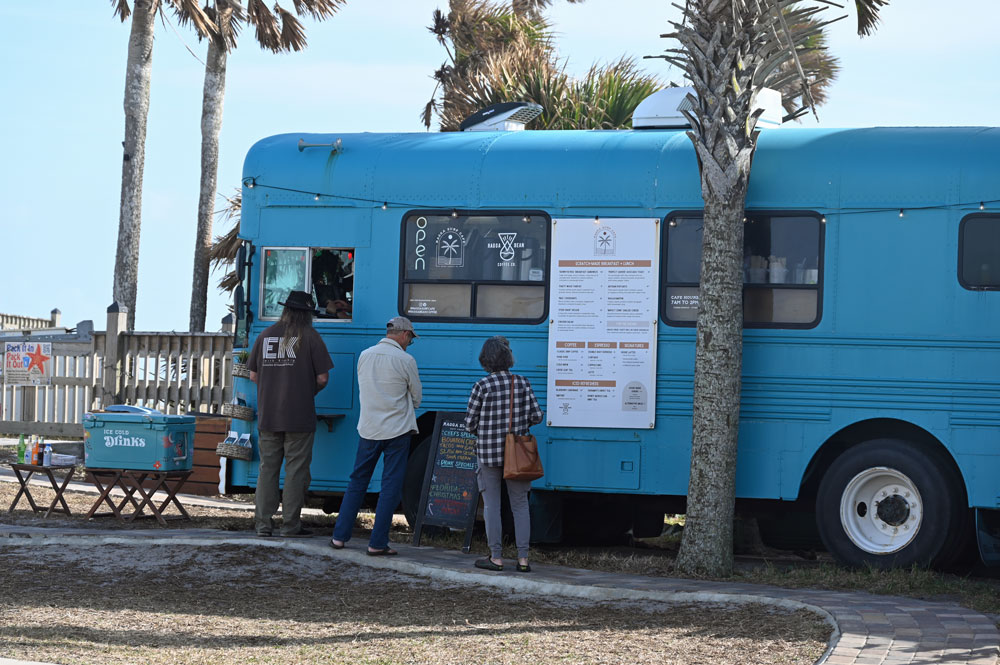
Palm Coast government accepted a $55,000 “donation” from the Town Center Community Development District–a government within a government–to build an outdoor seated dining area and eight food truck parking spaces on the side of The Stage at Town Center, the former performance venue of the Palm Coast Arts Foundation.
The donation, approved by the Palm Coast City Council Tuesday, coincided with the council’s second and final reading of an ordinance that significantly loosens restrictions on food truck operations in the city.
The city took over The Stage after the demise of the Arts Foundation and has been using the space for concerts in hopes of making it a hub for cultural events. Construction of the food-truck area will be carried out by city crews.
“We think that that improvement will be a grand, excellent idea,” Greg Eckley, co-chair of the five-member CDD Board of Supervisors, told the council.
The CDD has a $1.4 million budget drawn on a CDD tax, or “special assessment,” levied on property owners in the 1,557-acre Town Center zone, bordered by State Road 100 to the south and Royal Palms Parkway to the north, though it juts past Royal Palms into the panhandle-like triangle that now forms the Sabal Preserve housing development, near Old Kings Road. (A resident addressed the CDD board in January to complain that the monthly $200 CDD levy had been raised to $300, and that services were wanting.) The largest share of the money goes toward paying for landscaping, for a sheriff’s deputy assigned to Town Center, and for street lights.
Deputy City Manager Lauren Johnston said the plan is to complete the construction in time for an event called Beats and Eats as the monthly Food Truck Tuesday, until now held near City Hall, will move to The Stage where it will be paired with the Palm Coast Concert Series starting in May.
“This is something really cool,” City Council member Theresa Pontieri said. “It’s something good that people, I think younger generations, can really relate to. We see it happening in a lot of cities. This is just a very now thing, and so I’m really excited about it.”
“Great news about the donation for the thing at the concert series,” a food truck operator told the council, “but at that same time, we still lose March to October of something that in eight years we’ve been accustomed to.” She was referring to Food Truck Tuesday on Park Street adjacent to Central Park in Town Center.
The city administration and the council have been working toward loosening food truck–or “mobile food dispensing vehicles”–regulations since last fall. Previously, only the city could allow for food truck events at its own designated time and place. All others were banned, even on private property, though compliance was not airtight. As the number of rebels increased, the city decided to legalize them rather than fight them, recognizing the trend Pontieri mentioned in her remarks about the initiative at The Stage.
The new regulations will allow temporary and permanent food truck operations, but only in commercial zones, and with conditions. For example, permanent food truck courts will have to provide seating, lighting and restroom facilities. They’ll have to comply with city sanitation codes but will remain under the licensing purview of the state’s Department of Business and Professional Regulation. In other words, Palm Coast Code Enforcement may not inspect mobile kitchens and food trucks. It may only regulate their compliance with zoning and operational rules.
There will be a limit of three food trucks set up as “accessories” to an existing business, though larger stores such as Walmart or Target can add up to five more food trucks (or one truck for every 10,000 square feet of space).
The council wanted the “application and approval process as less burdensome as possible,” in Mayor Mike Norris’s words. A food truck operator told the council that food truck operators’ opinions were heard and respected as the city developed its ordinance.
A food truck operator suggested to the city to expand its allowances to allow food trucks at school athletic events or at city parks. The city’s plan is to regulate those allowances through the city’s parks and recreation reservation system, though private sports leagues that secure special event permits may contract with their own food trucks. The city has no system in place when there is no organized event.
Council member Charles Gambaro requested a future workshop to get beyond the policy framework and into the details of the permitting process. His aim is to “make it easy. Let’s make it make sense. Let’s cut the red tape.”
“This is a very good start. Doesn’t mean we’re at the end of the road and that there aren’t going to be some changes and improvements later on,” Pontieri said. The fee schedule was also not included in Tuesday’s approval, even though the ordinance became effective as soon as the council approved it. Pontieri wasn’t pleased about that and let City Manager Mike McGlothlin know in no uncertain terms.
“City manager, we asked that this board be told what the fees were going to be, so that we could discuss them in the sunshine with our food truck operators here,” Pontieri said, “and we don’t have that. So that process, those asks, the timing, if staff didn’t think, Hey, we’re not going to have it by that date, then we need to be able to set those proper expectations moving forward. Because I feel like we’re passing something, and presumably we’ll vote yes, and I think we should, but we don’t have all the information, and I don’t think that that’s a proper way to operate.”
The vote to approve the ordinance was unanimous.





















Using Common Sense says
Sounds like another money maker for the Towncenter CDD, so it does not surprise me that they pushed for it. Another unaddressed problem is parking. It seems to me that many retail development has been allowed in Palm Coast with inadequate and poorly planned parking. Factor in 6-8 food trucks and now the number of parking spaces for that retailer are even more inadequate. Is this decision fair and equitable for brick and mortar restaurants that must pay rent and other overhead expenses? Who is paying the insurance on this property, the city or the CDD? Did this property receive grant funding for Arts and Entertainment, as concrete pads do not seem to fit that requirement. Will the city or CDD receive the revenue generated from the food truck fees or both? How can this be approved without knowing the answers to these, and many other questions?
Doug says
“Ragga Surf Cafe, are you listening?” Run, run far away, and wait for Marineland. You’re much better than Palm Coast, and I’m sure much better off right now in St. Augustine.
Lil bird says
Regulated to the side of town center parking is so limited compared with around the main park where parking is on all 4 sides and visibility is 360.
Also of interest this Town Center development money means that in some way other businesses that took a risk and put their business in the town center to spurn its growth have actually helped pay for other restaurants buildout (slabs), rent (no fees required), electricity (hookups), trash services & even security.
Curious if impact fees for parking spaces and licenses for signage are also paid back to the city by anyone, if priority is given to PC trucks, if operating hours have been required… sounds like a lot has been approved without forethought at the expense of residents and actual brick and mortar shops that have struggled to survive on empty promises for years.
Take the $and run says
Let the trucks roll into town,pay a one time minister and roll out of town full of cash, without any regard for the well being of the brick and mortar which contribute to the local infrastructure 24/7/365. Not use,abuse and leave
Geoffrey Hicks says
The next council “action” will be to have future meetings include requests to park the food trucks in the driveway.