



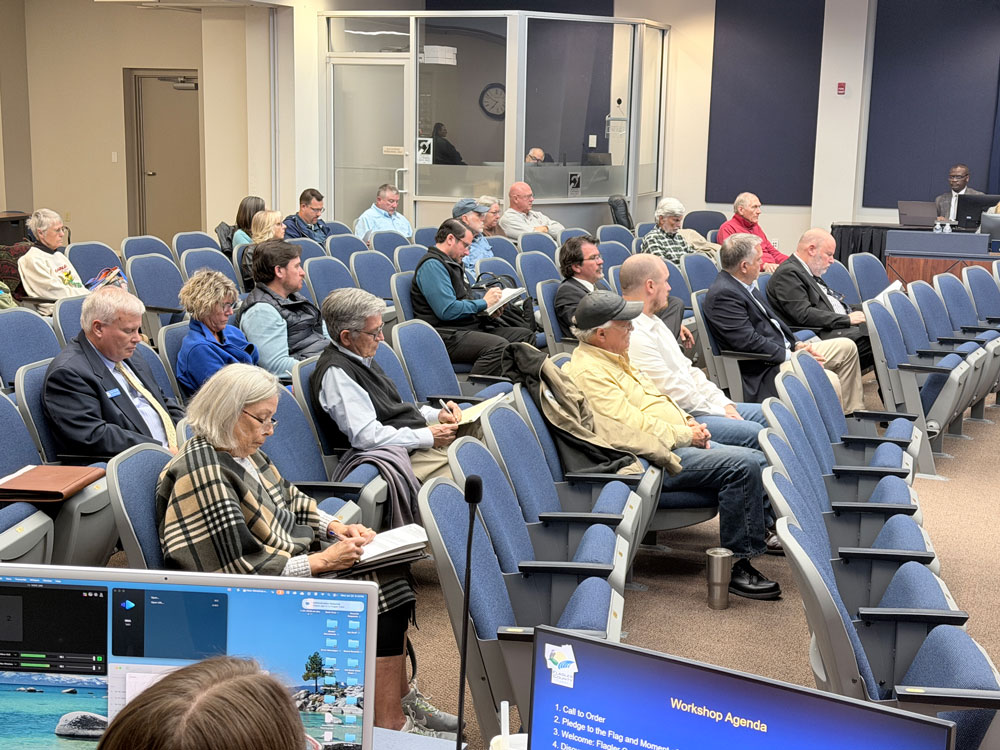
After a tortuous discussion about not creating the perception that Flagler County government is threatening to sue Flagler Beach in an annexation dispute, the the Flagler County Commission Wednesday night took a step that does just that: it approved a resolution that starts the conflict-resolution process state law requires of local governments before litigation begins. If negotiations fail, the county will file a lawsuit.
The only variance from the ordinary process in Wednesday’s resolution is the timeline. A lawsuit would be filed within 20 days of negotiations reaching an impasse instead of 10 days. The meeting left it somewhat vague as to how long the two sides would have to negotiate, though the negotiating agreement the county will send Flagler Beach, setting out timelines, will likely include a 60-day window that includes the 20-day clock.
Commissioner Kim Carney, who has led the charge in the dispute, moved to start the clock on conflict resolution and was seconded by Pam Richardson. Commission Chair Leann Pennington joined the 4-1 vote, as did, with obvious distaste, Andy Dance. Commissioner Greg Hansen dissented.
Dance said most of the issues are on their way to resolutions already, based on Wednesday’s discussion. He repeatedly, almost desperately, tried to reach consensus on a measure that would avoid all appearances of litigation, which he said was already clouding the public’s perception as local media–including this site–previously headlined the commission’s steps toward litigation. He wanted to take the approach summed up by Flagler Beach Commissioner Scott Spradley, an attorney and the City Commission’s most pragmatic centrist who often forges magnet-like compromises that unify his colleagues.
Spradley had told the commission that there is no avoiding the perception of litigation when the commission itself blared the purpose of Wednesday’s meeting in its agenda: “If you look at the agenda item, it talks about having this proceeding before court proceedings, which is litigation,” Spradley said.
His suggestion was to replace the resolution kicking off the law-required conflict-resolution process with a “tolling agreement” between the two governments. In legal terms, “tolling” something means temporarily pausing or delaying it for a set period of time.
“I would gauge that the city of Flagler Beach, in all likelihood, would approve a tolling agreement,” Spradley said, “and we eliminate the perception–and it is a very negative perception–of doing this thing because one government entity is going to sue the other one.” The time limit would be whatever the two sides would agree to. “As far as having the parties’ noses to the grindstone to get it resolved, we’re going to do that. Flagler Beach is going to do that no matter what. But it’s just that I think that the negative perception that would arise with instituting that proceeding can be avoided with a tolling agreement.”
Spradley spoke two and a half hours into the meeting–which was mostly a workshop, before it reconvened for a few minutes to enable the formal vote. By then Carney had already attempted one motion, and appeared uninterested in pulling back, preferring to stick with County Attorney Michael Rodriguez’s proposed motion to start the formal process. Rodriguez does not see the commission’s approach to be that far from Spradley’s.
“If a lawsuit is to be filed, it won’t get filed until we’ve exhausted every single avenue of the intergovernmental dispute resolution process, which is a joint meeting,” the county attorney said. “If we don’t come to an agreement at a joint meeting, the next step is a mediation. If we don’t come to an agreement at a mediation, then there’s the lawsuit. I don’t think that we even will probably get that far.”
“I’m trying to get to a place where we can resolve these issues before we invoke the conflict resolution,” Dance said. “My goal is to avoid the conflict resolution issue entirely and extend the timeline so we can work together cooperatively and solve these issues before we invoke.” Dance and Hansen saw no reason to have both a “tolling” deadline and a formal resolution enabling litigation.
Rodriguez said it’s a matter of protecting the county’s rights to file a legal action. A government challenging another over certain issues–Flagler County would challenge Flagler Beach over a Comprehensive Plan disagreement–has 30 days to file such a lawsuit. Theoretically, Flagler County has only until Feb. 9 to file, otherwise the lawsuit would be dismissed for missing that deadline.
“The county and city are agreeing that we will no longer be bound by the 30 days” set out in state law, Rodriguez said. “We’re now bound by the times we have agreed upon in this agreement.” Still, the negotiating window was not made clear.
The dispute centers on five issues surrounding Flagler Beach’s annexation earlier this month of 545 acres west of John Anderson Highway slated to become the Summertown development. The sister development of Veranda Bay on the east side of John Anderson, Summertown is to have 1,620 housing units and an 840,000-square-foot commercial center.
The litigation would not name SunBelt Land Management, the developer behind both developments, though SunBelt is obviously the focus.
Flagler County lists five issues in its dispute with Flagler Beach, three of them related to John Anderson Highway, a county road expected to remain a county road even after annexation. The John Anderson issues are: whether an adequate traffic study was conducted to show that the road can bear future development on the scale proposed; whether the city could or should take over John Anderson’s maintenance, or alternately pay the county a share of its maintenance; and whether the annexation is consistent with the county’s Comprehensive Plan to the extent that it increases housing density in a flood hazard area, affecting a hurricane evacuation route.
Two other issues are both more complicated on paper and potentially easier to resolve, based on signals from both sides last night. One of them relates to how the annexation fits in with a 2007 agreement between the county, Palm Coast and Flagler Beach on utility boundaries, and Flagler Beach’s responsibility to account for recycled water treatment. Flagler Beach considers the issue settled: it’s providing utilities and rebuilding its sewer plant to account for recycled water, which will all be dumped on Summertown’s and Veranda Bay’s lawns instead of in the Intracoastal.
The fifth issue is whether the Summertown annexation is consistent with Flagler Beach’s Comprehensive Plan in Summertown’s impacts on sensitive lands. That provision’s inclusion seemed at odds with the county’s own initiative to buy 153 of Summertown’s 545 acres to protect the headwaters of Bulow Creek. Ken Belshe, who represents SunBelt locally, is a willing seller. The county would have a hard time explaining to a judge why that provision’s inclusion in the dispute, at least at this stage–the land acquisition depends on state grants and will take time–wasn’t wasting the court’s time. Dance himself said it was “a disagreement among attorneys.”
The next step is expected to be a joint meeting of the Flagler Beach City Commission and the County Commission, and possibly a subsequent one to ratify whatever agreements the two sides’ lawyers draft out of the negotiations. The best-case scenario would be a so-called “interlocal,” or joint agreement setting out the negotiated settlement.
Dance noted that the dispute highlights the county’s efforts on a completely different track to formalize a process that would have an ongoing planning committee of all local governments working out annexation issues before they rise to the level of a dispute, let alone a potential lawsuit.
The meeting would have been hard to follow for an ordinary listener, focusing as it did–to the extent that it was focused: it often was not–on legal technicalities further complicated by the active presence of no fewer than six attorneys, each of whom took the mic in turn.
One of the most arresting moments of the evening was when Drew Smith, the Flagler Beach city attorney, addressed the commission and all but accused it of “bad faith,” with evidence and history on his side: one of the county’s causes of actions is to sue over the absence of recycled water capacity.
Smith had stood in that very same well before the commissioners on Nov. 16, 2020, pleading on behalf of his city for the County Commission to adopt a set of conditions on the Veranda Bay development, then known as The Gardens, as the commission was set to approve its development order. One of the conditions was for the county not to approve a plan without recycled water responsibilities clearly laid out.
“The county at that time said, Nope, not a part of this issue. They can build,” Smith said Wednesday.
“If you guys sue now and say they can’t develop without building a reclaim plant, I’m hard pressed not to argue bad faith,” Smith said. “I don’t mean to be confrontational. I’m sitting back there listening to that argument, and my blood is boiling because I stood here and made that argument here to this commission at that time, and that development got approved over that objection. So for a county to say, good for us, not for you, I have a real problem with that. That’s probably not what my client wanted me to say right now, but that’s what I have to say right now. Any questions?”
The only current member of the County Commission who was serving in 2020 is Greg Hansen. He had voted against approving the Veranda Bay agreement back then. He was the only one voting against initiating legal proceedings Wednesday evening.



























CarneyMustGo says
“No one up here has mentioned the word ‘lawsuit!’” – Kim Carney
*motions to file lawsuit
m thompson says
Back then, the County reluctantly agreed to a much smaller, less destructive development on these lands. The builder ran to the City with a changed massive destruction development project that is nowhere feasible in this location. Flagler Beach is agreeing to give them full rein to do what ever they want without regard to the aftermath. The aquifer will not sustain if this happens. If it does, it will be contaminated. These historic wetlands should never be disturbed!!!!
OP says
What a mess…
Citizens of Flagler Beach deserve a better administration, as the current one is pejorative.