



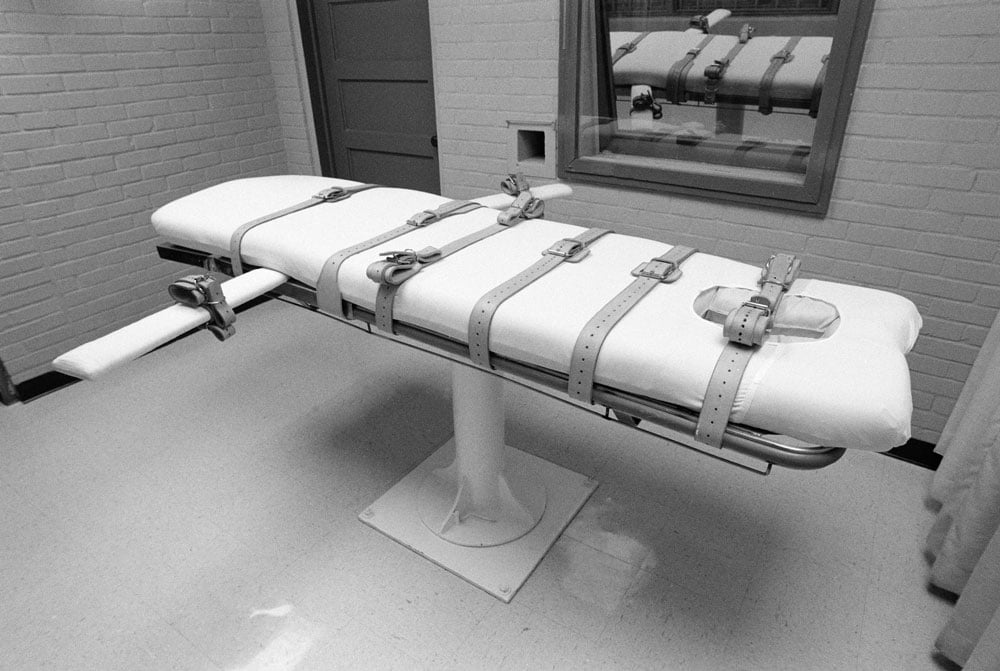
By Austin Sarat
Tennessee set out to execute Tony Carruthers on May 21, 2026, but he lived to tell about it.
Carruthers, who was sentenced to death for a 1994 triple murder, survived his date with death when the execution team members could find only one suitable vein in which to secure an IV, but not, as USA Today reports, the “backup line, which is required under the state’s lethal injection protocol.”
After the failed attempt, Tennessee Gov. Bill Lee gave Carruthers a one-year reprieve, a decision the governor did not explain.
What happened to Carruthers is a reminder that things frequently go wrong in executions, even if in almost all cases the problem is resolved and the execution is completed.
Indeed, in the past 80 years, only eight other men have had experiences like Carruthers’ and survived execution attempts.
Four of those execution “survivors” were killed by a second execution attempt, while others escaped that fate. Three others died on death row; one of them after the state agreed not to try to execute him a second time, and one of them is still alive and awaiting his fate.
Having studied capital punishment for decades, I know the Eighth Amendment’s prohibition of “cruel and unusual punishment” has shaped constitutional discussions around failed executions. But so far, courts have not stood in the way when state governments have wanted to try to execute the same man again.
Not just a lethal injection problem
Carruthers survived a lethal injection attempt, but execution failures have not been confined to that method. A look at the history of hanging reveals several instances in which it failed.
In 1833, for example, a hanging in Pennsylvania failed to kill Charles Getter, who had been sentenced to death for murdering his wife.
“The rope was placed around Getter’s neck. The hangman drew it up fast,” true crime author Amanda Howard notes. “Getter struggled and kicked, choking, before the rope broke, throwing him to the ground.” However, Getter did not die.
The executioner sent someone to look for a stronger rope. This time, the rope did not break and Getter met “the fate of a murderer.”
In 1894, Will Purvis’ hanging also failed when the noose loosened. Instead of dying from a broken neck, Purvis survived, suffering only rope burns on his neck.
Unlike Getter, Purvis returned to prison contending that he was innocent. His lawyers unsuccessfully tried to get the courts to prevent a second execution attempt. Purvis remained behind bars until 1898, when Mississippi’s governor pardoned him. Purvis is the only execution survivor ever to receive such grace.
In the late 19th century, the electric chair replaced hanging as the country’s primary execution method, but it did not prevent failed executions. At least once in the 20th century, the electric chair also failed to kill.
In the spring of 1946, the state of Louisiana tried to use it in the execution of Willie Francis, a 16-year-old Black youth who had been convicted of murdering a local sheriff. At the time, the electric chair was said to be the most humane execution method.
But what Francis experienced hardly seemed humane. When the electric current reached him, “He started going into convulsions.” The executioner “flipped the switch again,” but Francis was not killed.
Later, like Purvis, Francis turned to the courts to try to stave off another execution attempt. The decision in his case would set the precedent for how judges would deal with other execution survivors.

AP Photo/Bill Allen
An accident?
In January 1947, months after Francis survived the electrocution, the U.S. Supreme Court gave Louisiana permission to try again. The justices split, with five giving Louisiana the green light and four dissenting.
Justice Stanley Reed’s majority opinion emphasized that what had happened to Francis was accidental and that, without malicious intent, there was no violation of the Eighth Amendment. As he put it, “The fact that an unforeseeable accident prevented the prompt consummation of the sentence cannot, it seems to us, add an element of cruelty to its subsequent execution.”
In his view, “The cruelty against which the constitution protects a convicted man is cruelty ‘inherent’ in the method of punishment, not the ‘necessary suffering’ involved in any method employed to extinguish life humanely.”
Justice Harold Burton spoke for the dissenting judges. As he put it: “The intent of the executioner cannot lessen the torture or excuse the result.” A second execution would offend the “fundamental instincts of civilized man.”
Francis was put to death almost a year to the day after his first execution failed.
It would be several decades until another person survived an execution. But the pace of failed executions has only picked up since the start of the 21st century.
21st century execution survivors
From 2009 until May 2026, six people survived failed lethal injection attempts. Romell Broom became the first 21st-century execution survivor when in 2009 the state of Ohio gave up after trying for two hours to find a usable vein in which to secure an IV line.
In his case, the Ohio Supreme Court, relying on the Francis precedent, decided that “The insertion of IV lines is merely a preparatory step to the execution.” In its view, Broom’s punishment had not really begun. Therefore, a second execution would not violate the prohibition on double jeopardy or on the imposition of cruel punishment.
Alabama Department of Corrections via AP
But before Ohio could again attempt to execute Broom, he died on death row in December 2020 after contracting COVID-19. Another 21st-century execution survivor, Alva Campbell, also died on death row.
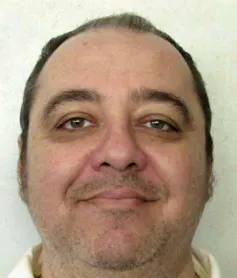
In 2018, Doyle Hamm reached an agreement with the state of Alabama stating that he would not be subject to a second execution after executioners couldn’t access a vein during an attempted lethal injection. Hamm died from cancer in 2021.
However, Alabama succeeded in executing two other execution survivors, Alan Miller and Kenneth Smith, both in 2024. In both cases, they had survived failed lethal injections.
And Thomas Creech is, like Carruthers, still alive after lethal injection failure, this time in Idaho. It’s not clear if and when Idaho will try again to put him to death. If it does, the state will use the firing squad, which will become its primary execution method on July 1, 2026.
Carruthers’ fate
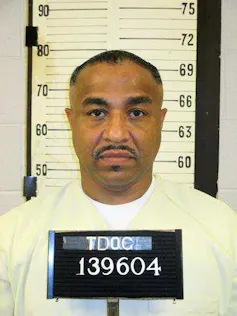
As Carruthers awaits his fate in Tennessee, defense lawyers in the state have asked Gov. Lee to halt all executions pending a thorough review of its protocol.
Tennessee Department of Correction via AP
And as the Death Penalty Information Center reports, “attorneys from the Federal Public Defender’s Office filed a new federal lawsuit … to prevent Tennessee from attempting to execute Mr. Carruthers a second time.”
That suit builds on litigation filed in March 2025 alleging that the administration of lethal injection in Tennessee inflicts cruel and unusual punishment.
Only time will tell if the judges who hear those cases will be persuaded by what Justice Burton wrote in the Francis case: “Although the failure of the first attempt, in the present case was unintended, the reapplication of the electric current will be intentional … The present case demonstrates that, today, two separate applications are sufficiently ‘cruel and unusual’ to be prohibited.”
When the state, Burton explained, seeks to execute someone, it has a duty “to make sure that there (is) no failure.”

Austin Sarat is William Nelson Cromwell Professor of Jurisprudence and Political Science at Amherst College.




























Pogo says
Don’t forget to ask the other experts too
https://www.google.com/search?q=death+penalty+by+country
Gary Delia says
Since 1973, 200 people have been exonerated after being wrongly convicted and sentenced to be executed. An eye for an eye bitches. But who knows how many innocent people have been killed by the righteous. Sadly, it boils down to who has the money to pay for a robust and well-researched legal defense. Robert Frost said it best: “A jury consists of twelve persons chosen to decide who has the better lawyer”.
Ray W. says
In 1994, Justice Stewart wrote that he would “no longer tinker with the machinery of death.” Some argue that he meant that, by reason of human error, by reason of frailty of thought, the death penalty process had become irreparable.
Gary Delia correctly refers to the more than 200 death row inmates who have been exonerated since 1973. Florida leads the way, with 30 exonerations of death row inmates since 1976. No conversation about the death penalty can be considered complete without the participants respecting the number of times the death penalty process has already failed. It is impossible to correct the execution of an innocent person.
Land of no turn signals says says
Firing squad never disappoints.