



By Chuka Onwumechili
The most culturally diverse men’s football World Cup in history is taking place in the United States at a time when foreign nationals feel less and less welcome in the country.
The 2026 competition kicks off on 11 June with games in Canada, Mexico, and the US. The US will host by far the largest number of matches, including the championship game. The 2026 cup is also hosting the largest number of competing teams in history – 48.
Over its near century-long history, the competition has remained the premier sporting event, attracting the largest number of travellers. Some spend huge sums of personal savings to be at the matches to cheer on their country and favourite teams.
Held every four years, the International Federation of Association Football (Fifa) World Cup is a mega sporting event that serves as a large avenue for cultural meetings and exchanges.
The 2022 World Cup in Qatar attracted 1.4 million visitors to a country of slightly over 2 million people. The number of travellers for the 2026 World Cup is expected to drop to 1.2 million due in part to the activities of the United States Immigration and Customs Enforcement (ICE) agency. Still, the number remains significant.
As a professor of intercultural communication, with decades of research connecting culture to communication, I have found the World Cup of particular interest. The number of global travellers to the World Cup brings with it cultural communication exchanges that cannot be overstated.
Intercultural communication involves contact between people with differing beliefs, values and norms. Cultural communication theorists define such exchanges over a short period as the earliest stages of acculturation, called the honeymoon stage.
It is an important stage of cultural encounter that helps advance social comfort and learning. It eases anxiety in a different cultural environment. These encounters go beyond the stadiums that will host games. They include encounters in neighbourhood stores, transport systems, bars and hotels, among others. Even for those watching remotely.
Matches on the field have the power to rise above the politics of the day and bring cultural unity.
Football and cultural exchange
Cultural encounters at previous World Cups have led to the spread of fan culture across the world. Think of the spread of the stadium wave or use of the vuvuzela, a coloured plastic horn.
The wave involves sections of fans in a stadium standing up by turns. This provides a spectacle that is believed to have spread to most of the world after magnificent wave scenes at the 1986 World Cup in Mexico.
At the 2010 World Cup, a South African fan tradition of blowing the vuvuzela spread to the rest of the world. There were vigorous attempts to clamp down on it because it was so noisy. But a few fans have kept the tradition alive.
Cultural exchange remains a critical aspect of a World Cup. The 2026 event will be no different. While most media reports focus on the vivid exchanges like the wave and vuvuzela, there are others that happen at the interpersonal and small group levels. Those exchanges can be just as long lasting. They include friendships, cultural learning, and the countering of cultural loathing and stereotyping.
How will that work in the US?
The US is a strong location for such cultural exchange. The country has historically accepted the largest number of migrants in the world and the resulting interactions have led to indelible cultural impact over generations. There is, for instance, a large Asian population in the north-west parts of the country and a large Mexican population in the south.
Yet, in 2026, the US has created an unwelcome situation for potential travellers. ICE raids on suspected migrant populations have dominated the news for months. This has an impact on numbers.
Hotel bookings are far below expectation in 11 US host cities. One report claims there is a booking pace “below expectations, trailing even a typical June or July without any major events”. Human Rights Watch has urged Fifa to pressure the US government to establish an “ICE Truce” during the competition.
An expensive trip
Fans hoping to attend the World Cup are also reportedly concerned about ticket and transport prices. Recently, Fifa’s marketplace, which serves as a resale platform, advertised “four tickets to the final at a cost of $2.3 million each”. While Fifa does not control pricing on its resale site, it takes 15% of the purchase fee from the buyer and 15% from the seller. This means Fifa would make US$690,000 if just one of the tickets sold at that price. It’s a staggering sum for a football match.
Fifa president Gianni Infantino defended the high cost of tickets by claiming it was the cost of doing business in the US market. Yet, such prices are nearly five times higher than the last World Cup in Qatar.
The New Jersey transport system eventually set train roundtrip transport at US$105 after a public outcry after an initial plan to increase the fare to US$150. The fare normally costs US$18.
The high costs and hyper immigration control associated with attending the World Cup in the US are likely responsible for the dampened hotel bookings.
Global broadcasts
There are even concerns with global broadcasts of games. China and India, the two most populated countries in the World Cup, may not often reach the final stages, but they are avid viewers of the games. Neither has access as Fifa has yet to reach TV and digital coverage agreements with providers in those countries. At the 2022 World Cup, the two countries reportedly accounted for 22.6% of total global TV reach. China alone accounted for 49.8% of viewing hours on digital and social platforms. The dispute involves the huge sums Fifa is asking for broadcast rights.
There are cultural exchanges that the World Cup provides even for those who watch from home in different parts of the world. While not as powerful as cultural learning through in-person contacts, there are still opportunities to learn, depending on the focus of the media coverage.
The men’s World Cup, which celebrates 100 years in 2030 and is co-hosted by an African country (Morocco), remains a key event in fostering cultural understanding and exchange. While the 2026 World Cup will do this, it has also brought to the fore the event’s ability to create division.

Chuka Onwumechili is Professor of Communications at Howard University.




























Laurel says
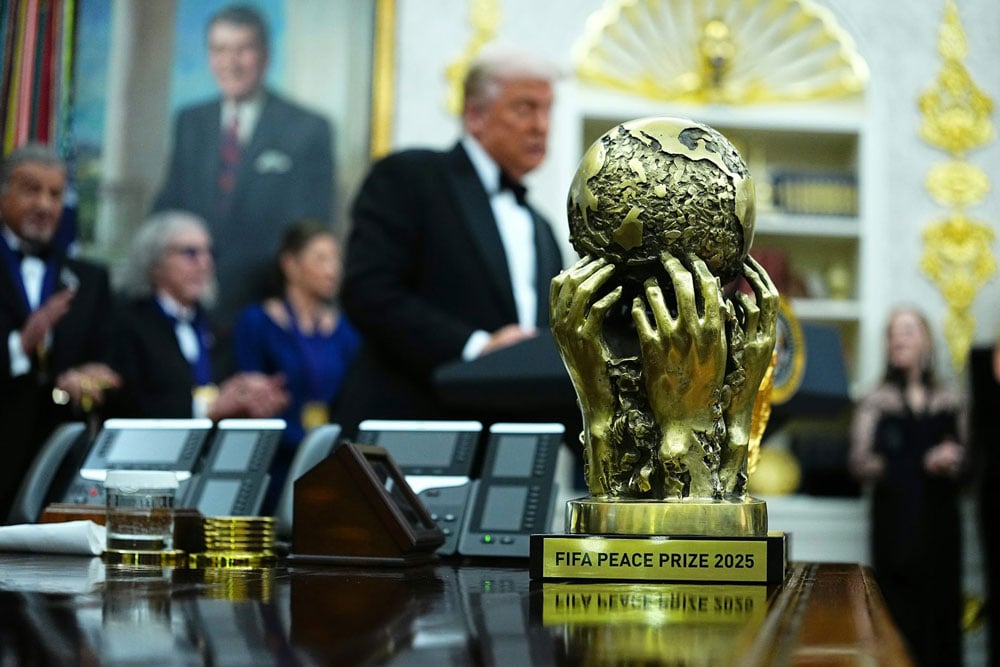
Does anyone on the planet take the FIFA Peace Prize seriously?
Chapstick must be raking in the money with all the butt kissing going on these days.
R.S. says
Trump did!!! He doesn’t even notice when he’s being turned into a laughingstock of the world.
Pogo says
A modest proposal…
… station teams in the slums, refugee camps, and sweat shops of the planet and broadcast the children’s pickup games.
Then have an award show for the artists involved.
A Concerned Observer says
“The most culturally diverse men’s football World Cup in history”
“World Cup brings with it cultural communication exchanges that cannot be overstated.”
“Intercultural communication”.
“Recently, Fifa’s marketplace, which serves as a resale platform, advertised “four tickets to the final at a cost of $2.3 million each”. Seriously?
The World Cup is about what all $port$ events are about, MONEY. Broadcast media sell air time for advertisements and sponsors pay to advertise their products or services. Resellers by blocks of tickets before individuals can buy them at face-value and resell them at astronomical costs, to levels far beyond what every-day people can afford. If an individual purchases a few tickets at face value and attempt to sell them for a profit, they are called scalpers and are liable for fines and jail time. Yet, Ticketmaster and other similar companies get away with it! Professional baseball, football. basketball hocky and socker players get multi-million-dollar (Pound, Franc, Yen, Peso, Euro, Ruble, Ruppe, Won and so-on) contracts for doing absolutely nothing of any intrinsic value. Everything from personal injury lawyers to dubious medicines, questionable exercise equipment and sports labeled clothing vie for their spot at the advertisement trough. These “sporting” events produce nothing, manufacture nothing and provide services to no one.
In many countries, “Soccer Hooligans” unfathomably destroy huge amounts of property and inflict serious injuries after an event to revelers and local police just trying to maintain a safe and legal venue. It doesn’t even seem to be the winner or loser of the event. Sadly, this practice only recently began to occur in the United States. And they call it entertainment…
Laurel says
Apparently, so many humans need to belong to a tribe, and sports are very tribal. Personally, I think sports are fun to do, but mostly boring to watch. Meh.
PaulT says
I completely agree, Laurel. I really used to enjoy competing, rugby and competitive sailing but cannot understand the obsession people have about watching other people compete. But yeah it does seem tribal. Not for me.
Laurel says
My friend and I got in trouble (don’t remember why) in high school, and were told we were not to get to go to any football games for x amount of time. That dean got the unexpected response of laughter!
Still funny today.
Have a tee shirt that states “Stranahan, 150% Football.” That about sums it up.
PaulT says
It’s true that FIFA has acquired a bit of a reputation as ‘rip-off merchants’and not just for the cost fans will have to pay for transportation to 2026 World Cup match venues let alone pay the prohibitive price for an actual tickets.
As for the specially created, never heard of before ‘FIFA Peace Prize’, you’d think Donald Trump would have the wits to realise it was an invented ‘thing’ designed to stroke his ego and that he’d be embarassed, but he does love shiny baubles.
You nay-sayers have to admit that with 48 teams from countries all over the planet the World Cup is a big deal and undoubtedly a major multi-cultiral mixing pot sort of event, as long as the competing fans actually talk to each other instead of yelling insults and indulging in the occasional punch-up. But at least it is truly international ‘world event’, not like the MLB ‘World Series’ where there are only 2 countries invoved. That nane is a masterpiece of American exaggeration.
There’s one real issue though. The sport performed at the Woeld Cup is called FOOTBALL by everyone in the world except Americans who won’t call it that because they hijacked that name for a gladiatorial, running-jumping and throwing ball game unique to the United States which should be called American Rugby because that’s where the spheroid ball came from.
But y’all insist that FOOTBALL must be called soccer which is JUST PLAIN WRONG.
Pierre Tristam says
I’m with PaulT. Every time I say or use the word soccer I cringe. It’s football, people.
Skibum says
Before I retired and moved from Seattle, WA I was invited by friends to go with them to a professional soccer… excuse me, FOOTBALL game. I had no idea the fun I was in for. When we arrived and parked, not at the stadium but nearby, we walked to a park where there were literally hundreds of people gathered around a gazebo, milling about. My confused expression was answered by, “just wait”.
Not long afterward, to the excitement and loud cheers from the crowd, comedian Drew Carey made his way onto the raised gazebo platform and addressed the crowd, ramping up the excitement level to a fever pitch. It turns out that he is the owner of the Seattle Sounders FC. Then a band started to play as Carey asked the crowd if we were ready to march to the stadium a few blocks away. Led by the band playing loudly and Drew Carey, we were caught up by the large crowd of fans and all took off for the stadium. It was hilarious. All vehicle traffic came to a stop as the mob of fans crossed streets mid block as if we all owned the city.
Once inside and seated with our drinks and food, the game soon started and, being my first ever live game… I was so confused I couldn’t tell what in the hell was happening! I have no idea who won, or how. But it was fun nevertheless.
Laurel says
That does sound like fun.
I went to a hockey game with some friends quite awhile back. Got to sit front row, center, with a pretty good view of the whole rink. I was trying very hard to follow the puck, and when it flew to the right, and the crowd looked to the left, I got confused. I was informed there was a fight going on to the left. I had a lot to learn about sports.
The dude says
Looking at the current state of the US…
Who would even WANT to engage in any sort of “cultural exchange” with us?
I’m not planning to watch or in any way support the men’s WC or FIFA this year. Which kind of sucks because I love watching the game.
I will probably watch the Women’s WC when it comes around, as the ladies games are always more exciting and less floppish than the mens… with the men’s game, they should hand out academy awards for some of the flops you see.
Laurel says
Hubby is now into women’s basketball. I’ve recently been introduced to “The Enforcer.”
Next.
Sherry says
WAY to much $$$$ in sports, ALL sports! Meanwhile, Teachers are scraping by! What a perverse world we now live in!