



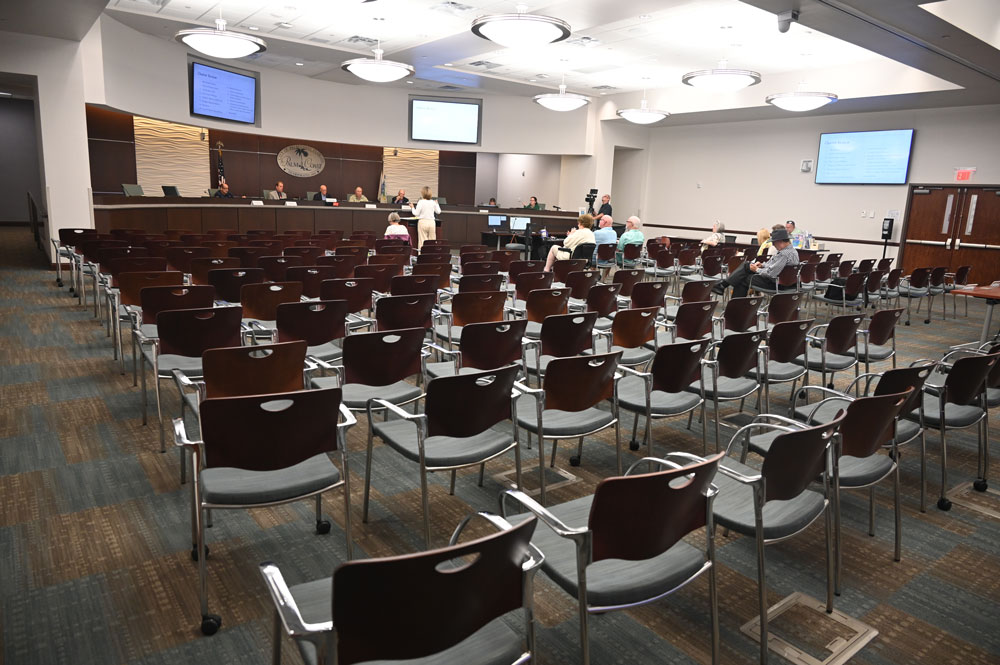
The Palm Coast City Council on Tuesday will have its first discussion about no fewer than 35 changes to the city charter that the council’s Charter Review Committee submitted when it completed its work last month.
The number of recommended changes is deceptive. Most clarify language rather than propose changes.
The most substantive changes address the timeline of council appointments or required special elections in case of vacancies in the mayor’s or council seats. Council compensation would no longer include benefits. Qualifying to run for a seat would become much easier, reducing the number of required petitions and eliminating the requirement that they be gathered from within the candidate’s district. The proposals also include a requirement that a member be present to cast votes, but not to take part in discussions.
Beyond that, the proposed changes clarify language, add definitions and allowances, such as the allowance for a city manager to live within a 50-mile radius of the city rather than within its boundaries.
Five or six recommended changes appear to be more administrative than charter-related, such as the requirement that “charter officers” (the city manager and the city attorney) be evaluated annually, a provision usually included in the officers’ contract, not in the charter. The proposals also rather vague call for the inclusion of a “Budget Assumptions” section in the annual budget message for “transparency,” and a requirement that the city attorney’s qualifications explicitly include expertise in municipal law–again, usually a contractual and administrative matter rather than a charter matter.
The proposals also clarify how the council may censure a fellow council member or the mayor, and how it may seek the removal of a member or the mayor, through a request to the governor, though the council itself does not have the authority to remove a council member. Those proposed provision seem especially superfluous considering that the council did both last year: it censured Mayor Mike Norris (twice) and formally requested that the governor remove Norris, a request that obviously went nowhere. It did so by four votes each time. The charter changes recommend making that process formal, and requiring a supermajority to do either.
Still, any proposed changes must go before voters for approval. But the council can’t very well submit 35 proposed charter amendments for the November ballot. The demand on voters would be too taxing, and the cost to the city for extra pages on the ballot would be too high.
The council will therefore have to decide which proposals to consider for the November ballot, and which to delay, or discard altogether. It’s up to the council to decide whether any proposals make it onto the ballot. It’s also up to the council to amend the proposals or write proposals of its own. Some council members are interested in loosening the city’s ability to borrow–or eliminate the current stricture, which prohibits borrowing of more than $15 million (if it’s backed by the general fund: the city may borrow without limits off of its independent funds, such as its utility or its stormwater fund). The council placed such a proposal on the November 2024 ballot. It was poorly written and poorly defended by the council. It failed.
A further complication: One of the proposals, pushed by Charter Review Committee member Michael Martin (who said he first developed the idea at former Mayor David Alfin’s urging), is to add a lengthy preamble to the charter. Another is to add a Citizens’ Bill of Rights. The committee does not consider that part of the charter. It is recommending that the council adopt it by ordinance.
In some regards, the committee’s report, prepared by Georgette Dumont, the consultant who facilitated the whole process for the committee, is not clearly organized. It does not include proposed ballot language. It does not include the ranking of 10 priorities, from most important to less important, that the committee had agreed to.
Unsurprisingly, the committee ranked the process of filling vacancies at the top. The vacancy that led to the appointment of Charles Gambaro in October 2024, replacing Cathy Heighter, drew recurring opposition from a small segment of the public and from Norris, who eventually sued over it and lost. The new language aims to avoid a recurrence of that situation.
The committee ranks the elimination of council benefits and the qualifying fees and process near the top, too.
Roughly speaking, any of the 35 proposals can be grouped into clusters that could make combining them easier in proposed ballot language. Five of the proposals regarding council vacancies and elections fall into one such group. The two proposals on compensation could be combined. Six proposals about charter officers could be set aside as belonging in city policy rather than in the charter. One of the proposals merely updates language, replacing the word “electors” with “registered voters,” or “by law” with “Florida Statute.”
The council appointed the committee in July. Each council member appointed one committee member. They were: Patrick Miller, Ramon Marrero, Perry Mitrano, Michael Martin and Donald O’Brien. The committee met numerous times between August and January, and its members attended three public workshops to solicit ideas and recommendations from voters at large. The committee meetings lasted about three hours each. Committee discussions were always civil, at times spirited, never abrasive or aggressive, a reflection of O’Brien’s chairmanship and Dumont’s unfailing good cheer and long experience with such panels.
The meetings drew barely any attendance. As a result, those in attendance took on the role of committee member emeritus, with disproportionate influence on the sort of recommendations that made it in the final report, even though they were clearly not representative of the public at large.
The full report appears below.



























Leave a Reply