



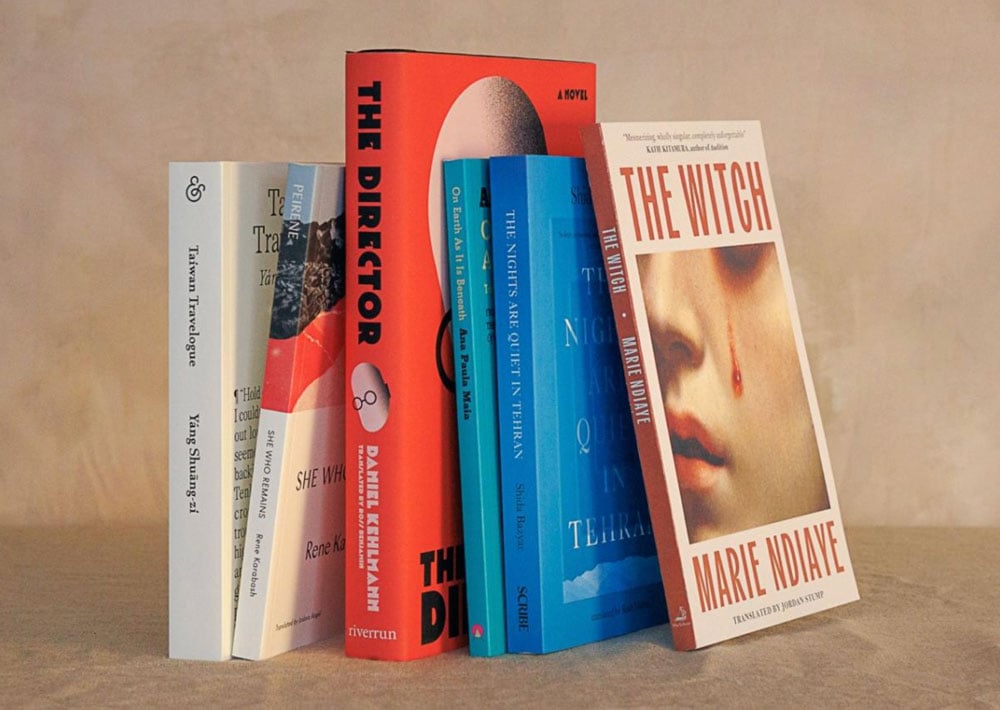
This year’s International Booker Prize shortlist presents a diverse and intriguing array of books that all demonstrate the highly creative imagination and inventiveness of their authors – and translators, of course.
Readers are invited to immerse themselves in six richly told tales from Bulgaria to Brazil and several points in between. Across these novels, we meet the unreliable narrator of a meta-fiction, a failed modern witch, a family of Iranian émigrés, a filmmaker compromised by the Nazis, a brutal prison warden, and a gender-traversing figure who seeks to save their own skin by shapeshifting.
Booker panel chair Natasha Brown has great praise for the shortlist, saying: “With narratives that capture moments from across the past century, these books reverberate with history. While there’s heartbreak, brutality and isolation among these stories, their lasting effect is energising.”
Here, our six literary experts guide you through the nominations for 2026.
Taiwan Travelogue by Yáng Shuāng-zǐ, translated by Lin King
Set in 1930s Taiwan under Japanese colonial rule, this exquisitely layered novel follows Japanese writer Aoyama Chizuko and her Taiwanese interpreter Ông Tshian-ho’h through a culinary and emotional landscape seeded with deliberate breadcrumbs: details that only reveal their full significance upon return visits to the book.
Taiwan Travelogue’s meta-fictional architecture is quietly audacious. Yang frames the narrative through a fictional author, a fictional translator and their respective silences, making the unreliable narrator not merely a device but a structural argument about whose knowledge counts and whose remains obstructed.
What makes the book genuinely pleasurable, however, is its treatment of intimacy between the two women. The queer undertow is rendered through the minute economies of shared meals and unfinished sentences, through which Yang smuggles the most profound questions about desire, friendship and colonial entitlement into the everyday.
Eva Cheuk Yin Li, lecturer in culture, media and creative industries
She Who Remains by Rene Karabash, translated by Izidora Angel
She Who Remains feverishly journeys through a centuries-old transgenerational wound that has reached its boiling point: a final reckoning between silence and testimony, tradition and change, truth and lies, living and dying.
A trans story narrated from an unspeakable place, the novel centres on Bekija, a 33-year-old gender-traversing member of a disappearing Albanian community ruled by the violent laws of the Kanun of Lekë Dukagjini.
In a place where women are a commodity and the only path to freedom is the willingness to kill and die, Bekija absconds their fate of a forced marriage as the last “sworn virgin” under the Kanun, socially transitioning from female to male.
A novel saturated with poetic intensity, captured stunningly by Izidora Angel’s translation, She Who Remains is a dervish dance of a dream. Timelines perpetually split, survival is not a promise, and gender outlaws face the impossible choice to break the cycle of centuries-old violence or perish in a gust of ash.
Boriana Alexandrova, senior lecturer in women’s and gender studies
The Witch by Marie NDiaye, translated by Jordan Stump
The Witch is an ambiguous, puzzling novella about Lucie, a minimally gifted witch. As she passes on her magic to her daughters, readers might expect a story of feminist empowerment. But instead, the family Lucie thought she knew flies away from her, and her own powers fail her when her husband leaves and her parents separate. The Witch tells the story of her response to this disintegration.
The novel shares its name with a famous 1862 French history of the witchcraze by Jules Michelet. But instead of Michelet’s potent witches defying medieval patriarchy, Lucie lives in a drab, modern world of fracture and disenchantment. That makes Ndiaye’s tale more realistic than magical.
If witchcraft is a metaphor for women’s power, then as a daughter, wife and mother, Lucie’s story is one of missed opportunities and pensive struggle. A weird but interesting read.
Marion Gibson, emerita professor of renaissance and magical literatures
On Earth As It Is Beneath by Ana Paula Maia, translated by Padma Viswanathan
In a remote, forgotten Brazilian penal colony built on historical violence, a sadistic warden initiates a monthly fatal hunt of inmates during the prison’s final days.
It’s impossible to read On Earth As It Is Beneath without thinking of Kafka’s In the Penal Colony – not only because of the setting but also the distressing feeling that envelops the reader, almost making them a character in this brutal narrative.
Maia manages to capture the absurdity and violence of a concentration camp environment. The dynamic between calm and horror is particularly crucial. There are few prisoners, watched over by only one guard. However, what makes this prison inescapable is the dehumanisation of everyone – prisoners, the guard, the prison director. One way or another, all are forgotten by society, as if dead.
Without question, this is a novel that reminds us how much dehumanisation happens “on earth as it is beneath”.
Vinicius De Carvalho, reader in Brazilian and Latin American studies
The Nights Are Quiet In Tehran by Shida Bazyar, translated by Ruth Martin
A moving, quietly powerful novel about one family’s experience of revolution, exile, memory and the enduring persistence of hope, The Nights Are Quiet In Tehran begins after the 1979 Iranian revolution and moves across four decades to 2009, and a life rebuilt in Germany.
Four sections are narrated at ten-year intervals in the first person. The novel opens in 1979 with Behzad, the left-leaning activist father in Iran, then moves to Germany through Nahid, the literature-obsessed mother who is the family’s emotional anchor. The third section follows Laleh, the firstborn daughter, on an awakening family visit to Iran in 1999. The fourth centres on 2009, when son Mo is detached from politics until Iran’s Green Movement erupts onto global TV.
This structure gives the book the feeling of a family album: intimate, incomplete and quietly charged with history, the shifting voices allowing each generation to speak from its own wound. Ruth Martin’s translation reads with clarity and gentle elegance, preserving the novel’s shifts in voice and emotional nuance.
Narguess Farzad, senior lecturer in Persian studies
The Director by Daniel Kehlmann, translated by Ross Benjamin
A cleverly constructed historical novel from one of the most acclaimed contemporary German writers, The Director follows W.G. Pabst as he returns to Nazi Germany after an unsuccessful stint in Hollywood. Once a doyen of Weimar cinema, he is now expected to make films bolstering the nation’s wartime morale.
The German title, Lichtspiel, is an early term for the medium of film – literally, “play of light”. What wilful illusions did the likes of Pabst conjure up to persuade themselves that their art could and should continue under Nazism? Daniel Kehlmann searches for an answer in characteristic gripping narrative style, here with an added cinematic flair.
Ross Benjamin’s translation masterfully differentiates between the novel’s many voices, including Pabst’s wife, son and assistant, whose confused, half-repressed memories of work on his final wartime film frame the novel.
Karolina Watroba, lecturer in German studies





























Leave a Reply