



By Timothy E Shanahan
After decades of stagnating reading performance, American literacy levels have begun to drop, according to the National Assessment of Educational Progress, a program of the Department of Education.
The average reading scores of 12th graders in 2024 were 3 points lower than they were in 2019. More kids are failing to even reach basic levels of reading that would allow them to successfully do their schoolwork, according to the assessment.
There is much blaming and finger-pointing as to why the U.S. isn’t doing better. Some experts say that parents are allowing kids to spend too much time on screens, while others argue that elementary teachers aren’t teaching enough phonics, or that schools closing during the COVID-19 pandemic has had lingering effects.
As a scholar of reading, I think the best explanation is that most American schools are teaching reading using an approach that new research shows severely limits students’ opportunities to learn.

Jacqueline Nix/iStock/Getty Images Plus
A Goldilocks approach to books
In the 1940s, Emmett Betts, a scholar of education and theory, proposed the idea that if the books used to teach reading were either too easy or too hard, then students’ learning would be stifled.
The thinking went that kids should be taught to read with books that were just the right fit for them.
The theory was backed by research and included specific criteria for determining the best books for each child.
The idea is that kids should work with books they could already read with 95% word accuracy and 75% to 89% comprehension.
Most American schools continue to use this approach to teaching reading, nearly a century later.
A popular method
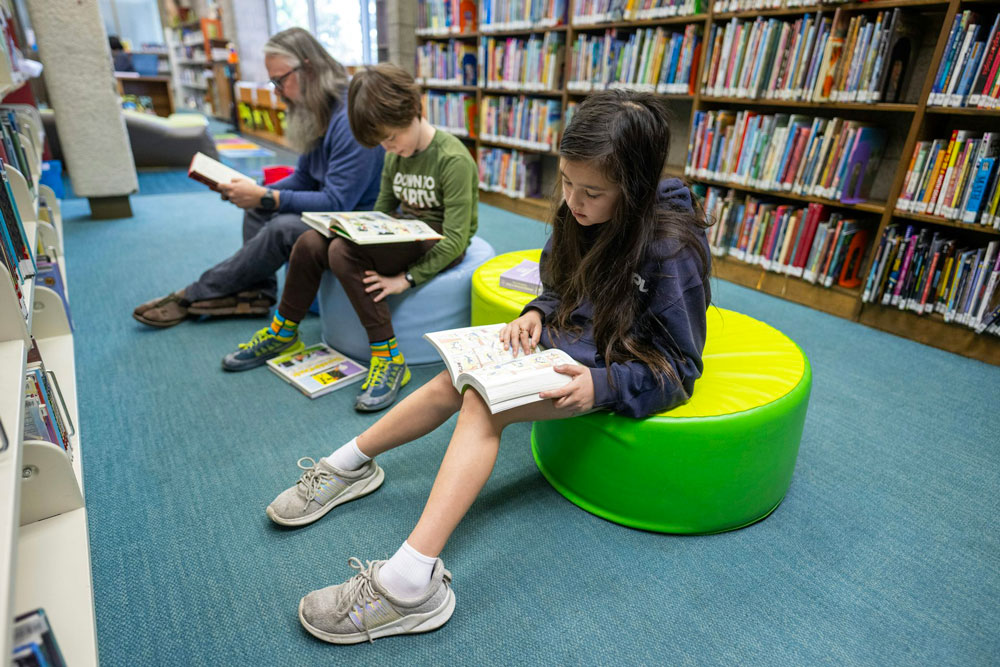
To implement this approach, schools usually test children multiple times each year to determine which books they should be allowed to read in school. Teachers and librarians will label and organize books into color-coded bins, based on their level of difficulty. This practice helps ensure that no child strays into a book judged too difficult for them to easily follow. Teachers then divide their class into reading groups based on the book levels the students are assigned.
Most elementary teachers and middle school teachers say they try to teach at their students’ reading levels, as do more than 40% of high school English teachers.
This approach might sound good, but it means that students work with books they can already read pretty well. And they might not have very much to learn from those books.
New research challenges these widely used instructional practices. My July 2025 book, “Leveled Reading, Leveled Lives,” explains that students learn more when taught with more difficult texts. In other words, this popular approach to teaching has been holding kids back rather than helping them succeed.
Many students will read at levels that match the grades they are in. But kids who cannot already read those grade-level texts with high comprehension are demoted to below-grade-level books in the hopes that this will help them make more progress.
Often, parents do not know that their children are reading at a level lower than the grade they are in.
Perhaps that is why, while more than one-third of American elementary students read below grade level, 90% of parents think their kids are at or above grade level.
What’s in a reading level?
The approach to “just right” reading has long roots in American history.
In the 1840s, U.S. schools were divided into grade levels based on children’s ages. In response, textbook publishing companies organized their reading textbooks the same way. There was a first grade book, a second grade book and so on.
These reading levels admittedly were somewhat arbitrary. The grade-level reading diet proposed by one company may have differed from its competitors’ offerings.
That changed in 2010 with the Common Core state standards, a multistate educational initiative that set K-12 learning goals in reading and math in more than 40 states.
At the time, too many students were leaving high school without the ability to read the kinds of books and papers used in college, the workplace or the military.
Accordingly, Common Core set ranges of text levels for each grade to ensure that by high school graduation, students would be able to easily handle reading they will encounter in college and other places after graduation. Many states have replaced or revised those standards over the past 15 years, but most continue to keep those text levels as a key learning goal.
That means that most states have set reading levels that their students should be able to accomplish by each grade. Students who do this should graduate from high school with sufficient literacy to participate fully in American society.
But this instructional level theory can stand in the way of getting kids to those goals. If students cannot already read those grade level texts reasonably well, the teacher is to provide easier books than adjusting the instruction to help them catch up.
But that raises a question: If children spend their time while they are in the fourth grade reading second grade books, will they ever catch up?

Jerry Holt/Star Tribune via Getty Images
What the research says
For more than 40 years, there was little research into the effectiveness of teaching reading with books that were easy for kids to follow. Still, the numbers of schools buying into the idea burgeoned.
Research into effectiveness – or, actually, ineffectiveness – of this method has finally begun to accumulate. These studies show that teaching students at their reading levels, rather than their grade levels, either offers no benefit or can slow how much children learn.
Since 2000, the federal government has spent tens of billions of dollars trying to increase children’s literacy rates. State expenditures toward this goal have been considerable, as well.
Despite these efforts, there have been no improvements in U.S. reading achievement for middle school or high school students since 1970.
I believe it is important to consider the emerging research that shows there will not be considerable reading gains until kids are taught to read with sufficiently challenging and meaty texts.

Timothy E Shanahan is Distinguished Professor Emeritus of Literacy at the University of Illinois Chicago.

























Deborah Coffey says
If we weren’t so arrogant, as in American exceptionalism and America first, we could just ask the leading countries in education. Call Singapore, China, Finland…and ask them what they do to foster literacy.
JW says
Deborah Coffey reminded me about comments from American teachers on this issue spending a few years in Europe and China to teach (English). They observed that kids there are very motivated to learn. It is not the teaching (it is part of it) but it is the parenting before they go to school and during the time kids are in school, i.e. encourage and show them the value to learn and think. American kids are living in an “adult” culture of sports and entertainment and their parents are their model. . Do we see parents reading books these days? Very few, because they have other priorities. It is sad but true! But it is a choice!
JimboXYZ says
Teaching children to read at their grade level is the contract. Can’t expect genius level from the average student. As for the underachievers, they’re always going to struggle. There’s the threshold(s) of “functional literacy” for every student for reading comprehension by year. Where the more gifted/intelligent take their obsession with reading & learning is the difference between succeeding & failing in life. That’s always been an individual responsibility ? And that doesn’t mean that evetually any student won’t take longer to self actualize at a cerebral level as the “late bloomer” ?
Take music for example, students are exposed, they learn the basics. Some suck at it, others so mediocre that they need to find themselves or something they’re naturally better at. And then there are the Rock Stars, the one’s that immerse themselves to become tour stage performers. The Gene Simmons 10,000 hours of living & sleeping with their guitars. Not everyone is cut out for that, to be the next Jim Hendrix/Eddie Van Halen or whomever else that your guitar god is/was ?
Back to the reading & books ? There’s the minimum required reading materials, the optional is suggested reading materials, where any one takes that hunger, quest for knowledge is their own endeavor, quest for excellence. What students get as the minimum is a matter of being exposed & immersed in the shallow end of the pool, the kiddie end so they don’t drown/fail. As they wade into that knowledge pool, where anyone is in over their head is whether or not hey sink or swim. Again that’s an individual thing ? Maybe they go back to the shallower end where their feet touch the bottom of the pool. Maybe they grow, tread that relative reading water and attain getting from the 3 foot depth to the 5 foot depth near the middle of the learning pool ? And maybe they get to the deepest end of the pool just the same, read at that level, become an author even, creating next level writings ?