


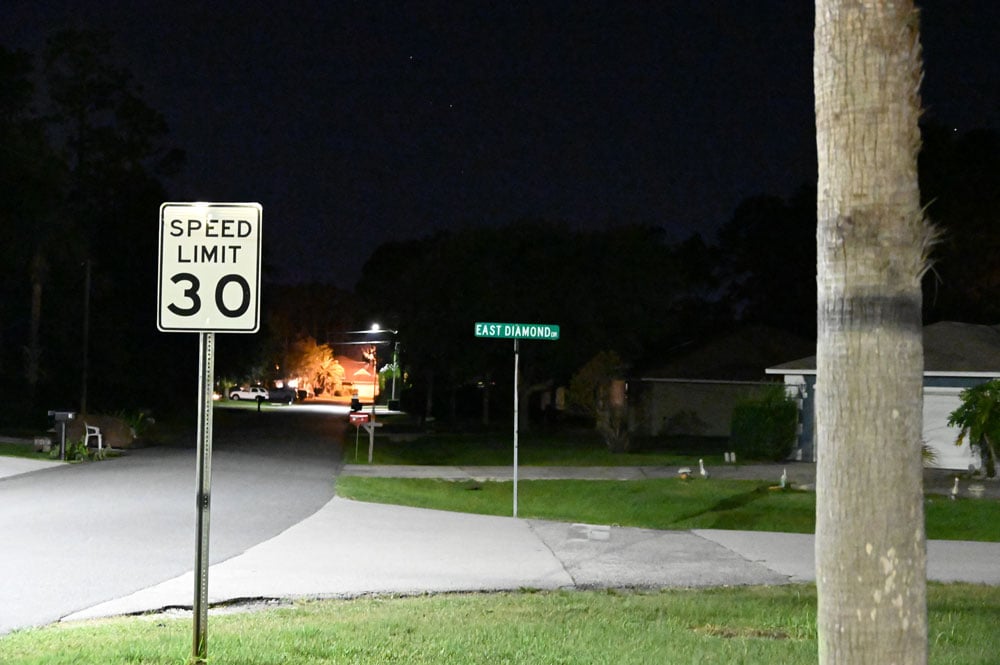
After the city studied drivers’ speeds at 48 speed zones and 109 locations across the city, the Palm Coast City Council in June 2024 opted against lowering speed limits on all residential streets from 30 to 25 miles per hour. It would have cost $1.6 million to do so, city staff told the council.
Today, the council heard a similar presentation and reached a similar conclusion.
The council again opted against lowering residential street speed limits, again as a matter of cost, though today’s conversion cost is put at $400,000 to $1.3 million. The council will seek state and federal grants on the off chance that it could implement the speed reductions that way. Crash data does not point to as serious a safety problem on residential streets as it would on collctor roads.
“I would like to see us be able to do this, but we have limited monies,” Council member Theresa Ponieri said, “and it’s tough when you’ve got to do 2,400 signs, because there’s, I would say, probably 30 problem streets in the city.”
To Council member Dave Sullivan, the return on investment isn’t there when the problems are limited to certain streets, not the majority. “Look at the critical areas, the more critical areas where there are crosswalks and children going across, things like that, where we can make improvements,” he said.
State law requires speed limits for residential streets to be set at 30 mph. Cities may set them lower. Kimley-Horn, the engineering and planning company, conducted the required investigation which had to precede any consideration of a reduction in speed limits across the city. The city’s 1,578 residential streets met the criteria for a 5 mph reduction, but not more. Lowering the speed limit on 71 collector roads was not warranted, the study found.
Five-year crash data on residential streets indicates 34 crashes, all involving pedestrians (21) and bicyclists (13), with 32 injuries–five major injuries, 20 minor, and seven “possible.” There were no fatalities. The fatalities have been on larger roads like Belle Terre Parkway and Palm Coast Parkway.
To universally lower speed limits, all speed limit signs must be replaced. “We’re forced by Florida law that every time you make a change from a 30 to 25 we must post the sign,” Traffic Engineer Scott Kehoe said. (Curiously, when Flagler Beach lowered its speed limit across the city to 20 mph, it did not follow that requirement.)
At every point where traffic changes from a collector road to a residential road, a speed limit sign must be posted. “This ends up bringing us to a total of about 2,400 signs that we would have to create throughout the city,” Kehoe said. Currently, 30 mph signs don’t have to be posted on residential streets because there is no change between a collector–like, say, Point Pleasant Drive–and a residential road–like, say, Postwood Lane.
“If the study had come back and said the collectors could be 25, then all we’d have to do is change out the collector signs to 25 and we’d be good,” Council member Ty Miller said. “But because there’s a differential, we now have to post signs at every single residential road.” And for long enough roads, more signs must be posted.
A typical sign with a contractor costs between $535 and $552. If the city were to bid out the project, it would cost at least $1.3 million, not including bond money and “mobilization,” or the cost of bringing construction equipment together. If the city were to do the job with its public works department, it would cost $550,000. It would take 18 months.
Retrofitting existing signs does not significantly bring costs down: it could be in the $400,000 range, but there’s only “a very small number” of signs that could be retrofitted that way, Engineering and Stormwater Director Carl Cote said. “It’s not a recommended approach to do it,” he said.
The city has a $30,000 machine to make street signs. It could make about 20 signs a day. The city engineer, unenthused already about changing speeds, was not recommending that route. “If we end up going this way, I would probably want a contractor to do it,” Kehoe said, “be done with this thing and put the signs in and they’re up, rather than have it drawn out for a year and a half or more.”
The more he spoke the more Kehoe sounded like Debbie Downer, reflecting the administration’s tepidness about lowering speed limits. “Just because we put a sign up doesn’t necessarily mean they’re going to drive that speed,” Kehoe said. “We have a lot of ‘do not enters,’ ‘no left turn’ signs that people still do what they do. So putting these signs in for the most part, over my 40 years of doing this, most people will drive what they’re comfortable driving at. So they’re already driving slower. We really don’t have any issues as far as serious injuries and fatalities on the residential roads, and it will cost pretty much a million dollars, plus we have to maintain them forever.”
One alternative is to request a grant through the Transportation Planning Organization, at least to reduce the cost. “I’d like us to pursue that aggressively,” Miller said. “I think there’s money there.” Council member Charles Gambaro suggested federal avenues. Miller is not interested in taking money away from the street fund, such as microsurfacing that is prolonging residential streets’ life. He does not see the crash data as particularly alarming.
“We don’t have streets with sidewalks on both sides, and it’s dangerous, and it just concerns me,” Council member Theresa Pontieri said. She agrees with Miller on not taking money away from other street needs and on the crash data, but also on seeking out grants. “I don’t want us to be having this conversation a year from now, and it because there’s a fatality on one of these long stretches,” Pontieri said.
To Mayor Mike Norris, it’s just a matter of punishment, and getting sheriff’s deputies to be less forgiving with warnings. “I’m not happy with some of the numbers that were presented last time, as far as enforcement,” Norris said. “I understand trying to give out warnings just for educating people, but sometimes you got to make them pay.”




















Go fast says
So these people,who spend money like drunken sailors, spend who knows what on TWO studies, have a $30,000. Machine at their disposal, which they apparently don’t want to use , Can’t figure a way to spend on public safety for the well being of our residents?
Mark says
“The city has a $30,000 machine to make street signs. It could make about 20 signs a day. The city engineer, unenthused already about changing speeds, was not recommending that route.”
“The more he spoke the more Kehoe sounded like Debbie Downer, reflecting the administration’s tepidness about lowering speed limits. “Just because we put a sign up doesn’t necessarily mean they’re going to drive that speed,” Kehoe said. “We have a lot of ‘do not enters,’ ‘no left turn’ signs that people still do what they do. So putting these signs in for the most part, over my 40 years of doing this, most people will drive what they’re comfortable driving at.
So what’s so hard about starting with that amount and at a lower cost? Sounds more like someone doesn’t want to be burdened by doing their job. Maybe he’d like to start adding speed humps instead like other cities at a higher cost.
Shark says
If FCSO did their job there might not be an issue with speeding. Running radar on I95 isn’t going to slow down speeders in town!!!
TR says
Not sure what you’re talking about. But I have yet to see the FCSO doing radar on I-95. I have seen the state police doing it though. Just today (03/17/2026) they were on palm coast parkway between Boulder Rock Rd. and I-95 on the west side. Yesterday I saw them on Royal Palm Pkwy and last Thurs. they were on Belle Terre Blvd.
TR says
Would just like to verify that the three times I mentioned that radar was being taken. i was referring to the FCSO doing the radar and not the State police.
JimboXYZ says
Sounds like an individual issue. Would like to know the details of the “accidents” of the pedestrians hit ? Were they hits by right turn motorists well under the 30, even proposed 25 mph that assumed there were no pedestrians coming from that direction ? I self impose my own speed limit at or under 30 mph. If there are cars parked on the driveways for being full ? That’s a situation where one slows down for the vehicles backing out into the road or children darting out from behind a parked car near the road. That’s a 5 mph property zone. Is there children or pets at obvious locations for those residential addresses ? Then there are the turns & intersections ?
Alfinville growth concept put homes at the intersection of Belle Terre and the street that doesn’t have a stop light from end to end of Palm Coast. Gotta slow down because some of those homes have 3-4 cars in the driveway. Anyone driving “stupid” around that corner is just asking for an accident for the same reasons there are children & pets anywhere else deeper from Belle Terre. 30 mph in the middle of the night isn’t a problem unless the motorist is impaired. Becomes a bigger problem atthe crack of dawn when everyone is on their way to work, school or whatever their early AM appointment for an errand is. The one’s that bother me he most are the morons that do burn outs for a hole shot from a dead stop. They’re muscle car, pickup truck gearhead types that have always been a problem. Rule of thumb from casual observation, 600+ HP, that’s generally 12+X the IQ of that village idiot. Some folks, +/- 100 HP is still 2X what their pea sized brains will wander the planet for a lifetime. There are the “too fast, too furious” types that need to self regulate themselves.
Dennis C Rathsam says
Cant imagine people speeding on there way to get home, with all the cars parked in the swales day & night. Deputies ride right by these illegally parked cars, on their way to Dunkin. A warning for these cars parked at night, would be nice. Considering these streets in P/C are very narrow, & the fire trucks are very big. Park where ever you like, but put your cars in your driveway overnight.
T says
Cost what bout those stupid palm coast signs going up everywhere how much are those?