



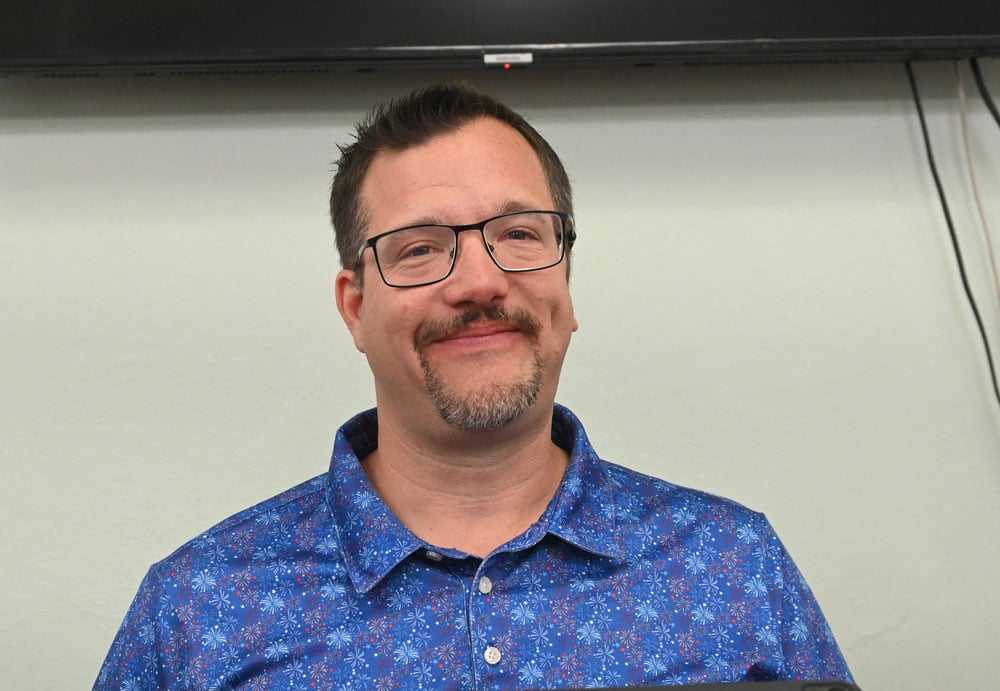
R.J. Santore III is one of three candidates running for two seats in the March 3 Flagler Beach election for the City Commission.
Santore is vice president of his family’s fireworks manufacturing company. Santore is running for the first time. Incumbent Rick Belhumeur is a builder, completing his third three-year term (only the first two terms were consecutive). Incumbent Scott Spradley is an attorney, completing his first term.
All three are at-large candidates. Voters of any party or non-party registered in Flagler Beach may vote for two candidates in the non-partisan election. The top two vote-getters will claim the seats.
FlaglerLive submitted six identical questions to the three candidates. As always, the aim is to elicit as much candor and transparency as possible. We have not put space restrictions on the candidates, as this is one of their only platforms to explain heir candidacy to a broad public. But we have asked them to refrain from making campaign speeches, make lists of accomplishments or use artificial intelligence in their answers for anything more than copy editing or spell-checking. We have also asked candidates to reasonably document their claims.
We have no way to positively verify whether the candidates have complied with the AI request. It is ultimately up to the reader to judge the quality and sincerity of a candidate’s answers, which are presented here as submitted. Here are Santore’s answers.

The Questions in Summary: Quick Links
1. Explain your role as a city commissioner, as you see it–the responsibilities of the job, its limits, your relationship with and expectations of the city manager, and how you would interact with the staff.
I’d like to start by comparing local government to a corporation. The citizens of Flagler Beach are the shareholders of Flagler Beach. The City Commissioners are voted in by the citizens and act like a Board of Directors. The City Commission can only hire or fire the City Manager (CEO) and City Attorney. The rest of city staff is only appointed (or released) by the City Manager (according to our charter).
Our City Charter defines the roles of a commissioner. Some of the common roles of a commissioner are to adopt or amend administrative code, approve budgets, approve zoning changes, set fine amounts or other penalties, levy taxes, regulate the rate charged for public utility services, authorize the borrowing of money, and convey or lease city land.
It takes a majority vote of the 5 elected commissioners to pass a motion. There are some exceptions that require a Super Majority (4) or Unanimous vote (5). Any changes to our Charter require a referendum vote from the citizens.
I have a professional relationship with our City Manager, Dale Martin. He has been responsive to my emails, and I admire his community engagement such as his community dinners during the holidays, game nights, and Tuesday Topics. To help me hit the ground running if I am elected, we are meeting weekly. Some of my expectations of our City Manager will be to present a lean city budget, minimize interruptions from infrastructure upgrades, and formalize equipment and grounds maintenance.
Although commissioners are not allowed to direct staff, I believe it is important to be present and available to staff. Our current policies can discourage employees from speaking to Commissioners. I want city employees to know that if they come forward with a problem to a commissioner, reporting it won’t cost them their job. I would like to accomplish this by visiting the different departments and setting policy that fosters a trusting relationship with our staff.
The commissioners have a responsibility to thoroughly research the agenda packet, seek public input, and vote on what is best for the shareholders of our city… the residents and business owners. Lastly, we have the responsibility to maintain the public’s trust.
See how the other candidates answered:
Rick Belhumeur | Scott Spradley

2. As the challenger, what justifies removing either of the candidates you are running against? Going past the assumption that they are fine people and that you would provide a fresh or different perspective, what do you cite as two or three specific examples for each that justify their removal, and how would you have been different?
From my perspective, the commissioners have lost touch with their constituents. Too often I hear candidates say they will “listen to the people,” but once elected there is a noticeable shift to listening more to city administration or outside interests. I would be honored to represent Flagler Beach and here are a few examples how I would vote differently on the following.
A. Citizen Referendum and Large-Scale Annexations:
In the early 2000’s, a citizen-led initiative changed our ordinances to mandate that any large-scale voluntary annexations would require a citizen vote for the final approval. For almost 25 years this protected Flagler Beach from overdevelopment and becoming like many other coastal cities. The two incumbents I am running against both voted in favor of removing our right to vote on the annexations from the people. When Veranda Bay was originally 2,735 units, Commissioner Belhumeur supported that number of units.
In 2024, before the Veranda Bay annexation had to be split in two because of an enclave issue, Flagler Beach submitted the application for a comprehensive plan amendment to the State under the State’s Coordinated Review Process. That is because FloridaCommerce flagged the development as a DRI (Development of Regional Impact). That process is the most thorough review from various State agencies such as Florida Department of Transportation, Florida Department of Environmental Protection, St. Johns River Water Management District, Florida Fish and Wildlife, and more. Under this review process, these State agencies are permitted to “object” to various parts of the Comprehensive Plan amendments and require the City to address the objections before the State approves. During that 2024 process, the State objected and the city did not formally respond.
Now with the development split into two, the city submitted the Summertown amendment first, but this time the city submitted this under the “State Expedited Review” process. Under this expedited process, the State has a shorter time window to review and is only allowed to give comments, not objections. I emailed all commissioners and voiced my objection during public comment, that a development of this size and impact near sensitive lands and neighboring Volusia County should have used the most thorough review process available. In addition, the city passed the Summertown annexation related ordinances without any guarantee that the additional floodplains, wetlands, and areas near the aquifer recharge would be protected. The city, instead, trusts the good faith from the same developer that has sued residents for opposing their development.
I know that was long-winded, but I would have voted NO to taking the people’s vote away, and I would never approve a comprehensive plan amendment at this scale without it going through a more thorough State review process. The citizens deserve that process.
B. South Side Condominiums:
Sachem Capital Corp. was the mortgage holder for the unfinished condos on the South end of Flagler Beach that were torn down earlier in the year. While Sachem worked to repossess the title of that property, the unfinished condos accrued code enforcement fines to $153,750. On May 8th, 2025, Sachem sent a local attorney before our commission to ask for a reduction of their $153,750 code enforcement lien. Sachem is a Real Estate Investment Trust (REIT) and at that time their balance sheet showed they had $491 million in assets and almost $180 million in equity. Although Sachem took quick action once they were able to repossess the title, our current commission voted to reduce the fine to $5,625. That’s $148,125 of our taxpayer dollars that was taken from our pockets and given to an investment company to purchase other properties and pay dividends to their shareholders. To add insult to injury, after the commission agreed to reduce the fine to $5,625, Sachem’s representative could not accept that massive discount without discussing with her client and returning another day.
My public comment that night opposed the large fine reduction. Since Sachem quickly filed permits and demolished the project in approximately 90-120 days, I would have reduced their fine by that amount ($250 per day x days).
C. The Golf Course:
I believe the city mishandled the sale of the golf course which has led to residents feeling unheard. A general rule of life is if there’s a lack of communication when communication is expected, people will naturally imagine the worst.
In 2024, Jeff Ryan started discussions with our City Manager to take over the lease of the golf course with the intention of purchasing the golf course from the city to invest and revive it. Unfortunately, those communications did not make it to all the commissioners, the mayor, or the public in a timely manner which led to public mistrust over the process and outcry at our city meetings. Unlike at the County level, our charter does not require the sale of a golf course to go through a bid process. There have been questions from residents as to how much has the golf course had cost us to date? Were those costs supposed to be covered by the lessee? Why aren’t those cost examples submitted into the agenda packets for review? Why can’t we enforce the lease? Does the course have resiliency value in the future with the more frequent flooding events? Is the deed restriction the safest way to keep it all as a golf course?
I have heard misinformation repeatedly about the golf course; that it couldn’t be purchased while leased to someone else (false, it can be) and that there were no other bids for the golf course (false, Anthony Stewart submitted several proposals).
Initially, the sale of the golf course was tied to a deed restriction which was intended to keep the medium density parcel and recreational parcel (golf course) only tied to golf course activities. I became concerned that with the increasing number of communities selling their public golf courses, that a future law change could take away the protections of a deed restriction. After hearing concerns from the residents, I asked several times through public comment as to why this isn’t being rezoned like every other applicant the city sees, and why didn’t we consider a charter amendment (which the City Attorney agreed is the strongest protections we could add). Thankfully, many months later, at the 2nd reading, the Commission and Mr. Ryan agreed to add those additional protections to the sale of the course.
What would I have done differently? I would have voted to keep the golf course for future resiliency options and enforced the terms of the lease. If we didn’t have the votes to keep the course, I would request it to go to bid to see what it truly goes for in the marketplace, not just appraisals. And finally, I would only agree to sell the golf course from the beginning with the strongest protections in place, a charter amendment that requires a citizen vote. In addition to all these options, I would recommend a public outreach outside of the formal city commission chambers. Workshops and social media outreach.
See how the other candidates answered:
Rick Belhumeur | Scott Spradley
3. Flagler Beach has unique challenges. What two or three issues or challenges do you see affecting Flagler Beach specifically that other local governments don’t have to deal with, and what specific, pragmatic and realistic solutions do you propose–solutions you could propose at the next joint meeting of local governments, for instance.
Flagler Beach is an amazingly unique city. I’m not aware of another city on the east coast of Florida where there are miles of publicly accessible beach with unobstructed views of the ocean, 3 floor height building restrictions, golf carts, and a wonderful assortment of locally owned businesses to visit. Our problems aren’t necessarily unique, as other municipalities have similar struggles. But I see opportunity in ours.
Infrastructure. Our city has some major gaps we’ve yet to address. Parts of our city still have asbestos cement water lines, but exact locations are unknown since we do not have an underground utility map. We’ve had several water main breaks and when I’ve requested a “lessons learned review” from our City Engineer, I was provided an email stating we have poor records for locating water lines and only waited until after a water main break to consider “more destructive exploration at the beginning of the project to increase accuracy.” It is concerning we’re going to take on a $46.3 million Wastewater Treatment Facility. How are we going to pay for that? Impact fees alone will not come close to covering a Wastewater Treatment Facility of this scale. Our utility bills will go up and possibly property taxes could be levied to pay this massive bill. Back in 2007, the Water Wars agreement was put in place to have growth pay for growth. The agreement required the developer that owned the land now known as Veranda Bay and Summertown to design, build, and convey a reclaimed water facility to the city of Flagler Beach. That was based off the original PUD with 453 units and golf course. Instead of holding the developer to those agreements, the city voted to let them off the hook instead of using it for bargaining a better deal to alleviate the burden to our tax base.
With Summertown in temporary limbo with the County’s conflict resolution process, and Veranda Bay approvals looming, I see this as an opportunity for the city to make growth pay for growth and have the developer uphold their end of the agreement and contribute something substantial to the Wastewater Treatment Facility which will have a reuse component to it.
Coastal Resilience. Since A1A is a State road, the pragmatic approach to renourishment is to continue to engage with County, State, and Federal funding sources. We must focus our energy on outreach to our Palm Coast and Unincorporated neighbors. Many in our county don’t realize the economic driver the beach is to the county. A phrase I like to say is the beach is why we live in Flagler County. It’s why we chose to live here. It’s what brought tourism, businesses, and more services to our community. It’s the reason why everyone lives in Flagler County and not Putnam County. Without the beach, are we ready to invest more into industrial to diversify our economic engine? If you haven’t noticed, it’s suddenly happening over the past couple of years.
See how the other candidates answered:
Rick Belhumeur | Scott Spradley
4. Let us assume that Veranda Bay and Summertown clear all hurdles and are part of Flagler Beach. First, how are both the planned 850,000 square foot commercial side of Summertown, including a hotel, restaurants etc., and downtown Flagler Beach’s similar commerce simultaneously sustainable, when even Palm Coast’s Town Center is struggling after 25 years of trying? And what will you do specifically to keep the two sides of the river from becoming competing sides of the city, as opposed to part of the same cohesive unit, especially if (as in Bunnell with Grand Reserve) the new developments’ residents start claiming several seats on the commission?
The developer-provided Financial Impact Study (from a business that’s now dissolved) did not address if both sides could be simultaneously sustainable. I asked for a sales leakage / diversion analysis to be provided. There was none provided. There is substantial development on Colbert, SR 100, and Old Kings Road. What will travel times look like due to increased traffic and a possible new pilot program that will allow golf carts to travel over the bridge? The new “boutique” hotel will have 250 rooms, which is 150 more than the Compass hotel. What are emergency evacuations going to look like since this is a Coastal Hazard Zone?
It’s difficult for me to hypothetically weigh in on Summertown and Veranda Bay becoming part of Flagler Beach because there are hurdles both need to overcome first. Summertown is in conflict resolution with the County and according to the developer, there is a version of Veranda Bay’s boundaries that was discussed but not produced during the first reading, showing an alternate area to be annexed (and areas not annexed).
In regard to new residents claiming several seats on the commission, we may have to look to districting. Based on my understanding, we currently have 3 commissioners and a mayor who reside on the south end of the barrier island. What will representation look like for the city? What about those carved out neighbors that are County? How many interlocal agreements will be needed for road maintenance, services, and even the minor things like golf carts on county / city roads?
This fragmented annexation will be complicated, but I am committed to working with our residents and close neighbors with a collaborative attitude.
See how the other candidates answered:
Rick Belhumeur | Scott Spradley
5. Based on your comments at the recent Woman’s Club forum and in previous public statements, each of you, to one extent or another, has put significant faith in growth not only paying for itself but potentially–regarding Veranda Bay and Summertown–generating a large enough windfall to underwrite capital improvements such as stormwater for the rest of the city. Yet none of the consensus documentation on the subject supports the claim that growth either pays for itself or generates a windfall, with clear evidence locally: Bunnell’s Grand Reserve, the largest single development in its history, was approved on high hopes that it would create a windfall. It has not. Palm Coast just approved the largest utility rate increase in its history–despite ranking among the fastest-growing cities in the state for some of the years since 2018. First, what independent documentation or analysis do you have (documentation not produced by the developer) showing the revenue you might expect from Veranda Bay and Summertown? Second, assuming, as is likely, that the new developments will not generate the sort of revenue you need to foot the full bill for the $46.5 million sewer plant, let alone the stormwater and other capital needs burdening your budget, what is your alternative revenue source?
These are precisely the questions that I and our residents have been asking from the city. Flagler County and Palm Coast have experienced periods of significant growth for decades. That growth has not created lower taxes or more affordable options. Where has more development created lower cost of living? There will be more administration, services, and new infrastructure sitting in AE floodplains, where there’s a 1% or greater chance of flooding annually.
Although the city went against a court order and allowed the developer not to build the reclaimed water facility, the city did not remove the requirement for the city to take on all the underground infrastructure in Veranda Bay. What standards are the utility lines built to? More stringent codes like Miami has, or less restrictive codes like the City and County have? What will happen when brackish water infiltrates these systems? We will have to foot the bill to make the repairs. With annexation boundaries fluctuating and for simplicity, the infrastructure should be the responsibility of the CDD who can better fund and take care of their own infrastructure. It’s the fiscally responsible option for the city to make.
The Fiscal Impact Study does not address it. Can impact fees contribute towards the Wastewater Treatment Plant? Yes, but let’s be realistic about how much. Impact Fees are capped in how much they can increase each year and only generate revenue when new homes connect to the system. If buildout goes as planned over 15 years, we’ll collect a fraction of what’s needed. If there’s a housing market slowdown it will take even longer and put us further behind. With a $46.3 million facility, Impact Fees are not going to foot that bill.
The developer was the alternate funding source for the Wastewater Treatment Plant. Those obligations were based on the 2007 Water Wars agreement and approved 453 unit PUD. Those should have scaled with increased units and densities of Summertown, Veranda Bay, and Marina Village. Keep in mind, the $46.3 million facility to be constructed only includes capacity up to 1.5 million gallons per day. We’ll need to upgrade it to its maximum capacity of 2 million gallons per day while Summertown and Veranda Bay are building out! Also, the development gets FREE reclaimed water from our wastewater treatment plant for a full 10 years AFTER it’s hooked up.
If I am elected with these annexations already in place, I will be requesting our City Manager to research the following methods to leverage growth paying for growth. I am only suggesting these options to prevent the burden of this debt being paid solely through utility bills and Ad Valorem taxes. If it’s paid through utility bills, Flagler Beach residences and businesses will be hurt the most and empty lot owners will get the biggest benefits. If it’s paid through Ad Valorem taxes, residences and businesses already constructed are valued higher and again will be hurt the most compared to vacant land owners whose lots are valued much lower.
a. Municipal Service Taxing Units (MSTUs) and Municipal Service Benefit Units (MSBUs): A special taxing district may be set up in the Summertown and Veranda Bay areas to pay for the infrastructure that serves them (reclaim water) to reduce utility bill increases.
b. Availability Charges / Standby Fees: To help protect the city if buildout is slow and lots are sitting empty, we can levy a Standby Fee. The city built the capacity for the lots, so the empty lots still pay whether they’re connected or not. This can generate consistent revenue at the platting stage and beyond.
c. Special Assessment (Non-Ad Valorem Assessments): Another tool to create an assessment district towards the Wastewater Treatment Facility debt. Vacant lots pay too. This ties into the next question, as Non-Ad Valorem assessments survive the possible elimination of Ad Valorem taxes.
See how the other candidates answered:
Rick Belhumeur | Scott Spradley
6. Let us assume that the legislature successfully places a ballot initiative that eliminates non-school homesteaded property taxes and that voters approve it. Let us also assume that you would have to enact your first budget without that revenue in your second or third year. Provide three programs, divisions, departments, initiatives or employees you are currently funding out of your general revenue that you would reduce or cut.
If the voters approve that ballot initiative, I don’t believe a single person will wish to make the decisions that commissioners across the State will have to make. These will be difficult decisions that affect the livelihoods of staff, services we’ve come to depend on, and could cripple communities if we are not prepared to address it.
Our City Attorney, Drew Smith, has said something along the lines of “I don’t usually comment on legislation coming down the pipeline as it will change as it goes through the process and may look different in its final form, if it even does pass and get signed into law by the Governor.” I agree, but since FlaglerLive is asking us to assume if it does pass, I want to show I’ve done the research.
My approach would be to first get estimated numbers that we will be dealing with. Our adopted FY 2025-2026 General Fund Budget is $15.3 million. Ad Valorem property taxes generate approximately $6.4 million of that revenue. Out of that, I would need to get concrete numbers from our Property Appraisers office to know the exact amount from homesteaded properties that would be eliminated. In a previous “Tuesday Topics” meeting hosted by our City Manager, he mentioned we have a high percentage of homesteaded properties. Hypothetically, we could be looking at a reduction by a few million dollars. Here is where I would look first.
a. Ask Department Heads for Recommendations for Cuts. Once the deficit is known, the department heads will be tasked with presenting cuts to their departments.
b. Reduce Professional and Contractual Services. Our Facilities Department has almost $350,000 in non-personnel operating costs. In General Government there’s $567,805 in operational costs which includes another $121,875 in contractual services. The Legal fund is $190,000. Going through line items I can ask what’s essential for public safety and core services, what can be deferred, what can be renegotiated, and what can be eliminated. Our budget also included 14 new positions to hire. I would prefer to freeze new hiring before affecting current employees and their families.
c. Defer Capital Projects. The General Fund also includes vehicle replacements, facility improvements, park projects, and equipment purchases. I would ask what projects can be deferred. We could evaluate and implement maintenance programs to prolong the life of our vehicles and equipment.
d. Replace Lost Revenue Streams. My previous answer ties into this point. We can look to other funding sources, so we don’t have to gut public safety. As previously mentioned, Non-Ad Valorem Assessments, Municipal Service Taxing Units (MSTUs), Municipal Service Benefit Units (MSBUs), and Availability / Standby Fees are all alternate sources that are not affected by the ballot initiative. If we are strategic and serious about growth paying for growth, we can implement these and have a more resilient revenue stream whether this passes or not.
Although I did not name three departments to eliminate, I did that because I feel it would be irresponsible without knowing the exact shortfall and I don’t wish to create panic over serious financial challenges that we can move forward NOW to lessen the blow later. I can promise that I have studied the budget, I will be prepared at these budget meetings, and I look forward to our community’s input during the process.
I want to thank those who took the time to read through our answers. These weren’t simple questions and I hope you found I gave you more than simple answers. I hope my answers showed you how I think and my approach. Over the past couple of years, I’ve read the budget, the agreements, and the fine print because that should be what the minimum a commissioner owes the people who elect them. Whether it’s protecting your right to vote on large annexations, holding a half-billion dollar investment company accountable for their code enforcement fines, demanding the most thorough State review process for developments near our sensitive lands, or studying a $87 million budget. This is the work I put in, and I’m ready to do it on the dais. Flagler Beach is worth the effort. For my kids and the future generations that will come after us.
See how the other candidates answered:
Rick Belhumeur | Scott Spradley






















Belinda says
Insanity is doing the same thing repetitively and expecting a different result. It clearly is time for a change.
The answers to the interview questions given by RJ Santore, are clearly very well thought out, demonstrate a deep understanding of the issues that face Flagler Beach, and a much different approach than the current commissioners asking to keep their jobs.
RJ Santore is a seasoned, steady businessman that understands city issues thoroughly and has a solid/steady temperament. Flagler Beach has many important decisions that need to be made and many important things that need to be looked into. It is critical the individuals doing this are steady, not over emotional, and think before speaking.
RJ Santore has the ability and willingness to explain things well. He also believes that ALL the citizens have a right to participate in the decision-making.
It goes without saying that RJ Santore, will ensure the people have their voice given back to them and rational sanity will be restored to the City Commission.
RJ Santore is clearly the correct hire for the City Commission. He needs our votes. He also needs us to get people out to vote for him on Tuesday, March 3.
Please choose wisely and vote for RJ Santore.
Mothersworry says
Well done! You managed to mention your candidates 5 times!!
Matt says
Let’s go RJ!! He is truly listening to Flagler Beach residents. It’s no secret, he’s been doing this for the past couple years at all the City Hall meetings. He’s completely on record fighting for public input. And not just listening to the public, he has been encouraging the current commissioners to VOTE according to Flagler Beach residents’ concerns.
It’s a breath of fresh air and authentic to have a candidate like this. Flagler Beach needs a local guy in office. He will do the work required and listen to the public. If you are a Flagler Beach resident and truly care about your input and the future of our unique and charming city, RJ is absolutely the clear choice for your vote on March 3rd.
m thompson says
I feel RJ has the sensible foundation & vision to get this city shaped up & help get the “Flagler Beach Vision Statement” back on track. The dedicated & loyal long term residents have watched this city (with their concerns being ignored) being turned into a niche tourist destination by the current staff to create a lavish unrecognizable metro urban sprawl. It may look great & wonderful to some on the ‘conceptual fantasy plan’ but wait until reality sets in. Who will be left to fix the budget with no revenue, good clean water for everyone, the increasing flooding & the sinkholes in the roads…….
OP says
Isn’t it time to rebuild a new commission? We need a fresh perspective, and we need a commissioner who can bring that needed change.
The current commissioners have been in their positions for far too long, failing to lead us in the right direction and showing a lack of accountability to taxpayers. If they feel they shouldn’t run a municipal golf course business, how can you run a city business?
It’s a part of a city recreation for citizens, isn’t it? Why didn’t they direct him to do the right thing? We wonder how they oversee a city manager?
We hope Mr. Santore will offer a new approach—one rooted in transparency, community engagement, and a genuine commitment to addressing the needs of our citizens. It’s time for a change. We hope he understands that the community deserves to be heard and reflected in governmental decisions. This is not just about changing faces; it’s about revitalizing our approach and ensuring that our commission is responsive, responsible, and ready to tackle the challenges ahead.
Let’s support him and embrace the fresh perspectives that will truly benefit our community!
Let’s vote!