



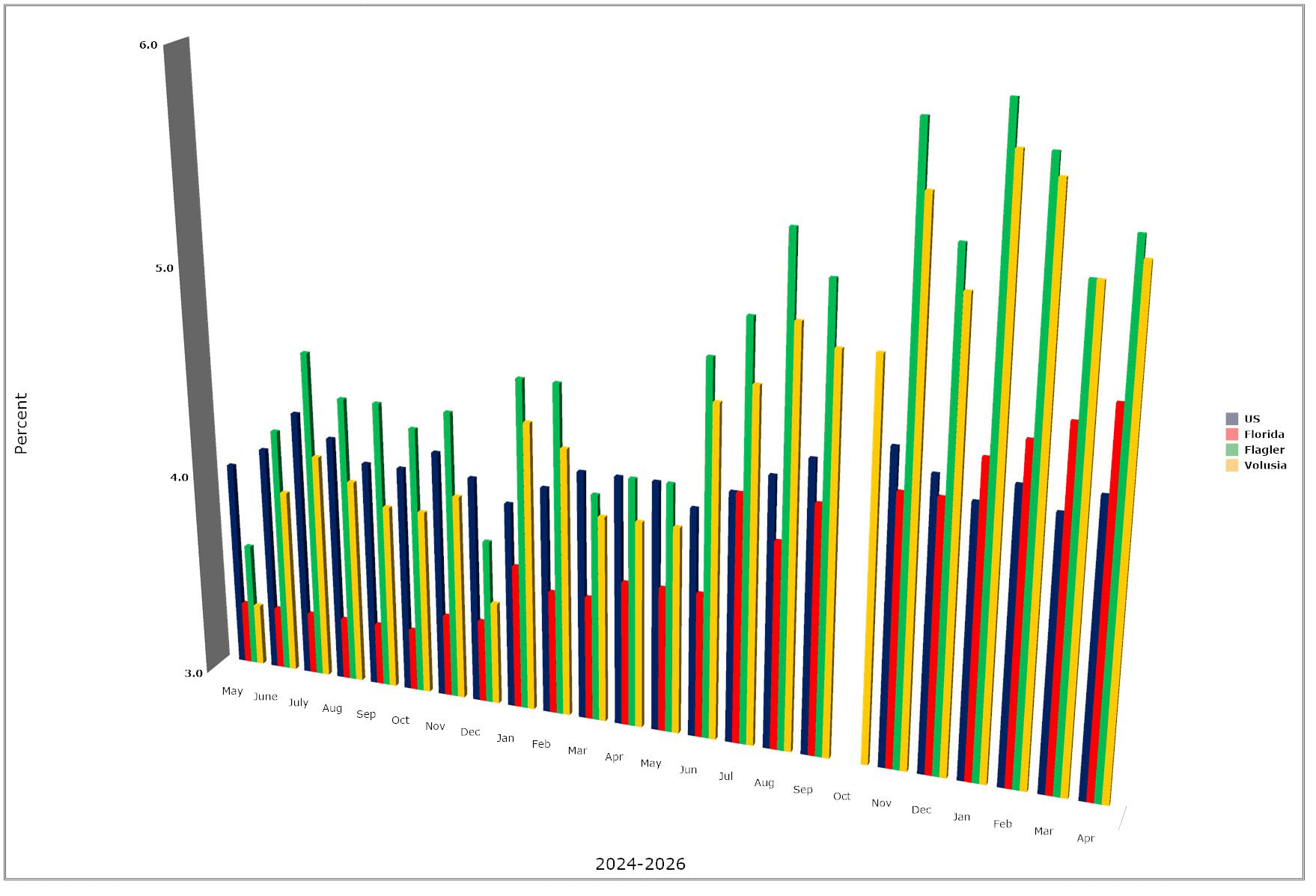
After slight declines in February and March, Flagler County’s unemployment rate again rose in April, to 5.5 percent, with Palm Coast’s rate close behind at 5.4 percent. Florida’s rate rose to 4.8 percent, continuing a steady increase that began in January 2024, when the state’s unemployment rate was 3.1 percent. It is the first time since 2020 that Florida’s unemployment rate exceeds the nation’s.
It appears that the long post-Covid period of historically low unemployment, when both the county’s and the state’s rates hovered in the 3 percent range, is over, replaced by increasing uncertainty provoked by the war in Iran, rising inflation and interest rates, and the effects of artificial intelligence on the job market.
Flagler County’s higher unemployment was driven by an increase of about 100 people on unemployment insurance, to 3,104, and a 200-person increase in the labor force, to 56,491, though the labor force total is still slightly below the 56,532 recorded in July 2024 and the record 56,574 last September. The number of employed persons does not necessarily reflect jobs held in Flagler County, but only jobs held by Flagler County residents. They may be working in surrounding counties or teleworking.
The labor force is an indication of the number of people willing to join (or rejoin) the labor force, as well as the number of people of working age migrating into the county. The month before Covid struck in March 2020, Flagler County’s labor force was 48,462. It has increased 16.6 percent. The county’s population has increased 21.8 percent since, an indication that a disproportionate number of people increasing the county’s population are retirees.
The number of unemployed reflects those who qualify for the state’s 12-week allotment of unemployment benefits, which top off at $275 a week.
The federal government calculates the alternative measure of unemployment and underemployment by including discouraged workers who have dropped out of the labor force as well as those employed part-time for economic reasons–because they could not find full-time work or because their hours were cut back. In April the Florida rate was 8.3 percent, compared to 8.1 percent for the nation.
The Flagler County Association of Realtors has not publicly released home-sale figures since February. That month, FCAR reported 199 closed sales of single-family houses, almost the same number as a year before, at a median price of $364,900, down from $370,000 a year before, with houses spending 95 days on the market compared to less than 50 days in early 2022. The median sale price has been relatively steady, within a band of a few tens of thousands of dollars, since 2022, but inflation accounts for a sizeable portion of the price. In other words, a house that sold for $364,900 in February would have had an inflation-adjusted value of $288,849 in February 2020.
Over 40 percent of sales were in cash, again an indication either of retirees selling homes elsewhere and buying here, or of investor activity. The association counted an inventory of nearly 2,000 available single family houses, a tenfold increase since early 2022. Foreclosures represent barely a blip on the market.
In April, consumer confidence among Floridians declined for the second consecutive month, falling 3.5 points to 74.6 from a revised figure of 78.1 in March, the same 3.5-point decline as with national consumer confidence, according to the University of Florida’s Bureau of Economic and Business Research (BEBR). All five components that make up the state index declined in April.
“The decline in sentiment is not unexpected, as the ongoing conflict in the Middle East has triggered a global energy shock,” said Hector H. Sandoval, director of the Economic Analysis Program at BEBR. “This has led to a sharp rise in gasoline prices and renewed inflationary pressures, with monthly inflation posting its largest acceleration since 2022. These rising costs are straining household finances, even as the broader labor market remains relatively stable. However, Florida’s unemployment rate is now higher than the national average, a trend not seen since 2020. Against this backdrop, Floridians are feeling less confident about their financial situations, which helps explain the weakening in consumer sentiment.”

























Joe D says
Thank you FlaglerLive for not only forwarding the “official” Flagler/Florida Unemployment data, but REMINDING people that after a MAXIMUM of 12 weeks with a maximum $275/week benefits ( some of the lowest and shortest benefits in the COUNTRY), unemployed people simply “drop off” the charts and aren’t counted in the OFFICIAL STATISTICS anymore, as if they don’t exist! So in reality, Flagler County’s REAL unemployment rate is 8.8% counting those people with exhausted benefits and those forced into part time work who couldn’t find a full time job.
Just ridiculous!
R.S. says
I wonder what the unemployment rate of various ethnicities tends to be in Flagler. The national statistics tend to be lower for white laborers than for Blacks; avoiding the rates per ethnicities tends to obscure the built-in unfairness of the system.
Florida State Average: The unemployment rate for Black Floridians sits at approximately (8.0%), compared to the state’s overall average of (4.8%).
Flagler County Average: The overall unemployment rate for all races in Flagler County is (5.5%).
National Context: Nationally, Black unemployment tracks around (7.3%), which is roughly double the rate of white workers.
Hispanic workers tend to track more closely to white averages.
FedUp says
What do you expect when you’re practically building out the entire county and welcoming people from all walks of life to move here with no job base? Please, I’m listening, and I truly hope whoever wrote this article isn’t that stupid. 🤦♂️
Deborah Coffey says
What? You’re mad at a factual article with data? I’m confused.
The dude says
The number is much higher than that.
Floriduh lies about these things.
Pogo says
A light breeze compared to the storm on its way; Soylent Green is people.
celia says
City and county elected needs to stop administration staff from wasting our hard earned taxes in super expensive advertising out of area targeting potential newcomers to move to this county and cities as there are no jobs! Big waste of money is still being done and very negative to the local economy! Lets stop deceiving potential newcomers as done from our diminished pockets and with the local taxpayers approval.
Atwp says
Florida is a Republican state, did you all expect improving numbers.
No work says
Just wait ! Better days are coming !
All those high paying jobs our county and city clown shows (BOCC), city council) keep telling us they are bringing in will be arriving. 😂