



By Nancy Forster-Holt
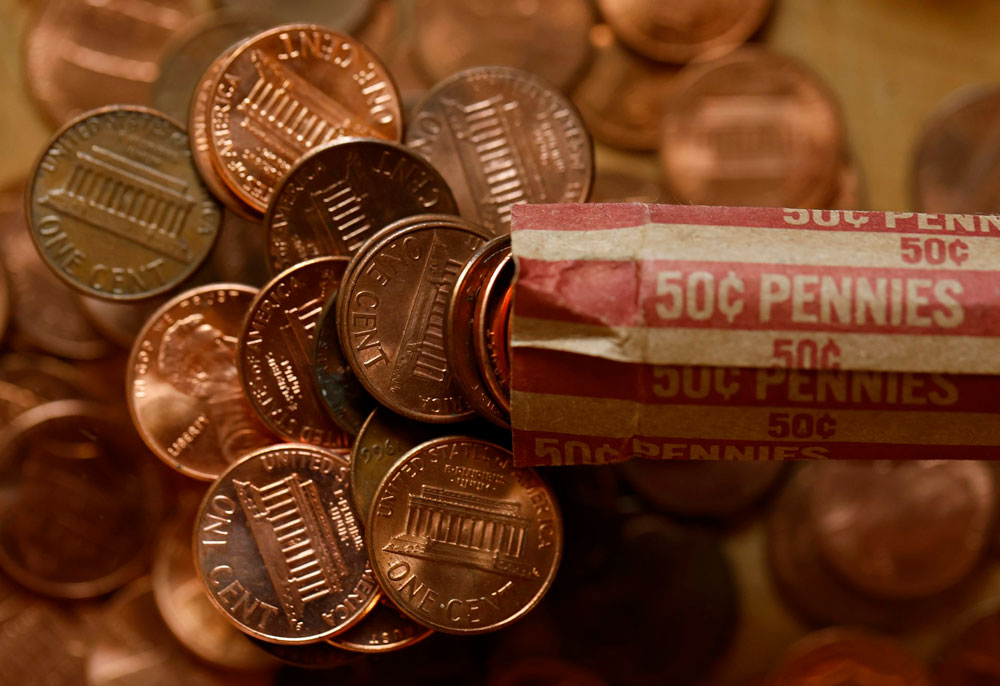
By now, Americans know the strange math of minting: Each penny costs about 4 cents to make. Chances are you have some in a jar, or scattered among pockets, purses and car ashtrays.
As small as it is, the penny punches above its weight culturally. If it ever disappeared, so too might the simple kindness of “take a penny, leave a penny,” alongside timeless classics like penny loafers and the tradition of tossing a penny in a fountain.
But the penny’s days are indeed numbered. The U.S. Mint pressed the last 1-cent coin on Nov. 12, 2025, following a directive from the White House. While pennies will remain legal tender, old ones will gradually be taken out of circulation.
The impact of this change will reach beyond coin jars. Its ripples will be felt as small, cash-reliant Main Street merchants face another test of adaptability in a system that increasingly favors scale, technology and plastic. It will also be felt by people who rely on cash – often people without bank accounts who have the least room to absorb even tiny shifts in price.
My interest comes from my former lives as the chief financial officer of a large credit union and as a small-business owner. Now, I bridge theory and practice as a professor – or “prac-ademic,” as I like to say – studying the challenges facing Main Street businesses.
When the penny goes away, some will win, some will lose – and for some, it’ll be a coin toss.
Heads, they win
The first and most obvious winner is the U.S. government, which will save tens of millions of dollars each year by no longer minting a coin that costs more to make than it’s worth. Ending production seems like an easy call for efficiency’s sake.
Banks and credit unions will likely benefit too. Pennies are disproportionately expensive to handle: Every bag of pennies gets counted, sorted, rolled, verified and shipped back to the Federal Reserve, generating labor and equipment costs that far exceed the coin’s value. Removing the smallest denomination strips out an entire layer of cost and friction from bank operations – savings that scale immediately across thousands of branches.
Another beneficiary, this one hiding in plain sight, is who transports the cash: the armored-carrier industry. For companies such as Loomis and Brink’s, pennies are heavy, low-value cargo, and a logistical money-loser. Removing penny pickups eliminates one of their most inefficient services, reducing fuel use, labor hours and truck wear.
Large retailers will likely also win. Size and scale make it easier to undertake preparations both big and small, such as reprogramming cash registers and stockpiling pennies to hedge against shortages. Larger companies also have the talent and bandwidth to figure out the true costs and benefits of accepting cash or noncash payments. If most of their transactions are already digital, they could be relatively indifferent to the end of the penny.
Large retailers also negotiate lower card processing rates, which are the fees merchants must pay to the card companies every time a customer uses a credit or debit card. These rates aren’t uniform: Large chains get discounted pricing based on sales volume, while small businesses face higher costs for identical transactions. It follows that any policy change leading to more people paying with plastic will disproportionately benefit larger retailers.
To be sure, some banks, credit unions and large retailers have expressed concern and surprise at the pace of the change and the lack of guidance from the federal government. But for most, the penny’s end is a minor operational footnote. Online-only businesses operate in this frictionless world as well – no coins, no counting, no issue.
Tails, they lose
For small, Main Street businesses, the penny’s disappearance highlights the structural disadvantages they already face – and I think it will force a reckoning about what types of payments benefit their bottom lines.
As pennies phase out, local businesses are likely to round cash transactions to the nearest 5 cents, resulting in what economists call a “rounding tax.” Rounding to the nearest nickel could cost businesses and consumers about $6 million annually, according to researchers with the Federal Reserve Bank of Richmond.
And it wouldn’t offer much relief if more shoppers turn to plastic and other noncash payments. That’s because most small merchants lack the negotiating power to lower their card-processing fees.
Card acceptance comes with a layered stack of costs for merchants: interchange fees, network assessments, processor markups, gateway fees, chargeback penalties, terminal rentals and more. Together, these average 2.5% to 3.5% per sale for many small businesses. Also, there are expenses related to adopting the latest, greatest payment methods, and then keeping them updated.
Consider a quick-service restaurant where a typical customer spends $14. If that customer pays with a credit card and the business pays an average processing fee of 2.2% plus 10 cents per transaction, each sale incurs about 41 cents in fees. Even low-cost debit cards include fixed per-transaction charges that disproportionately affect businesses when the per-sale average is small. When the average sale is $10 or less, it barely covers the cost to process it as a card transaction.
That said, handling cash also comes at a cost, and it’s not always easy to know what’s best for business. One analysis found that accepting cash costs 53 cents per $100 of sales, compared with $1.12 for accepting debit payments using a signature and 81 cents for PIN-based debit. Of course, businesses also should keep in mind that different customers will have different payment preferences.
And speaking of customers, those who are most likely to feel the pinch from the end of the penny are people who still rely on cash: older adults, lower-income households, people without credit cards or bank accounts – either unbanked or under-banked – and people who budget in cash because it provides firmer spending discipline.
A few cents added to a grocery total or a convenience store purchase may not matter to someone tapping a rewards credit card, but cash-dependent consumers experience those small increases directly, with no offsetting points, perks or end-of-month cash back. And yes, prices often end in 99 cents, which get rounded up, not down. So the burden falls disproportionately on those least equipped to absorb even small, cumulative increases.
For some, it’s a coin toss
Digital-first consumers may barely notice the penny’s disappearance. They tap phones, scan QR codes and use payment apps that will still settle to the exact amount.
While businesses haven’t received final guidance on how to handle payments in the post-penny era, one option is to price electronic transactions to the cent and round cash transactions to the nearest nickel. If that were widely adopted, digital payments alone would remain precise.
Consumers who use cashless payments may believe their choice doesn’t affect how they shop, but behavioral research says otherwise. Credit cards reduce the “pain of paying,” leading people to spend more – often 10% to 20% more than with cash. Credit card rewards programs further incentivize card use. In one last nod to the cost of noncash payments, those rewards are funded by higher merchant fees that ultimately translate into higher retail prices.
Killing the penny makes economic sense for the government and some businesses, yet it also highlights a deeper truth: Efficiency tends to reward the already efficient. For many, however, even when the change is small, every cent still counts.

Nancy Forster-Holt is a Clinical Associate Professor of Innovation and Entrepreneurship at the University of Rhode Island.




























JimboXYZ says
As I understand the new rules of rounding for the elimination of the penny ? Existing pennies can be used to pay for anything according to the new rounding rules.
If the price of anything is a price that calculates to:
.01-.02 dollars (cents), that is rounded down to .00.
.03-.04 dollars (cents), that is rounded up to a nickel .05.
.06-.07 dollars (cents), that is rounded down to a nickel .05.
.08-.09 dollars (cents), that is rounded to a dime .10.
For example: a consumer buys a package of hamburger buns for $ 1.49. That is rounded up to $ 1.50 for what is paid for it, consumer paid 1 cent more. Let’s say that same consumer buys 3 of them at $ 1.49 each. That total bill comes to $ 4,47. To pay for that, the consumer would be charged $ 4.45. saving 2 cents for buying more, then again does a consumer need 3 packages of hamburger buns to save 2 cents ? Consumer loses if they buy 1 or 2 packages for 1-2 cents on those quantities. 2 Packages is $ 2.98 and the round is up for $ 3.00.
What is fuzzy is each transaction at a different location is separate from say the credit or debit card that a consumer consolidates purchases ? And that’s where the bank is going to apply the same rules of rounding up or down. In the end there will be inflation and one will have to be apply their math skills from K-12 to figure out that the pricing games that will result from the penny being eliminated as it is. Who knows, the bank may just deduct pennies from your account as it’s not a physical copper penny, only a mathematical number stored digitally. And eventually there is a reconciliation & settling up when account is finalized & closed for a given reporting period or permanent account close ?
Sistermoose says
Better solution: Buy pennies from ebay & spend them. They sell rolls of pennies & loose coins. Have to find best deal with free shipping. I never tried because i dont have a credit card. Hope someone else can try.
Laurel says
I guess it makes cents (sorry, I couldn’t help it). Psychologically, people see $2.99 and see the “2” as dominant. $3.00 is more, but the tax is not considered for either, making both prices over $3.00. Being of logical mind (been accused many times), I find gas prices the most annoying. So, gas is $2.99 +9/10ths of a cent? Seriously? I never say $2.99, it’s $3.00! Most everyone sees $2.99. Yes, technically it’s under $3.00, but c’mon!
Good ole Walmart came up with odd numbers, making things look, again, psychologically cheaper.They came up with $3.64! It should be interesting to see how they advertise in the near future.
Young people have no interest in the penny, or the nickle, or the dime for that matter. Can’t blame them; the worth ain’t there. Us seniors are simply used to cash and coins, and are used to being precise. Oh well, I’m keeping my wheats.
BillC says
Simple solution- mint a 4¢ coin :)
PaulT says
Can we still cash in our pennies? Does that big whilygig machie at Publix still exist?
I hope so because our huge coin jar is pretty full..
But seriously though, I never, ever got taken in by those $19.99 deals, always knew deep down they were trying to pull the wool over my eyes.
But what will happen to sales tax?
Logically, eventually, it will have to be rounded up or dropp, So either 10% or 5%.
If not my change in 7% Flagler or 6 1/2% St Johns is going to be a serious point of contention. When the retailer takes a hit and rounds up I’ll leave with a smile but if I’m having a bad day and get stiffed with a round down I’ll let that cashier know I’m not happy. I know it’s not their fault but principles matter…..
The real penny is going away but will we still have electronic pennies? With the derisory rates banks pay on savings accounts pennies matter and if King Donald gets his way and lowes interest rates any further we’ll be deprived of even they small trickle of monthly payments..
Pogo says
https://www.youtube.com/watch?v=_2RIWwOxk7g
DaleL says
I think this is much ado about almost nothing. It is time to think about or even file our income tax forms. On the forms, the monetary amounts are all rounded to the nearest dollar. At a restaurant and in some other situation there is a tip added to the payment. When I tip, I usually round up or sometimes a bit down to the nearest dollar.
Ray W. says
If I am reading a The Cool Down story correctly, an American startup company has developed AI software that can identify the most efficient times at which to inexpensively purchase electricity from a grid in order to charge large storage batteries installed at remote EV battery fast-charging stations. Apparently, infrastructure capacity to remote locations may be more easily strained by additions to the grid.
By this managed battery storage process, the impact on demand caused by too many EVs charging at once during high-demand grid hours can be reduced to more manageable levels at a lower cost to EV consumers.
Make of this what you will.
Me?
ERCOT’s Texas customers can choose billing options. One option allows them to buy electricity based on wholesale prices. During low demand periods when most of the wholesale demand is supplied by much less costly solar and wind plants, rates may be comparatively low. But when the natural gas plants and the pipelines that fueled them froze during 2021’s winter storm Uri, and much of the grid crashed, wholesale prices skyrocketed for those customers who had selected the variable rate option.
Even during the recent winter ice storm Fern, reports claim that residential electricity prices in some areas temporarily jumped from less than 20 cents per kilowatt hour to over $1.80 per kilowatt hour. During winter storm Uri, my younger son lived in a Fort Worth subdivision located in critical care hospital grid; his home never lost power and his bill didn’t rise. But he worked in a train company complex with about 600 co-workers. He tells of hearing the anger of friends and colleagues whose electric bills when they could get power skyrocketed during the storm.
A penny here and there can sure add up!
As an aside, Buc-ee’s just added 16 EV charging stations to the already existing 16 stations. I have no idea whether both installing battery storage capacity and purchasing the available AI software could either pad the store’s bottom line or cut costs for EV customers or both.
James says
Who’s kidding who… considering the political climate nowadays, they could just want to get rid of the penny because Lincoln’s face is on it.
Now, as far as investments. If you were to have simply purchased ten thousand dollars worth of “forever” US Postage stamps ten years ago, you might have made a really nice return by now.
Just say’n.
James says
Funny how in these times of national (perhaps self inflicted) crisis one’s thoughts turn to the mundane objects of everyday life that one would, under other circumstances take for granted.
Such is the case of the penny. Is it, as I jokingly suggested, just because “Lincoln’s face is on it” that some would like to see it erased from everyday life?
After some thought on the matter, it occurred to me that this might indeed be the case.
If so, perhaps it would be better to change the coin, at least for the next few years.
The front baring simply the number 1, with the top border inscription “One Nation.” The bottom, simply “United.” The back of the coin baring the Lincoln Memorial as it should… since this is ultimately what his death represents.
The cent piece, ubiquitous in a decimal based system. As common as the common man, (finally at peace)united, indivisible, 1.
That is what the penny and the man on it symbolizes… perhaps?
Just a thought.