



By Aleh Cherp, Jessica Jewell and Tsimafei Kazlou
Just 1% of the world’s coastal waters could, in theory, generate enough offshore wind and solar power to provide a third of the world’s electricity by 2050. That’s the promise highlighted in a new study by a team of scientists in Singapore and China, who systematically mapped the global potential of renewables at sea.
But turning that potential into reality is another story. Scaling up offshore renewables fast enough to seriously dent global emissions faces formidable technical, economic and political hurdles.
To reach global climate targets, the world’s electricity systems must be fully decarbonised within a couple of decades if not sooner. Wind and solar power have grown at record-breaking rates, yet further expansion on land is increasingly constrained by a scarcity of good sites and conflicts over land use.
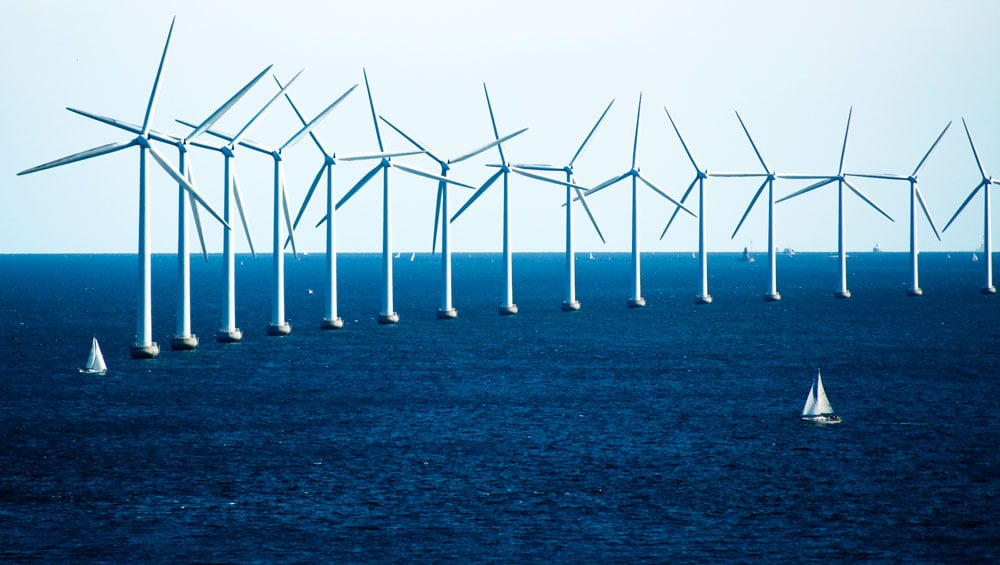
Moving renewables offshore is therefore tempting. The sea is vast, windy and sunny, with few residents around to object. The team behind the new study identified coastal areas with enough wind or sunlight, and water shallower than 200 metres, that are relatively ice-free and within 200 kilometres of population centres.
They estimate that using just 1% of these areas could generate over 6,000 terawatt hours (TWh) of offshore wind power and 14,000TWh of offshore solar power each year. Together that’s roughly one-third of the electricity the world is expected to use in 2050, while avoiding 9 billion tonnes of CO₂ annually.
That sounds impressive as 1% of suitable ocean seems small. Many European countries, such as Denmark, Germany, Belgium and the UK, already allocate between 7% and 16% of their coastal waters for offshore wind farms. Yet what matters for climate mitigation is not only how much low-carbon energy could eventually be produced, but how fast that could happen.
At present, offshore wind generates less than 200TWh per year, less than 1% of global electricity. By 2030, that might rise to around 900TWh. Hitting 6,000TWh by 2050 would require annual installations – each year, for two decades – to be about seven times larger than they were last year.
Offshore solar requires an even steeper climb. The technology is still experimental, producing only negligible amounts of electricity today.
Even if 15TWh a year (an equivalent of some 15GW capacity) can be generated by 2030, to reach the estimated potential of 14,000TWh by 2050 would require sustained annual growth of over 40% for two decades. Such a rate that has never been achieved for any energy technology, not even during the recent record-breaking growth of land solar.
Achieving techno-economic viability
Around 90% of existing offshore wind capacity is located in the shallow, sheltered waters of northwestern Europe and China, where most turbines are directly fixed to the seabed. Yet most of the untapped potential lies in deeper waters, where fixed foundations are impossible.
That means turning to floating turbines, a technology that currently accounts for just 0.3% of global offshore wind capacity. Floating wind power faces serious engineering challenges, from mooring and anchoring, to undersea cabling and maintenance in rougher seas.
It currently costs far more than fixed-bottom systems, and will need substantial subsidies for at least the next decade. Only if early projects prove successful and drive down costs could floating wind become commercially viable.
Offshore solar is even further behind. The International Energy Agency rates its technology readiness at only level three to five on an 11-point scale — barely beyond prototype stage. The new study refers to research saying offshore solar could become commercially viable in the Netherlands only around 2040-2050, by which time the world’s power system should already be largely decarbonised.
Overcoming growth barriers
Even when low-carbon technologies become commercially competitive, their growth rarely continues exponentially. Our own research shows manufacturing bottlenecks, logistics and grid integration eventually slow expansion. And these challenges are likely to be even tougher for offshore projects.
Social opposition and the need for permits can also slow progress. Moving wind and solar offshore avoids some land-use conflicts, but it does not eliminate them. Coastal space close to populated areas is already crowded with shipping, fishing, leisure and military activities.
In Europe, approval and construction of offshore wind farms can a decade or more. Permits are not guaranteed: Sweden recently rejected 13 proposed wind farms in the Baltic Sea due to national security concerns.
What is realistic?
Offshore renewables will undoubtedly play an important role in the global energy transition. Offshore wind, in particular, could become a major contributor by mid-century if its growth follows the same trajectory as onshore wind has since the early 2000s.
However, that would require floating turbines to quickly become competitive, and for political commitment to be secured in the Americas, Australia, Russia and other areas with lots of growth potential.
Offshore wind (green) is tracking the growth rate of onshore wind (orange):

Aleh Cherp (Data: IEA, Wen et al)
Offshore solar, by contrast, would need to achieve viability and then grow at an unprecedented rate to reach the potential outlined in the new study. It may be promising for niche uses, but is unlikely to deliver large-scale climate benefits before 2050.
Its real contribution may come later in the century, when we will still need to expand low-carbon energy for industries, transport and heating once the initial decarbonisation of power generation is complete.
For now, the world’s best bet remains to accelerate onshore wind and solar power as well as proven offshore wind technologies, while preparing offshore solar and floating wind power options for the longer run.

Aleh Cherp is Professor in the Department of Environmental Sciences and Policy at Central European University; Jessica Jewell is Professor in Technology and Society at Chalmers University of Technology; Tsimafei Kazlou is a doctoral candidate at the Center for Climate and Energy Transformations at the University of Bergen.




























JimboXYZ says
With all the unaffordable waste of fraud & abuse, this is a pipe dream that the USA would ever be able to pull this off. & the first hurricane season and this would be wiped out. The real solution is the human population needs to stop growing like it is. Another pipe dream is desalinate the Ocean’s waters & use that for fresh water. The corrosive nature of the ocean and any of these fantasies are simply not feasible. We don’t even have the money for westward expansion in the county without raping & pillaging anyone’s life’s savings for a retirement. These solutions would create a few trillionaires & the rest of us would be homeless & broke like the system is already producing.
Earlier in the afternoon, one of the new construction duplex rental homes built recently under Alfin, that roof is already sagging for the decking and the place might be a 2 years old at this point. The same type of new construction that floods existing homes under the new Palm Coast Building Codes. Can’t wait for that lawsuit or warranty home repair to be a reality for those Alfinville victims.
I have zero faith that windmills to power the grid off shore would ever be a reality. Rebuilding the beaches is a exercise in futility. We can’t even expand the Sewage Treatment Facility infrastructure without creating massive hyper inflation. The best we can hope for is to build data centers.
Dusty says
With CO2 at 4% of the atmosphere and the manmade portion of those emissions at 11%. I gail to see the benefit of offshore wind generation to produce power. I have worked on sea going vessels for most of my adult life and I can assure you that corrosion and salt spray will make those machines a maintenance cost nightmare.
Jim says
Everybody knows windmills kill all the birds. Trump said so.
Everybody knows windmills cause cancer. Trump said so.
Everybody knows the the Chinese build all the windmills but they don’t use any of them in China. Trump said so.
With all these facts provided by our president who has a sterling record of providing fact-based information in each and every utterance, how can we believe that windmills could be used to help provide our energy needs (and help fight global warming – of course, Trump says that’s a lie as well….)?
I feel for the younger generations in our country now. They are going to find themselves living in what was once the greatest country on earth but is turning into the place you go to ignore/kill science and facts and won’t have an ally to call on when help is needed.
Ray W. says
According to a Deutsche Welle story, Germany is home to thousands of gravel pits, with nearly 250 filled with water.
A vertical solar farm just opened for operation on one of those many water-filled pits. 2,600 vertical dual-sided solar panels individually float on the surface, looking like so many dominoes. Tethered together, they lean in high winds, just as sailboats lean in the wind.
Being vertical, maximum solar power is generated during the morning and afternoon, periods of higher demand. The pond water lowers ambient temperatures. Heat decreases solar panel efficiency, so the floating panels are more efficient than land- based panels.
The floating farm doesn’t take up any arable land. The panels, according to the story, provide two-thirds of the business’s electricity needs.
Make of this what you will.
Me?
Think of the possibilities. Every pond of decent size near highway interchanges could be home to a vertical solar farm, at zero land cost. Moral pits. Gravel pits and rock quarries. Reservoirs.
Solar panel efficiency is still in its infancy. Wind farm efficiency, too. Power production costs are dropping and will continue to drop. These two technologies already offer the cheapest options for today’s increasing electrical power demands. The blindered among us cannot see this. Perhaps they never will.