



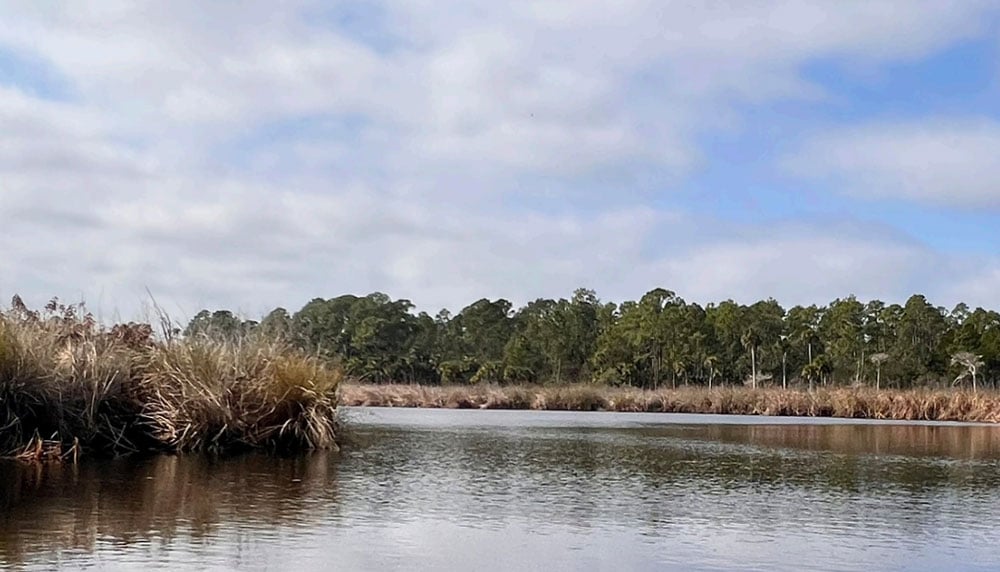
Transforming the 1,160 acres of land surrounding the headwaters of Bulow Creek into a county park will cost between $28 million and $40 million. The principal paved trail alone, linking the pedestrian bridge on State Road 100 to the south end of the park, would cost $8 to $12 million, Flagler County commissioners learned this week.
The design of the future park, which would be close to the size of Princess Place Preserve, has been a $1.5 million project fully paid for by the state Department of Transportation. The park is to be a destination in itself, but also become part of the region’s larger system of trails north and south of it.
Elizabeth Manley led that phase for Kimley Horn, the engineering company, and has been presenting periodic updates, as she and her team did to the public last February. At the time, the cost of turning the largely wetlands expanse into a park was unknown. Commissioners learned it at their meeting on Monday.
Commissioners did not mention the cost ahead in their discussion. None of those funds have been secured. The county is hoping to find state and federal dollars. The presentation Monday was the last before a final report finalizes the scope of the design.
“It is what it is. We have to have a plan, right?” Commissioner Kim Craney said. “We don’t have a plan, we can’t do it.”
Commissioner Andy Dance, who kayaks on Bulow Creek and speaks of it at times as if he were its John Muir, focused on the possibilities ahead.
“I love the progression that we’ve seen from the beginning of the project up till now, some additional details that have been added with this current presentation,” Dance said. “Part of what we preserve our natural lands for is to be able to provide access for the residents to be able to enjoy them. And there’s those two ponds, even though you have Bulow Creek, which is the main attraction. Those two ponds are incredible, the setting there is incredible, and you overlook that, and from the bridge looking over the expanse of the marsh that’s there, there’s a lot of amazing viewpoints within the park.”
Manley gave an overview of the work so far and the projection of what the park could be, using a series of slides illustrating the geography and the architectural look ahead.
“Overall the project is wonderful in and of itself,” Manley said, “but it’s really special in the connections that it makes in this regional greenway that you’ve well established, both with natural resources and existing parks, future parks, but also regional recreation in terms of trail networks from Graham Swamp all the way down to Bulow State Park.”
A central feature of the future park is a north-south trail that will start at the extreme northwest corner, at the terminus of the existing pedestrian bridge on State Road 100, itself part of the Graham Swamp trail. That 2.6-mile paved trail will run the length of the western edge of Bulow Creek park, coming out at Old Kings Road. It’ll look similar to the Graham Swamp trail. There’ll be another 2.7 miles of unpaved trails through the park.
The project could all be built at one time, or in “subphases,” she said, over many years. “From a priority standpoint, that north-south trail represents phase one. That was the driving force of the funding in terms of trail connectivity,” Manley said.
Other phases would include a trailhead at the southeast corner of the park, and a creek picnic area in the southeast corner, north of the Polo Club, built on what had previously been platted lots for housing. There’s a paved drive and a cul-de-sac in that area. Placing the picnic area there meant avoiding disruptions elsewhere. A “robust” vegetation buffer will delineate the park from the Polo Club. The picnic area will not have utilities, but will have a restroom.
There will be what Manley diplomatically called “waterfront enhancements,” which is another way of describing creek access points for non-motorized boats. Those access points will consist of a fixed dock for wildlife observation and a floating kayak canoe launch.
Trailheads will look similar in look and scale to those on the Lehigh Trail. “Prefabricated, but dressing it up a bit with some native material, coquina around the bottom and in key locations,” Manley said, “a number of a medium and a small picnic pavilion with some wraps around the bases that are going to mimic the Eco Discovery Center to the north.” The Eco Discovery Center is the county project pairing the future tourism bureau’s offices with an elaborate visitor center near the pedestrian bridge on State Road 100.
Throughout the park visitors will have “environmental education opportunities” through signs, QR codes, kiosks, interactive elements and storytelling.
The designers have met with the St. Johns River Water Management District and the U.S. Army Corps of Engineers to discuss wetlands impacts and mitigation (when a wetland is damaged or destroyed in one place, it must be rebuilt or protected elsewhere, even if not on the same property). Palm Coast’s utilities may service the park’s trailheads.
“One exciting piece of news we bring tonight is there are some additional uplands that have been discovered in these last few months of field reconnaissance and coordination with agencies, and that’s fantastic in terms of being able to extend our trail a little bit differently,” Manley. “Overall, just a gorgeous site.”
A map of wetlands as opposed to uplands shows to what extent wetlands dominate the site: it is close to 90 percent wetlands. “We’re trying to keep most of these recreational improvements in the upland areas, because they are a little less sensitive,” Manley said.




























Really Annoyed says
Better to see this than too many homes!
Pogo says
“I think having land and not ruining it is the most beautiful art that anybody could ever want.”
― Andy Warhol
JimboXYZ says
This is just more insanity, throwing $ 40 million into a trail from SR-100 to Bulow State Park.
Anna Jones says
These numbers are shocking: $28–40 million total for Bulow Creek Headwaters park, with the 2.6-mile paved trail alone at $8–12 million — over $3–4.6 million per mile. That’s excessive for wetlands land with nearby existing access at Bulow Creek State Park and Graham Swamp.
Our county budget has more than doubled, with the state flagging $59 million in wasteful spending. Residents need tax relief and basic infrastructure, not gold-plated new parks. Time for real fiscal accountability and prioritizing core services.
FlaglerLive says
The $59 million claim by Blaise Ingoglia is disinformation. Don’t use this site to perpetuate it.
Anna Jones says
Taxpayers have every right to question spending, no matter how you spin it.
FlaglerLive says
Questioning spending is fine. But let’s not be coy or cute about what we’re talking about. Mr Ingoglia–and commenters who don’t document what they claim–spin. We report facts and document them.
Tourist says
Girl, learn your information before you run for office and stop using AI to write for you.
Laurel says
I’ll take a park over development any day of the week.
Dennis C Rathsam says
That moneys are better served else where. We need more shit fixed than another park!
Jen says
This will be considered a new project and the politicians can pocket money. So you know it’ll happen.!
John Bloomfield says
Don’t get me wrong, I can’t express how much I enjoy the trails we have that make visitors jealous with the scale and quality they bring to our area. But please …please consider lifecycle sustainment costs! The trailhead at Graham Swamp Oaktrails has been closed on and off for over a year now due to wood rot. Engineers need to assess safety of the boardwalk and it is likely going to take money that doesn’t exist, nor was it planned for. The south trail from Leigh high has metal boardwalking but is a wide, cleared path. Trees falling pose minimal risk. That is not the case with the trailhead at Oaktrails cutting over to Colbert. Many of those massive trees fell during last heavy storm season, I believe due to new construction in the last 15 years changing ground saturation. I know the city is trying to be proactive on doing something about Woodlands neighborhood flood issues. Are Urban forestry folks connecting with land management?